

Great Leaders
Think Differently
The Four Mindsets Shaping the Future of Work
While many organizations were just beginning to discuss the importance of mindsets, GP Strategies was already conducting research to understand what truly drives effective leadership. Beginning in 2019, our research over the past six years has reaffirmed that the four key mindsets we identified as foundational remain essential for successful leaders in today’s complex world.
Growth | Inclusive | Agile | Enterprise
Leaders are being asked to thrive through uncertainty and ambiguity and to manage change that is happening faster than ever before. Despite the challenging environment, leaders still possess a clear understanding of what’s needed to guide their teams—such as fostering growth, innovation, inclusion, and collaboration—to ensure the organization’s success.
Since we first set out to research mindsets, our world has undergone a dramatic transformation. We’ve faced a global pandemic, turbulent markets, regional conflicts, and the rapid rise of generative AI. Demographics are shifting, new ways of working are emerging, and diversity, equity, and inclusion initiatives are constantly evolving. All of these factors combine to create a complex and unpredictable leadership environment in which adopting important leadership mindsets looks different than it did six years ago.
Our latest research revealed the following core themes that will be explored in greater detail throughout this report:

Leaders need both mindsets and skillsets, but mindsets are often more ingrained and harder to shift.

The level of uncertainty and chaos that leaders face now is unlike anything before—both inside and outside the organization.

All four mindsets matter, but enterprise and growth are widely recognized as the keys to unlocking real success in today’s fast-changing world.

Leaders are taking strong action to support organizational success, growth, and innovation, but an element of fear is holding them back from making bold choices.
Mindsets vs. Skillsets
According to Training Industry’s 2025 State of the Training Market report, the 2023 global spend on corporate training reached over 390 billion dollars, of which leadership development is a critical component. Leadership development empowers executives to define and communicate vision; trains leaders to coach, delegate, and drive change; and equips frontline managers with the skills to lead teams effectively. From virtual classrooms to in-person workshops, the list of skills being taught is seemingly endless. But leadership isn’t just about skills. Mindsets also matter.
Take feedback as an example. Many leaders are taught the same steps for delivering feedback. And yet, in the real world, we see a wide range of effectiveness in delivering feedback, even if leaders take all the proper steps. If the steps are the same, why are the outcomes so different? Many times, the answer lies in the leader’s mindset.
A mindset is the unique combination of beliefs, identities, and experiences that shapes our thoughts, actions, and decisions. A skillset, on the other hand, is the collection of abilities a person has that can be used to solve problems and perform tasks.
Mindsets and skillsets influence one another. Strong, well-developed leadership mindsets are a powerful indicator of how confidently and effectively leaders drive positive change. In contrast, skillsets are more about the specific abilities that leaders have. Skillsets are more tactical in nature and describe what leaders can do, not necessarily how they do things.
Mindsets

Leadership mindsets are key because they influence how we handle challenges and grow. While shifting them can be tough—since experiences, values, and environment shape them—true leadership comes from within. It’s not always obvious to others, so staying intentional and resilient is essential even when things get noisy.”
– Director, Talent Development Portfolio
Skillsets
Based on my experience in leadership development, shifting mindsets is essential, but skills often lag behind. Leaders may know what they should do, but translating that knowledge into concrete skills can be difficult. Without the right skills, their effectiveness diminishes, especially under pressure, affecting everyone around them. Building strong skills is crucial and often more challenging than changing mindsets.”
– Connie Bustamante, Director, Leadership Development, Bristol Myers Squibb
The Four Foundational Leadership Mindsets
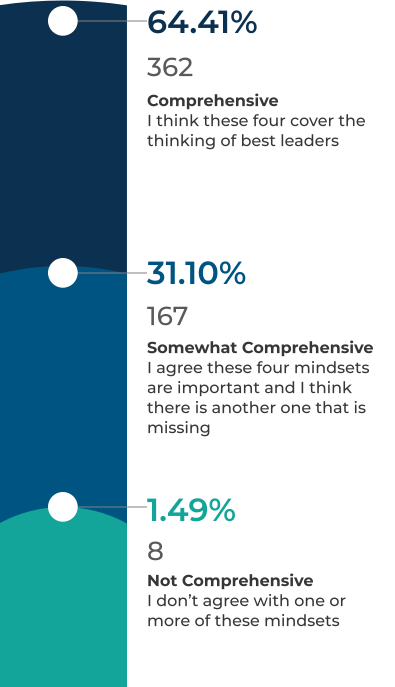
We have identified four mindsets that are especially critical to leadership success: enterprise, growth, inclusive, and agile. But there isn’t one magic bullet mindset. These four are not the only mindsets a leader needs. They do, however, create a framework—an umbrella structure—to provide clarity and direction for leaders to conceptualize, prioritize, and demonstrate leadership thoughts and behaviors.
Our recent research has confirmed the findings of our initial 2019 study: these four mindsets consistently prove to be the foundation of effective leadership. What has evolved is how these mindsets manifest in practice: the behaviors leaders demonstrate, the barriers they face, and the indicators of success. The following pages explore these in depth.
99%
say the four mindsets are comprehensive or somewhat comprehensive

Mindset
A particular way of thinking, shaped by attitudes and opinions, that guide and influence the actions you take.
Agile
The belief that success in a complex and volatile world requires flexibility, adaptation, innovation, and resilience.
Enterprise
The belief that success is maximised when we prioritise the needs of the larger organisation.
Growth
The belief that skills and behaviors can be cultivated through effort.
Inclusive
The belief that contribution and performance are unleashed in a inclusive environment.

Growth Mindset
A growth mindset is the belief that skills and behaviors can be cultivated through effort. With this mindset, challenges, obstacles, and feedback become an opportunity to learn and grow.
The essence of a growth mindset is recognizing what needs to change, committing to improvement, and evolving in response to new realities. A growth mindset also enables other mindsets and skillsets to thrive. It comes as little surprise, then, that a growth mindset emerged as the top priority among leadership mindsets, with 46% of surveyed leaders ranking it as most critical, underscoring its growing influence in modern leadership.

One of our core values is about exploring possibilities. I resonate strongly with that value, and it’s one of the things that resonates across the organization, too. It invites employees to consider various approaches to problems or to consider new ways of working, accomplishing tasks, and serving our customers, whether internal or external. It demonstrates that the company is really interested in not always doing things the same way over and over again, even if those things are working. What can we keep making better and better?”
– Director, Talent Development Portfolio

Key Success Indicators
According to the leaders we surveyed, they know they are successful in instilling a growth mindset when the people on their team embrace new ideas and creative thinking. For organizations aiming to innovate—and who isn’t?—fostering a growth mindset might just be the secret weapon. It’s what enables teams to learn from the past, adapt, and push forward. To stay competitive, discover new markets, or design fresh products and services, organizations need people who are willing to experiment, learn, and iterate. Leaders who value a growth mindset don’t just support innovation—they drive it.
An equally important indicator of success is when team members learn from setbacks and apply lessons to move forward. True resilience involves more than bouncing back; it requires using challenges as opportunities for growth. This approach transforms recovery into continuous progress, propelling individuals and organizations toward greater success. Fostering a growth mindset builds resilience that drives forward momentum, rather than merely returning to the status quo.
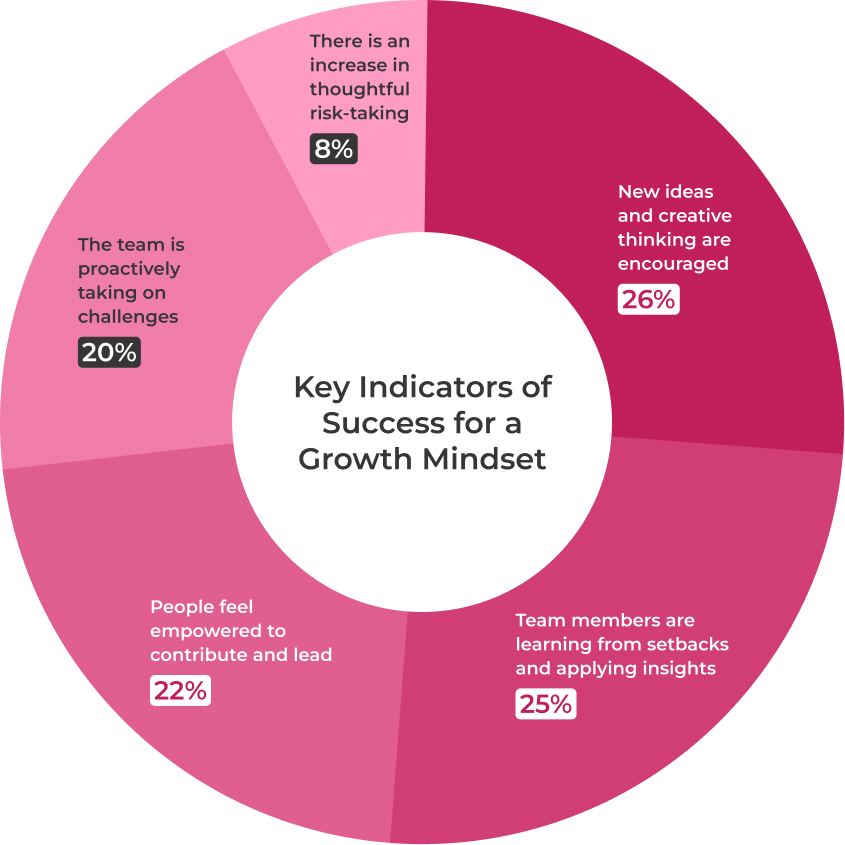

In an environment characterized by constant swirl-and-churn and significant external headwinds, is simply learning from challenges enough? There is an expectation that a growth mindset involves not only learning and doing things differently but also taking risks. However, only 8% of respondents cited increased thoughtful risk-taking as a sign of success. This notably low emphasis on risk-taking as a success metric warrants careful attention, especially since research consistently shows that underlying fear often influences leadership behaviors and organizational culture. Simply tackling immediate challenges without encouraging intelligent risks can lead to stagnation, resulting in missed opportunities for innovation, growth, and learning.
What Leaders Can Do
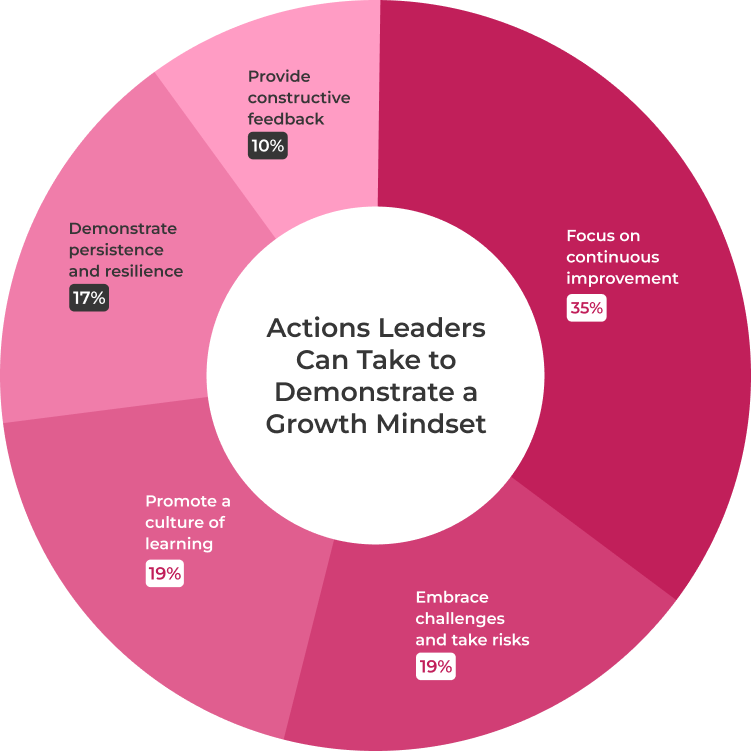
35% of the leaders we surveyed say that focusing on continuous improvement is the best way to demonstrate a growth mindset. Leaders now are focusing forward—not resting on their laurels but striving to do better and anticipate the next need.
Continuous improvement isn’t always about sweeping, organization-wide transformations. More often, it shows up in smaller, everyday moments, like refining a meeting agenda, experimenting with a new way to take notes, or presenting information more clearly. It’s about staying curious enough to ask, “What if we tried this a different way?” and then creating a culture where that question is welcomed. Leaders play a key role in this process by encouraging team members to take ownership of improving how work gets done.
Embracing a growth mindset means continuously seeking opportunities to grow, innovate, and adapt. Change is essential—for our organization, our customers, and a better future. To succeed in a shifting world, we must think differently, decide quickly, and commit to ongoing growth.”
– Head of Leadership Development, Talent, and Performance
Mindsets and AI
A growth mindset invites experimentation. It encourages us to try, fail, and try again while remaining confident that trying and failing are part of the learning process. This mindset serves leaders who seek to navigate the uncertainty of AI. AI itself is a massive experiment in a growth mindset: this technology is growing rapidly because it is constantly failing, learning, and improving with each iteration. The way we, as humans, interact with these tools requires a similar approach.
What did leaders associate least with growth mindset actions? Giving constructive feedback. Even a growth-oriented individual can be unsure about where they need to grow and learn. They continue to work hard to improve but do so without direction. While a mindset of continuous improvement is valuable, without feedback, it can become vague, draining, and even discouraging. Improvement should feel purposeful and motivating, not like an endless treadmill or a sign that someone is never “good enough.”
Obstacles
A growth mindset encourages individuals to focus on process over outcome and to embrace mistakes as opportunities to get better. While that sounds like a great idea, the reality is that leaders are evaluated on and expected to produce results. One third of the leaders we surveyed indicated that what prevents them from having a growth mindset is the fear of failure or making mistakes.
As a leader, there’s an expectation that you will make the right decisions and be successful. The stakes are high, and leaders feel the weight of that burden. While the leaders we surveyed are willing to create opportunities for others to develop a growth mindset, what holds them back personally is the focus on being the one with the right answers instead demonstrating a willingness to be vulnerable, to potentially fail and learn.
…It all starts and ends with a growth mindset. I would prioritize all four, but a growth mindset is the catalyst that ensures everything works the way it needs to.”
– Russell Rodriguez, VP & Retail Banking Training Manager, First Hawaiian Bank

Adopting a growth mindset requires leaders to embrace a learn-and-grow mentality, but this can be challenging due to the pervasive fear of appearing weak. Leaders often see mistakes as vulnerabilities, making it difficult to admit they don’t know an answer or foster open discussion without feeling exposed. The pressure to consistently get it right cultivates a “play it safe” mindset, which hampers their ability to model psychological safety and trust within their teams, especially when they themselves feel they’re not granted the same grace.
This fear is intensified by internal organizational factors, including complex structures, silos, and a culture of blame and perfectionism, as well as external pressures like geopolitical tensions, economic fluctuations, and rapid technological shifts, like AI. Heightened visibility and perceived transparency make mistakes more noticeable and enduring, leading leaders to adopt cautious, strategic approaches to risk. The result is a climate marked by risk aversion, self-doubt, and reluctance to communicate openly or take decisive action, thereby hindering innovation and authentic leadership.
Key Takeaways
A growth mindset can fuel resilience by helping teams learn from setbacks and get better. Leaders play a crucial role in providing feedback and encouraging perseverance among their team members. But they can only do so if they foster an environment of psychological safety, one in which their team members—and themselves—feel that it’s okay not to have all the answers but to have the willingness to learn and grow.

Inclusive Mindset
An inclusive mindset means fostering an environment where everyone feels empowered, respected, and valued. It involves recognizing the unique talents within our workforce and actively removing barriers to ensure their insights are effectively included and leveraged.
Shifting to an inclusive mindset is critical—leaders need to truly understand and experience what inclusion feels like. And, just as importantly, what the absence of it feels like. Inclusive behavior doesn’t happen by accident; it grows from role models, the values we reinforce, and the consistent messaging from senior leaders that inclusion is not optional but foundational.”
– Connie Bustamante, Director, Leadership Development, Bristol Myers Squibb

Key Success Indicators
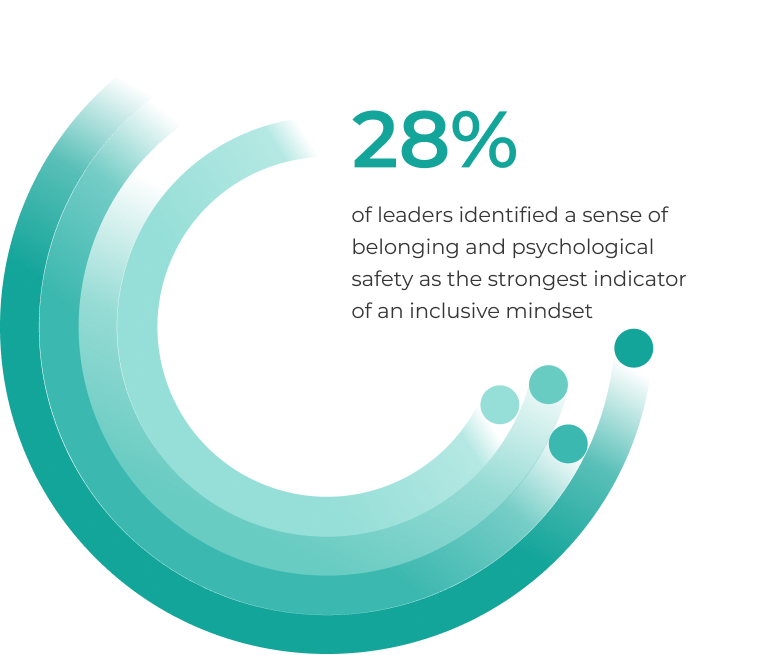
An inclusive mindset isn’t just a value. It needs to be felt, which can make it particularly hard to measure and fully identify. In our research, 28% of leaders identified a sense of belonging and psychological safety as the clearest evidence of inclusive leadership, underscoring the critical role leaders play in shaping environments where people feel safe, seen, and supported.
But belonging isn’t just a feel-good sentiment. A strong sense of belonging significantly improves employee engagement. In addition, when employees feel a sense of belonging, it increases performance and productivity, reduces turnover, and improves well-being. Coupled with psychological safety, it provides fertile ground for increased collaboration and innovation. If these things are further paired with the freedom to speak up and engage in healthy debate, we see the distinguishing factors between great teams and those that are merely good.
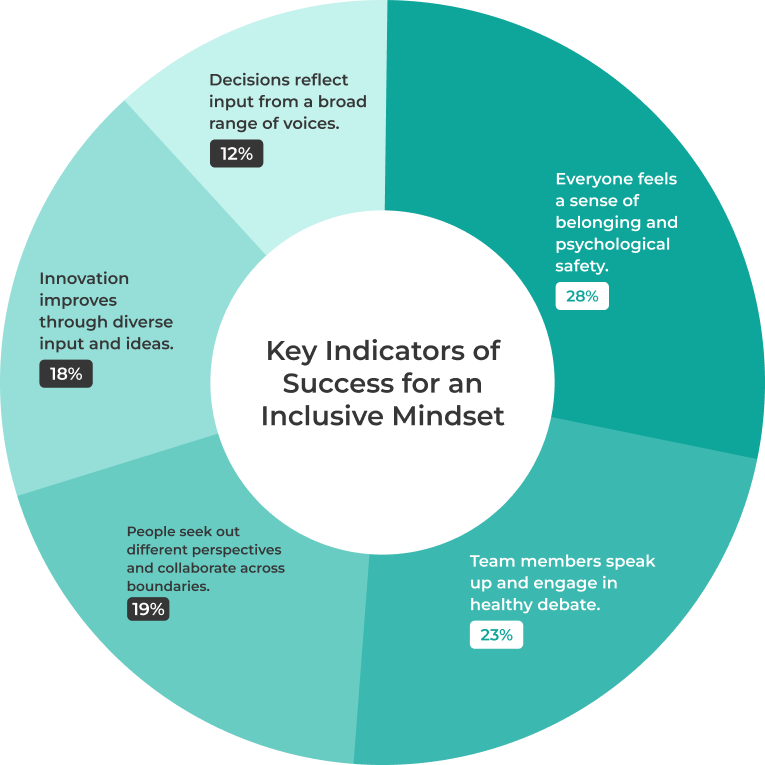
Notably, “decisions reflect input from a broad range of voices” was indicated as a key inclusive mindset success indicator by only 12% of leaders we surveyed. This reveals that, while leaders believe having healthy debates that reflect a variety of voices is critical, actually including the results of those conversations in their final decisions is less important than choosing a low-risk, safer option.
While fostering psychological safety and belonging are essential, they aren’t enough on their own. Leaders should not just actively seek out but also integrate diverse perspectives into their decisions. Without this, organizations will reinforce the status quo and miss valuable insights.
What Leaders Can Do
Seeking contributions emerged as one of the most important actions a leader with an inclusive mindset takes. In fact, 58% of respondents indicated an inclusive mindset is best demonstrated through a combination of actively seeking opinions and contributions from a wide range of individuals creating opportunities to acknowledge and leverage differences.
Leaders are advocating for a wide range of voices to be heard—that’s good news for organizations looking to make sure they are remaining competitive, engaging all employees, and innovating. Diversity of thought and opinion will increase that sense of belonging, improve collaboration and innovation, and, ultimately, help drive business results. Moreover, leaders recognize their role in creating opportunities to acknowledge and leverage differences, thereby demonstrating a proactive approach that can help foster a culture of inclusivity.

While many leaders are adopting inclusive behaviors—like seeking input and creating opportunities—the actions that challenge cultural norms and address deeper structural inequities are often less prioritized. These include engaging in uncomfortable but necessary conversations and actively removing systemic barriers that limit access and opportunity. Such actions demand greater courage and commitment, and they’re essential for truly inclusive leadership. As the definition of inclusivity evolves, leaders must move beyond the “safer” visible behaviors and engage with the deeper, sometimes contentious, work that drives lasting systemic change.
Mindsets and AI
Building an inclusive mindset around AI means involving a diverse group of people in its development and use. It’s about ensuring equity and transparency so that AI benefits everyone, not just a select few. Broad access and open communication help prevent AI from becoming siloed or biased, fostering trust and shared understanding. When organizations open the doors to different perspectives, they create a space where AI serves the entire community, enabling innovation rooted in fairness and shared purpose.
Obstacles
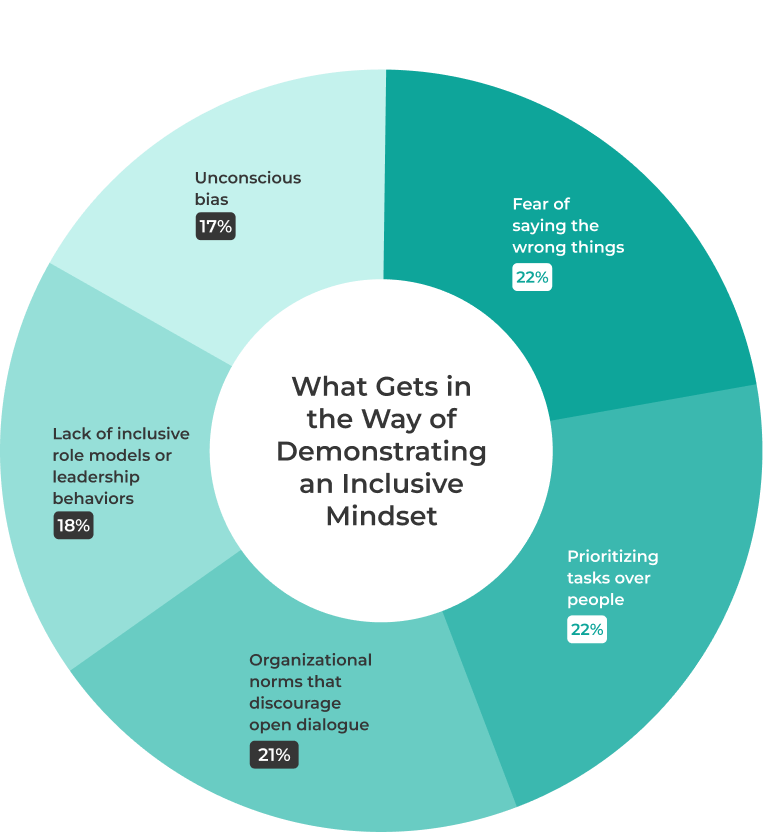
Leaders often hesitate to embrace the more challenging aspects of an inclusive mindset—not because they don’t see the value, but because the barriers are complex and deeply rooted. Whether it’s the fear of saying the wrong thing, the pressure to prioritize tasks over people, or cultural norms that discourage open dialogue, these challenges can quietly undermine inclusive intentions.
Because no single barrier stands out above the rest, the path forward isn’t clear, so it’s no wonder that leaders often struggle with where to begin. But as with any inclusive mindset, the starting point is self-reflection. Leaders should begin by increasing self-awareness and approaching others with curiosity—releasing judgment of both themselves and those around them. Inclusive conversations thrive not on fear or hidden agendas, but on genuine interest, empathy, and a willingness to understand another person’s lived experience, perspective, and ideas. Inclusive conversations can often feel risky or controversial since uncertainty about what can be said or whether the discussion should even occur may hold people back from fully engaging.
Key Takeaways
A leader with an inclusive mindset supports an environment of belonging and psychological safety. To foster that environment, leaders recognize they need to actively seek opinions and contributions from a wide range of individuals and create opportunities to leverage differences. To do so, they need to overcome a combination of factors, including their own fear of saying the wrong thing, a focus on results over relationships, and organizational norms that discourage dialogue.

Agile Mindset
An agile mindset is characterized by an adaptable approach that supports change and helps navigate ambiguity. An agile mindset involves the confidence to move forward in the absence of complete information and resilience in the face of adversity.

Key Success Indicators
Leaders described true success as a culture where team members feel trusted and empowered and can take initiative and make decisions without waiting for permission. It’s a shift from control to confidence, where autonomy signals that agile movements are not just encouraged but embedded in everyday practice.
Agility flourishes in organizations that rely on distributed authority rather than top-down decision making. When decision making is delegated to those closest to the work, people with the most relevant insights can act swiftly and effectively. Minimizing bureaucracy and simplifying approvals empowers teams to act quickly, fostering greater efficiency and engagement, but they must be trusted and empowered to do so.
Agile mindset success also means being open to change, even if it comes late in an effort. Situations involving shifting market conditions, new information, or unexpected global events can require a sudden change in direction. Within organizations, changes to structures, roles, or technology often drive the need to adapt. To be truly agile, teams must be able to pivot quickly in response to new circumstances and recognize that more changes are likely to follow. Rather than being unsettled by these adjustments, agile teams expect them and are prepared to adapt as needed. When leaders see this readiness to adapt, they know that an agile mindset has taken root.

When we talk about having an agile mindset, the key word is “rewiring.” …If something isn’t working, let’s try something else. Being agile is crucial for skill development.”
Melissa Reese
Director, Manager Development, Leadership Development CoE
What Leaders Can Do
Leaders who aren’t afraid of change set the tone for their teams. Our survey respondents told us that the best agile minded leaders:
- Demonstrate adaptability and learning
- Embrace change and innovation
- Adjust decisions based on changing circumstances
Respondents also made it clear that this is an “and/also” proposition: embrace change, innovate proactively, and adjust decisions based on changing circumstances.
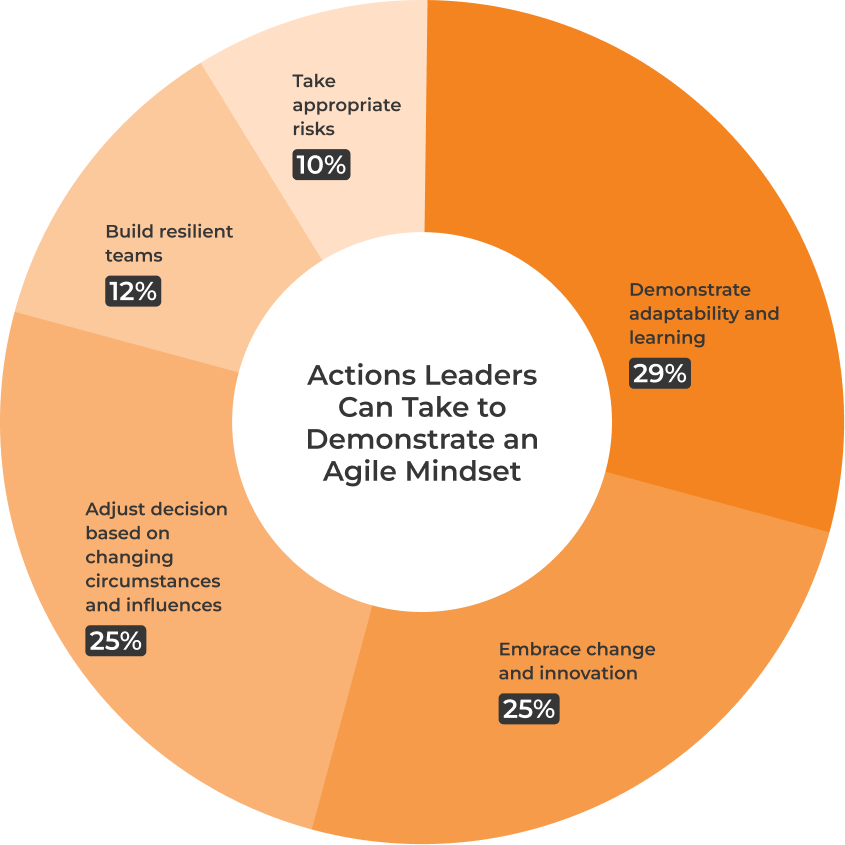
Given the pace of change and the multitude of issues leaders have had to navigate, this is perhaps not surprising. Macroeconomic pressures alongside internal organizational challenges like upskilling, reskilling, shifting workforce demographics, and competing priorities coalesce to create deeply complex environments. Leaders understand that change can emerge from numerous directions at any time, making adaptability essential—but adaptability alone is insufficient. To truly thrive rather than survive, organizations must not only adapt but also proactively embrace change, innovate, and be preparedfor the inevitable change.
A persistent aversion to risk-taking stands out as a major challenge to an agile mindset. Despite valuing adaptability and improvement, leaders hesitate to disrupt the status quo or embrace uncertainty. Instead of proactively seeking change, many default to reacting only when necessary, avoiding calculated risks even when innovation demands it. This reluctance to step outside established comfort zones continually limits true agility. To fully unlock the benefits of an agile mindset, organizations must help leaders overcome this risk aversion and foster a culture where bold action is not just encouraged but expected.
Mindsets and AI
Embracing an agile mindset with AI invites us to experiment boldly, recognizing that failure is an inevitable part of the learning journey. As AI technology evolves rapidly, organizations must stay flexible—ready to pivot, learn from setbacks, and adapt to new developments. An agile approach encourages continuous iteration, allowing teams to stay ahead of change and harness the full potential of AI without getting bogged down by rigidity or fear of failure.
Obstacles
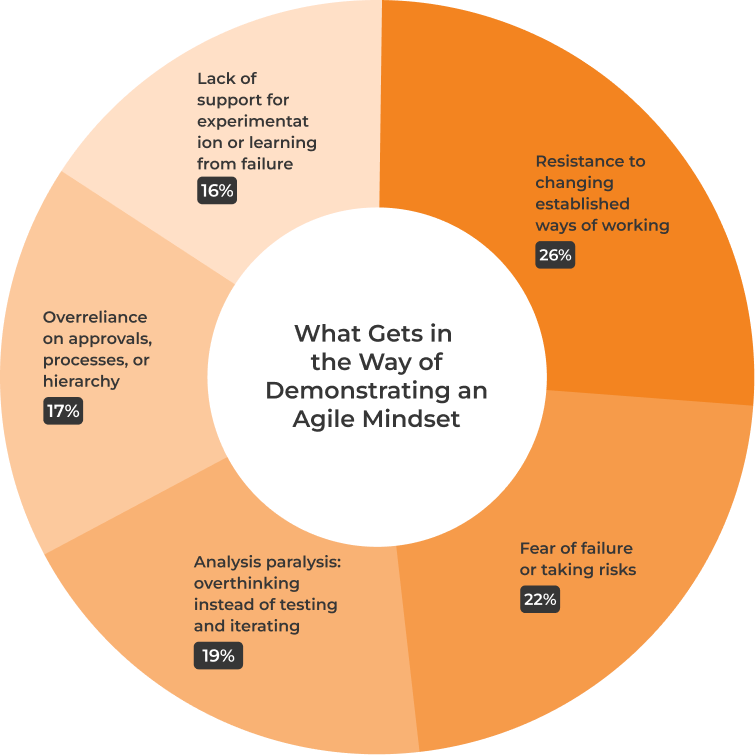
What holds many leaders back is a resistance to changing established ways of working and a fear of taking risks. The ability to pivot quickly and adapt with confidence is essential, yet leaders often find themselves constrained by rigid systems and structures that weren’t designed for speed or flexibility. While they recognize the need to be more adaptable, legacy processes and hierarchical norms can make it feel like the organization is working against them.
But the obstacles don’t all come from the outside. Leaders themselves identified the fear of failure as the second biggest hindrance to an agile mindset, echoing the sentiment of fear that also holds them back from adopting a growth mindset.
Key Takeaways
Agile leaders foster an environment where their teams feel empowered and confident to make decisions independently and embrace change. By demonstrating their own willingness to adapt, innovate, and adjust, they serve as role models for this behavior. However, external factors (like organizational resistance to change) and internal challenges (like fear of failure) can make it difficult for leaders to fully demonstrate agility.

Enterprise Mindset
Having an enterprise mindset refers to thinking and planning wisely to make better decisions that align with an organization’s long-term goals. It involves ensuring that your leadership decisions consider the broader organizational impact beyond your immediate team or function.

Key Success Indicators
Since we first published mindsets research, the concept of an enterprise mindset has emerged as a critical area of focus for organizations and leaders. Those we surveyed recognized that an enterprise mindset is vital for organizations seeking to drive the behaviors that allow the organization to thrive. Our survey respondents also identified that leaders adopting a “win as a team” mentality is a key indicator of success. What’s more, leaders actually demonstrated a bias for enterprise behaviors, specifically when decisions are made with the broader impact in mind, not just the local impact.

The enterprise mindset is crucial for breaking down silos, preventing duplicated efforts, and promoting strategic alignment—especially as remote and global work increases and cost pressures rise. Without this approach, organizations risk missing out on the value of integration.
Without an enterprise approach, the result is often less than the sum of the parts—‘1 + 1 = 1.5’ instead of 2.”
– Connie Bustamante, Director, Leadership Development, Bristol Myers Squibb
What Leaders Can Do
One-third of the employees we surveyed said they align their work with the organization’s overall mission and strategy. Employees want to understand how their work contributes to the overall organization’s goals. They need clarity on what to focus on—and that clarity has to come from their leader. In the rush of daily tasks, it’s easy to lose sight of why the work matters.
When leaders clearly align team priorities and goals with the organization’s mission, they help connect the dots. This provides direction and sets a clear standard for measuring performance—both for the team and the leader. It’s easier to assess what’s going well and where improvement is needed when priorities are clear.
So, what do the best leaders do to demonstrate an enterprise mindset? The most effective leaders elevate individual contributions. By aligning personal efforts with organizational objectives, team members can see the direct impact of their work. This clarity fuels motivation, reduces burnout, and fosters a sense of purpose. When people understand how their unique contributions drive enterprise success, uncertainty fades and engagement rises. Leaders with an enterprise mindset make this connection visible, turning everyday tasks into meaningful progress.
Mindsets and AI
Implementing AI with an enterprise mindset means deploying it thoughtfully and strategically across the organization. It involves fostering collaboration so that different teams and individuals contribute their insights, ensuring AI aligns with the broader business goals. Rather than chasing after the latest shiny object, organizations should connect AI initiatives to their core priorities, making sure its use drives meaningful value and supports sustainable growth from the top down.
Despite the enterprise mindset goal of eliminating silos, the least frequently chosen action among leaders is collaborating across departments. While leaders often support the message of collaboration, the actions required to truly embed this mindset are less common and more challenging to implement.
In today’s financial services, an enterprise mindset is essential. With ESG and social leading the way, success means giving back, serving our markets, and creating impact beyond profit.”
– Russell Rodriguez, VP & Retail Banking Training Manager, First Hawaiian Bank

Obstacles
Leaders express a desire to focus on the bigger picture, but when faced with real-world pressures, individual and team-level success often takes precedence over broader, shared outcomes. Competing priorities and limited Leaders express a desire to focus on the bigger picture, but when faced with real-world pressures, individual and team-level success often takes precedence over broader, shared outcomes. Competing priorities and limited capacity to look beyond the immediate scope get in the way. Caught in the whirlwind of urgent tasks and persistent performance metrics, leaders may feel compelled to prioritize immediate deliverables over collaborative, long-term initiatives. Additionally, the pressure to showcase quick wins can inadvertently discourage risk-taking and cross-functional efforts, reinforcing a narrow focus on individual achievement.
Organizations have long struggled with silos—those narrow, inward-facing views that limit collaboration and innovation. But perhaps even more damaging is the white space—the unclaimed gaps between functions, where business opportunity gets lost, innovation stalls, and customer needs go unmet. These aren’t just inefficiencies—they are missed possibilities.”
– Connie Bustamante, Director, Leadership Development, Bristol Meyers Squibb
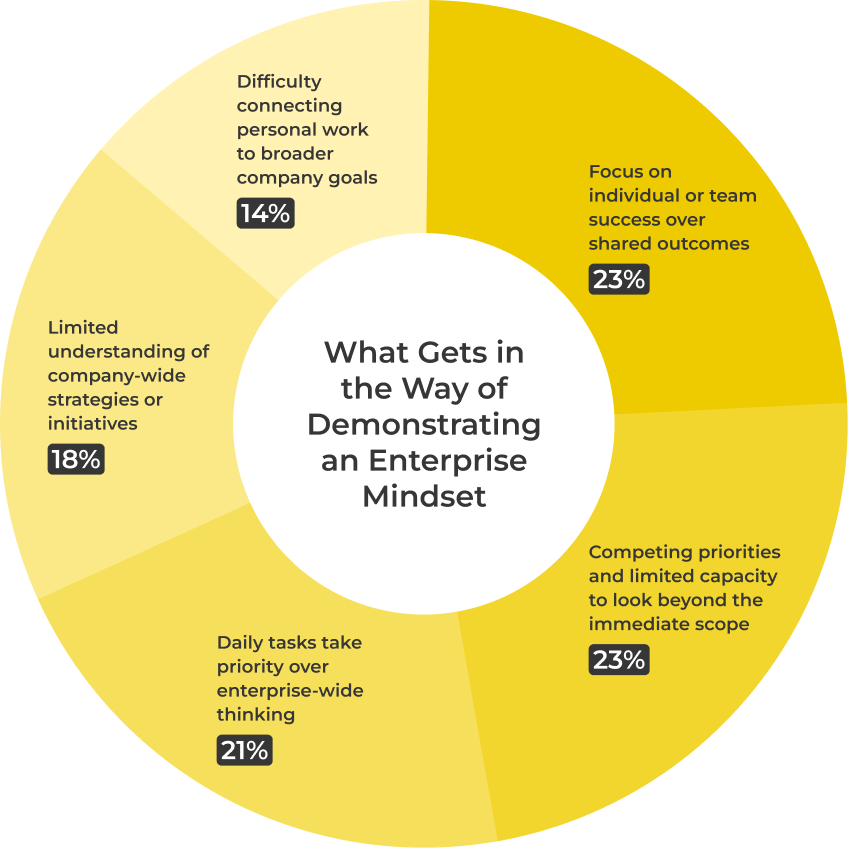
As is the case with the other mindsets, beneath these challenges lies an undercurrent of apprehension—while leaders may not explicitly voice it, there is a clear implication that some fear being judged as falling short in achieving personal success or meeting their individual goals. Ultimately, this anxiety about not fulfilling their own objectives can overshadow the broader enterprise mindset, creating a subtle barrier to thinking and acting collectively.
Key Takeaways
When an enterprise mindset is present, team members not only have a “win as a team” mentality, but they also make decisions for the greater good. Strong leaders support enterprise thinking by helping those team members align their priorities to larger goals. What stands in the way of an enterprise mindset is competing priorities and the success of individual teams.
Fear Factor:
Leaders Need a Supportive Culture
Leadership today is about visibility—mistakes are more visible than successes. This creates fear and anxiety, making leaders hyper-sensitive. They feel the need to position themselves carefully, choosing battles wisely, because every move is scrutinized and has long-lasting consequences.”
Lyn Wright
Sr. Staff, Talent Management, Illumina

Throughout our research, fear surfaced repeatedly—not always overtly, but undeniably—as a powerful undercurrent shaping leadership behavior and mindset adoption. When we looked at the top obstacles across critical leadership mindsets, fear emerged as a common theme.
Leaders are not prioritizing the most challenging yet necessary actions—like giving constructive feedback, taking risks, and addressing behaviors that exclude marginalized groups. These are the behaviors that truly advance inclusive, agile, and enterprise mindsets. While leaders may be learning and adapting, the research shows a reluctance to take bolder, more behaviorally demanding steps—the kind that disrupt the status quo and push boundaries in service of broader organizational and customer goals.
To help leaders overcome their fear of failure, organizations must create psychological safety: environments where leaders trust their senior teams and are trusted in return. When leaders feel safe to experiment, to speak up, and to explore new technologies, they are far more likely to act with courage, inclusion, and enterprise-minded boldness.
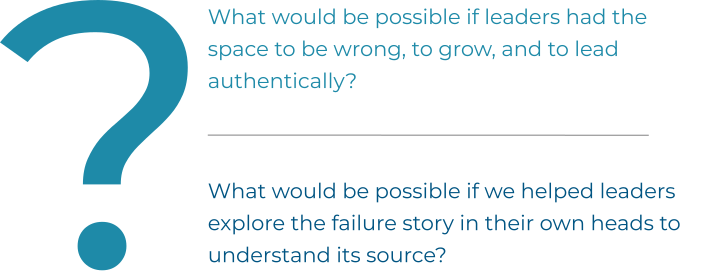
However, with this fear, we can also see a deeply-rooted silent courage. Leaders are absorbing anxiety to protect their teams, and they often lack the safety net they strive to provide. This raises critical questions:
If we want leaders to model the mindsets that matter, we must start by addressing the emotional environment in which they operate. The mindset shifts we’re asking of leaders aren’t just about strategy or skill—they are deeply human. And leaders require safety, too.
Taking Action:
Leading with Courage and Clarity
Today’s leaders stand at the epicenter of a storm that is more turbulent and unpredictable than any before. The secret to thriving in this environment lies in cultivating the right leadership mindsets and behaviors. Thriving leaders are willing to embrace ongoing growth and to intentionally shatter old processes in pursuit of something greater. They invite diverse perspectives, even if that means friction or saying the wrong thing. They spend less time boasting about their achievements and more time advocating for shared resources, collaboration, and a vision that benefits the collective. They move fast, yes—but they do so with purpose and thoughtfulness.
To lead with courage and clarity, to build the mindsets that matter, leaders need support. And the organizations that will end up on top are those that are striving to provide the psychological safety, trust, and well-being that today’s leaders need.
Leaders need more than grit and resilience. They need to adopt a bold, courageous kind of leadership. And it’s up to their organizations to provide the foundation for it.

Combining Mindsets for
Maximum Impact
Mindsets are most effective when combined because they can reinforce and amplify each other. An enterprise perspective can identify opportunities for the greater good, while an agile mindset fosters the behaviors a leader might need to act on those opportunities, for example.
When practiced together, these mindsets can reduce silos and enhance connection. This synergy creates momentum, fuels continuous growth and performance, and unlocks greater creativity, collaboration, and impact than any one mindset can alone.
-
Growth + Agile Experiment boldly, learn quickly, and continuously improve.
-
Growth + Enterprise Challenge the status quo to create value for the organization and its customers.
-
Growth + Inclusive Take a different approach by integrating diverse perspectives.
-
Agile + Enterprise Create value fast while keeping an enterprise lens.
-
Agile + Inclusive Adapt with speed while ensuring diverse voices inform the path forward.
-
Inclusive + Enterprise Break down silos to collaborate for collective success.

Meet the Author:
Leah Clark
Leah Clark is a thought leader and author for GP Strategies. She researches, writes, and speaks on the topic of leadership and has written several articles and research reports, including pieces on authentic leadership communication, leading during uncertainty, leadership mindsets, and the impact of introversion and mindfulness on innovation. Leah holds a Master of Arts in Organizational Psychology from Columbia University and a Bachelor of Arts in English and Sociology from Boston College.
GP Strategies conducted the research utilizing a dual approach: applying an online data collection methodology and engaging the Centiment collection agency. Data collection occurred between June 2, 2025 and July 21, 2025. Overall, 610 responses were received. 107 (17.54%) responses came from Canada, 166 from the United Kingdom (27.21%), and 237 (38.85%) came from the Americas region. 100 (16.4%) responses were in other areas or an undisclosed location.