
As we have moved toward greater dependence on technology, the definition of blended learning has changed. Traditionally, blended learning was thought of as a combination of digital and face-to-face learning components (Blended Learning 1.0). Over time, however, effective blended learning programs have begun to mean a variety of learning elements — like virtual or in-person workshops, eLearning modules, learning games, or components such as line manager check-ins and coaching sessions—not necessarily just digital and face-to-face learning. This was Blended Learning 2.0.
Now, we are entering into Blended Learning 3.0 thanks to artificial intelligence (AI).
If Blended Learning 2.0 represented greater integration of digital and social learning, then Blended Learning 3.0 represents the next evolution in learning design, where AI augments traditional blended models to deliver more personalized, scalable, and context-aware experiences like:
- Adaptive and personalized journeys driven by AI to deliver uniquely effective journeys for every learner.
- The ability to quickly generate trusted new learning assets with more variation and localization, which drives relevance and enhances the user experience.
- Automation and deep skills mapping provided by AI tools generate highly effective new curated pathways according to the specific needs of learners and businesses.
In this blog, we’ll explore areas of AI adoption in L&D, practical strategies for implementing AI, and how AI tools can be used to reimagine the blended learning journey, including the emerging possibilities of automation and skills-based personalization.
Areas of AI Adoption in L&D: From Efficiency to Embedded Learning
First, let’s explore the evolving journey of AI adoption within corporate learning.
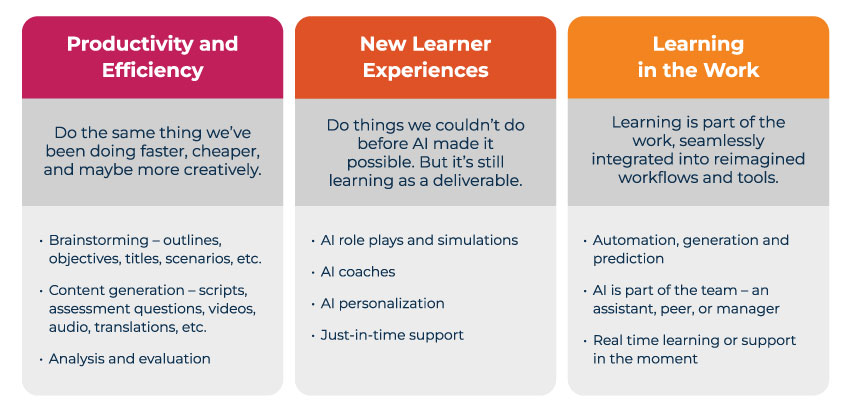
The diagram above outlines three different areas in which our clients often find themselves. Many of our clients are still in the first category, using AI for productivity and operational efficiency, trying to accomplish tasks faster or more cost-effectively by automating repetitive tasks. Tools like ChatGPT, Copilot, and Learning Content AIQ can streamline the production of learning materials. Here, AI supports L&D teams, but not learners directly.
Some clients are beginning to explore AI as a way to transform the learning experience itself, enabling more personalized, interactive, and adaptive solutions. Here, in the “New Learner Experiences” category, learners begin to interact with AI themselves. Role-play bots, coaching assistants, and personalized learning journeys offer a deeper, more responsive experience. One that goes beyond traditional formats.
Fewer still are reaching the next frontier: embedding AI-powered learning directly into the workflow. The third category refers to when AI is woven into the tools, systems, and workflows people already use. AI assists in real time, delivering just-in-time support and shaping a true learning in the flow of work model.
We’ve been talking about learning in the flow of work for a long time. It’s where we want to go. We’re starting to see hints of what it can look like as the tools get better, but not many companies are there yet. As AI allows us to do things we couldn’t do before, we are only limited by our own creativity. Getting more comfortable in creating new learner experiences right now is important because it’s a stepping stone to learning in the flow of work.
AI Tools and Platforms to Redefine the Blended Learning Journey
Having explored the strategic landscape of AI in L&D, let’s look at the tools making this transformation possible. The collection of AI tools and platforms that we have been reviewing at GP Strategies is expanding all the time. We are seeing new tools entering into the space, and legacy tools that are adding AI features as we go. As with any AI tool, it’s important to get client approval to use AI and ensure that all tools are vetted and secure.

AI Coaching and Role Play
As client interest in AI grows, we’re hearing more requests to “include an AI coach.” The proper response to that is: What do you mean by an AI coach? What kind of experience are you actually looking for? It’s important to differentiate between AI role play and AI coaching because they serve different purposes.
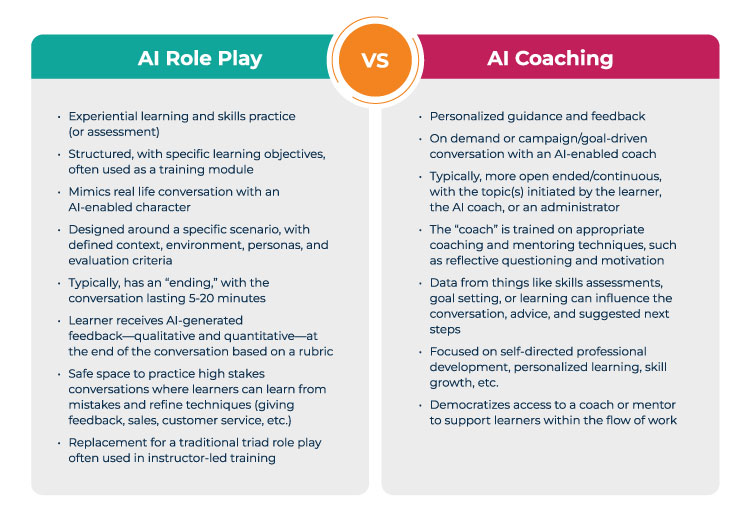
AI role play simulates a specific scenario like we’re used to having in live environments. It’s a controlled interaction designed by us with a clear learning goal (e.g., handling objections or giving feedback). The learner practices a particular skill in a defined context, gets feedback, and repeats as needed. It’s targeted, scenario-based practice.
AI coaching, on the other hand, is designed to simulate the experience of a coach. It doesn’t give direct answers. Instead, it asks the right questions, prompting the learner to reflect, explore options, and build awareness. It’s typically more open-ended and focused on ongoing development, not just one skill.
These are different learning experiences. Sometimes, what’s actually needed is neither. You may need an on-demand subject matter expert, a Q&A bot, or access to a searchable knowledge base. These things might feel like a “coach,” but they’re not.
Why include AI-enabled role play?
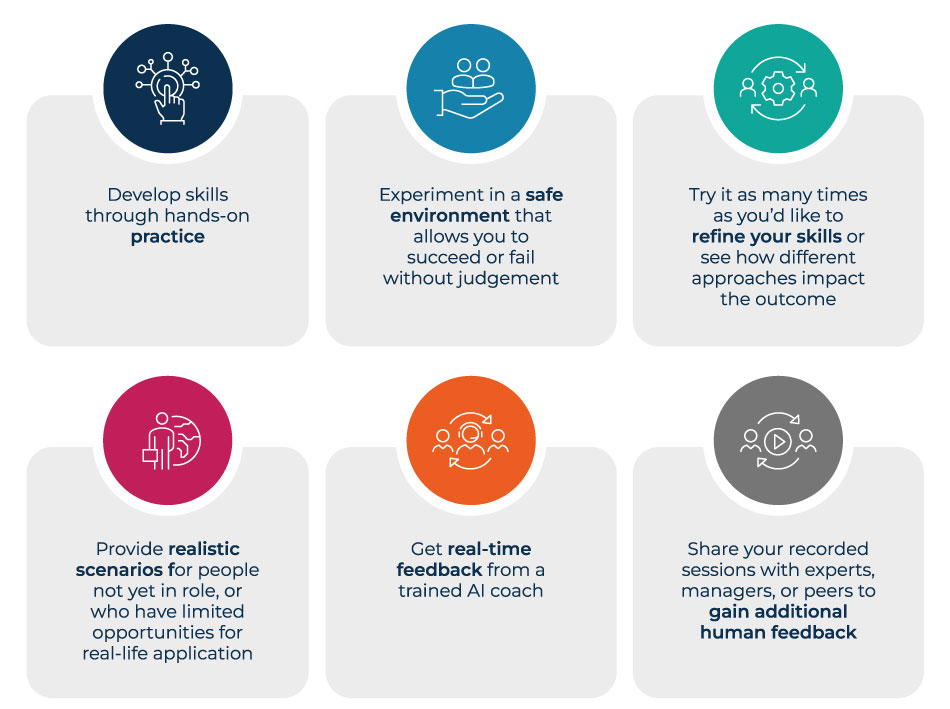
Today, we’re focusing on AI role play because it’s a concrete, high-impact use case that’s easy to understand and apply. It offers a practical, low-risk way to build real skills. Learners can practice in a safe environment. The AI doesn’t judge. It allows people to start, stop, and try again as many times as they like, testing different approaches without fear of failure. There’s no pressure, and no time limit.
Role play also gets closer to realism than traditional methods. Unlike scripted actors, the AI bot can respond dynamically and adapt to the learner’s choices in the moment. And it provides real-time feedback, which helps learners improve quickly.
The AI bot plays two roles in this experience. First, it acts as the persona the learner interacts with: simulating a customer, colleague, or manager. Second, it offers feedback based on defined criteria or a rubric. That feedback can be shared with a human coach, peer, or manager to add a human layer of reflection and support. In short: it’s scalable, safe, and effective.
Reimagining the Blended Learning Journey
As AI tools become more sophisticated and accessible, we have an opportunity to rethink not just what blended learning includes but also how it unfolds over time. The traditional journey includes several critical touchpoints, but these steps are also potential failure points: things like scheduling, collecting feedback, or sustaining behavioral change often break down due to time or resource constraints.
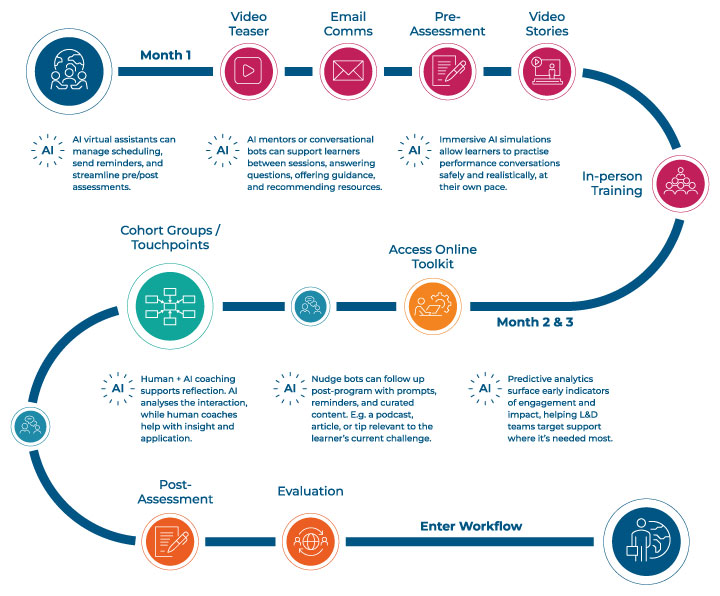
By integrating AI strategically, we can address these gaps and improve outcomes, creating more fluid, responsive, and personalized pathways. Here’s how human+AI design can reshape the blended journey for greater impact:
- AI virtual assistants can manage scheduling, send reminders, and streamline pre- and post-assessments.
- AI mentors or conversational bots can support learners between sessions, answering questions, offering guidance, and recommending resources.
- Immersive AI simulations can allow learners to practice performance conversations safely and realistically, at their own pace.
- Human+AI coaching can support reflection. AI analyzes the interaction, while human coaches provide insight and guidance on application.
- Nudge bots can follow up post-program with prompts, reminders, and curated content like a podcast, article, or tip relevant to a learner’s current challenge.
- Predictive analytics can surface early indicators of engagement and impact, helping L&D teams target support where it’s needed most.
This approach builds not just a training layer but a performance layer. Using AI enables cost-effective and spaced practice by automating nudges, reminders, and micro-assessments, extending the learner journey without increasing budget. Some of these elements are still experimental, and we are constantly exploring what’s possible.
5 Key Considerations When Integrating AI into Blended Learning
While the potential of AI to enhance blended learning is clear, successful integration requires thoughtful planning. It’s not just about adopting new tools. It’s about designing experiences that are ethical, inclusive, and effective. Here are five critical factors to keep in mind when integrating AI into blended learning.
- Keep a human in the loop. AI can support learning, but human oversight remains critical for quality, context, and ethical judgment. Learners still need coaching, sense-making, and emotional connection.
- Design for balance. AI should enhance, not replace, human-led and digital components. The challenge is designing the right blend, where live sessions, digital content, and AI tools each play to their strengths.
- Ensure data privacy. AI requires data to function effectively, but this raises concerns about learner privacy, consent, and responsible data use. Transparent practices are essential. Designing inclusive, fair experiences must be a core principle.
- Integrate with existing systems. AI doesn’t always plug neatly into existing LMSs or platforms. Address interoperability and data flow early on during design.
- Build AI literacy. L&D teams and learners alike need to build confidence with responsible AI integration. Without that foundation, adoption and impact will be limited.
Reimagining Learning in the Flow of Work with AI
AI is more than a new tool. It’s a trigger for rethinking how learning is designed, delivered, and experienced. As organizations move from formal training toward integrated performance support, L&D must evolve, reframing its role, building new capabilities, and adopting a more agile mindset.
Want to explore how AI can strategically enable learning in the flow of work for your organization? Reach out today and talk with our experts.
About the Authors