
When the world shifted online in 2020, the learning industry had to move mountains. In a matter of weeks, in-person workshops were transformed into virtual classrooms. Trainers adapted overnight. Entire courses were reimagined as eLearning or virtual instructor-led training (VILT).
At the time, it felt like the acceleration everyone had been predicting. We had fast-forwarded ten years into the digital learning future! Virtual learning was cheaper and faster to deploy, making it infinitely scalable. Why would anyone go back?
Five years later, we’re seeing the answer unfold. Across industries, there’s a quiet but significant resurgence in demand for in-person learning. Clients tell us the same thing in various ways: “It’s just different when we’re in the room together.”
From financial services to professional firms, our clients are finding new opportunities to reunite people for learning experiences that can’t be replicated through a screen. Many organizations are bringing teams back into the office, and, naturally, training follows. As hybrid work reshapes team dynamics, in-person learning feels less like nostalgia and more like a necessary recalibration.
But with global workforces, leaner training teams, and shrinking travel budgets, it’s not as simple as going back to how things were. Today’s question for L&D professionals isn’t whether in-person learning should return. It’s when and why.
Choosing the Right Learning Modalities
Learning is a live art. Digital learning is like producing a TV show—controlled, repeatable, and consistent. In-person learning is more like theater: the audience changes the performance every time. The participants’ energy, questions, and emotions make each delivery unique. That’s the magic of being in the room, and it’s something no technology can fully replicate.
But, the truth is, in-person learning isn’t always the right choice. Virtual delivery, when designed well, has matured into an incredibly effective channel, and self-paced eLearning remains unmatched in terms of scale and consistency. The best programs today don’t choose one—they mix modalities with purpose. Let’s explore what that looks like.
The Decision Matrix: Matching Modality to Need
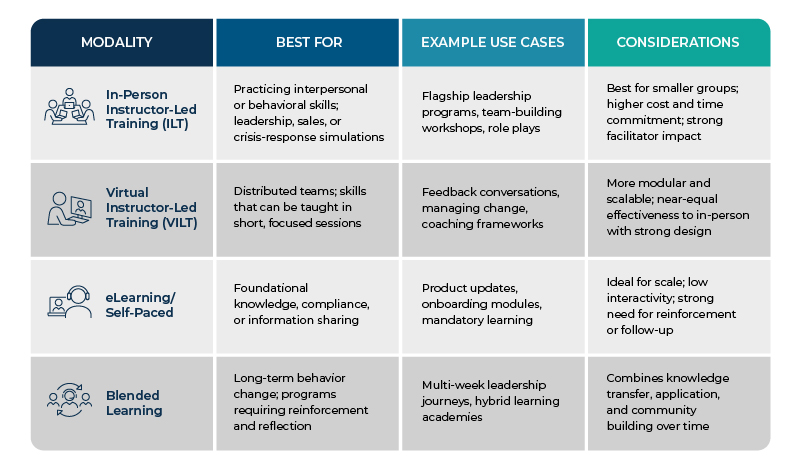
We should avoid crowning one format “the best.” Building great learning means building the right learning mix for your audience and business context.
When In-Person Learning Makes the Difference
In-person learning shines when the objective goes beyond knowledge transfer and the goal is connection, collaboration, and transformation. A simple rule of thumb: if you’re trying to change hearts and minds, not just share information, it’s worth being in the room.
We’ve seen this play out repeatedly:
- Cultural Alignment: When two divisions of a global company we work with were placed together for a training opportunity due to budget constraints, what happened went far beyond the agenda. People from different teams, who had never met, discovered shared challenges and began building new cross-functional relationships. Months later, those connections were still driving collaboration.
- Flagship Programs: Picture a global company that needs to retrain thousands of employees. A great option would be to have the top 300 leaders participate in a blended, in-person journey before the rest of the cohort. Individual contributors can engage in a VILT that senior leaders transition into after their in-person learning. The smaller, live component for leaders sets a tone of authenticity and commitment that cascades through the rest of the organization.
- Behavioral Shifts: In-person learning also remains vital for high-touch development like leadership presence, communication, and customer experience. These skills depend on real-time interaction and feedback. You can teach feedback models virtually, but you feel the courage to rehearse using them in a live room.
In other words, the value of in-person learning often lives in what happens between the content: the side conversations, the shared laughter, the moment someone says, “I thought it was just me.”
Published in Training Industry
Elevate Your L&D: Is Your Team Equipped for the Future?
Blended Learning Done Right
Between all-virtual and all-in-person lies a powerful middle ground: the blended learning journey. Blended learning works because it mirrors how people actually learn: through a rhythm of consuming, practicing, reflecting, and applying. But to succeed, it must feel cohesive, not piecemeal.
Don’t Set a Schedule. Tell a Story.
Think of your blended learning program like a story. A six-week journey shouldn’t be a playlist of disconnected activities. It should include a narrative and could look something like this:
- Start with short eLearning bursts or videos to build foundational understanding.
- Bring cohorts together for an interactive virtual session to apply frameworks.
- Host an in-person workshop to help people rehearse those skills in realistic scenarios.
- Implement microlearning nudges and community discussions to keep the learning alive.
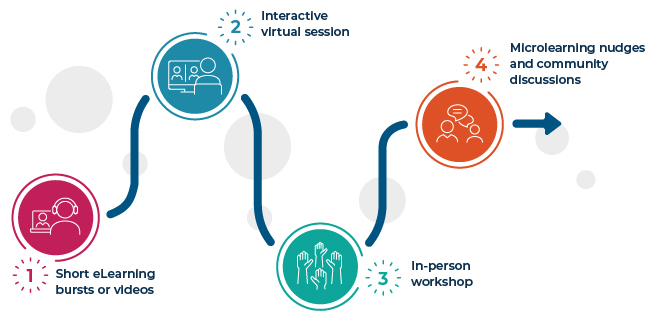
Without a thread—a client case, an evolving scenario, a shared challenge—the experience can feel fragmented, and learners become more likely to disengage earlier. When blended learning is done well, it gives learners control without letting momentum slip. The magic lies in balancing asynchronous learning to prepare and reinforce with synchronous moments (virtual or in-person) to create depth and connection.
For more on blended learning
Blended Learning 3.0: Designing Smarter with AI
Rebalancing Your Learning Delivery Mix
If you’re reconsidering your learning delivery strategy, here’s a quick checklist to guide your decisions:
- Start with outcomes, not formats. Before deciding on modality, clarify what success looks like. Are you teaching or inspiring? Do you need to transfer knowledge or transform behavior?
- Understand your audience. Distributed teams may thrive with VILT; hybrid or hub-based teams might benefit from local in-person cohorts. Match design to work realities.
- Weigh scale vs. depth. In-person training delivers deeper impact but limited reach. Virtual and blended approaches can extend your reach without losing engagement.
- Design for facilitator success. Whether using professional facilitators or internal leaders, provide the structure, resources, and confidence they need to deliver consistently, especially for large-scale events.
- Plan for sustainability. The learning journey doesn’t end at the final session. Use reinforcement tools (coaching, microlearning, AI practice environments) to keep new skills alive.
Our Role: Helping You Find the Right Fit
At GP Strategies, we start with a conversation, not a product. Sometimes, we deliver your programs with our facilitators and global resources. Other times, we help you design your own internal faculty—training your people to deliver effectively and confidently. And often, we co-create blended or hybrid journeys that strike a balance between cost, impact, and experience.
Our goal is simple: to help organizations craft learning experiences that feel alive—whether they happen in a classroom, on a screen, or in a headset. Because while technology will keep evolving, one thing won’t change: learning is, and always will be, a human experience.
Ready to find the right learning mix? Reach out today to connect with our team of learning experts to get started.
About the Authors