The H2 2020 release is here and full of new features and functionality! We have broken down the updates in a series of 10-15 minute On Demand webinars for you to quickly learn what to expect in your updated SuccessFactors environment.
SAP SuccessFactors H2 2020 Release On Demand Webinars
Get in touch.
Learn more about our talent transformation solutions.
Transformation doesn’t happen overnight if you’re doing it right. We continuously deliver measurable outcomes and help you stay the course – choose the right partner for your journey.
Our suite of offerings include:
- Managed Learning Services
- Learning Content Design & Development
- Consulting
- AI Readiness, Integration, & Support
- Leadership & Inclusion Training
- Technical Training
- Learning Technologies & Implementation
- Off-the-Shelf Training Courses

3 Key Mindset Shifts for L&D Capabilities in 2021
This blog article was written prior to LEO Learning becoming part of GP Strategies.
We all know this year has brought a lot of changes to the world of work, and with that has come a number of challenges for L&D professionals. Back in 2019, in an annual survey, Toward’s Maturity (now Emerald Works) found that L&D professionals from a huge range of industries indicated that while virtual classrooms and social learning were key priorities, they were also the biggest gaps in learning capabilities.
This year has forced us, as an industry, to focus on virtual as the key method of learning delivery.
We’ve spoken at length about what we’ve seen our clients doing this year, but now it’s time to look forward and understand how you can best prepare your learning programs for the year to come.
1. Designing Your Learning Programs Virtual-First
Similarly to when mobile-first design became a priority in eLearning delivery, designing virtual-first learning is a must.
Where learning had previously been event-focused, often shaped around a one-time action, we now need to be looking ahead to how we can not only make virtual learning work, but how we can make it a priority.
One key take-away organizations have learned in the last seven months is that they cannot simply take old face-to-face training sessions and pull them online. Delivering a simple PowerPoint or a webinar in place of your old training won’t hold the engagement or harbor the results needed.
So, how can you design virtual-first?
There are a number of things to consider, including:
- Redesign your learning from the ground up. Start with your objectives and reconsider the purposes, as well as the mode, of delivery.
- Audit your current content to identify useful existing resources.
- Curate content and knowledge as part of this process.
- Continue to experiment with your learning design. Keep experimenting.
- Inject interactivity into your sessions. Aim for more of a workshop feel than a lecture. In fact, move the knowledge-heavy materials online so people can access them before or after the session.
- Remember, new tools are being developed all the time, so make the most of them. Use more than one in your session.
- Consider your break-out spaces, and design the learning with these in mind as you would in a physical setting
- Solid facilitation matters online – and this goes far beyond simple presentation.
2. Making Space for Collaboration and Social Learning
Lacking the physical space in which to interact, social learning and collaboration have been high on the agenda for learning this year. Social learning, however, is a difficult thing to master. As we learned in a recent LEO Campfire session, and a sentiment repeated in the webinar, is that you cannot expect people to collaborate or learn socially simply because you have made the space.
Collaboration within virtual learning sessions is absolutely possible when planned.
You can use polls, chat rooms, and external channels like Slack. There are a huge variety of ways to encourage participation in these events, even at a distance. However, creating an ongoing social learning environment can be a challenge.
One of the key ways to tackle this is to develop a marketing mindset when it comes to learning.
Marketing campaigns are all about engagement, and the world of learning has a lot to learn from the likes of social media. Use-generated content (UGC) is a powerful tool for collaborative learning. It’s a great way to get people engaged and keep them invested in the learning journey. UGC itself can often have a snowball effect—it can be a little slow to start but the more people get involved, the more people are likely to join in. Marketing-inspired learning campaigns are a great place to start to get these initiatives going.
3. Actively Focus on Performance and Behavioral Change
Behavioral change has always been a key focus in L&D. But now that many of us are learning at a distance, it can be harder to measure this impact.
Learning teams have to design for knowledge retention and transfer into the workplace. This has always been the case, but now the workplace is changing—and for many people is within the home—it’s important to consider how behavioral change may translate differently.
Employees are no longer occupying the same physical space as their management, and as many organizations aim to hire more fully remote candidates, this is a significant part of the next normal. Mentoring and coaching have never been more important as a form of ongoing workplace learning.
In order to ensure managers and coaches aren’t overloaded, it’s vital that this capability is built up over time to help support a more self-directed and less event-based continuous learning model. Alongside coaching and mentoring, it’s important to align learning to performance goals. Performance consulting can be a hugely formative part of learning design.
In a recent LEO-led client knowledge-share session, one of the attendees discussed a performance committee involved in the development of all of their learning. This committee evaluates any new learning for its alignment business, performance, and learning objectives. This helps the organization ensure the link between learning and business goals is a vital part of its learning strategy.
Get in touch.
Learn more about our talent transformation solutions.
Transformation doesn’t happen overnight if you’re doing it right. We continuously deliver measurable outcomes and help you stay the course – choose the right partner for your journey.
Our suite of offerings include:
- Managed Learning Services
- Learning Content Design & Development
- Consulting
- AI Readiness, Integration, & Support
- Leadership & Inclusion Training
- Technical Training
- Learning Technologies & Implementation
- Off-the-Shelf Training Courses

The Power of STEM Roles
A STEM profession isn’t something I put a lot of thought into early on in my own career. It wasn’t something I thought I really would end up doing for a living either. However, after almost 7 years working in the power industry and 4 years working with various electrical grid system operations in business development, I think about it all the time. With so many new career opportunities that didn’t even exist a decade ago, including jobs I might not have even been able to picture, the importance of considering STEM roles early on is clear.
I’m also surprised by how quickly digital transformation has not only taken the power industry by storm, but all technical industries. It certainly is an exciting time to be in the mix of it all. Technology is constantly pushing us all forward, and with that, we are challenged to create new solutions and find new answers. It is important to celebrate the options that are available now in STEM roles.
I am most grateful for the vast amount of opportunities there are to be involved in technical fields without needing to be a “technical” person. I have the chance to work with my clients as their partner to help promote different strategies across a technical workforce and through process improvement. I engage with my clients to develop effective strategies and solutions that show measurable improvements in the way they operate and maintain workforce conditions and worker knowledge and safety. I believe in what we do—it helps me to better support my clients’ growth, and it empowers me as well.
The projects that I am involved in are always unique; they present new challenges for a digital strategy and, oftentimes, an overall transformation, whether it is about their people, processes, or technologies. The workforce is being transformed as well; there are so many different approaches, tools, resources, and modalities for change management in technical industries. Opportunities to learn and grow abound in the STEM fields—it is exciting to be a part of it.
Happy National STEM Day!
Get in touch.
Learn more about our talent transformation solutions.
Transformation doesn’t happen overnight if you’re doing it right. We continuously deliver measurable outcomes and help you stay the course – choose the right partner for your journey.
Our suite of offerings include:
- Managed Learning Services
- Learning Content Design & Development
- Consulting
- AI Readiness, Integration, & Support
- Leadership & Inclusion Training
- Technical Training
- Learning Technologies & Implementation
- Off-the-Shelf Training Courses

October is Breast Cancer Awareness Month: Employees Took Steps to Help Find a Cure
Several GP Strategies employees supported Breast Cancer Awareness, through the American Cancer Society (ACS), during the month of October. The virtual event was administered through a Chatbot on Facebook Messenger! Participants logged their miles and as they passed a milestone (half way and the finish line), they were awarded badges via augmented reality filters. The fundraiser was also administered through participant’s own Facebook page and each state had a Facebook group page where members could seek advice, give advice, and post information about the status of their fundraiser/walk.
Sue Martin joined the Michigan 35 Mile Breast Cancer Challenge. She ended up walking 100 miles for her mom who was diagnosed with triple negative metastatic breast cancer in 2018. Sue said, “My mom is my HERO! She never complains and never stops fighting. My family joined me to walk the last steps of my 100 miles and we surprised my parents with a lot of pink!” That’s dedication! Sue also met a new friend, through the Michigan ACS Facebook group, who was recently diagnosed with breast cancer. They meet once a week and continue to walk together!
In North Carolina, Katrina McCoy participated by walking 35 miles in honor of her aunt, a breast cancer survivor, and raised $380!
Kayla Ratz linked up with Colorado’s 35 Mile Breast Cancer Challenge. She walked to help support ACS and the warriors, families and friends who are impacted by this awful disease. A few days were below freezing and there was snow on the ground, but she managed to walk 60 miles and raise $325!
Lisa Seidl participated in Michigan, walking 38 miles and raising $220 in honor of friends fighting and surviving breast cancer. She said, “We all know at least one person who has been afflicted with breast cancer. It is a disease that in one way or another, affects us all.”
Sheri Winter supported ACS by walking 35 miles in California and raising $230. She walked for her sister-in-law, who passed away with metastatic breast cancer two years ago, her best friend who is battling it now, and one of GP Strategies clients.
When there are goals to meet in ousting a disease, we come together! Collectively, these women walked 268 miles and raised $1,635 in October.
In a time where many in person events have been disrupted by the pandemic, it is exciting to see how organizations continue to implement innovative ways to achieve success through immersive technologies and collaborative tools to help them shift their strategies and remain agile.
Get in touch.
Learn more about our talent transformation solutions.
Transformation doesn’t happen overnight if you’re doing it right. We continuously deliver measurable outcomes and help you stay the course – choose the right partner for your journey.
Our suite of offerings include:
- Managed Learning Services
- Learning Content Design & Development
- Consulting
- AI Readiness, Integration, & Support
- Leadership & Inclusion Training
- Technical Training
- Learning Technologies & Implementation
- Off-the-Shelf Training Courses

Effective Whistleblowing Arrangements: A Global GRC Priority for the Financial Services Sector and Beyond
This blog article was written prior to LEO Learning becoming part of GP Strategies.
Whistleblowing is a timely topic due to the increasing focus that global regulators in that sector have placed on conduct, individual accountability, and responsibility and a recent survey of UK Bank employees that revealed that 25% would be worried about the negative consequences for them if they raised concerns at work.
Part two in this series will look at the EU Whistleblowing Directive and part three at best practice for whistleblowing training and communication.
Whistleblowing: The GRC Topic Consistently Making News Headlines
Whistleblowing is rarely out of the media, with headline-grabbing cases spanning everything from hospitals to Hollywood, and manufacturing to banks. As a result, the encouragement and protection of whistleblowers is a priority for regulators and legislators across the globe. All organizations are on notice that effective whistleblowing arrangements should form the heart of both their culture and their governance framework.
The legal and regulatory environment is particularly complex in the financial services sector. Here, whistleblowing arrangements must meet not only the general legal requirements applicable to all organizations, but also the regulations specific to individual regulatory bodies. Increasingly, these regulations must also be interpreted and applied within a wider conduct- and culture-focused regulatory agenda.
The legal and regulatory environment is changing rapidly and must be monitored closely. This is particularly true for organizations with a global presence that must comply with multiple legal and regulatory requirements across multiple jurisdictions.
Whistleblowing in the UK
In the UK, financial services organizations must comply with a two-tier legal and regulatory framework in relation to whistleblowing. Tier one is the Public Interest Disclosure Act 1988 (PIDA) which protects ‘workers’ from detrimental treatment or victimization from their employer if, in the public interest, they blow the whistle on wrongdoing. Tier two comprises of the whistleblowing rules and guidance introduced in 2016 by the Financial Conduct Authority (FCA) and the Prudential Regulatory Authority (PRA). The latter is mandatory for some organizations, broadly banks, and operate as guidance for others. Both of these tiers are currently under review by the respective authorities.
The UK was the first EU country to introduce whistleblower protection legislation in 1998, but PIDA is now subject to increasing levels of criticism. The main concerns voiced by bodies such as the All Party Parliamentary Group (APPG) on whistleblowing are that the legislation no longer adequately protects whistleblowers and contains no mechanism for addressing whistleblowing allegations. These concerns must also be seen in the context of the new EU Whistleblowing Protection Directive that comes into force in 2021. Brexit means that the UK will not be required to comply, but the Directive may provide a timely opportunity to review and update the UK’s own legislation.
The way that the FCA handles whistleblower cases has also been criticized by the APPG on whistleblowing and the FCA has signaled that it is reviewing its procedures as a result.
In November 2018, the FCA published a review of the whistleblowing arrangements in place within the Retail and Wholesale Banking sector. Although it identified some areas of good practice, it also highlighted areas for improvement. These included failings in relation to the role of Whistleblowers’ Champions and the inadequate provision of information and training. The FCA urged firms to review the findings and to consider the steps needed to improve their whistleblowing arrangements. Having reiterated its expectations and highlighted areas for improvement, the clear implication is that Senior Managers and organizations can expect enforcement action for failings in their whistleblowing arrangements and/or for the performance of the Whistleblowers’ Champion role.
In addition, the FCA has made it clear that effective whistleblowing arrangements are an essential part of the culture of financial services organizations. In 2020/2021, we may see this reinforced by an extension of the mandatory rules in the FCA Handbook (SYSC 18) to non-banks.
Whistleblowing in the EU
In October 2019, the EU’s Whistleblower Protection Directive (the Directive) was adopted by the European Council. The Directive’s central aim is to provide better protection for those who seek to expose corporate wrongdoing in the public interest. These protections are extended to a broad range of individuals—essentially anyone working in the public or private sector who could acquire information about wrongdoing in a work-related context. This group extends well beyond employees to include job applicants, former employees, supporters of the whistleblower, and journalists. The protections are against dismissal, retaliation, and any other form of discrimination, such as being denied training or receiving poor evaluations.
The scope of the Directive is limited to wrongdoing relating to EU law. This is a broad category and includes, for example, tax evasion, money laundering, public procurement offenses, product safety and road safety, environmental protection, public health, and consumer and data protection. Beyond this, national legislators are encouraged to extend the coverage to wrongdoing relating to national laws too.
The Directive will impact all private and public sector organizations with over 50 employees operating in the EU (not just those in the financial services sector). The scope extends to non-EU organizations operating in the EU, including UK organizations, post-Brexit. Relevant organizations with over 250 employees must comply with the Directive (in the form in which it has been implemented in relevant national law) from the end of 2021. There is a deadline extension for organizations with between 50 and 250 employees.
Whistleblowing in the US
The Sarbanes-Oxley Act and Dodd-Frank Act both include provisions giving whistleblowers a right of action as a result of retaliation or victimization. Like the FCA in the UK, the US regulators have also made it clear to financial services organizations that effective whistleblowing arrangements are an important regulatory and cultural expectation. In January 2019, for example, the New York Department of Financial Services (DFS) issued its Guidance on Whistleblowing Programs.
The Guidance sets out the principles that all regulated institutions should meet when designing and implementing whistleblowing arrangements. These include provisions in relation to anonymity, confidentiality, and protection from retaliation. They also refer to the importance of having a “top-down culture” that supports whistleblowers and encourages them to come forward.
In September 2020, important clarification was given by the SEC on the scope of Dodd-Frank Rule 21F-2(d)(4). The provision covers the protection of whistleblowers from retaliation.
In 2018, the US Supreme Court ruled in the Digital Realty Trust decision that Dodd-Frank Rule 21F-2(d)(4) only applies to whistleblowers that make reports to the SEC; not those who make internal reports within their organization. Not surprisingly, since the Digital Realty Trust decision, the number of tips to the SEC Office of the Whistleblower has soared. The SEC have now confirmed this interpretation and that those who make reports through internal channels are not ‘whistleblowers’ as defined by the Dodd-Frank Act. Protection may still be available under other legislation, regulations or guidance, for example, under Sarbanes-Oxley.
Unlike the position in the UK and the EU, however, the SEC Whistleblower Program, created in July 2010 pursuant to Section 922 of the Dodd-Frank Act, has allowed the Securities and Exchange Commission (SEC) to pay rewards to eligible corporate whistleblowers who voluntarily provide “original information” leading to a successful enforcement action that results in monetary sanctions over $1 million. More than $500 million has been paid out since 2011. Indeed, on September 28, 2020, the SEC issued its 100th whistleblower award under the reward program.
What Should Your Next Steps Be? Act Now!
In summary, whistleblowing arrangements, particularly within the financial services sector, are increasingly under the spotlight. The cost of non-compliance is high, not only for organizations, customers, and other stakeholders, but also the wider public and, of course, for the whistleblowers. Effective whistleblowing arrangements, including training and employee communications, are now a global GRC priority for financial services organizations and beyond.
Are you looking for expert-led support on whistleblowing to support your organization’s learning goals? Our friendly team is on hand to offer fully tailored support to match your needs. Get in touch.
Get in touch.
Learn more about our talent transformation solutions.
Transformation doesn’t happen overnight if you’re doing it right. We continuously deliver measurable outcomes and help you stay the course – choose the right partner for your journey.
Our suite of offerings include:
- Managed Learning Services
- Learning Content Design & Development
- Consulting
- AI Readiness, Integration, & Support
- Leadership & Inclusion Training
- Technical Training
- Learning Technologies & Implementation
- Off-the-Shelf Training Courses

How to Harness the Power of Storytelling in Learning Videos
This blog article was written prior to LEO Learning becoming part of GP Strategies.
When it comes to inspiring people to embrace a new change in behavior, storytelling isn’t just better than the other tools, it’s the only thing that works.
We believe that the above quote, from Professor Boyd, is totally accurate. So whether you’re thinking of creating your own visual materials or plan on hiring a professional learning company to help, it’s imperative that you have a handle on some of the basics of storytelling.
Without an effective story—this applies to documentary as well as drama videos—a learning video will flounder. Viewers won’t engage. Clarity will be lost. And the all-important human behaviors could easily feel disjointed and unmotivated.
There’s an enormous global industry around structuring stories for the screen—thousands of seminars, courses, and books are available. While story structure can be framed and described in numerous ways, the standard story form usually boils down to a simple sequence of events.
What Is Story Structure?

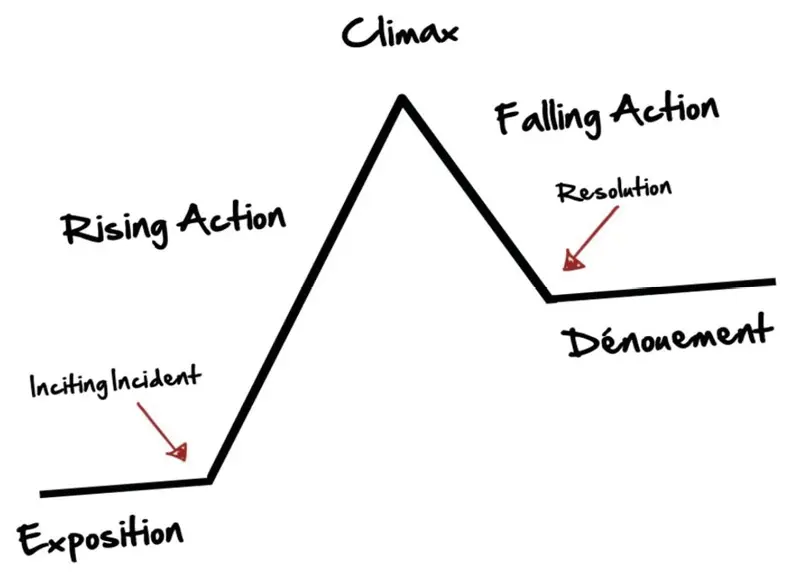
This diagram is a simple rendering of the “shape” of most conventional stories. It’s derived from the work of Joseph Campbell, a famed American Literature professor whose work has been adopted by filmmakers the world over.
The shape of this narrative basically follows a journey—from uneventful, through to very eventful, peaking with a climactic event, and ending with some sort of resolution. While there are thousands of films that don’t work in this way, it’s surprising just how many do.
How Do I Structure Story Specifically For Learning?
The classical model works well for longer-form narratives like film or TV, but it’s a little over-engineered for a learning video. We would tend to focus on five elements of this larger structural diagram:
- Exposition
- Inciting incident
- Rising action
- Climax
- Resolution
Exposition is the information an audience needs to get the most out of a scene or story.
The inciting incident is an event, thought, or circumstance that forces the main character into a decisive course of action in order to achieve a specific goal. It’s often characterized by a situation becoming more difficult for them than they’d anticipated.
Rising action shows the character we’re following (our protagonist) grappling with the central problem or obstacle. Things can get easier at times and more difficult at others.
The climax, in pure story terms, is the achievement of that goal. However, in eLearning, this can often be a decision-point question.
The resolution is the end-point of the story—what the situation is after the goal has been achieved. In blockbuster movies, this is often a very short phase of the overall narrative. It could look like one of these:
- The hero gets the girl and they drive off into the sunset.
- The town is saved and the hero/heroine is lauded.
- The loner strolls out of town, leaving everyone a bit wiser.
However, in eLearning, the story’s resolution takes on a far greater significance. It’s often a section of the story that shows the good consequences or benefits of behaving in a certain way, and should therefore be given the weight it deserves.
How Are the 5 Story Phases Applied to a Workplace Drama?

As you can see, it’s not necessary to film every aspect of the story structure here. Certain elements can be done just as effectively as eLearning screens (exposition and resolution) or as a challenge to the learner (climax). Think about what needs to be filmed within your story, and how other media such as photography or question-setting could augment it.
Get in touch.
Learn more about our talent transformation solutions.
Transformation doesn’t happen overnight if you’re doing it right. We continuously deliver measurable outcomes and help you stay the course – choose the right partner for your journey.
Our suite of offerings include:
- Managed Learning Services
- Learning Content Design & Development
- Consulting
- AI Readiness, Integration, & Support
- Leadership & Inclusion Training
- Technical Training
- Learning Technologies & Implementation
- Off-the-Shelf Training Courses

What Training Is Needed to Help Protect Vulnerable Customers?
This blog article was written prior to LEO Learning becoming part of GP Strategies.
Financial services organizations across the globe are seeing an increase in newly vulnerable customers hit by the health or financial consequences of COVID-19.
In July 2020, the UK’s Financial Conduct Authority (FCA) estimated that over 24 million adults in the UK currently display at least one characteristic of vulnerability. That’s over a third of the population. Now is the right time to take a fresh look at how your firm deals with vulnerable customers.
Protecting Vulnerable Customers Is a Priority for Regulators
The Financial Conduct Authority (FCA) has named vulnerability as one of its key areas of focus in its 2020/21 Business Plan.
US financial regulators, such as the Securities and Exchange Commission (SEC) and the Financial Industry Regulatory Authority (FINRA), have also put the protection of vulnerable customers at the top of their priority list.
The regulatory buzzwords here are “fairness” and “consistency”. Getting this right, however, goes beyond policies and procedures. Treating vulnerable customers fairly means embedding the right behaviors in your firm’s culture too. Indeed, the FCA has called for a “practical shift in firm behavior”.
What Training Is Needed to Protect Vulnerable Customers?
Awareness and training have a major role to play at a cultural, policy, and procedural level. This is not only in terms of treating customers fairly, but also in demonstrating to regulators that staff are equipped and trained to deliver fair and consistent outcomes.
Effective training will ensure that staff:
- Understand the characteristics of vulnerability
- Know how vulnerability may impact their customers
- Understand their firm’s approach
- Know how to respond
- Have the opportunity to practice these skills in a safe environment
- Can engage in practical real-life scenarios
Working With Vulnerable Customers: How We Can Help
Understanding and working with vulnerable customers has been a key part of Governance, Risk, and Compliance (GRC) training for a long time. As we adjust to the “new normal”, it’s important that we shape it in a way that prioritizes supporting those who need it most.
At LEO GRC, we have over 15 years of experience offering expert-led GRC training as well as eLearning courses for all sectors. With a key focus on behavioral change, we work with corporate and governmental organizations and are proud to help many of the world’s leading financial services organizations to deliver global compliance training programs.
Whether you’re looking for an off-the-shelf GRC solution, a custom training program, or simply want some advice on how to shape your vulnerable customers’ training, get in touch.
Get in touch.
Learn more about our talent transformation solutions.
Transformation doesn’t happen overnight if you’re doing it right. We continuously deliver measurable outcomes and help you stay the course – choose the right partner for your journey.
Our suite of offerings include:
- Managed Learning Services
- Learning Content Design & Development
- Consulting
- AI Readiness, Integration, & Support
- Leadership & Inclusion Training
- Technical Training
- Learning Technologies & Implementation
- Off-the-Shelf Training Courses

4 Microlearning Principles That Enhance Compliance Training
The phrase “new normal” has become part of our everyday language. But as present circumstances continue to evolve, it can be hard to pin down what the new normal actually is. From mass remote working to considerable changes in customer relationship management, one thing is for sure: In learning and development (L&D), we have to be quicker than ever to adapt to the changes in working life. And that means adapting our compliance training programs.
Why Microlearning for Compliance Training?
We’re more than half a year into this new normal, so we’ve all had plenty of time to pivot our learning strategies, embark on digital transformation, and learn how to manage compliance training at a distance. Now is the perfect time to review your compliance training program to ensure that it is on message, sustainable, adaptable, and scalable in the long term.
This is where microlearning principles come in.
Microlearning has a huge range of benefits in any area of learning and development, from information retention to increasing completion rates. Here are four key benefits for compliance training specifically.
4 Ways Microlearning Enhances Compliance Training
1. Microlearning Improves Information Retention
As the world of work continues to change, it’s vital that any new training is impactful, understandable, and digestible. One of the best things about microlearning is the breakdown of complex topics into accessible nuggets of information.
Typically lasting 2–10 minutes, microlearning condenses training down to its purest form. This means that the brain no longer needs to filter out extraneous information. This, in turn, leads to greater retention of the key messages and the ability to deliver specific action points.
2. Microlearning Requires Less Bandwidth
Up until recently, most compliance training has taken place in the workplace, where strong Wi-Fi is the norm. But with more people working from home, perhaps with many others needing access to the same internet connection, it’s important to consider connectivity and bandwidth issues—especially when delivering mandatory compliance content. Nothing annoys a learner more than a course that fails to record their completion or score a test properly.
Due to its short format, microlearning requires less bandwidth than longer, media-rich forms of training content. While animation, for example, is less demanding on internet bandwidth than video, these shorter bites of eLearning content allow for easier access while using weaker internet connections.
3. Microlearning Is Easier to Adapt at Scale
The new normal remains an ongoing development. Microlearning offers both increased flexibility and a more rapid, responsive delivery option.
For example, if your information security policies change in response to new risks, a targeted microlearning solution can be developed and rolled out at scale and at speed. This can be done with a much shorter lead time than a full-length module.
Microlearning can also be used to address interim training needs, such as refreshers and updates.
4. Microlearning Is Flexible for the Time-Poor Workforce
Whatever the new working environment brings for your workforce, there are many demands on their time. Some are spending too long in front of a screen and are experiencing “Zoom fatigue.” Others are busy working with customers or are in front-line professions away from screens for long periods of time.
Microlearning’s shorter seat times address this problem and provide bite-size learning interventions that fit more easily into the working day.
Elevate Your Compliance Training with Microlearning
Microlearning principles can revolutionize your compliance training by improving retention, reducing bandwidth requirements, enabling rapid scalability, and accommodating busy schedules.
Need help with delivering bite-sized compliance training at a distance? Talk to us about your training needs.
Get in touch.
Learn more about our talent transformation solutions.
Transformation doesn’t happen overnight if you’re doing it right. We continuously deliver measurable outcomes and help you stay the course – choose the right partner for your journey.
Our suite of offerings include:
- Managed Learning Services
- Learning Content Design & Development
- Consulting
- AI Readiness, Integration, & Support
- Leadership & Inclusion Training
- Technical Training
- Learning Technologies & Implementation
- Off-the-Shelf Training Courses

Facilitation Best Practices From Virtual Facilitators
We’re working and learning from home longer than expected. For many of us, our kids have returned to a very different type of classroom from last year, with at least some mixture of virtual. And at work, we’re leading meetings and delivering learning for larger audiences, which puts a strain on our virtual capabilities.
As a learning professional, you may have suddenly found yourself leading virtual sessions. Your role becomes even more important as a facilitator, as you strive to create meaningful engagement.
We put together the following best practices and checklists for virtual facilitation based on our experience. Whether you’re new or a veteran virtual trainer, keep these things in mind to deliver engaging virtual training.
Tips for Fluid Virtual Facilitation
Virtual is much different than in-person. When you’re face-to-face with someone, body language is easier to communicate, people are more willing to ask and answer questions, and topics are easier to discuss.
Keep a few key things in mind to create a great energy in virtual:
- Be more energetic than you would in person. Energy is easier to read when face-to-face, so effective virtual facilitators need to play up their energy levels.
- Don’t fear silence. It’s okay to ask a question or make a point and wait a few seconds before continuing or until someone offers an answer.
- Sound conversational. Don’t read directly from slides—talk naturally. If you’re reading from a script, practice reading through it out loud first.
- Feedback in a virtual environment is more challenging. People can’t read body language, and you can’t see how people are responding. Prepare yourself mentally in case it’s difficult to get a feel for how your participants are responding.
Virtual Facilitation Checklist: Creating Connections and Driving Engagement
There are a few virtual facilitation best practices to help create connections between you and your participants:
- Engage throughout by calling on people.
- Use participants’ names.
- Include interaction.
- Ask standard questions, but also try new ways of questioning.
- Collaborate rather than lecture.
In addition, use the following checklist to keep your participants engaged throughout your virtual sessions:
- Connect with each individual as they come into the virtual room.
- Encourage participants to chat their ideas, thoughts, and reactions with everyone as you are talking, and reinforce the chatter. Along the same lines, encourage participants to follow up with each other with private chats about specific ideas.
- Peer pressure and peer support are integral to a successful virtual learning experience. When participants know they will be called on to collaborate with one another, they will be more engaged throughout the entire program. But warn them at the beginning that you may do this! And let them know they may say “Pass” if they prefer not to answer.
- Use the participation buttons (raised hand, green check mark, red X, emoticons) whenever possible to solicit responses. For example, you could say, “If you agree with what you just heard, put up a green check mark. If you see it differently, use a red X.”
- Call on folks, especially when you ask closed‐ended questions that warrant a “check” or an “X.” Then ask some open‐ended questions so they can elaborate and feel included.
- Invite people to “raise their hand” to be called on; just don’t forget to erase the icon after the exchange is over.
- Keep a running tab of who has spoken already so that you can call on those who haven’t yet responded.
- Write down comments that people make; include their names next to the comments so that you can refer back to what people said.
- If someone comes in late, send them a private chat to welcome them. You can even have some prewritten chat messages for similar situations ready to copy and paste into the chat function.
- Personal stories matter even more virtually. Have crisp anecdotes to drive your points home. Data can get boring in a hurry.
- Whatever you do, make it conversational and use humor, just as you would in an ILT… only VILT needs it even more.
Breakouts and Collaboration
When using breakouts, try to visit every group to check in and ensure that each group has some output to return to the main session with.
Don’t triage the breakout groups. The more people talk, the more opportunities there are for sharing and ideas.
Camera Use
Using the video camera makes it more personal and engaging for both the facilitator and the attendees depending on the content and number of participants. It is recommended for the facilitator to appear on camera at least in the beginning if not throughout the session if there are bandwidth issues. When using video, look directly at the camera when talking. It helps to give the impression that the facilitator is looking at the audience. It’s awkward at first and takes a little practice, but use peripheral vision to look at the audience.
By keeping these best practices in mind, your virtual facilitation should feel more fluid, and it will create more engaged participants. If you have a tip to add or have found something to be helpful that’s not on this list, please leave a comment. We’d love to hear about it!
Get in touch.
Learn more about our talent transformation solutions.
Transformation doesn’t happen overnight if you’re doing it right. We continuously deliver measurable outcomes and help you stay the course – choose the right partner for your journey.
Our suite of offerings include:
- Managed Learning Services
- Learning Content Design & Development
- Consulting
- AI Readiness, Integration, & Support
- Leadership & Inclusion Training
- Technical Training
- Learning Technologies & Implementation
- Off-the-Shelf Training Courses

5 Ways to Improve GRC Training at a Distance
This blog article was written prior to LEO Learning becoming part of GP Strategies.
As mass remote working continues to be the norm for many and is becoming a permanent part of the world of work for some organizations, it’s vital we look at how best to maintain and develop regulatory training programs.
What Is Governance, Risk, and Compliance (GRC) Training?
GRC training is an ever-expanding topic, so it can be hard to pin down. GRC covers mandatory training topics set by law and regulation, but it increasingly encompasses a broader set of topics selected by the C-suite of the organization itself, including culture, respect in the workplace, and leadership skills.
Whatever your organization’s definition of GRC training is, it’s likely to include mandatory and non-mandatory training across a range of topics. So let’s take a look at how to manage those things in the world we now find ourselves in.
Managing GRC Training Virtually Isn’t New
When you think of GRC training, you might think of the Health & Safety eLearning module you took when you first started at your organization (and likely have to take again on a yearly or six-monthly basis). Or perhaps you think of the Anti-Money Laundering module recently rolled out to employees internationally.
Ultimately, GRC training has been managed via digital learning for a long time. So managing this virtually, on the whole, isn’t a new thing. Despite the “new normal” we find ourselves in, it’s reassuring as L&D professionals to know that this vital part of employee onboarding and training doesn’t have to be overhauled in the way that other types of training now do.
However, there are elements of GRC training that will need to be moved from face-to-face to Virtual Instructor-Led Training (VILT) environments. One example of this is management and leadership training, another is small group training on specialist GRC topics including Client Assets, GDPR, Vulnerable Customers, The Volcker Rule, and Regulatory Updates.
Handling Management and Leadership Training at a Distance
A common theme we’ll see throughout this article is maintaining the human element or connection in training. This is possibly at its most important when it comes to management and leadership training.
In this sense, the need for human connection is two-fold. It’s:
- in the way the training is handled
- and in the behavioral changes required from your leaders in this newly distanced world of work we find ourselves in
VILT can be a vital tool for helping to both shape management and leaders in the way you had before, but there’s also a distinct need to change both the way this training is run and the areas your leaders and managers are trained in. Managing and leading people at a distance requires a very different approach and skillset to managing people directly in person. So keep that in mind as you read through the rest of this article.
While the format of most of your GRC training may not need to change, there are a number of considerations to make when it comes to the content, delivery, and context of the training itself. Here are five ways to adapt your GRC training to meet the challenges of the ‘new normal’.
1. Keep Training Targeted and Effective
As an increasing percentage of people are working remotely, we’re spending more time than ever looking at screens. Zoom and screen fatigue are on the up. Yes, it’s important to keep learners engaged in this content, but it’s also important we don’t keep them in front of screens for longer than necessary, especially with content that isn’t relevant.
That’s why it’s more important than ever for GRC training to be targeted, addressing the right group of learners about the right topics. Need GRC training that works for both new starters and existing hires? Ask your learning content creator about creating two options in the same module, one for complete training and the other as a refresher.
As L&D professionals, we’ve been pushing against the idea of “one size fits all” training for a long time, but with more distractions and less motivation for training, it’s more important than ever to look at tailored learning solutions. The use of diagnostics and adaptive testing ensures that every minute of learning seat time has purpose and value for both the learner and their organization.
2. Reading Your Audience at a Distance
So what happens when you’re faced with delivering GRC training in a VILT environment? Although these sessions may be for only a select group of employees, it’s still worth knowing how to handle the challenges of virtual classrooms.
LEO’s learning consultants have been researching and compiling learner archetypes and how these change when you’re in a virtual setting. We believe there are four main archetypes that learners move between: The Achiever, The Thinker, The Showperson, and The Dormant. Each will express different levels of internal and external engagement and managing these levels of engagement is vital to success.
3. Changing Learning Content to Reflect the World We Live In
One of the biggest challenges of moving to mass remote working is not only keeping up with GRC training remotely, but adjusting the content available.
With more people than ever working from home, regulations around information security and data protection are especially important to consider. For example, have you considered the repercussions of people taking calls in non-private spaces within their home? Or the possibility of employees logging on to public WiFi?
Also worth considering are the ways in which we deal with vulnerable customers and, of course, with COVID safety measures. GRC training not only applies to those working from home but also to those on the front line, working in healthcare, in essential retail, and in some hospitality venues.
These are all things that need to be considered and covered in your GRC training now that people’s working situations have changed. It’s also worth considering how this will change your organization’s approach to these areas in the future, in a world post-COVID.
4. Adapting GRC Training for Availability and Internet Connectivity
Another challenge we need to face when adapting GRC training to a world where many work from home is accessibility. GRC training would typically take place in an office, with a strong internet connection using office WiFi. As many households now have multiple people working from home, and in some cases children schooling from home, internet connections are under strain.
So it’s worth considering the format of your training. Media-rich content and video-based training may struggle to load or crash while your learners are taking the course(s). There are also many more distractions in the home, so attention may be split between minding children, other people working different jobs in the same room, and other distractions that come with working from home.
In this case, we can look at implementing microlearning practices and reducing the amount of video used in eLearning content. Animation can be a great substitute that requires far less bandwidth, and can therefore be more accessible to your employees regardless of their internet connection or homeworking set up.
5. Measurement and Data Capture
When it comes to user-friendly eLearning content, and the Learning Management System (LMS) or Learning Experience Platform (LXP) it’s hosted on, it’s always important to account for connectivity issues, timing out, and any other reasons learners may not be able to complete training in one go.
It’s vital that your systems are able to allow learners to pick up where they left off on their training, the same way we see with streaming services like Netflix—even if they have to switch devices to complete their training. Without this, you may see completion rates decrease as learners find it more difficult and time-consuming to complete training, especially if they have to start again from the beginning.
With this comes a consideration of measurement and data capture. Capturing accurate completion and progress data are vital to rolling our GRC courses in any setting, but especially remotely. In a situation where you can no longer provide your learners with a dedicated time and space to complete their learning, it’s incredibly important to ensure accurate measurement can take place from a distance. Robust testing must take place for all content before it’s released to a remote workforce, to ensure higher completion and compliance rates once passed on to your learners.
Conclusion
While GRC training may have traditionally taken place online, there are still a number of factors to consider when creating accessible and manageable training for learners to complete at home. Whether you’re directing leadership training in a VILT session or rolling out a new course about money laundering, keeping the above in mind can help you to maintain completion rates and keep your training relevant to the “new normal” much of your workforce will find themselves in.
Need help with delivering GRC training at a distance? Get in touch.

Get in touch.
Learn more about our talent transformation solutions.
Transformation doesn’t happen overnight if you’re doing it right. We continuously deliver measurable outcomes and help you stay the course – choose the right partner for your journey.
Our suite of offerings include:
- Managed Learning Services
- Learning Content Design & Development
- Consulting
- AI Readiness, Integration, & Support
- Leadership & Inclusion Training
- Technical Training
- Learning Technologies & Implementation
- Off-the-Shelf Training Courses