5 Reasons Now is the Right Time to Revisit Your Listening Strategy

Ah, 2020. What can I say? It’s been quite a year. Australian wildfires, Kobe, the COVID-19 disease, the COVID-19 recession, RBG, movements for racial justice and the end to race-related violence. And it’s not over yet. We are currently in the middle of hurricane season (they predict up to 25 potential storms this year), unprecedented wildfires on the West Coast, and just 2 months away from a presidential election in an increasingly polarized United States.

These societal, political, economic, and health situations have a significant impact on the world of work. Rather than business as usual, many organizations have been scrambling to make decisions that will ensure their financial solvency, as well as the physical and psychological wellbeing of employees.

With the radical shift in organizational priorities, and the need to make vital decisions at a rapid pace, many organizations have abandoned their employee listening strategies. And with such pressing needs, this is understandable. But it’s time to re-engage. Your workforce has been rocked by these events, and now more than ever their voices need to be heard.

Below we explore all your misgivings about conducting a survey now and all the reasons why you really should.

What good will a survey do? While your employee listening strategy may feel trivial at the moment, taking the time to solicit the opinions of your workforce will go a long way in showing them that you care. Think about it. The emotional toll that the past few months have taken on all of us, and the cognitive load that we continue to carry around, have left us all feeling vulnerable. The ability for employees to engage in a dialogue with their organization and express their concerns, fears, and hopes for the present and the future can be an incredibly cathartic act. Moreover, the possibility that actions will be implemented based on their feedback and the fact that their input can be a catalyst for meaningful change can give people a sense of agency and hope in a moment where so many of us are searching for meaning.

Do we even have time for this? The past few months have undoubtedly forced your organization to become more agile. It’s likely you’ve had to pivot your strategy and priorities at least once and more likely, on several occasions. In this perpetual state of uncertainty, you might be concerned about your ability to address the survey results. How can we focus on this with everything else we have going on? You may be thinking “Can’t we wait until things are normal again?” Well if you’re waiting for things to return to normal, don’t hold your breath. While waiting until “normal” shows up, you may find yourself delaying your listening strategy for another 6 months. Possibly a year. Possibly two. Can you really wait that long to hear from your employees?

The reality is that it is never a bad idea to survey, and there are ways to manage this process to ensure that the data drives meaningful actions. First, make sure to adapt the questionnaire to reflect the current priorities of your workforce and organization. Also, asking fewer questions will make it easier for your employees to participate in the survey and easier for you to analyze and act on the results. Finally, adjust your approach to action planning and make the process less formal. Don’t spend more time on analysis than action. Focus less on detailed reviews of results, and encourage managers to use the data as a jumping off point to discuss what can be done to create a supportive work environment.

An opinion survey? Shouldn’t they just be happy to have a job? With 1.4 million Americans currently unemployed, and the remainder left fretting about their job security, it might be easy to put your listening strategy on the back burner. Don’t. While financial security may satisfy the bottom rung of Maslow’s hierarchy, a paycheck is simply not enough to unleash the discretionary effort and potential of your workforce. It certainly isn’t enough to retain your top talent, who in spite of it all are still a hot commodity and at risk of finding something better. For most people, work is about much more than money–it’s about doing something that gives them a sense of meaning and purpose. A 2018 Pew Research Center study found that career and work come in second place when Americans talk about what gives them meaning in life–after family and before money. During these difficult times, it’s important not to lose sight of your mission and culture. The shared set of values, beliefs, and norms it represents will be the guiding light that inspires your workforce to go above and beyond. Making your culture a strategic priority for your organization and evaluating it through a survey, will give you the insights you need to connect people to work that inspires them.

Won’t doing the survey now skew the results? You might feel that given the tremendous events of the past few months, the data you collect will not be an accurate representation of your organization. But remember, the intent of the survey is to provide you a snapshot of what is happening in your organization now. Interpreting the data through the lens of your current reality will enable you to make sense of your results. Remember, the insight isn’t in the number, but rather in aligning the number with your institutional knowledge. Furthermore, keep in mind that the current situation does not define your organization. While there is a tendency to believe that crises disrupt and permanently transform organizations, the reality is a bit more nuanced. These moments amplify the aspects of your culture that are already working well, and those that aren’t. Rather than transform your organization, the structural shortcomings and advantages that were there all along will just be more glaring.

What if the results are bad? It’s normal to feel a certain level of anxiety about what you may learn from the survey. In the absence of information, it’s natural to assume the worst. But when all is said and done, you can’t fix what you don’t measure. You have probably put several measures in place over the past few months to create a work environment that is healthy, safe, and equitable. Now is the moment to measure the effectiveness of those actions. This crucial data will enable you to course correct what isn’t working. If you don’t dig in now, things will only get worse. And you never know, you may even be pleasantly surprised with what you find. If your efforts over the past few months have been successful, you could potentially find that your workforce is more engaged than ever.

As much as crises can challenge an organization, they also offer a unique opportunity to re-evaluate and re-assess your culture. Using a survey to better understand the needs of your organization will give you the insights you need to help your workforce to come out of this situation with a renewed sense of purpose and commitment.

To learn more about surveys and employee listening strategies, visit the Employee Engagement Experience.

About the Authors

Colleen Casey
When I was about 8 years old, I made the obligatory pilgrimage of every born and bred New Jersey native to the Thomas Edison museum. The other children and I pummeled our patient tour guide with innumerable questions (mostly pertaining to whether or not Mr. Edison had died on the premises). Upon learning that Mr. Edison had not received much in the way of a formal education, I inquired “But how was he so smart if he never went to school?!” The simple and astute response of the guide – “He asked a lot of questions.” My career in public opinion and employee polling has led me to do just that – ask a lot of questions in order to better understand how others see the world and what shapes those perceptions. In my current role, I use the insights that I gain from engagement surveys to help our client organizations better understand how their employees view their work, their leaders and the organization’s culture in order to enable them to implement meaningful change based on employee feedback. I feel that my time spent studying sociology and living in France provided me with a unique opportunity to see the world through a different lens and understand how culture informs the way we view ourselves, the world around us, and the institutions that shape us. These academic and personal experiences have been highly valuable to me in my career, heightening my sensitivity and awareness of the necessity to bring a unique approach to client measurement strategies, an approach that aligns with and reflects their unique organizational culture.

Get in touch.

Learn more about our talent transformation solutions.

Transformation doesn’t happen overnight if you’re doing it right. We continuously deliver measurable outcomes and help you stay the course – choose the right partner for your journey.

Our suite of offerings include:

  • Managed Learning Services
  • Learning Content Design & Development
  • Consulting
  • AI Readiness, Integration, & Support
  • Leadership & Inclusion Training
  • Technical Training
  • Learning Technologies & Implementation
  • Off-the-Shelf Training Courses


How to Design a Distance-Friendly Blended Learning Experience

This blog article was written prior to LEO Learning becoming part of GP Strategies.

We learn fastest when we’re dropped in the metaphorical deep end.

Andrew Joly, Head of Strategy at GP Strategies

Andrew Joly’s opening quote sheds light on what most of us have been up against these last six months, since the COVID-19 outbreak. Feeling disconnected, disengaged, and as if we’re treading water. Yet, it can be difficult for managers to identify which employees need additional support to remain engaged and productive—especially from a distance.

So, how can learning design make this feat easier and more effective for line managers and their respective employees? It starts by understanding how to identify the critical learning need, followed by knowing when and how to deliver the right kind of virtual blended learning experiences to address that need.

When Is Something Learned?

L&D is in the business of imparting knowledge to change behaviors. We believe something can be considered to be learned when the appropriate behavior happens at the moment of need. This is also referred to as “the moment of impact (MoI)” or even the “Moment that Matters” and is important for measuring the effectiveness of learning. In order to provide learners with the necessary program and associated support to enable that ‘Performance Behavior’ (as we refer to it) to happen, learning designers work backward from this moment.

Is Your Distance Learning Program Working?

There’s clear pressure for all L&D professionals to deliver a personalized learning experience, rather than simply offering a “one-size-fits-all” learning package. Learning designers have the opportunity to reinforce a connected learning community, a critical component for distance learning programs.

In current times, the power of community and shared experiences can multiply critical feedback loops and increase the speed and effectiveness of learning programs. These shared connections and experiences are a focus for strategic learning designers as they look for ways to help learners build confidence and ensure they reach their desired performance behaviors.

Getting the Balance Right Between Learners and Organizations

First and foremost, learning designers must understand that people are navigating many challenges in their professional and personal lives—many of which are uncharted for all of us. With this knowledge, it’s important for managers and business leaders to help people find time to engage with learning initiatives as they navigate through competing priorities.

Learning designers are now stressing how critical it is to build and support a journey that empowers learners to reach desired performance behaviors. To do this, LEO Learning recommends a three-step approach for delivering an effective blended learning environment:

Step 1: Align

Alignment is about communicating the benefits of learning and helping learners reach the right place for their journey. Strategies like line manager-led coaching discussions or self-assessments can help employees identify and reflect on their previously unknown skills gaps as they prepare for the learning.

As we attempt to balance learning with an employee’s other tasks and responsibilities, learning is often the first priority to take a backseat. To keep learning front of mind, start by communicating your broad vision before and during the learner’s journey. This helps set learner expectations and prime them for learning delivery.

Step 2: Deliver

While gamification and/or video tools can help deliver beautiful learning packages, technology is just one piece of the puzzle. At this step in the process, learners need a balance of the proper tools and learning content in order to acquire and practice the new skills they’ve learned. 

Job aides, templates, and simulations are all valuable tools that help learners reflect and build on their knowledge. Furthermore, learners should continue having discussions with line managers, as well as peers and coaches, throughout the delivery phase of their learning journey.

Step 3: Sustain

Sustain is about transferring a learner’s knowledge into their daily jobs. Building confidence is critical at this point as it ensures that learning rates don’t drop off. Putting it into practice in a worker’s everyday role will help them sustain and grow their learning.

This knowledge transfer from instruction to practice can be achieved through ongoing discussions and collaboration, journaling about new practices and/or performance behaviors, and by offering further practice opportunities where learners can leverage their new skills.

About the Authors

Dani Sheller

Get in touch.

Learn more about our talent transformation solutions.

Transformation doesn’t happen overnight if you’re doing it right. We continuously deliver measurable outcomes and help you stay the course – choose the right partner for your journey.

Our suite of offerings include:

  • Managed Learning Services
  • Learning Content Design & Development
  • Consulting
  • AI Readiness, Integration, & Support
  • Leadership & Inclusion Training
  • Technical Training
  • Learning Technologies & Implementation
  • Off-the-Shelf Training Courses


Beginning Your Journey: Migrating from SAP On-Premise to Employee Central in the Cloud

As companies begin transitioning to the cloud, we are getting a lot of questions around how to migrate to Employee Central from on premise SAP system effectively. What are the key questions to address prior to making the leap to the cloud and what are the important considerations needed in the process? Throughout this blog, I will address these questions today in order to alleviate some of the mystery surrounding this process.

The first and most important question you must ask as an organization is if you plan on keeping your SAP on premise system up to date with the data from Employee Central, or will you retire it at go-live? In my experience, many customers choose to keep their legacy SAP environment due to the number of existing integrations that would need to be reproduced and signed off in Employee Central. This is a daunting task as part of the initial rollout and requires coordination with many different vendors and their individual testing requirements. Thus, the lowest risk approach is to replicate data from Employee Central back to legacy SAP and let the existing integrations and payroll processing run as they do today. You can then replace the integrations and payroll over time as separate projects, where the risk is more manageable.

Next, you must decide as an organization if you want to roll out the entire employee population in one big bang or, if you will take a phased approach.

Core Hybrid

If you plan on having everyone go live at the same time, then you are looking at a “Core Hybrid” approach to your data replication back to legacy SAP. This means that Employee Central is the system of record for all employees and the employee data only flows in one direction (EC -> SAP). This simplifies the replication process greatly as you don’t have to deal with transfers between live and non-live populations. This also means that data migration, conversion, validation, and regulatory approval must be acquired globally for go live. Switching to a phased rollout later on is not recommended as it will require a total redesign of your approach and replication process. My biggest piece of advice for this approach is to begin your mapping process as early as possible. Specifically, begin thinking through the desired future data model you want to have in EC vs. the current data model in SAP. There are a few key elements to check in this mapping and design decisions need made with conversions between the systems in mind. All of the following mappings must be able to convert seamlessly between EC and SAP. If there is ambiguity, it can cause issues later with the SAP configuration for valid dropdown values based on area/subarea and group/subgroup groupings on the SAP side.

1.   Employee Group/ Subgroup to WorkAgreementAdminCategoryCode/ WorkAgreementTypeCode

2.   Company Code/ Personnel Area/Personnel Subarea to Company/Location

3.   Action/ Reason to PersonnelEventTypeCode/ PersonnelEventReasonCode

4.   Pay component frequency in Employee Central to Payroll Area frequency in SAP

NOTE:  The payment frequency (Hourly, Bi-weekly, Monthly, etc.) coming from Employee Central is validated against the payroll area frequency used in SAP. We’ve encountered and created workarounds to this validation for customers where these could not be aligned.

These values must be able to convert in both directions if you are going to successfully perform data conversion and load for go-live as well as ongoing replication of data from EC back to legacy SAP. Be especially careful of a single EC event type/reason mapping to multiple SAP action/reasons based on other attributes or context. If a single event is mapped to hire, rehire, and job change for instance, it will cause replication issues with the SAP validation checks for existing employees and status changes.

Side-by-Side

Alternatively, if instead, you plan on a phased rollout with different waves of employees going live at different points then you are looking at a “Side-by-Side” approach to your replication process. This means that for the live population Employee Central is the system of record and will replicate employees down to legacy SAP (EC -> SAP). However, for the non-live population you will maintain SAP as the system of record and transfer the employees to Employee Central using either web service integration or file extracts (SAP -> EC). All of the mapping decision points referenced above will still apply to this process. If this is your approach, the recommendation is to split your population by company or country for the phases. The replication configuration allows you to specify which companies and countries to feed to legacy SAP.

In addition, you can also configure the allowed countries as part of the SAP inbound logic to filter out countries that are not in scope. Any employee records that are in a non-live country/company will be dropped from the replication in this manner, however you still need a way to send the SAP data for those employees back to Employee Central. There are several ways to accomplish this, such as leveraging the standard SAP extraction templates or writing your own custom code to extract templates in CSV format for transfer via SFTP. Alternatively, you can leverage the web service integration delivered by SAP to transfer employee data. SAP is working on expanding the configuration capabilities of this interface to handle custom relationships and other data you may want to export by giving you the ability to write your own extract logic to map to an EC field. I have seen the demo of this and it will be a very powerful addition to the integration capabilities to get more real time data transfer. In either approach, you must filter the employees sent over by the inverse set of companies/countries as the live population to avoid any circular employee updates from the change pointers. Additionally, there is a more complex scenario addressing how to transfer employees from live to non-live or vice versa. I will cover this more in depth in another blog post.

In summary, you need to decide on your approach early as it affects the replication scope between Employee Central and SAP greatly. There are also impacts to your configuration and customization requirements to facilitate the selected approach. I referenced several critical mappings that you need to have ironed out early in your design process to avoid headaches later. These are the most common causes of replication related errors between the systems, so having a solid data model mapping up front will eliminate those issues later on. Finally, if you decide on a phased rollout, then you will need to break your population up by company or country in order to prevent employees from the non-live population from being sent.

Hopefully this post has been informative and started the requirements gathering process for your organization. I will be posting a subsequent article on Side-by-Side integrations and some of the pitfalls to avoid in my next blog post. If you have questions please contact me at mwhite@gpstrategies.com.

About the Authors

Michael White
As Director of SAP Technologies for GP Strategies’ Human Capital Technology Group, Michael is responsible for managing the technical resources that perform development and integration work in and out of both the SuccessFactors cloud solutions and the SAP ECC software platform. He has been working with SAP software since 2006 in a wide variety of roles ranging from Solution Architect all the way to Software Developer. This gives him a unique understanding of the SAP architecture from both a functional and detailed technical level and enables him to both understand the needs of the customer and immediately assess how the system can or cannot meet those needs. Michael holds a Master of Science in Computer Science and a Bachelor of Science in Computer Science from the Georgia Institute of Technology. He has also presented at multiple SAP Insider conferences in both the USA and Europe as well as the Houston ASUG conference.

Get in touch.

Learn more about our talent transformation solutions.

Transformation doesn’t happen overnight if you’re doing it right. We continuously deliver measurable outcomes and help you stay the course – choose the right partner for your journey.

Our suite of offerings include:

  • Managed Learning Services
  • Learning Content Design & Development
  • Consulting
  • AI Readiness, Integration, & Support
  • Leadership & Inclusion Training
  • Technical Training
  • Learning Technologies & Implementation
  • Off-the-Shelf Training Courses


6 Types of Video Drama to Use in eLearning

This blog article was written prior to LEO Learning becoming part of GP Strategies. 

What Different Types of Video eLearning Should I Be Thinking About?

Video is an essential part of many eLearning courses and development programs. But there’s no one-size-fits-all approach for incorporating video within a learning strategy that best suits your particular organization’s needs.

Indeed, even the types of videos shown within eLearning can change the effectiveness of a course. In this guide to the different types of video eLearning, we break down three different categories of video — scripted drama, documentary, and immersive video — and shed light on different forms these videos can take, their pros and cons, and much more.

Scripted Drama

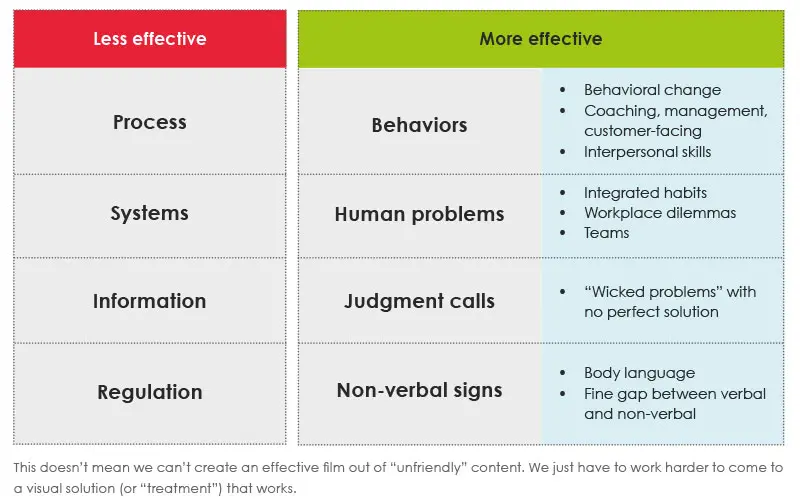
At its best, learning dramas (scripted stories that have actors in them) touch the viewer like no other medium. They can engage and stimulate minds and emotions in profound and long-lasting ways. Drama’s major strength lies in its ability to show behaviors—human beings in all their complexity, with recognizable flaws, problems, and ambitions. When behaviors are rendered truthfully and with an understanding of the audience’s culture, a sort of transference takes place. The viewer places themselves in the shoes of the characters they’re watching. And this promotes engagement in much more than facts or principles.

With dramas, we should aim to present identifiable dilemmas that people find difficult to resolve. That’s the shortest version of a learning video’s most important maxim.

Learning dramas are most effective when based on particular types of source material that features behavioral challenges:

Here are six drama video formats that you could use:

1) Linear Narratives

These are stories that are told “in a straight line.” In other words, from beginning to end and unbroken. They are relatively rare within learning initiatives. However, they can be incredibly effective in building a convincing set of characters, a clear context, and an ever-increasing sense of tension and drama. This format tends to be naturalistic, and seeks to convey your workplace and the work done within it as accurately as possible.

Linear narrative video works best for content that is:

  • Difficult to pin down in terms of “right” or “wrong” (e.g. judgment calls)
  • Highly behavioral in nature (e.g. “Why do we break the rules when we know them perfectly well?”)

2) Branching Scenarios

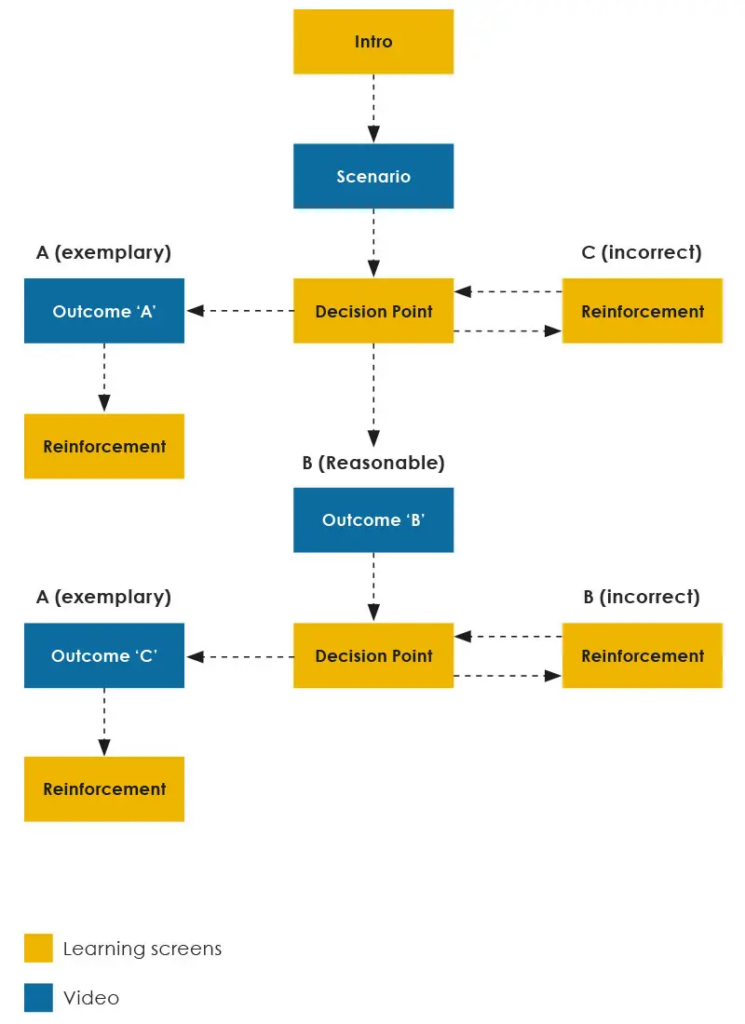
Perhaps the most popular dramatic form in learning at the moment is what’s often referred to as branching drama or branching scenarios. The structure shown above allows learners to make decisions that affect the narrative. They get to see the consequences of their decision-making in a tailored experience. Branching dramas can be designed hand-in-hand with the overall modular learning design so that the learning experience is seamless and the learning as effective as it can be.

Each branching drama project is shaped from scratch. Sometimes the source material contains a high level of complexity, so the structure diagram would need more branches and a greater number of variables. It’s possible to work with simpler branches than the one shown here—a right and wrong path, followed by feedback.

This branching structure would work best for content that:

  • Is heavy on consequences
  • Has a clear binary right/wrong axis

3) Narrated Story Sequences

Narrated stories can easily be neglected in discussions about format. They can be highly effective as well as quick to create and inexpensive in comparison to other styles. That’s because they allow for a greater volume of footage to be shot in a day, as audio recording/actors speaking aren’t a concern.

Narrated stories involve a voice being played over the footage, describing the background to the action, or the inner thoughts of the characters. This encourages a narrative to be thoughtful and reflective.

It works well for material that:

  • Is innately sensitive or reflective
  • Requires the learning to pick through issues carefully

4) Non-Naturalistic Snapshot Films

Sometimes learning is best affected by caricature. Showing your learners an over-the-top example of how something should (or more commonly should NOT) be done, is a popular approach. This format tends not to have a believable physical setting. It can be shot against a plain backdrop or in a neutral-looking space.

It works best when:

  • Most learners are familiar with the learning point and simply need clarification or a refresher
  • A straightforward judgment call is required

5) Disrupted Timeline

Rather than going “beginning-middle-end”, these narratives can run as “end-beginning-middle”. This allows us to show the end-result of a set of actions upfront, then examine how that outcome came about.

This can create a narrative hook in the viewer—especially where the initial scene is particularly impactful—that can focus minds and provide a dramatic context for the learner’s thinking as they watch.

6) Right Way/Wrong Way Sequences

This is another popular format. Learners are asked to watch a particular key task or behavior being done badly and then asked to identify what went wrong, why it went wrong, and how things might have been done better. They then see the same situation with the same characters, but this time the task is carried out perfectly.

Documentary: A Non-Fiction Format

And then there’s the non-fiction documentary. Something of a catch-all term, documentary can take many forms—from a formal interview with a CEO to a voiced-over presentation created with stock footage. There’s a wide range of options in between, including advertorial comms pieces, case studies, and product explainers.

Videos showing complex physical processes tend to be particularly effective here—for example, the various tasks on an assembly line. This can be made clear quickly and precisely when filmed.

The documentary format gives context and authenticity to your messaging, and this can be vital. The British Army, for example, usually prefers documentary to drama video as it feels non-soldiers are easily spotted by those taking the training, and this could reduce the authenticity of their videos.

As with dramas, non-fiction formats are varied:

  • Interviews with cutaways
  • Case studies
  • Product explainers
  • Vox-pops
  • Advertorial
  • Mixed-media presentations

With documentary videos, there’s a stronger case for starting with a blank page. While it’s possible to create any of the formats listed above, it’s more effective to create a blend of these that fits the precise needs of the project. Documentary products can include combinations of different formats—for example, stock footage with voice-over and animated elements, or vox-pops with case study-style B-roll footage.

Should We Consider Emerging Formats?

These days, there’s a glut of new visual media technology that offer the opportunity to work in innovative formats such as 360-degree film, augmented reality (AR), and virtual reality (VR). While these formats can be eye-catching and offer something new and exciting to your learners, there are potential pitfalls. If you’re considering using cutting-edge technology, it’s wise to consider:

  • The full cost of implementation – do you have budgets for enough headsets, for example?
  • Learning efficacy – does the technology you’re looking at deliver the function you’ve defined?
  • Appetite for something new – will your employees welcome innovation in learning?

These innovative technologies can have a narrow use in a learning context. For example, a 360-degree video headset experience might be very effective for hazard-spotting or replicating a specific physical environment, but outside of that, it’s probably no more effective than conventional video. It’s worth asking yourself: “What is your ROI on new technologies? Can the same thing be done as effectively for a lower cost?”

Factor in some R&D time before you commission a product involving new technology as there can be any number of hidden barriers to adoption.

A Final Word About Different Types of Video eLearning

Video can be a fantastic resource for your ongoing learning strategy. Whether you’re seeking to make use of video as part of a blended learning program, one-off training, or front and center in your latest learning initiative, it’s always important to go in fully prepared. Among the many kinds of drama, non-fiction, and emerging types of video eLearning, we hope you’ve found something that resonates with your needs and can help you create a more engaging learning experience.

About the Authors

Frank McCabe

Get in touch.

Learn more about our talent transformation solutions.

Transformation doesn’t happen overnight if you’re doing it right. We continuously deliver measurable outcomes and help you stay the course – choose the right partner for your journey.

Our suite of offerings include:

  • Managed Learning Services
  • Learning Content Design & Development
  • Consulting
  • AI Readiness, Integration, & Support
  • Leadership & Inclusion Training
  • Technical Training
  • Learning Technologies & Implementation
  • Off-the-Shelf Training Courses


A Mission-Critical Approach to Planning to Expect the Unexpected

2020 has brought unprecedented business disruption in a remarkably short period of time. COVID’s complete shutdown of markets, social unrest, and disruptive cyber-attacks have left business leaders spinning. Looking ahead, we are facing a tsunami of real and possible events: multiyear global pandemic, continued aftermath of BREXIT, the escalated trade war with China, conflict with Iran, cyber security threats, ongoing social unrest, contentious elections, and of course, the climate crisis.

We all remember the pain of the dot-com bust, 9/11, and the 2008 great recession that punished our economy for years, but those were individual events that occurred over multiple quarters. What we are facing now is rapid-fire, with no periods of rest. To survive these simultaneous shocks, business leaders need to adopt a mission-critical approach to management and remain ready for each new and inevitable shock.

As was famously written in Sun Tzu’s The Art of War, “the general who wins the battle makes many calculations in his temple before the battle is fought. The general who loses makes but few calculations beforehand.” We know the battle is coming and we know that it will be challenging. Now is the time to calculate our next steps and prepare for the battles ahead.

Step 1: Expect the Unexpected

Planning starts with identifying the signs of shifting circumstances. In the elite forces of the military, all ranks are trained to “expect the unexpected” by spotting these shifts early. When on watch, a guard scans the landscape over and over in search of any changes or disruptions. Often, these are as subtle as a change in the pattern of leaves on a bush or tree. The guard isn’t expecting to see an individual but rather the barely imperceptible shift they cause in their surroundings.

In business, knowing and studying your competitors to identify signs of their market shifts is critical to your survival. If markets shrink, you must capture additional market share. To do that, you must identify and react to your competitors’ market moves. By looking for a break in competitive patterns, you can identify opportunities earlier and plan proactively.

This competitive positioning will not only help you survive a downturn, but will also position you well for accelerated growth when recovery begins.

Step 2: Identify Risk and Rehearse Reactions

Given the onslaught of recent events, it’s not enough to prepare against the known environment. Through operational rehearsal, or war-gaming, the military uncovers risks and consequences and builds contingency plans to prepare teams to react effectively and decisively during any crisis. Operational rehearsal is active, engaged, and thorough. Teams work to:

  • Understand the Inherent Risks by examining the operating environment, including government, market, and competitive forces and how they interact.
  • Test Plans by creating challenges against the environment and competition to experience how they might respond.
  • Build Confidence by taking teams through every possible scenario and outcome.
  • Align Teams at all levels and across all divisions.

Businesses that leverage operational rehearsal can identify, plan, and react. Just as important, the exercise also challenges rooted mindsets and changes outcomes. Through war-gaming, individuals are given freedom to test their worst fears; teams learn to anticipate strategic shocks and trauma, creating a clear competitive advantage. The next crisis is met with confidence as teams have been trained to expect the unexpected.

Step 3: Capture Crisi-tunity

After identifying risks and calculating outcomes, the planning continues on the ground, as each unique event requires adopting OODA protocol (Observe, Orient, Decide, and Act) in times of crisis. Elite military forces landing in an unknown situation leverage OODA as a situation analysis methodology to force teams to efficiently examine if the macro environment is holding up the way they thought it would, orient themselves to the actual conditions, determine the best course of action, and execute.

Planning to Expect the Unexpected

Every event has an impact on business, whether it is as significant as a national election or as seemingly workaday as a competitor introducing a new product. There are always winners who are poised to benefit and losers who are sometimes decimated. What separates the two is preparedness: the anticipation and planning for rapid response when an event occurs.

Most organizations can create positive business outcomes when things are going their way, but only the extraordinary ones prepared to capitalize on adverse situations are able survive the shocks and rise to the top of their industry.

About the Authors

Damian McKinney
After an 18-year global career with the UK Royal Marine Commandos, where he earned the rank of Lieutenant Colonel by the age of 35, Damian McKinney entered the private sector. He discovered that the Royal Marines’ Special Forces approach to challenging and complex military operations was directly relatable and transferable to the business world. In 1999, he founded the company McKinney Rogers to fulfill his passion for tackling “real operational challenges” under severe pressure to deliver the mission every time. Over the last 20 years, he has built a global organization with offices on every subcontinent dedicated to delivering tangible and sustainable results for companies including Diageo (in partnership with investor TPG Capital), Grohe Lixil, Pfizer, Thomson Reuters, Upfield (in partnership with parent KKR), and Walmart. McKinney Rogers was acquired by GP Strategies in January 2017, where Damian continues to operate and grow the McKinney Rogers practice.

Get in touch.

Learn more about our talent transformation solutions.

Transformation doesn’t happen overnight if you’re doing it right. We continuously deliver measurable outcomes and help you stay the course – choose the right partner for your journey.

Our suite of offerings include:

  • Managed Learning Services
  • Learning Content Design & Development
  • Consulting
  • AI Readiness, Integration, & Support
  • Leadership & Inclusion Training
  • Technical Training
  • Learning Technologies & Implementation
  • Off-the-Shelf Training Courses


Digital Transformation: The Necessary Shift in Organizational Change Management

Traditional OCM becomes agile

As enterprises mature on their digital transformation journey, they evolve from structured hierarchies to agile teams. This necessitates a move from traditional OCM to an approach that stands ready to face conflict and failure, which are both acceptable and inevitable. Gartner defines this evolved OCM approach as “organizational fluidity.”

Change leaders in fluid organizations must allocate time for examining and reshaping goals as teams and the business mature. To drive success, leaders may also want to set aside time for teams to practice operating more effectively together. Newly integrated teams will experience smoother handoffs when their roles are well-defined and when they are able to anticipate rough patches. Anticipation doesn’t necessarily result in elimination of difficult situations, but rather knowing how to work through them with minimal repercussions. Finally, think of what is learned from experiencing challenges in the workplace. Change leaders should plan for and facilitate forums where teams can talk about their failures, and then share and document best practices.

Personal analogy

As an adult, I learned to ride a horse. I’m in decent shape for my age but had previously only been on horseback as a teenager at summer camp. Horseback riding has been a journey—one that I chose, of course, but a journey that I will compare to the experience of a front-line worker who is personally impacted by a digital transformation initiative. At first, my experience riding a horse combined excitement (anticipation of a brand-new activity) and nervousness (will I fall/fail?), with some discomfort (I know I can do this but boy, are my muscles sore). Over time as my confidence and competence increase, I receive coaching in the proper body position, which allows me to more effectively communicate with my horse. Through practice, I demonstrate improved posture and communication with my horse, so we graduate to more advanced challenges such as navigating bending versus straight lines, trotting over poles, and then higher jumps. Yes, I’ve fallen off, but in the process, I’m learning how to anticipate and possibly avoid future falls. My horse and I are becoming a more agile team.

Meanwhile, back at work …

A digital transformation demands that we communicate differently within our teams as well as up, down, and across the organization. If we are vague or hesitant, our intent won’t be conveyed, and decision-making by our colleagues will be being negatively impacted. Change leaders in digitally transforming organizations must coach each role on their relationships to others, and then define and practice the types of clear communication that are necessary to achieve success through desired business outcomes.

We hope you found our series on digital transformation relevant, and we invite you to join the conversation by leaving your comments below.

About the Authors

Ellen Kumar
Ms. Kumar is a Solution Architect with GP Strategies, and has served in roles ranging from Account Executive, to Operations Director, to Project Manager/Training Consultant. Prior to GP Strategies, she worked for University of Dayton Research Institute and GE Aircraft Engines (now GE Aerospace). She holds an M.S. in Materials Science & Engineering from University of Dayton.

Get in touch.

Learn more about our talent transformation solutions.

Transformation doesn’t happen overnight if you’re doing it right. We continuously deliver measurable outcomes and help you stay the course – choose the right partner for your journey.

Our suite of offerings include:

  • Managed Learning Services
  • Learning Content Design & Development
  • Consulting
  • AI Readiness, Integration, & Support
  • Leadership & Inclusion Training
  • Technical Training
  • Learning Technologies & Implementation
  • Off-the-Shelf Training Courses


Gone in a Flash: Converting Outdated Technology Before 2020 Ends

Once a ubiquitous app for animation and interaction—and now considered a security risk—Adobe Flash will see its last day on December 31, 2020. In fact, many browsers have already disabled it, with HTML5 taking its place.

Flash has been a valuable tool in the learning industry, giving our online courses movement and interest that increased engagement. But at the end of the year, all those Flash-based elements will cease to operate, rendering unconverted courses inoperable. Compounding the situation, there are no tools to automate the remediation process that also deliver effective learning, so conversion will look different in every organization.

So if you still have Flash content in your library, what do you do?

Four steps to converting Flash courses to HTML5 before 2020 ends.

GP Strategies has helped many organizations convert thousands of hours of learning and moved their content libraries through Flash conversion with a four-step process:

  • Step 1—Assess your current state. Review your existing portfolio of Flash courses and determine which to eliminate, which to convert, and which to transform. Confirm your access to the source code of the courses. Do you have just the published files, or do you have the source files? This will become an important feature of your conversion journey.
  • Step 2—Prioritize your courses. You can’t transition everything at once, so prioritize which courses you will convert and transform first.
  • Step 3—Develop a conversion plan. Implement a conversion strategy that meets your needs based on schedule, budget, user requirements, business strategy, and maintenance plans.
  • Step 4—Convert your courses. Apply the appropriate conversion method for each course, conduct testing across required devices, and ensure a successful implementation in your LMS.

While you’re converting, consider these best practices.

The end of Flash can trigger the beginning of something new for your learning organization. While rationalizing Flash courses, you can inventory and retire outdated courses from your entire library. Here are some best practices to keep in mind while the conversion is in progress:

  • Develop a mobile strategy that guides priorities and a content strategy that guides development.
  • Consider incorporating new modalities or instructional strategies that can increase engagement and retention, such as chatbots, microlearning, and modern learning approaches.
  • Plan for mobile learning needs with a responsive design course structure and navigation. This can always be implemented during a Phase 2 approach if you are constrained with time or budget.
  • Incorporate leading strategies that optimize the learner experience and make the conversion process seamless.

The clock is ticking. Convert your courses now.

We are all finding our new normal with COVID-19, and distributed workplaces are more commonplace than ever, which in turn places even more emphasis on your online learning assets. Now is the time to consider new modalities and strategies to move your learning organization forward. And if you still have Flash courses to convert, all is not lost. GP Strategies can help you modernize your portfolio and guide you into the future of virtual learning.

About the Authors

Brenda Finora
As the Senior Director of Learning Services, Brenda has over 21 years of experience in architecting and supporting custom learning and technology solutions for varied industries. She supports business operations within the GP Learning Solutions Group. Overseeing project executions, Brenda strives to ensure the company attains performance results and creates long-lasting relationships with clients. She enjoys working with various teams and seeing ideas come to life through the process of training development. Brenda believes there is nothing better than hearing clients say “I love it” as they see their vision become tangible products that solve business problems. She is excited to work for a company that values teamwork, creativity, and a focus on creating “raving fans.” GP Strategies’ teams are the cornerstone for cultivating high-performing learners. To Brenda, this philosophy allows the company to shine among the landscape of training and learning solutions organizations. Brenda earned an MA in Policy and Leadership from the University of South Florida, an MA in Counseling from the University of South Florida, and a BS from the University of Florida. In addition, she is a certified Project Management Professional (PMP) and Lean Six Sigma Yellow Belt.

Get in touch.

Learn more about our talent transformation solutions.

Transformation doesn’t happen overnight if you’re doing it right. We continuously deliver measurable outcomes and help you stay the course – choose the right partner for your journey.

Our suite of offerings include:

  • Managed Learning Services
  • Learning Content Design & Development
  • Consulting
  • AI Readiness, Integration, & Support
  • Leadership & Inclusion Training
  • Technical Training
  • Learning Technologies & Implementation
  • Off-the-Shelf Training Courses


How Remote Monitoring Provided Easy Access to Data and Notification of Equipment Anomalies During the COVID Disruption

During the COVID-19 pandemic, we’ve been asked the same questions many times – how have our Monitoring & Diagnostics (M&D) staff adapted to a work-at-home environment? How are we able to maintain our workload? What changes have we made?

The answer is simple: We have not changed. Not even in the slightest. We have maintained 100% effectiveness, and possibly extended visibility by a small percentage. How is this possible?

With the infrastructure already in place, we were fully prepared to move to a remote work environment at a moment’s notice. Our software and services solutions have always been focused around three aspects:

  • Accessibility
  • Visibility
  • Optimization

Secure connections through VPN services and a robust and optimized monitoring system were already in place. And because we are already working remotely for our customers across the world, we had established a flexible schedule that continued seamlessly.

Through cloud-hosted platforms and secure connections, GP Strategies‘ M&D staff can access customers’ EtaPRO systems in just a few minutes at a moment’s notice. The global asset interface highlights abnormal conditions on critical equipment, allowing for focused efforts on prioritized items. This process is supplemented by advanced trending features, automated reporting and alerting, logging, and a fully integrated tracking system for issue management. EtaPRO has provided:

  • The ability to focus efforts where they matter
  • A stable and reliable network infrastructure
  • Optimized monitoring system configuration

Not every plant is equipped with an optimized monitoring system, and maybe not every plant needs one. What every plant does need, however, is accessible data and a platform to prioritize this data. Even at acceptable failure rates, there is always room for improvement. If a pump bearing failure occurred abruptly and symptoms were apparent 2 weeks prior, there is room for improvement. If a condenser was running high for 3 weeks due to low circulating water flow because it went unnoticed, there is room for improvement.

Catching just a few issues early can quickly recover investment costs in a stable monitoring infrastructure by reducing downtime, preventing untimely failure, identifying performance losses early, and maintaining accurate instrumentation.

For more information on how you can implement a remote Monitoring and Diagnostic program to optimize the performance of your people, assets, and facilities, contact us.

About the Authors

GP Strategies Corporation
GP Strategies is a global performance improvement solutions provider of sales and technical training, e-Learning solutions, management consulting and engineering services. GP Strategies' solutions improve the effectiveness of organizations by delivering innovative and superior training, consulting and business improvement services, customized to meet the specific needs of its clients. Clients include Fortune 500 companies, manufacturing, process and energy industries, and other commercial and government customers.

Get in touch.

Learn more about our talent transformation solutions.

Transformation doesn’t happen overnight if you’re doing it right. We continuously deliver measurable outcomes and help you stay the course – choose the right partner for your journey.

Our suite of offerings include:

  • Managed Learning Services
  • Learning Content Design & Development
  • Consulting
  • AI Readiness, Integration, & Support
  • Leadership & Inclusion Training
  • Technical Training
  • Learning Technologies & Implementation
  • Off-the-Shelf Training Courses


Top 10 Keys to Success in Organizational Change Management (OCM)

Understanding Organizational Change Management (OCM) 

Organizations and their employees today are experiencing change on an unprecedented scale. As advances in technology and other market pressures continue to drive large-scale change, companies face the prospect of adapting to new ways of working or falling hopelessly behind. Given this environment, it sometimes surprises me to hear comments from customers that seem to show a lack of understanding for managing the people side of organizational change management.  

Some of the complaints I have heard in early conversations with customers as they consider change management services a part of a large, complex systems implementation or overall business transformation include: 

  • “We don’t need change management here.”  
  • “It’s too soft and mushy.”  
  • “I don’t see the value.”  

Even after purchasing services and landing consultants on the ground, I often hear questions like, “When I hire outside consultants to support my initiatives, what should I expect from them?” or “I have a few consultants onboard, and I don’t see anything tangible from what they are doing!”  

This is understandable if the consultants are not engaged in value-added efforts. It is less understandable when these comments stem from a lack of knowledge about change management or the desire to focus solely on the “tangible” parts of change, like technology and the aspiration for immediate results. 

The Importance and Benefits of OCM

In all this confusion about what iOCM is and what it is not, businesses stand to lose progress on key growth strategies while the success of vital strategic initiatives hangs in the balance. So, before we get started, let us quickly align on a basic OCM meaning. 

In the HBR article, “Leading Change: Why Transformation Efforts Fail,” John Kotter shares that the basic goal of change management is “to make fundamental change in how business is conducted in order to help cope with a new, more challenging market environment.” Kotter also shares an important benefit: “Your org flexes with tectonic shifts in competitors, markets, and tech—leaving rivals far behind.”  

Who doesn’t want to achieve that level of adaptability? According to recent data, “93% of projects with excellent change management met or exceeded project objectives, compared to 15% with poor change management.” The key phrase here is “excellent change management.” If you’re looking to drive similar results in your next initiative, it is important to create the right plan. Here are ten tips that can help improve your OCM efforts. 

Top 10 Tips for Achieving Success in OCM

1. Embrace a People-First Focus & Journey Mindset

  • Understand that without mobilizing your people effectively, no transformation or systems implementation will be successful. If this is not a strength of senior leadership or embedded in the organizational culture, get help in spreading this message. This will help build trust, a much-needed component of change success. 
  • Change does NOT happen overnight. It is a journey, but one that should begin as early as possible. Change is also a process, which is comprised of many different stages that cannot be skipped. Be wary of shortcuts. They may seem enticing at first, but they will ultimately slow down the pace of your change initiative. 

2. Communicate a Sense of Urgency 

  • Life coach and author Tony Robbins has said that “Change happens when the pain of staying the same is greater than the pain of change.”  This concept should serve as a guiding principle for your leaders.  
  • People need the motivation to get out of their comfort zones, so one key to success is making sure Urgency = High & Intense. Creating a sense of urgency helps drive awareness and desire. Remember, that while urgency is not difficult to create when business is bad, it can be harder to impart a sense of urgency when things are already going well.  
  • Plan for the fact that it is hard to get people to change, especially in organizations that have experienced a number of leaders who have failed to produce change outcomes. 

3. Set Visionary Direction

  • When setting visionary direction, it is important to capture the hearts and minds of your team members. The vision and direction need to be powerful and clear—part art and part science, or “analytical thinking and a little dreaming” as Kotter puts it. This vision should be a clear story that you can communicate to someone in five minutes or less. Think of it as an elevator pitch. You should be able to explain the vision and direction to a colleague during a short elevator ride. 
  • Once you set the direction, you must ensure that employee behaviors align with your goals at each level of the organization. Nothing undermines change more than a lack of integrity when leaders do not walk the talk. 
  • Creating and communicating a strong vision will help both teams and individuals drive awareness throughout the organization and aid in breaking down resistance. 

4. Align Your Leaders

  • According to Kotter, organizations often fail by not creating a powerful enough “guiding coalition” of leaders. 
  • A high sense of urgency may assist you in developing this coalition. 
  • The coalition of leaders must have a shared commitment to helping achieve the outcomes the change is intended to produce. 

5. Build a Culture of Trust

  • In his presentation First Why, Then Trust, Simon Sinek noted that “when we’re surrounded by people who believe what we believe, something remarkable happens: Trust emerges….Trust comes from a sense of common values and beliefs.” 
  • Studies have shown that many individuals cite breach of trust as the main reason for leaving their jobs. 
  • For workers, getting out of their comfort zones is highly dependent on their ability to trust others within the organization. 

6. Create Effective Teamwork

  • Many leaders, especially those used to working in silos, often have a poor record of working together on teams. If left unaddressed, this can pose a serious threat to success. 
  • Applying the time, effort, and focus necessary to build the memory muscle around teams across the organization is crucial to success. 

7. Offer Continuous Communication 

  • Without effective, constant communication, gaining commitment to change will be nearly impossible, so prioritize communication in your change efforts accordingly. 
  • Pay close attention to the appropriateness of the communications and the degree to which they focus on “what,” “why,” “how,” and “What’s in it for me?” (WIIFM). Create an effective feedback loop and evaluate your communication methods. 
  • Use all current channels and experiment with new, creative channels such as text alerts. 

8. Mitigate Your Risks 

  • Another definition of OCM change management is “a systematic process that mitigates risks and leverages change as a resource to create success” (from the HBR article, “Managing Risks: A New Framework,” by Robert S. Kaplan and Anette Mikes). 
  • An effective change management program will help mitigate risk and can be “sold” with this understanding. 
  • Feedback loops from communications and change agent networks help reduce risk. 

9. Build Commitment Rather Than Compliance 

  • When employees are committed to the change, they are ready, willing, and able to make the change a success. They will seek continuous improvement opportunities. 
  • If workers have not been involved in the process and are complying simply out of obligation, the result is a lack of willingness to help solve problems and make the system better. This jeopardizes the organization’s ability to sustain the new system and processes.  
  • Communications plays a key role in driving commitment. 
  • Capability development, training, super-user network, and end-user adoption needs must be addressed. 
  • Process and other change impacts must be understood and communicated. 

10. Implement Change in Your Corporate Culture

  • Change is a journey, not a destination. 
  • Celebrate success by calling out quick wins throughout the journey. Recognizing both individuals and the team is important for morale and momentum. 
  • Reinforcement is critical for sustainment. 

Key Components for Successful Change Management

Successfully implementing organizational change management requires a strategic approach focused on clear communication, leadership alignment, and a strong emphasis on employee engagement. By adhering to these top ten keys for success, organizations can navigate the complexities of change more effectively, mitigate risks, and ensure a smoother transition with better outcomes. 

Are you preparing an upcoming technology implementation or other large-scale initiative? Our change management consulting experts can help you overcome resistance and lead organizational change by aligning your leaders, your initiatives, and your workforce.  

About the Authors

Kimberly Kemp
Kimberly Kemp works as a human performance technologist who helps clients to solve their business problems. Kim currently serves in a business development role with responsibility for managing some of GP Strategies' most strategic accounts. As Strategic Account Manager, Kimberly is responsible for developing, fostering, and growing strategic business relationships with business leaders by guiding and recommending approaches to execute business strategies and initiatives. Kimberly functions as the customer contact and advocate building a deep understanding of each customer’s strategic direction, identifying and shaping customer requirements, developing a winning strategy, while teaming across GP Strategies. In previous roles, Kim has provided oversight to project teams that implemented global learning strategies, change management, and performance improvement solutions designed to accelerate the comprehension and use of complex technology, improve the chances of initiative success, and improve the performance of front line workers. Ms. Kemp has helped clients implement such solutions in the consumer products, manufacturing, government, communications and pharmaceutical industries.Prior to working with GP Strategies, Ms. Kemp was a Chinese-Mandarin Language Translator and Instructor for the United States Army. She completed the Air Education and Training Command’s instructor training and practicum and performed the duties of a National Security Agency, National Cryptologic School Adjunct Faculty member. Kim is also a member of the IT Senior Management Forum, the only national organization dedicated exclusively to fostering upper-level executive talent among African-American IT professionals.

Get in touch.

Learn more about our talent transformation solutions.

Transformation doesn’t happen overnight if you’re doing it right. We continuously deliver measurable outcomes and help you stay the course – choose the right partner for your journey.

Our suite of offerings include:

  • Managed Learning Services
  • Learning Content Design & Development
  • Consulting
  • AI Readiness, Integration, & Support
  • Leadership & Inclusion Training
  • Technical Training
  • Learning Technologies & Implementation
  • Off-the-Shelf Training Courses


Advice for Implementing SuccessFactors Onboarding 2.0 From a Professionally Certified Onboarding Expert

Nearly 3 years have elapsed since I wrote my last article on Onboarding 2.0: SuccessFactors: All aboard with ONB2018 – a simplified HR Onboarding experience! It covers solution capabilities and provides a comparison with the legacy version and the presumptive roadmap. Since then, a lot has happened to the Onboarding module: SAP came out with an official roadmap, selected pilot customers to implement the module, and made the solution generally available (Q4 2019). As for me, I have successfully implemented the Onboarding 2.0 (ONB2.0) solution for one of my customers that happened to be an early adopter. Once it was available, we immediately started off on the big bang implementation, giving me the opportunity to work on the solution design and configuration with detailed insights into Onboarding 2.0.

Having worked on this version for an early adopter and having done several implementations of the legacy version of Onboarding, I write this article to share some of my learning and advice for those considering implementing ONB2.0.

What is Onboarding 2.0?

In a nutshell, ONB2.0 is the new version of the SuccessFactors Onboarding solution, which was built to utilize existing SuccessFactors tools, including Role-Based Permissions, Business Rules, and the Employee Central (EC) data model. This design avoids redundancy in the implementation and maintenance, thus simplifying usability and allowing a seamless, unified experience for users across the SuccessFactors suite.

To learn more about the new Onboarding 2.0 features and a comparison with legacy Onboarding 1.0, read one of my previous blogs, SuccessFactors: All aboard with ONB2018 – a simplified HR Onboarding experience, or check out this article by my colleagues at GP Strategies.

Highlights of Onboarding 2.0

Some of the major improvements over the legacy Onboarding 1.0 (ONB1.0):

  • Provides better tracking of onboarding status, helping hiring managers and HR administrators to get a better overview of the in-process and overdue tasks they are responsible for
  • Supports mass processing of onboarding tasks and assists in completing the onboarding tasks for multiple onboardees at once, saving more time
  • Allows different onboarding tasks to be assigned to different responsible groups. This means IT tasks can be assigned to the responsible IT person/group and the Buddy assignment can be done by the manager.
  • Comes with an improved mobile-responsive user interface (UI)

Experience From My Recent Implementation

Because it is a new solution and this implementation was among the first, the solution posed several challenges, including a high number of “bugs” or defects and outdated documentation. The team reported a number of these defects, and SAP was keen in understanding and code fixing, as needed. Our great partnership with SAP played an important role in addressing these hindrances, making sure the project timelines were intact.

As often expected from a new solution in the market, Onboarding 2.0 does come with some limitations. There were challenges meeting some requirements, which are specified later in this article. Despite the limitations, we were still able to meet most of the critical requirements, build a satisfying solution that was easy to use, and effectively automated some of their manual processes.

I would not say configuration is simpler than the older version, as some part of configuration includes more steps than earlier. For example, one of the main tasks was creating fields/objects and presenting them in custom UI involving several steps, which is time consuming, than creating fields and UI planes in legacy version. ONB 2.0 has, however, simplified the need for double maintenance of user records, permissions, corporate structure, and its data.

If you have implemented ONB1.0 previously, the experience will help you in designing the processes, but the steps and tools involved in configuring the ONB2.0 solution are completely different from ONB1.0.

There is no doubt that Onboarding 2.0 is a better investment and user experience than the legacy version. It is more appealing and easy to use and maintain.

Implementation Advice

Onboarding 2.0 presents an opportunity to give a first impression about your processes and systems to new hires. Hence, it is important to, as needed, reimagine your processes with the above in mind.

  • A golden rule is to keep it simple, and use standard features and processes wherever possible.
  • Because ONB2.0 heavily uses the Employee Central data model and tools, it is especially important that customers have the right people from their EC/Master Data team participate in ONB2.0 implementation. Data models and business rules must be updated, and special care must be taken to ensure that these changes in EC do not impact downstream systems.

Note: Consultants working in ONB2.0 are required to have EC knowledge. SAP has recently also made it mandatory for consultants working on an ONB2.0 project to be certified in EC, effective 14 September 2020.

  • EC must be configured first.

Note: Since the 2020 1H release, EC is no longer a prerequisite for Onboarding 2.0, but a miniature version of the EC system must be set up.

  • If EC is live and hire/rehire criteria is defined in Manage Data, then the rehire process in onboarding must be configured. If not, you risk losing the hire record in the Onboarding module.
  • Creative and attractive homepage tiles for posting company policy documents or sharing information and videos can go a long way in marketing company culture and making that good first impression.
  • The new Email Services feature gives an excellent opportunity to change the default layout of system emails. With the help of HTML tags, you can create appealing and branded emails.
  • Prior to implementing Onboarding 2.0, we advise customers to take an inventory of all onboarding forms across locations and languages. Invest time to update, simplify, and combine company forms as needed.
  • Keep an eye out for the biannual releases, or have your technology partner manage them for you, as they bring some great enhancements that you can take advantage of during the implementation.
  • Go beyond the onboarding experience, and explore cross-boarding for internal hires and offboarding to make that last impression.
  • For customers considering an upgrade from ONB1.0 to ONB2.0, go in with an open mind and consider this a fresh implementation project and not just a release upgrade. ONB2.0 is in fact an entirely new product with near complete process mapping and enhancements over ONB1.0.

Limitations in 2.0: What needs to improve?

While Onboarding 2.0 is a quite robust solution, it does come with its limitations, bringing our role as experienced consultants to the forefront. A few limitations that I have experienced are listed below.

  • Onboarding processes come with predefined steps that you can use but does not allow custom additional steps. For example, if you want a step for a hiring manger to review the data and another step for a recruiter to add further information, then it is currently not supported.
  • While the Schedule Meeting feature allows managers to schedule some important onboarding meetings, there is no direct integration to a calendar tool like Outlook.
  • No approval workflow can be associated with equipment tasks, unlike in ONB1.0.
  • No support is available for delegating tasks to someone other than the preconfigured responsible participants. Even when the Checklist tasks allow you to specify a delegate, the task does not actually notify the delegated user or appear in their To-do task list.
  • Email services do not support the flexibility and customization that existed in ONB1.0. ONB2.0 has preconfigured email templates, with limited standard tokens and triggers. While we can personalize the texts and create custom email notifications, we cannot create custom tokens and triggers, limiting our choices on when in the process they are triggered. An example is generating notifications for IT equipment.
  • 0 reporting is with People Analytics, which is much more mature and advanced compared to the basic reporting in ONB1.0, but standard reports are not yet available.

These are some of the limitations that I found within the solution, but they are all possibilities for SAP to enhance later.

Need to migrate from ONB1.0 to ONB2.0?

SAP has not yet rolled out an automated migration tool for the transition from the legacy to the new solution. In their roadmap, SAP has stated that selected migration tools for customers who would like to move from ONB1.0 to ONB2.0 will be available in Q4 2021. This means customers will either have to wait or start implementing a new build to replace. Documentation available from SAP suggests that when it’s available, the tool might not be able to transfer 100% of the configuration depending on the complexity of the current solution. The legacy version is not expected to see many developments as in ONB2.0. For these reasons, it is an opportunity to start a fresh implementation and to revisit and improve the current processes.

Functionality parity is currently not provided on U.S. and Canadian forms. A workaround for this, as suggested by SAP, is to use a hybrid deployment of both ONB1.0 and ONB2.0 until the time that this is supported by the new solution. However, I do not suggest this approach, as it adds complexity and compromises user experience to a partial set of users.

If you are currently trying to decide if or how to migrate to ONB2.0, GP Strategies offers a gap analysis for ONB 2.0 to investigate and discuss your options. We will assess your current solution design and post our best advice to you. Having an updated Onboarding 1.0 implementation workbook is essential to this exercise.

Looking to implement Onboarding 2.0?

If you are considering implementing or upgrading to Onboarding 2.0, feel free to contact us. We, at GP Strategies, are a team of expert professionals ready to support your transformation journey. We have experience performing multiple Onboarding 2.0 implementations, and this experience makes us best suited to assist you with your onboarding technology.

I hope you enjoyed reading and found this informative. Do share your feedback in the comments below.

About the Authors

Harsha Vernekar
Harsha is a Senior Consultant with GP Strategies. She has led several successful SuccessFactors implementations and supported multiple clients with a focus on Onboarding, Recruiting Management, and Recruiting Marketing. Her clients come from a variety of industries including pharmaceutical, retail, manufacturing, food and beverage and technology. She has worked with both the legacy and current SAP SuccessFactors Onboarding product as a Lead Consultant. Among her credentials she holds Professional Certification in SuccessFactors Onboarding.

Get in touch.

Learn more about our talent transformation solutions.

Transformation doesn’t happen overnight if you’re doing it right. We continuously deliver measurable outcomes and help you stay the course – choose the right partner for your journey.

Our suite of offerings include:

  • Managed Learning Services
  • Learning Content Design & Development
  • Consulting
  • AI Readiness, Integration, & Support
  • Leadership & Inclusion Training
  • Technical Training
  • Learning Technologies & Implementation
  • Off-the-Shelf Training Courses