Harness the Power of Unlearning

Change is happening at an exponential rate. Volatility, Uncertainty, Complexity, and Ambiguity (VUCA)—a term introduced by the military in 1987—has become our status quo. A shift in demographics within the labor market, rapid urbanization in developing countries, economic power shifts, technological evolution, the push for globalization, and now the new reality of COVID-19 are changing the fundamental nature of the way humans work.

Our lives, as we knew it, shifted overnight. From work, school, socialization, or shopping—our in-person reality changed to a virtual reality. Our economy has shifted and business models have pivoted to survival mode. Amid the confusion and chaos, in order to adapt to the change, we are having to quickly relearn much of what is common and familiar to us both personally and professionally. We are experiencing agility and adaptability in its truest and most beautiful form, much of which can be attributed to our ability to learn and relearn. But in order to successfully relearn, we must be willing to unlearn what is no longer relevant or existent. So, what is unlearning and how does it happen?

What Is Unlearning?

The simplest definition of unlearning is to overwrite or discard something from our mind. Unlearning involves the giving up or abandonment of knowledge, actions, or behaviors. Unlearning is not about forgetting, it is about the ability to choose an alternative mental model or paradigm.

When we learn, we add new skills or knowledge to what we already know. Mostly likely you have experienced unlearning without realizing it. Each time you start a new job, you need to unlearn the dynamics and environment of your former job and relearn them in the context of your new organization. When you travel to a foreign country, you are quickly unlearning and relearning local customs or laws. Luckily, countries like the UK recognize this can be a challenge for some and are gracious enough to remind us at every corner to look left before we cross the street. Or think about every time you get a new mobile device or smartphone—there is always an unlearning curve and relearning curve as you navigate the new device, upgrade, or enhancement that replaces an existing function or feature. You adapt to the situation and establish a new mental model in accordance with the need.

Unlearning isn’t just for us. Organizations go through the process of unlearning as business models shift—much like we are seeing right now with auto manufacturers producing ventilators and safety gear, fast-food franchises leveraging their supply chain to deliver school lunches, and beer manufacturers producing hand sanitizer.

Unlearning Is the Foundation of Lifelong Learning

Harnessing the ability to unlearn is the foundation of lifelong learning. Experts estimate that up to 40 percent of what tertiary students are learning will be obsolete a decade from now when they will be working in jobs that have yet to be created. Undeniably, the top 10 most in-demand jobs today didn’t even exist 10 years ago. Change in the business environment is continuous, and the ability of people to be agile and respond accordingly is the optimum solution.

Abandon the commonly held notion that learning is for children and young adults. You graduate from high school, get a university degree, and consider yourself done with education. In the past, this may have been sufficient to land and keep a great job until you retire. The concept of being a learner has shifted. The concept of learn, do, retire ceased to exist years ago. To be agile and adaptable, you need to learn, unlearn, and relearn. This is the cycle of a lifelong learner.

Modern careers are like nonstop conveyor belts—you need to keep moving and learning no matter what stage of your career you are in. Being content is a mindset that puts us at risk. Consider how quickly industry, business, and technology evolve—this is how our employees get left behind. Instilling lifelong learning ensures talent remains agile, adaptable, and ready to fill the next organizational gap.

In our current situation, unlearning paves the way for current and future success.

The Three Steps of Unlearning

The process of unlearning has three steps.

First, you need to acknowledge that the old mental model has become obsolete or no longer relevant. This step is the most difficult of all, especially in our current environment. The acknowledgement of change can trigger grief for what is no longer—and for us, much of what we knew will require unlearning from travel to socialization to the way we work. Businesses are also recognizing their operating models are no longer relevant and need to pivot.

As we establish habits and behaviors, we start acting involuntarily and it makes us unconscious of our mental models; moreover, people tend to ignore the fact that their habit, skill, or knowledge has become irrelevant. Acknowledging lapses in mental models can even trigger fear of losing our jobs, reputation, and career. To overcome this fear, stay open to new ideas and have a growth-oriented mindset.

Our mindset is a set of assumptions and it varies from person to person. There are two distinct types of mindsets: growth mindset and fixed mindset (as established by American psychologist Carol Dweck). People with fixed mindsets believe that their aptitude, character, and creativity are static fundamentals that they cannot change in any meaningful way. They consider success to be an assessment of those inherent attributes, an assessment of how those given attributes measure up against a standard, and they focus on avoiding failure at all costs because failure deprives them of the sense of being smart or skilled.

On the other hand, people with growth mindsets tend to thrive on challenges. They see failure not as a measure of unintelligence or being empty-headed, but as an impetus for growth and learning new abilities. If you have a fixed mindset, you would not be able to even identify the areas where you are lacking. Having a growth mindset is necessary for unlearning, relearning, and learning.

Second, identify or create a new model or plan of action that helps you achieve the unlearning goal. For example, think of a software engineer who has mastered one coding language—soon, he will find that the market has evolved, and there is a new language trending. If he ignores the trend and keeps his focus on that one language, his knowledge becomes obsolete. The engineer will need to develop a plan of action to unlearn, or evolve, his current skill set to include a new programming language.

Remember that this process of unlearning and then identifying an alternative will lead you to self-actualization. People undergoing this process usually end up realizing their true potential. According to Maslow’s hierarchy of needs, self-actualization is the highest level of psychological development and it occurs when you maximize your potential. This realization of true self helps people embrace the unknown and find motivation in their growth.

Once you’ve identified the “problem” and “solution,” focus on the last and the most important step: ingraining the new habits. You might find it easier to fall back to your old habits, but if you focus on creating milestones and have S.M.A.R.T.—specific, measurable, attainable, realistic, and time-based goals—you will see your habits changing. When you focus on the new model and flood your routine with newly designed actions, the process of learning something new consumes you and makes the old actions you wanted to unlearn extinct. Practicing unlearning will make it easier for you to be adaptable and your brain will become tuned to adjust with the changes. The ability of the brain to change continuously throughout our lives is referred to as neuroplasticity by doctors and psychologists. As we learn how to unlearn, our brain becomes elastic. It develops new neural connections, recognizes new stimuli, and starts acting accordingly.

We often use the phrase “it’s like riding a bike” when describing something that is ingrained in our memories and becomes instinctual. But what happens when you try to unlearn something as common as riding a bike? How does your brain react and just how difficult is it to unlearn and relearn how to ride a bike? Engineer Destin Sandlin sets out to explore these questions by changing one feature of how the bike operates to test how his brain reacts (or doesn’t react). Check out his TedEd video to see unlearning and relearning in action.

Unlearning Is the Future

As we are seeing today with the global response to COVID-19, our ability to adapt to change is imperative for survival. The most successful companies and employees will be the ones who learn, unlearn, and relearn. Computers, artificial intelligence systems, robotics, and other machines are easily programmed to unlearn and relearn through coding—human workers need to do the same to stay relevant.

About the Authors

Keith Keating
With a career spanning over 20 years in learning & development, Keith Keating holds a Master’s Degree in Leadership and has experience in a myriad of areas ranging from Instructional Design, Leadership Coaching, Operations Management, and Process Transformation. More recently Keith has been leading clients on the development and execution of their global learning strategies. Regardless of the role, at the heart of everything Keith does centers around problem solving. He studied Design Thinking at MIT’s Sloan School of Management and found Design Thinking was a perfect tool to add to his problem solving "toolkit". Since then, Keith has been utilizing Design Thinking to help clients tap into understanding and resolving unmet customer needs.

Get in touch.

Learn more about our talent transformation solutions.

Transformation doesn’t happen overnight if you’re doing it right. We continuously deliver measurable outcomes and help you stay the course – choose the right partner for your journey.

Our suite of offerings include:

  • Managed Learning Services
  • Learning Content Design & Development
  • Consulting
  • AI Readiness, Integration, & Support
  • Leadership & Inclusion Training
  • Technical Training
  • Learning Technologies & Implementation
  • Off-the-Shelf Training Courses


8 Truths to Shape Your Success

I’ve spent the better part of the year talking and writing about resilience, personal and organizational engagement strategies, and future-proofing your career in an up-ended world. Recently, however, I’ve been drawn to the thought leadership about managing professional growth that I was introduced to more than two decades ago.

I think these tenets for personal professional development have held up well, and I’m sharing them here, with minimal commentary, to fuel your search for more great days at work:

  1. You have primary responsibility for your job satisfaction and success. Luck may play a role. Managers and colleagues can support you or undermine you. But no one can “make” you engaged. Roll up your sleeves, figure out what’s important to you, and do the hard work.
  2. Your current position offers the best, most immediate opportunities for growth, achievement, and fulfillment at work. Don’t wait for what’s next. Your career is happening now. As your employer pivots in response to the global pandemic, look for ways to be a hero – or at least to add more value. It’s time to dust off your Growth Mindset and put it to work.
  3. Your personal values are the fuel for your growth and leadership. The key word here is fuel. Your values are your motivators, the guideposts you use to make decisions. They contribute to your authenticity as a leader. If you don’t know what’s important to you, it’s time for you to sit on a metaphorical mountain top and figure it out.
  4. Building on strengths is the fastest route to success. Buck Blessing, one of the greats in the workforce transformation space before it was called that, once said: “If you focus only on development needs, you’ll die a very average person.” Be like Buck. Fix career liabilities and use your strengths to become a star!
  5. You can’t do it alone. Constructive, continuous dialogue with your manager makes the difference. You may own your success, but your manager is uniquely positioned to help you connect what you want with what the organization needs. Managers, alas, aren’t mind readers. Go tell yours what you’re thinking about. Enlist their support. Offer ideas.
  6. Feedback is an essential ingredient of remarkable accomplishments. If you don’t know what to stop, start, or continue doing to get better you won’t be able to change. Ask people for feedback. This gets easier with practice. While you’re at it, give the gift of feedback to help others become more successful!
  7. Nothing happens unless you take action. Action demands a plan and the courage to carry it out. What’s the worst that can happen? Really? Take that first step. And the next. Shift direction if you need to. Keep going.  
  8. Your organization’s success depends on the expertise, thinking, and efforts of engaged individuals like you. As clichéd as it may sound, it is a win-win proposition. Discover and align what matters to you with what the organization needs. Involve others. Make your work work for you… and for your employer.

You can learn more about Managing Professional Growth (MPG®), our flagship engagement and development process, here.

About the Authors

Mary Ann Masarech
Mary Ann Masarech spent the first third of her career writing, designing, and marketing skills training for top-notch consulting firms. She acquired a broad Mary Ann is the Lead Consultant for GP Strategies’ Engagement Practice. In this role, she leverages her extensive experience with instructional design and client experience to create practical tools and strategies that clients apply worldwide to create successful businesses and thriving workplaces. She is also co-author of The Engagement Equation: Leadership Strategies for an Inspired Workforce (Wiley, Oct 2012), and a founding member of the Norma Pfriem Urban Outreach Initiatives, a not-for-profit that addresses food insecurity and education for underserved adults and children. Mary Ann is a graduate of Wesleyan University. 

Get in touch.

Learn more about our talent transformation solutions.

Transformation doesn’t happen overnight if you’re doing it right. We continuously deliver measurable outcomes and help you stay the course – choose the right partner for your journey.

Our suite of offerings include:

  • Managed Learning Services
  • Learning Content Design & Development
  • Consulting
  • AI Readiness, Integration, & Support
  • Leadership & Inclusion Training
  • Technical Training
  • Learning Technologies & Implementation
  • Off-the-Shelf Training Courses


What 2020 can TEACH us about Leadership…and Life

Turn the page on 2020. Leave it behind. It’s tempting to do. Millions of individuals worldwide have been infected. Thousands of lives lost. A healthcare system strained to the breaking point. Economies in tatters–job loss, small businesses shuttered, families struggling to pay rent or pay for food. Reminders of the systemic presence of racial injustice that have amplified conversations and action, but have also caused additional racial trauma for so many.

It’s hard to find the positives, the light, the path forward. We talk about resiliency–but resiliency implies a bouncing back to where we were and where we can’t go back. Too much has changed. Our eyes have been opened to our collective vulnerability–to our impact on each other physically, psychologically, emotionally, and economically. We need to reimagine what our world is going to be like as we start to take tentative steps into 2021 with hope.

But before we can leave behind a year that has taken so much away from us, we need to understand what this year has given us. We’ve gained lessons about leadership and new perspectives on Trust, Empowerment, Accountability, Community, and Humanity. What did 2020 TEACH us?

  • Trust – 2020 reminded us how important trust is to all relationships including those between leaders and their teams. Employees have looked to their leaders, during this year of great uncertainty, and asked them to be transparent in their communication and interactions, even when the news wasn’t always good. They’ve asked them to be reliable by showing up regularly and helping them overcome new challenges. And they’ve looked to them to be selfless and understanding to the personal challenges brought about by home schooled children, social isolation, increased fear, and anxiety. More than ever, leaders have shown up authentically for their people and expressed their own vulnerabilities during a time when no one was immune to stress and strain. Transparency, reliability, authenticity, selflessness–key elements of trust that 2020 has illuminated as being important to a trusting relationship. Teachable moment: Leadership is less about follow up, more about trust. The more trust you give, the more your people will trust you as a leader.
  • Empowerment – The immediate pivot to alternate approaches to working shifted the paradigm of the leader-employee relationship. This was not a year of leaders bestowing empowerment on others, but of employees making decisions and taking actions of their own accord because they simply knew what needed to get done. Without immediate physical access to leaders and colleagues, and with the need to respond quickly, employees answered client calls, delivered products, or innovated in some way to get the job done. Empowerment is about feeling that you can make decisions and take action without asking permission–in 2020 employees “just did it” and demonstrated that they know what is required to be successful. Teachable moment: Continue to give power away–let your employees make decisions and support them.
  • Accountability – This year amplified accountability in its many layers. Virtual teams became the norm and leaders realized that just because they couldn’t see their teams working it didn’t mean it wasn’t happening. Productivity and engagement of employees remained constant despite alternate ways of working. People proved they could get-it-done and be accountable for their contributions. On a larger scale, accountability has been amplified in the areas of diversity, equity, and inclusion. There is greater awareness for the fact that conversations on DE&I aren’t enough. Organizations, leaders, and employees need to move beyond conversations–they need to be accountable for taking actions consistent with creating a culture of inclusivity. Changing policies, looking at hiring and other practices, and sharing power are just some of the ways accountability around DE&I has flourished. Teachable moment: Focus on actions that produce desired outcomes more so than physical proximity or words.
  • Community – 2020 simultaneously wrecked and bolstered community. What it took away in the form of human contact, in the form of physical proximity, it gave back in spirit. This year reminded leaders and their people that their groups are more than teams of workers–they are a community of individuals who support, share, and need each other to thrive. Community was reinforced in the creative ways people found to connect with each other socially–through Zoom Happy Hours, socially distanced gatherings or through the personal conversations that have increasingly marked the start of meetings and conversations across the globe. Community emerged in the shared purpose employees felt in meeting customer needs despite obstacles. And it was perhaps most pronounced in the frontline and healthcare workers who put their lives on the line to serve their communities. Teachable moment: Community is a more powerful motivator than taskkeep it alive on your teams.
  • Humanity – Thank you, 2020, for reminding us that we are not the center of the universe. Even the best of leaders can’t control everything. We are human beings who fail, who get sick, who care about each other, who lift each other up, and who need each other. 2020 taught us everything about empathy–putting ourselves in other people’s shoes emotionally and cognitively. That doesn’t need to change with the arrival of a vaccine. We will continue to be human beings who will struggle and succeed. The more we can seek to understand the unique experiences of our colleagues, the more connected we will be. It is that shared humanity that reminds us that together we can achieve anything. Teachable moment: Connecting with each other as human beings shouldn’t end with a vaccine. Empathy should be a #2021goal.

2020 is a wasted year–but only if we let it be. There are things this year can teach us that we can carry forward to grow a better world, organization, leader, employee, and human being. Trust, empowerment, accountability, community, and humanity–let’s do more than rebound, let’s take these lessons forward and emerge a little stronger and also a little kinder.

About the Authors

Leah Clark
Leah Clark is the Leadership Practice Lead at GP Strategies, as well as an author and the founder of LeaderConnect. With over 28 years of experience in her field, Leah brings a unique perspective on the mindsets and skillset that are critical to leadership success to her coaching and consulting. Her clients benefit from her collaborative approach to crafting a well-connected and thoughtful leadership development strategy. Leah holds a Master of Arts; Organizational Psychology, Columbia University and a Bachelor of Arts; English and Sociology, Boston College.

Get in touch.

Learn more about our talent transformation solutions.

Transformation doesn’t happen overnight if you’re doing it right. We continuously deliver measurable outcomes and help you stay the course – choose the right partner for your journey.

Our suite of offerings include:

  • Managed Learning Services
  • Learning Content Design & Development
  • Consulting
  • AI Readiness, Integration, & Support
  • Leadership & Inclusion Training
  • Technical Training
  • Learning Technologies & Implementation
  • Off-the-Shelf Training Courses


Blended Learning’s New Definition

Blended learning as a concept has been around for over twenty years. However, with the rise of digital transformation, the concept has evolved.

What is blended learning? How has it changed? First, let’s talk about what it used to be.

The Traditional Definition of Blended Learning

Blended learning is a strategy to provide learning content with a mix of delivery modalities to achieve a learning program’s goal. By definition, blended learning can be effective assuming you are leveraging the strengths of each modality.

A blended learning program blends one or more of the following modalities:

  • Instructor-Led Training (ILT)
  • Web-Based Training (WBT)
  • Video
  • Job Aid
  • eLearning Module
  • iPDF
  • Virtual Instructor-Led Training (VILT)
  • Infographic
  • Tabletop Exercise

For example, a blended program could include a short WBT primer, followed by a one-day, highly interactive ILT session. Once back in the field, the learning and support is augmented with some job-aids and on-the-job coaching. From a legacy perspective, traditional blended learning is strictly a sum of its parts–each individual component is a discrete element mixed with other discrete elements.

With the disruption of digital transformation, we need to evolve the definition of blended learning to reflect the increasing complexity and efficacy of modern learning journeys.

The New Definition of Blended Learning for the Digital Learning Journey

The new approach to blended learning moves from a collection of discrete elements to a whole experience that is more than a sum of its parts. The learner is one of the most important components. And a key feature of a digital learning journey is the ability of the learner to take control of the experience–achieving a relevant learning experience.

This short clip is from a presentation I delivered for Chief Learning Officer Magazine where I discuss this concept a bit more, imagining blended learning as a tossed salad compared to a smoothie.

Blended Learning’s New Definition for the Digital Learning Journey

Blended Learning Journeys

When we’ve implemented these programs, we’ve seen increases to learner engagement, improved retention, better completion rates, and improved performance across the organization.

Here is a simple example of blended learning developed as a digital blended learning journey.

What’s critical is how the components come together to create a truly integrated and engaging experience. By focusing on user experience, data analytics, new disciplines, new design components, and the concept of negative space in learning, blended learning can be a strategy to elevate learning programs.

More from Matt

This is a section from Matt’s webinar The CLOs Guide to a Modern Learning Technology Ecosystem, featured in Chief Learning Officer Magazine.

For similar videos, check out our YouTube channel playlist featuring the learning technology ecosystemlearning skills of the future, and more.

About the Authors

Matt Donovan
Chief Learning & Innovation Officer
Early in life, I found that I had a natural curiosity that not only led to a passion for learning and sharing with others, but it also got me into trouble. Although not a bad kid, I often found overly structured classrooms a challenge. I could be a bit disruptive as I would explore the content and activities in a manner that made sense to me. I found that classes and teachers that nurtured a personalized approach really resonated with me, while those that did not were demotivating and affected my relationship with the content. Too often, the conversation would come to a head where the teacher would ask, “Why can’t you learn it this way?” I would push back with, “Why can’t you teach it in a variety of ways?” The only path for success was when I would deconstruct and reconstruct the lessons in a meaningful way for myself. I would say that this early experience has shaped my career. I have been blessed with a range of opportunities to work with innovative organizations that advocate for the learner, endeavor to deliver relevance, and look to bend technology to further these goals. For example, while working at Unext.com, I had the opportunity to experience over 3,000 hours of “learnability” testing on my blended learning designs. I could see for my own eyes how learners would react to my designs and how they made meaning of it. Learners asked two common questions: Is it relevant to me? Is it authentic? Through observations of and conversations with learners, I began to sharpen my skills and designed for inclusion and relevance rather than control. This lesson has served me well. In our industry, we have become overly focused on the volume and arrangement of content, instead of its value. Not surprising—content is static and easier to define. Value (relevance), on the other hand, is fluid and much harder to describe. The real insight is that you can’t really design relevance; you can only design the environment or systems that promote it. Relevance ultimately is in the eye of the learner—not the designer. So, this is why, when asked for an elevator pitch, I share my passion of being an advocate for the learner and a warrior for relevance.

Get in touch.

Learn more about our talent transformation solutions.

Transformation doesn’t happen overnight if you’re doing it right. We continuously deliver measurable outcomes and help you stay the course – choose the right partner for your journey.

Our suite of offerings include:

  • Managed Learning Services
  • Learning Content Design & Development
  • Consulting
  • AI Readiness, Integration, & Support
  • Leadership & Inclusion Training
  • Technical Training
  • Learning Technologies & Implementation
  • Off-the-Shelf Training Courses


Nova Definição do Blended Learning

A aprendizagem blended ou mista, como conceito, existe há mais de vinte anos. No entanto, com o surgimento da transformação digital, este conceito evoluiu.

O que é o blended learning? Como isso mudou? Primeiro, vamos falar sobre o que costumava ser.

A definição tradicional de Blended Learning

O blended learning é uma estratégia para fornecer conteúdo de aprendizagem com uma combinação de modalidades de entrega para alcançar o objetivo de um programa de aprendizagem. Por definição, o blended learning pode ser eficaz, supondo que você esteja aproveitando os pontos fortes de cada modalidade.

Um programa de aprendizagem combinada combina uma ou mais das seguintes modalidades:

  • Treinamento Liderado por Instrutor (ILT) – presenciais
  • E-learning ou Treinamento baseado na web (WBT)
  • Video
  • Job Aid
  • eLearning Module
  • iPDF
  • Treinamento Virtual Conduzido por Instrutor (VILT)
  • Infográfico
  • Atividades Práticas

Por exemplo, um blended learning pode incluir um pequeno WBT, seguido por uma sessão de ILT altamente interativa de um dia. Uma vez de volta ao “campo”, o aprendizado e o suporte são complementados com alguns job aids e coaching no trabalho. De uma perspectiva legada, o blended learning tradicional é estritamente uma soma de suas partes – cada componente individual é um elemento distinto misturado com outros elementos distintos.

Com a interrupção da transformação digital, precisamos desenvolver a definição de blended learning para refletir a complexidade e eficácia crescentes das jornadas de aprendizagem modernas.

A nova definição de blended learning para a Jornada de Aprendizagem Digital

A nova abordagem do blended learning passa de uma coleção de elementos discretos para uma experiência completa que é mais do que a soma de suas partes. O aluno é um dos componentes mais importantes. E uma característica principal de uma jornada de aprendizagem digital é a capacidade do aluno de assumir o controle da experiência alcançando uma aprendizagem relevante.

Esta é uma breve apresentação que fiz para a Chief Learning Officer Magazine, onde discuto esse conceito um pouco mais, imaginando o aprendizado combinado como uma salada em comparação com um smoothie.

Blended Learning’s New Definition for the Digital Learning Journey

Jornada Blended Learning

Quando implementamos esses programas, vimos aumentos no envolvimento do aluno, melhor retenção, melhores taxas de conclusão e melhor desempenho em toda a organização.

Aqui está um exemplo simples de um blended learning desenvolvido.

O ponto crítico é como os componentes se unem para criar uma experiência verdadeiramente integrada e envolvente. Ao focar na experiência do aluno, análise de dados, novas disciplinas, novos componentes de design e o conceito de espaço negativo no aprendizado, o blended learning pode ser uma estratégia para elevar os programas de aprendizagem.


More from Matt

This is a section from Matt’s webinar The CLOs Guide to a Modern Learning Technology Ecosystem, featured in Chief Learning Officer Magazine.

About the Authors

Matt Donovan
Chief Learning & Innovation Officer
Early in life, I found that I had a natural curiosity that not only led to a passion for learning and sharing with others, but it also got me into trouble. Although not a bad kid, I often found overly structured classrooms a challenge. I could be a bit disruptive as I would explore the content and activities in a manner that made sense to me. I found that classes and teachers that nurtured a personalized approach really resonated with me, while those that did not were demotivating and affected my relationship with the content. Too often, the conversation would come to a head where the teacher would ask, “Why can’t you learn it this way?” I would push back with, “Why can’t you teach it in a variety of ways?” The only path for success was when I would deconstruct and reconstruct the lessons in a meaningful way for myself. I would say that this early experience has shaped my career. I have been blessed with a range of opportunities to work with innovative organizations that advocate for the learner, endeavor to deliver relevance, and look to bend technology to further these goals. For example, while working at Unext.com, I had the opportunity to experience over 3,000 hours of “learnability” testing on my blended learning designs. I could see for my own eyes how learners would react to my designs and how they made meaning of it. Learners asked two common questions: Is it relevant to me? Is it authentic? Through observations of and conversations with learners, I began to sharpen my skills and designed for inclusion and relevance rather than control. This lesson has served me well. In our industry, we have become overly focused on the volume and arrangement of content, instead of its value. Not surprising—content is static and easier to define. Value (relevance), on the other hand, is fluid and much harder to describe. The real insight is that you can’t really design relevance; you can only design the environment or systems that promote it. Relevance ultimately is in the eye of the learner—not the designer. So, this is why, when asked for an elevator pitch, I share my passion of being an advocate for the learner and a warrior for relevance.

Get in touch.

Learn more about our talent transformation solutions.

Transformation doesn’t happen overnight if you’re doing it right. We continuously deliver measurable outcomes and help you stay the course – choose the right partner for your journey.

Our suite of offerings include:

  • Managed Learning Services
  • Learning Content Design & Development
  • Consulting
  • AI Readiness, Integration, & Support
  • Leadership & Inclusion Training
  • Technical Training
  • Learning Technologies & Implementation
  • Off-the-Shelf Training Courses


3 Key Ways to Adapt Your Learning and Measurement Strategies in 2021

This blog article was written prior to LEO Learning becoming part of GP Strategies.

Shifting to virtual learning has been a reality for all organizations this year. So as we look to the ‘next normal’, what key capabilities do we as L&D professionals need to focus on building?

We’ve all learned by now that a one-size-fits-all approach doesn’t work, and we can’t simply translate live, in-person, or event-based training directly into the online world. And the same is true with online facilitation. When it comes to transforming face-to-face trainers into virtual facilitators, and as we adapt our learning design to the new experiences and needs of our learners, there are a number of ways we can expand and adjust our best practices.

1) Prioritize Empathetic Learning Design

As the world of work continues to change, a key focus of capability building is adapting our learning design to meet the needs of our learners in their changed environments. In the same way we would make use of break-out groups, social interactions and informal chats in coffee breaks in face-to-face sessions, it’s important to also make space for these in virtual sessions. 

But there’s more to it than giving everyone five minutes every hour on the hour to stretch their legs – though mind you, this is really important.

Our learners are no longer in the same space; we can’t expect them to have the same requirements. Everything from wavering internet connections to being distracted by the people they live with, facilitators need to be prepared to deal with faltering engagement that they wouldn’t encounter in-person. This comes down to empathetic design and delivery.

So, how can we be more empathetic in our design for virtual learning?

Be Understanding of Mental Wellbeing

A great example comes from a global financial services organization we work with that is adapting its leadership training to suit virtual delivery. Leadership teams there work under extreme time pressure generally. They come into these sessions in a state of heightened anxiety or stress.

So the organization introduced mindfulness and breathing exercises into the start of every session. Taking only five minutes out of the agenda, these breathing exercises created a clean break from any stress the participants are coming from. It adds a physical element to the session and enables the leaders to step into the session. These mindfulness moments enable the leaders to feel more relaxed, engaged, and ready to participate in the session ahead.

Be Mindful of Lives Outside of Work and Learning

Empathy in design can be simpler than including breathing exercises into sessions. At its core, it focuses on accommodating your learners’ particular needs. And caring for their mental health and overall well-being is part of that. For example, accommodating the need that some people may have to leave the call for various reasons, need to turn off their cameras, or go on mute to sort something out is a basic design consideration.

It’s important to be open about this flexibility at the beginning of the session. Put clear boundaries in place, and let your learners know what the process is for that—for example dropping a quick message in the chat if you need to pop out for a few minutes. You might also need to accept that your lesson plan may need to be shorter. You probably won’t get everything done that you would ideally want to, but that is because you are now working to the learners’ environment – not the other way around.

2) The Importance of Storytelling in Virtual Learning

Storytelling is a powerful tool for learning in any environment as our brains are naturally wired to learn through story. However, as many of us are working at a distance, stories become an increasingly important tool for emotional and intellectual engagement and connection.

Sharing Your Own Stories

We believe that it’s important to focus on authentic stories. This could be, for example, amusing anecdotes from within the organization, like the tale of a particularly awkward client meeting from years ago. Allowing others to learn from your experiences, especially if you can package it up in humor, can be incredibly valuable.

On top of this, sharing stories from your own career and experiences can help your audience open up and become more engaged in the learning. If they feel like they know you a little bit better, they’re more likely to relax into the session.

User-Generated Content

This authenticity can also come from User Generated Content (UGC), in the form of short videos, blog posts, or anecdotes shared into your learning system or even in the session itself. Focusing on authenticity in this way keeps your storytelling more relevant to your learners.

User-generated content can be a great way to increase engagement with your learning and encourage learners to invest time in the lessons beyond the virtual sessions you’re delivering.

Knowledge-sharing through stories can be an incredibly powerful tool. It brings people closer together and increases social engagement. Even better, people gravitate towards it anyway. Encouraging knowledge-sharing through UGC just formalizes the process and extends the reach beyond one-on-one conversations.

3) Measuring the Impact of Learning

When we asked the webinar audience how 2020 has impacted their learning measurement strategies, 52% said they were maintaining it and 26% said theirs had improved. This is fantastic news in what has been an incredibly challenging year.

At the other end of the scale, 21% said that it had been put on the back burner. This is completely understandable in light of competing priorities and many L&D departments facing budget restrictions.

However, as we move forward, measuring the business impact of learning needs to become a key capability for L&D.

Measurement Beyond Data

Learning measurement has changed over the last couple of years.

While proving learning ROI is important and hard data is a big part of that, for us, it’s often about collecting stories. In other words, capturing thoughts and experiences through surveys, polls, open questions, and anecdotes. Saving these stories and seeking them from managers in other departments can be a great way to gain executive buy-in if you lack the technology to luxuriate in vast quantities of data.

Testimonials and quotes from colleagues and management across your organization can be extremely valuable. Of course, the ideal situation is to have advanced learning analytics and perhaps a Learning Record Store (LRS) as a centralized focus for your data. But if you don’t have this, or are looking for buy-in for it, these stories can act as important evidence for the worth of your learning initiatives.

About the Authors

Patrick Thomas

Get in touch.

Learn more about our talent transformation solutions.

Transformation doesn’t happen overnight if you’re doing it right. We continuously deliver measurable outcomes and help you stay the course – choose the right partner for your journey.

Our suite of offerings include:

  • Managed Learning Services
  • Learning Content Design & Development
  • Consulting
  • AI Readiness, Integration, & Support
  • Leadership & Inclusion Training
  • Technical Training
  • Learning Technologies & Implementation
  • Off-the-Shelf Training Courses


5 Tips for Building an Effective and Engaging Digital Learning Academy

This blog article was written prior to LEO Learning becoming part of GP Strategies. 

What Is a Digital Learning Academy?

Digital learning academies can fall under a number of names. You may have heard them described as hubs or portals, for example. They focus on a specific learning initiative or strategic need within an organization. A popular example of these includes leadership academies.

Here are some common traits of digital learning academies:

  • Are well-known learning initiatives within an organization
  • Focus on a specific learning initiative
  • Deliver multiple programs and learning pathways
  • Deliver multimodal learning
  • May include content curated from outside your organization

Next, we’ll look at tips for building the perfect digital learning academy.

1) Define Your Purpose Early

One of the most important features of a digital learning academy is the clear focus and direction of the learning.

Clearly defining your purpose allows you to build a sustainable source of learning that you can manage effectively and strategically in the future.

Brand and consistency become incredibly important when curating external and internally created content. It’s vital to think about the impact of the academy and the results you wish to achieve. Academies are, after all, long-term investments. As your learning objectives and initiatives evolve, the academy and the content inside it should as well. You shouldn’t simply set up the curriculum and walk away—it’s an ongoing process.

2) Measure the Impact of Your Learning

Where a Learning Management System (LMS) may work as a catalog for your learning, a digital learning academy has a level of expectation surrounding it. With a single point of focus, measurement and reporting becomes even more important. 

With a specific learning intent in mind, this is where learning design and measurement become interlinked.

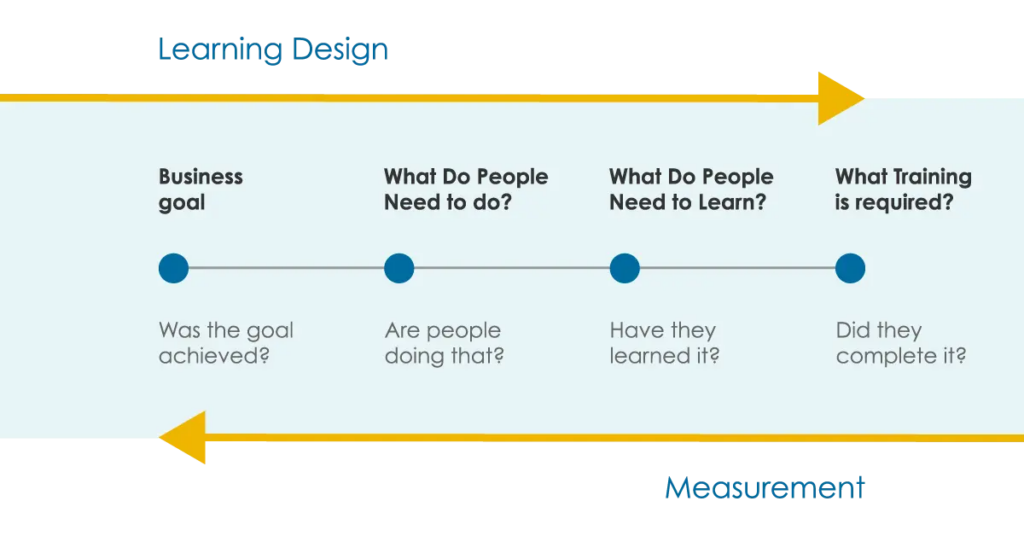
Learning design and your measurement strategy should work to complement each other. Good learning design starts with understanding your business goals to help determine the training required. A sound measurement strategy builds in the opposite way. 

Although metrics like completion rates may seem a little superficial, they’re important underpinnings to the wider measurement piece. With the correct logic and strategy in place for the learning design, these lower-level metrics gain more meaning than if you were measuring completion rates alone. These measurements become more relevant and useful in the wider context of your requirements and in the context of an academy itself.

The last two key measurement questions focus on behavioral change and goal achievement. Learning the information is one thing, but are your learners really transferring those skills into the workplace? If they are, how is this measured against organizational KPIs and goals? Any learning you design won’t be the sole reason for lasting behavioral change, but it will be a key component. It needs to be measured effectively.

3) Faculty and People Are Vital to Success

Digital learning academies are no longer simply about supplying learning content. The faculty involved and your Subject Matter Experts (SMEs) have never been more important. Just as your learning content and pathways need to be designed, so does your academy faculty.

A digital learning academy is the perfect place to drive best practice in learning. They are in place to drive a number of important behaviors including engagement, taking ownership of learning, and connection with the content.

The most important people for the success of your academy fall into three categories, each with their own roles.

Firstly, Governance:

  • Driving and ensuring relevance of content
  • Maintaining quality and creating guidelines
  • Encouraging innovation and growth
  • Marketing and communication
  • Reporting to the board

Secondly, Your Academy Faculty:

  • Presenting credibility and authority around key topics
  • Moving beyond training roles to become experts
  • Learning to be facilitators of digital/virtual learning
  • Editing and curating content
  • Supporting learners as much as delivering content
  • Developing into consulting roles

Finally, Your Champions:

  • Engaging others in learning
  • Leading by example
  • Mentoring and coaching other learners
  • Assisting with social marketing
  • Challenging academy content and strategy, working alongside the governance team

As you can see, each of these sets of people have vital roles to play in the success of your digital learning academy and these roles should be designed as carefully as the learning content.

4) Designing the Ideal Learning Experience

You can design and create the best content in the world, but if no one can find it, or they don’t hang around long enough to figure out how to, then it doesn’t matter. Your academy needs to deliver a great User Experience (UX).

You can optimize for UX through a few simple steps to keep users engaged and the content easily accessible:

  • Personalize the content where you can – creating profiles/logins is a great place to start. Collect basic data, for example, the department they work in, learning topics of interest, etc. 
  • Start with fewer options – don’t bombard your learners with access to everything at once. Begin by presenting a few options, like entries to new learning pathways or a “continue” button.
  • Prioritize user-friendly language – you shouldn’t be making them work to access the content they need or want. Regardless of their expertise, keep language simple and concise.
  • Create a sense of progress – milestones, progress bars, and completion percentages throughout both the learning and the system are a great way to keep learners motivated.

5) Your Alumni Are Key

When you’re building and refining a digital learning academy, your learners are your most important stakeholders. So your alumni (those who have already completed courses or entire programs within your academy) are the key to getting the word out and increasing engagement.

Your alumni can have a great level of influence on your learners. Word of mouth, social marketing, and shared experiences are great ways to get more learners enrolled in your academy and keep them engaged with the content.

It’s important to consistently drive and tell stories in your organization around what is working. And in order to maintain transparency and build trust, it can also be useful to communicate what isn’t working and provide feedback to the faculty involved in the academy.

About the Authors

Nic Price

Get in touch.

Learn more about our talent transformation solutions.

Transformation doesn’t happen overnight if you’re doing it right. We continuously deliver measurable outcomes and help you stay the course – choose the right partner for your journey.

Our suite of offerings include:

  • Managed Learning Services
  • Learning Content Design & Development
  • Consulting
  • AI Readiness, Integration, & Support
  • Leadership & Inclusion Training
  • Technical Training
  • Learning Technologies & Implementation
  • Off-the-Shelf Training Courses


The EU Whistleblowing Directive: 5 Tips for Delivering Effective Communications and Training Programs

This blog article was written prior to LEO Learning becoming part of GP Strategies.

There is a growing global trend towards the implementation of organizational-level whistleblowing (speaking up) policies and procedures. For some organizations, this is driven by external legislation or regulation, such as the EU Whistleblowing Protection Directive which comes into force at the end of 2021. For others, the drivers are more internal and are linked to organizational culture and operational resilience.

Whatever the drivers, to be effective, all whistleblowing policies and procedures must be communicated effectively. Indeed, some legislation and regulation specifically requires training programs to be delivered. The EU Whistleblowing Protection Directive, for example, includes a requirement for organizations to communicate their whistleblowing arrangements to their employees and to provide training on how to access internal reporting channels.

Engaging Learners on Three Levels

The most effective whistleblowing communication and training programs, like other conduct and behavioral change programs, engage learners on three levels: emotional, logical, and practical. At GP Strategies, we refer to this as ‘Heart, Head, and Hand’ engagement.

Heart: Engaging Learners Emotionally

Messaging here addresses aspects of organizational culture and may include:

  • Applicable aspects of the organization’s values, such as taking responsibility, being open, and listening to others
  • How whistleblowing protects stakeholders, including customers and colleagues
  • How whistleblowing helps the organization to learn from mistakes and put problems right quickly
  • The organization’s zero-tolerance towards retaliation or victimization of those who blow the whistle

Head: Engaging Learners Logically

Messaging here may include:

  • Who and what is covered by the policy, procedure, and any applicable legislation and regulation
  • Protections from retaliation
  • Confidentiality and anonymity
  • Available channels and how they work
  • What to do if you experience retaliation

Hand: Engaging Learners Practically

This aspect is best addressed through practical exercises or scenarios that enable learners to practice what they have learned in a safe environment and to experience what it ‘feels’ like to:

  • Identify a problem
  • Decide to report it
  • Address issues of confidentiality and anonymity
  • Choose a channel
  • Make a report
  • Give feedback
  • Identify retaliation
  • Take action against retaliation

The closer this experience is to an individual’s role, the better.

So far, so good. But anyone involved in drafting whistleblowing communications and training will know that the messaging can become very complex, very quickly.

Complex Messaging of Whistleblowing Training

The main source of this complexity is the relationship between legislation, regulation, and internal values, and culture. Each of these may, for example, contain different definitions of ‘wrongdoing’ and each may offer protections from retaliation in different circumstances.

This is a challenge for those organizations impacted by the EU Whistleblowing Protection Directive. For example, ‘wrongdoing’ under the EU Directive only covers breaches of specified EU-wide legislation, but the scope may be extended by local legislation. Internal policies may extend it further still.

This complexity is heightened for international organizations attempting to draft globally applicable content. Similar issues may arise in relation to provisions on anonymous reporting and feedback response times.

Whistleblowing or Speaking Up?

Earlier in the article, you will see that the phrase ‘speaking up’ has been used in parenthesis next to the word ‘whistleblowing’. I did this because the positioning of whistleblowing, together with the complexities described above, has led to the term being dropped by many organizations in favor of ‘speaking up’ or similar phrases.

This trend may also reflect a desire to move away from the negative connotations often associated with the term ‘whistleblowing’ in organizational settings.

So, to conclude, here are five tips for delivering effective communications and training programs on internal whistleblowing (speaking up) arrangements.

5 Top Tips for Creating Best-Practice Whistleblowing Training

1. Be Clear and Precise

This is particularly important in relation to fundamental concepts such as wrongdoing and the availability of legal protections

2. Be Holistic

Make it clear how your organizational culture and applicable regulations and legislation fit together.

3. Maximize Practical Engagement

Use practical exercises and scenarios where possible that enable your learners to experience your process from start to finish.

4. Tailor the Content

Use adaptive learning techniques to create tailored learner journeys. This may include uplift content, for example, for different jurisdictions, line managers, and those authorized to investigate or handle whistleblowing cases within your organization.

5. Consider a Campaign

Whistleblowing is an ideal subject for a learning campaign. Consider encouraging emotional engagement through a teaser campaign, posters, screensavers, and other assets outside of a digital learning course.

Are you looking for expert-led support on whistleblowing to support your organization’s learning goals? Our team is on hand to offer fully tailored support to match your needs. Get in touch today.

About the Authors

Renato Hoxha

Get in touch.

Learn more about our talent transformation solutions.

Transformation doesn’t happen overnight if you’re doing it right. We continuously deliver measurable outcomes and help you stay the course – choose the right partner for your journey.

Our suite of offerings include:

  • Managed Learning Services
  • Learning Content Design & Development
  • Consulting
  • AI Readiness, Integration, & Support
  • Leadership & Inclusion Training
  • Technical Training
  • Learning Technologies & Implementation
  • Off-the-Shelf Training Courses


Virtual Learning Delivery Tips: L&D Professionals Reveal What’s Working

This blog article was written prior to LEO Learning becoming part of GP Strategies.

Here are five ways virtual training delivery is working well, as revealed by our colleagues in a recent webinar.

1) Learning Design

We see the broad agreement that simply moving face-to-face instructor-led training (ILT) sessions online doesn’t work.

Virtual sessions need to be re-designed from the ground up. Our clients seem to fall into two distinct pools when it comes to designing whole-day or several-day training events for the online world:

  • Splitting up longer training into smaller sessions spanning several days or even weeks
  • Keeping to the same time, but adjusting the structure accordingly to maintain engagement across the day(s)

Some attendees suggested combining shorter live sessions with asynchronous online activities, such as breakout sessions and group projects. Others suggested creating online resources that learners can either work on or refer back to after the session to aid the transfer of learning into their work settings. Blends really support shorter virtual sessions.

Another key theme in the audience feedback was to focus on the content that really matters. Whether you’re facilitating an all-day session or a more staggered learning experience, your learners will have more distractions in their current working environments. Many suggested keeping the sessions tightly streamlined. Don’t try to cover too much content, and only select topics that are relevant to your audience (do not prioritize all of that “nice to have/good to know” content).

Attendees advocated strongly for increasing opportunities to interact and collaborate into their learning experiences. They suggested using WhatsApp groups to use before/after sessions to build the cohort or designing opportunities for roleplay and group projects. All of this can help to build a sense of community.

2) Learner Interaction

When you’re facilitating learning online, it can be difficult to pick up and measure engagement levels. This is where the tools you have at your disposal can work wonders. Building in thoughtful interactions is incredibly important.

No one will actively listen to someone drone on for an hour. Attention spans drop after 3-5 minutes.

When we asked our audience about this, the common theme in their suggestions was making the most of technology. One of the key suggestions, and something we advise our clients to do all the time, is to make use of more than one technology. So, switch between tools to keep people actively engaged and give them more to do as part of their learning. It can be a little awkward at first for the facilitator, but incredibly effective in engaging your virtual learners.

Some of the technologies and interaction opportunities suggested included:

  • Polls
  • Interactive slides
  • Quizzes (using your virtual learning platform or external apps)
  • Screen annotations from learners in real-time
  • Chat functionality
  • External chat channels like Slack or Whatsapp
  • Digital whiteboards

3) Collaborative Learning

Collaborative learning has been high on the priority list for many L&D professionals for quite a few years. While 2020 has brought many challenges, it has also brought a huge range of opportunities for greater collaboration. Given the right challenge and space in a virtual environment, learners are more likely to openly engage with others.

While learners are participating in a space that’s more familiar and comfortable to them, as many are working from home at the moment, there can be great opportunities for collaboration. However, virtual classrooms are intimate spaces that need to be created.

Collaboration works when people understand what’s required and trust others to work together. The wider community shared some nice tips for building this sense of space for collaboration.

Some of the suggestions from our audience included:

  • Ask people to share their experiences. Really listen.
  • Use small break-out groups with a low faculty-to-participant ratio
  • Create forums and open discussions pre-, during, and post-workshop/session to capture participant thoughts (this can also help you improve in future)
  • Convert materials from audience participation into eLearning and additional resources
  • Connection before content – understand that some learners need to be seen and heard during a session to get the most out of it

4) Facilitating Virtual Learning

Good facilitation skills matter online as much as they do in person. But online facilitation skills are distinct.

Alongside mastering the technology, the online facilitator must find ways to challenge learners while accommodating the likelihood that people will get distracted. They need to make space for the reflectors in the room whose lack of engagement can be misinterpreted as disinterest and bottle the excitement of the over-exuberant participant who can severely derail an online session.

Following some research, we’ve come up with a framework to help facilitators understand the different types of learners in an online environment. We call these the virtual learner archetypes.

Getting the most out of the learners online requires a deeper sense of empathy—and an acknowledgment that people are not in fixed states. The online facilitator needs a specific set of skills to navigate the virtual setting. Just as with face-to-face learning, the facilitators have a lot of influence over how interactive and collaborative the session is.

With active engagement more important than ever, we weren’t surprised to see the majority of the suggestions revolving around maintaining the human element of learning online. From keeping things light to being vulnerable as a facilitator, we had a huge range of suggestions from the audience.

Here are some of our favorite suggestions:

  • Keep your camera on and look into it rather than at your notes
  • Have a short informal chat before diving into the materials
  • Keep classes small – one participant suggested six people is the perfect number as you can still engage with each person
  • Share your own stories and experiences before asking anyone else to share theirs
  • Use the element of surprise – for example, change your background or switch up the format. One person suggested turning your camera upside-down (I need to try that one!)
  • Have a script to follow but don’t read from it – always maintain a connection with your learners

5) Comfort and Well-Being

Your job as an online facilitator is also to care for the wellbeing of your participants. They may be at home, but it’s likely that they will be spending the entire day staring into their computers. Simply giving people permission to take a break, walk away, and do their own thing allows people to recharge.

We often find that, as the facilitator, you need to give people the explicit direction to relax, and then they do. This is a must for sessions that last more than an hour or two.

All of the audience suggestions for looking after the well-being of their participants revolved around making time and space for learners to switch off and move around, with some suggesting adding in these breaks as frequently as every 20-40 minutes.

Creating ‘brain breaks’ can be beneficial for both learner engagement and encouraging social or collaborative learning later in the sessions. Encouraging people to mingle in the way they naturally would during an in-person session can be great for morale, focus, and productivity.

Plus, your learners are much more likely to enjoy the session and transfer their learning back into their work environment.

About the Authors

Patrick Thomas

Get in touch.

Learn more about our talent transformation solutions.

Transformation doesn’t happen overnight if you’re doing it right. We continuously deliver measurable outcomes and help you stay the course – choose the right partner for your journey.

Our suite of offerings include:

  • Managed Learning Services
  • Learning Content Design & Development
  • Consulting
  • AI Readiness, Integration, & Support
  • Leadership & Inclusion Training
  • Technical Training
  • Learning Technologies & Implementation
  • Off-the-Shelf Training Courses


3 Things You Should Know About the New EU Whistleblower Protection Directive

This blog article was written prior to LEO Learning becoming part of GP Strategies.

With headline-grabbing cases involving all sectors, from healthcare to Hollywood and financial services to manufacturing, whistleblowing is rarely out of the media. As a result, the encouragement and protection of whistleblowers is a priority for legislators and organizations across the globe.

Whistleblowing is a complex area that spans law, regulation, and culture. The complexity is increased for organizations with a global presence, staff, and policies. The cost of non-compliance is high for everyone involved, especially for the whistleblowers themselves.

This article focuses on the new EU Whistleblower Protection Directive (the Directive) and highlights three facts that all organizations need to know in order to prepare for its implementation next year.

What Is the EU’s Whistleblower Protection Directive?

In October 2019, the EU’s Whistleblower Protection Directive was adopted by the European Council. The Directive’s central aim is to provide better protection for those who seek to expose, corporate wrongdoing. These protections are extended to anyone working in the public or private sector who could acquire information about wrongdoing in a work-specific context.

These protections don’t just cover employees. They’re also in place to protect job applicants, former employees, supporters of the whistleblower, and journalists. The protections are there to support again dismissal, retaliation, and any other form of discrimination, such a being denied training or receiving poor evaluations as a result of whistleblowing.

While the scope of the Directive is limited to wrongdoing specific to EU law, it’s still broad. It includes:

  • Tax evasion
  • Money laundering
  • Public procurement offices
  • Product and road safety
  • Environment protection
  • Public health
  • Consumer and data protection

Beyond the scope of the Directive, national legislators are encouraged to extend the coverage to cover their national laws as well.

Below are three facts all organizations need to know about the EU Directive.

1. It Applies to All Organizations Operating in the EU

The directive will impact all private and public sector organizations with over 50 employees operating within the EU. It covers all sectors, including financial services, pharmaceutical, manufacturing, and hospitality. Non-EU organizations that operate within the EU will also be affected, including UK organizations post-Brexit.

Relevant organizations with over 250 employees must comply with the Directive (in the form it has been implemented through relevant national legislation) from the end of 2021. There is, however, an extension on this deadline for organizations with between 50 and 250 employees.

2. It Requires Real Change

The Directive requires organizations to make material changes to their whistleblowing arrangement and policies. For some, this may simply be updates. For others, it will require setting up an entirely new framework for reporting and processing disclosures.

Reporting channels must be in place for individuals to make reports, either in writing (through an online reporting platform, email, or letter) or orally (via a telephone hotline, voice messaging, or in person). These channels must be clearly outlined in policies and processes that inform individuals how their report will be handled. This includes:

  • What an investigation looks like
  • Who will conduct the investigation
  • Who will decide if wrongdoing has occurred

Organizations will then have a window of three months, or six in exceptional cases, in which to respond to and follow up on reports.

Protective measures must also be put in place relating to confidentiality. These must prevent an individual’s identity from being disclosed without their consent to anyone beyond authorized staff members. The Directive leaves it to each Member State to decide whether anonymous reports should be accepted and, therefore, anonymity will be subject to local legislation.

3. Communication and Training Are Vital

Affected organizations must also provide clear, easily accessible, and transparent information about their whistleblowing arrangements to employees about the reporting channels open to them and the process that they should follow.

Line managers, HR, legal/compliance departments, and those involved in any whistleblowing investigations must receive tailored training regarding the handling of reports. This training should include:

  • How to respond to whistleblowing reports
  • Who to inform once a report has been made
  • How to ensure confidentiality (and, if applicable, anonymity)

More widely, organizations are expected to take steps to encourage reporting by promoting a supportive and open culture. This may involve:

  • Reviewing Codes of Conduct
  • Considering ‘tone from the top’ messaging
  • Undertaking cultural surveys

It’s Important to Act Now: What Are The Next Steps?

These procedural and cultural changes will take time to implement. We encourage organizations to start as soon as possible to make sure they can meet the implementation deadline.

Put simply, you need to act now. Whistleblowing arrangements and processes are fast becoming a global GRC priority. They are vital to protect employees, whistleblowers, customers, and other stakeholders as well as meeting your legal and regulatory obligations.

Are you looking for expert-led support on whistleblowing to support your organization’s learning goals? Our friendly team is on hand to offer fully tailored support to match your needs. Get in touch.

About the Authors

Renato Hoxha

Get in touch.

Learn more about our talent transformation solutions.

Transformation doesn’t happen overnight if you’re doing it right. We continuously deliver measurable outcomes and help you stay the course – choose the right partner for your journey.

Our suite of offerings include:

  • Managed Learning Services
  • Learning Content Design & Development
  • Consulting
  • AI Readiness, Integration, & Support
  • Leadership & Inclusion Training
  • Technical Training
  • Learning Technologies & Implementation
  • Off-the-Shelf Training Courses