Implementing Performance Management Successfully

Research like the Performance Management Solution Provider study (Bersin, Deloitte Consulting LLP 2019) argues that most people despise performance management. But is this really the case? Successful performance management initiatives consider three key questions: why, what, and how.

When top management in any organization decides to implement any form of performance management, they must ask themselves why they need performance management. There can be many reasons, but the important factor is that the outcome of the performance management process must add value to the organization, include only relevant employees, and have the ability to be measured.

Performance management is a way of capturing the information needed to measure the “what.” What is it that the organization needs to register in order to fulfill the “why”? Is it measurable production targets, the manager’s personal view of an employee’s performance in relation to company values, or something else?

When why and what are established, the decision-makers must find the best way to create a process (how) that supports why the initiative was created.

It is this process, the “how,” that is the key of performance management.

Previous analysis, from many sources, explains why employees (remember that performance management includes all levels of employees) find performance management a waste of time and just another bureaucratic action that interferes with daily activities. These analyses are all based on questionnaires like the one used in the Performance Management Solution Provider study (Bersin, Deloitte Consulting LLP 2019).

In my opinion, the reason why employees may not be engaged with performance management programs is lack of communication and ownership!

Top management has to communicate the “why” to the entire organization. There must be a common understanding of the need for performance management, and this understanding must be refreshed on a regular basis.

Managers on all levels must take ownership of the process, be ambassadors for the organization, and transfer the “how” to their direct reports. Without manager acceptance of the process and ownership of the purpose, any type of performance management will fail.

The organization must be ready to invest in developing managers to be – managers. Part of their job is to manage people, and they must have the tools to be able to pass on the “why” of performance management in order to make it worthwhile and make sense to all employees included in the process.

About the Authors

Lars Ole Dencker
Lars is a highly experienced consultant with 20+ years of experience with SAP HCM and SuccessFactors. For the last 6 years, Lars has focused on implementing SuccessFactors Performance & Goals, as well as Succession, and has been involved in more than 20 customer implementation projects. Lars currently holds an SAP professional certification in Perform & Align.

Get in touch.

Learn more about our talent transformation solutions.

Transformation doesn’t happen overnight if you’re doing it right. We continuously deliver measurable outcomes and help you stay the course – choose the right partner for your journey.

Our suite of offerings include:

  • Managed Learning Services
  • Learning Content Design & Development
  • Consulting
  • AI Readiness, Integration, & Support
  • Leadership & Inclusion Training
  • Technical Training
  • Learning Technologies & Implementation
  • Off-the-Shelf Training Courses


Business Innovation: The Power Within

Business innovation used to be the preserve of disruptive new players in the market and organizations, such as technology or chemical companies and automotive manufacturers, that considered R&D as part of their culture and organizational DNA. This is no longer the case. Business and customer demands change so frequently that innovation is constant, and the pace of change is relentless.

As an innovative organization, you have a market differentiator built into your products and solutions. If you don’t, chances are you are unwittingly differentiating yourself by price, that is, you have few or no unique product features and you have to discount to get sales.

So how do you keep up with the pace of the market or, better still, gain an advantage over your competition to put the pressure on them?

Focus on your customers to determine what they will need and want next. But how do you know what they need and want next?

Your workforce probably knows what customers want and need because they interact directly with them daily. Customers share their frustrations about the current version and its limitations and shortfalls versus the competition with your employees.

How do you tap into that knowledge and turn the frustrations of your frontline staff into your next competitive advantage to drive business innovation?

Include your best frontline staff as customer champions in the development of the next iteration of your product or service. Their insights may help you skip a couple of product iterations to leap ahead of the competition.

By employing agile design techniques and design thinking methodologies, you can test a Minimum Viable Product (MVP) on a sample of existing customers to gauge their reaction. You will get unfiltered feedback on what works and what doesn’t, and by adopting an MVP approach, you can keep the development time and costs down.

The MVP is meant to generate a reaction from a user or consumer; it isn’t a fully working version but is indicative of what the new solution could do. If your MVP achieves what the customer needs and gets you ahead of the competition, why do you need to spend more time and money developing it further? Go with it as it is, provided it meets the required safety standards and successfully represents the company image and reputation you want to portray.

If your MVP doesn’t generate the reaction you wanted, you will gain valuable feedback and not have invested time, effort, and money into a solution your customers don’t want.

Either outcome is valuable if you want to be an innovative solution provider that gives your customers what they want. By viewing these activities through an innovation lens, the old succeed-or-fail thinking doesn’t apply because you gain a valuable insight, whatever the result.

By moving quickly, you will have the advantage of shorter time to market and take the competition by surprise or save yourself from the high cost of wasted development funds, a lackluster product launch, poor sales, and the accompanying reputational damage.

The knowledge you require is already within your organization—reach out to your employees, gather their input, and apply the relevant information that results. Combining this with the methods mentioned above will help you drive business innovation toward the outcomes you need.

People used to say, “Knowledge is power.” In today’s fast-moving business environment, knowing something isn’t enough; you must do something with that knowledge. We believe the new version of that saying is, “The application of knowledge is powerful.”

So, ask yourself, “How can I apply the knowledge within my organization to be a more powerful and innovative force within my industry?”

About the Authors

Ian Croft
I have always been fascinated by performance excellence. Obviously, we don’t call it that when we watch our favorite sports team/heroine/hero winning at their sport or while we watch an amazing artistic performance—we just enjoy the moment. For me, that moment is frequently followed by these questions: • How did they do that? • How hard have they worked individually or as a team to be that good? • What do they do that others don’t do that makes them successful? Being a Performance Consultant with GP Strategies allows me to explore those questions with clients on a daily basis. I was born and raised in the UK and moved to the US at the start of 2007. My career started with a UK-based bank where I specialized in commercial banking. It was the chance to help clients build successful businesses that attracted me to commercial banking over the other alternatives on offer. I spent several years working with clients on expansion strategies, restructuring their businesses, and working through the day-to-day challenges of running their businesses. I moved into commercial banking training during 1998 after completing an MBA. That’s when I found my true passion: helping people become the best they can be at what they do. I moved to a global bank during 2000 in a training role and became a Learning and Performance Consultant with responsibility for four of the bank’s businesses in 2003. In this role, I traveled internationally, delivering training and working with the four businesses to solve performance issues. My final role with the global bank was as Head of Commercial Banking for North America. After leaving banking, I became a Solution Architect within the Global Learning Solutions division of a major consultancy firm. This gave me the opportunity to work with diverse clients on learning and performance issues and indulge my passion for helping clients improve the performance of their businesses. I have been with GP Strategies since 2016 and truly love what I do here. Each day brings fresh challenges as I partner with clients to solve performance issues at individual, department, divisional, or organizational levels. I live in Delaware with my wife Elaine and our dog Charlie. I am an avid cyclist and can be found out on the roads of Delaware, Pennsylvania, and Maryland most weekends.

Get in touch.

Learn more about our talent transformation solutions.

Transformation doesn’t happen overnight if you’re doing it right. We continuously deliver measurable outcomes and help you stay the course – choose the right partner for your journey.

Our suite of offerings include:

  • Managed Learning Services
  • Learning Content Design & Development
  • Consulting
  • AI Readiness, Integration, & Support
  • Leadership & Inclusion Training
  • Technical Training
  • Learning Technologies & Implementation
  • Off-the-Shelf Training Courses


Asset Data: The Foundation of Successful Asset Management

Asset management has been viewed over the years as a systematic process of developing, operating, maintaining, upgrading, and disposing of assets in the most cost-effective manner (including all costs, risks, and performance attributes).

According to ISO 55001 and ISO 55002, in order to successfully deliver and sustain a quality asset management system, in any industry, an asset management framework should be in place. The asset management framework should include the strategic asset management plan that defines the path for aligning organizational objectives with asset management objectives and the method of delivery and sustaining. The most important enabler to successfully implement a quality and sustained asset management framework throughout the entire lifecycle of any asset (physical and intangible assets) is a data management strategy.

According to Gartner, “Asset performance management (APM) entails the capabilities of data capture, integration, visualization and analytics tied together for the explicit purpose of improving the reliability and availability of any physical assets.”

The data management strategy can be described as the process an organization develops to create, use, store, manage and govern their asset data. The strategy should entail at minimum the governance, guidelines, procedure of the organizational business, maintenance/reliability data management activities and compliance. It should provide clarity on the creation and use of data, locations, criticality, regulatory requirements, data transfer, naming conventions, taxonomy principles and more. Also, it will serve as a baseline for the intended functional purposes of master data, transactional data, process data, monitoring data, and condition-based maintenance data such as oil analysis, vibration analysis, ultrasonic analysis, etc.

To ensure that the requirements of the strategy are fully implemented, a delivery structure must be in place to address the data fundamentals, including content, classification, and specifications, that impact the end-user interpretation of data and integration with a technology platform. Also, a quality management plan is needed to address data integrity, including data quality planning, control, assurance, and improvement, which impacts the organizational process to manage data, such as reliability and maintenance data.

Most organizations across different industries globally struggle to achieve quality asset data; spending millions of dollars every year in maintenance budgets and ad hoc data cleanup. These firefighting situations are a result of ineffective or non-existent asset management framework that is driven by a well-defined, fit for purpose data management strategy with a robust implementation plan.

Quality data is essential to any asset intensive organization and crucial to the success of that organization, especially in making informed business decisions. As organizations grow in size and complexity or the asset starts aging; it essentially affects the volume of data, the rate at which it’s generated and decision makings. The effect of these changes will require a systematic approach to manage data, guide change, and address deviations to contain the changes in the organizational or operating context.

The systematic approach starts with data collection and validation to establish the quality data building blocks, which will guarantee consistent and assured quality asset data throughout the asset lifecycle. The result of the systematic approach typically produces a quality Asset Register, which comprise a set of hierarchical (parent-child) relationships and descriptions that define:

• Functional locations
• Equipment
• Maintainable assemblies and components
• Parts/materials
• Failure modes

The asset register structure is the key reference point for all maintenance and reliability activities. It links all aspects of the numerous equipment items, maintainable assemblies, components and parts with management and technical information that is required to ensure safe and effective operation and maintenance within the organization. It also provides the basis for data collection, cost analysis, performance monitoring and continuous improvement at all levels of the organization.

A quick test or measure if your asset data meets quality requirements, is to confirm if the asset master data (asset register) is fully aligned with the asset drawings (as built, P&IDs, etc.), the physical asset on-site, and all required asset/equipment technical documentation (OEMs/etc.).

The big questions are:
Does your organization have an asset management system or process?
Do you have a well-structured asset management framework?
Do you have a well-defined, purposeful data management strategy with a robust implementation plan?
Do you have validated asset data?

Answering these big questions is no small feat. Any objectives that involve APM are going to require solutions that are comprehensive, unique, and easily integrated. If your answer to the above questions is no, or needs further thought, you are not alone. Many organizations are just beginning to take a fresh look at their data management strategy and asset management.  GP Strategies can help you get started on your journey with APM OptimizeTM.

GP Strategies’ APM Optimize is designed to address these needs and more across multiple industries such as oil & gas; energy; automotive; pharmaceutical; metals; food, beverage, and consumer goods; manufacturing; and more.

About the Authors

Chuma Chukwurah
Chuma John Chukwurah is the Asset Performance Management (APM) Services Director at GP Strategies. He is an APM specialist with over 20 plus years of working experience in various fields of APM, Asset Integrity & Process Safety, Maintenance, and Reliability design and delivery. Chuma oversees the APM solutions/delivery, services, and sales in multiple market sectors, including energy, pharmaceutical, food and beverage, electronics/semiconductor, metals, oil & gas, process, and others.

Get in touch.

Learn more about our talent transformation solutions.

Transformation doesn’t happen overnight if you’re doing it right. We continuously deliver measurable outcomes and help you stay the course – choose the right partner for your journey.

Our suite of offerings include:

  • Managed Learning Services
  • Learning Content Design & Development
  • Consulting
  • AI Readiness, Integration, & Support
  • Leadership & Inclusion Training
  • Technical Training
  • Learning Technologies & Implementation
  • Off-the-Shelf Training Courses


People Analytics Strategy Brief: Three Essential Components for People Analytics Success

Are you just getting started with people analytics? Are you looking to take your HR Reporting and Analytics to the next level? This is the first article in a planned series of People Analytics Strategy Briefs in which I’ll discuss some people analytics topics in short form.

Three Essential Components for People Analytics Success

In my experience as a people analytics practitioner and consultant, I’ve found that there are three essential components for people analytics success:

  • Data and tools
  • Analytical team
  • Data-driven organization

Data and Tools

First, you need clean data from your HR source systems (HRIS, performance, learning, etc.) and a great data visualization tool that enables leaders inside and outside of HR to interact with the data.

Analytical Team

Next, look to build a people analytics strategy team with HR acumen, an analytical mindset, and the ability to tell stories with HR data.

Data-Driven Organization

Finally, ensure that you have executive support for your team and objectives, and buy-in from HR and the business as a whole to accept and act upon your people analytics outcomes and recommendations.

People Analytics Success in the Near Term

That’s it! Three components are explained in just a few sentences. Now go out there and get it done!

If it were only that simple… The reality is that as the importance of people analytics continues to grow, you likely already have a mandate to establish a people analytics team and generate data-driven insights for your organization. Results are needed today, not beginning in months or years.

With that in mind, you don’t necessarily need all these components established at a top level to get started and have success with people analytics. Here are some ideas to get past your roadblocks and generate momentum:

  • If your organization is skeptical about people analytics, find an ally and start with a smaller project or analysis.
  • If you don’t have entirely clean data integrated in a single system, do some manual integration and data cleansing in Excel.
  • If you are short on talent,reach out elsewhere in your organization for analytics expertise and support.

Hopefully you found this People Analytics Strategy Brief useful. Does it resonate with you? What would you add? What else would you like to read about? Let’s discuss—feel free to reach out to me directly, or share your thoughts in the comments below.

Visit our SAP SuccessFactors People Analytics page to learn more about how we can help your organization get on the right track.

About the Authors

GP Strategies Corporation
GP Strategies is a global performance improvement solutions provider of sales and technical training, e-Learning solutions, management consulting and engineering services. GP Strategies' solutions improve the effectiveness of organizations by delivering innovative and superior training, consulting and business improvement services, customized to meet the specific needs of its clients. Clients include Fortune 500 companies, manufacturing, process and energy industries, and other commercial and government customers.

Get in touch.

Learn more about our talent transformation solutions.

Transformation doesn’t happen overnight if you’re doing it right. We continuously deliver measurable outcomes and help you stay the course – choose the right partner for your journey.

Our suite of offerings include:

  • Managed Learning Services
  • Learning Content Design & Development
  • Consulting
  • AI Readiness, Integration, & Support
  • Leadership & Inclusion Training
  • Technical Training
  • Learning Technologies & Implementation
  • Off-the-Shelf Training Courses


Exciting News about PeopleSoft 8.57 Training

PeopleSoft 8.57 is here and GP Strategies is offering hands-on training for your project teams. GP Strategies provides on-site, private Oracle PeopleSoft training courses for corporate groups of four or more. As a leader in PeopleSoft training, we know that even the finest courseware falls flat without world-class instruction, which is why our instructors are experienced PeopleSoft implementation professionals.

Take a look at some of our most popular PeopleSoft 8.57 on-site project-team training courses:

  • PSF130 Query (2 Days)
    This course teaches participants how to create SQL queries using basic and advanced features of the PeopleSoft Query tool.
  • PSF140 Tools I (5 Days)
    PeopleTools I is the prerequisite for all other PeopleTools courses. In this course, participants work with Application Designer to construct web-based PeopleSoft applications, from database tables to the graphical interface.
  • PSF141 Tools II (5 Days)
    This course takes your PeopleSoft development skills to the next level, covering advanced topics and techniques for more sophisticated applications and customizations.
  • PSF142 PeopleTools I/II Accelerated (5 Days)
    This course provides accelerated virtual training on PeopleTools I/II. It combines exercises from PSF140 and PSF141 into one hands-on course.
  • PSF351 PeopleSoft Fluid User Interface (3 Days)
    The course covers the development of new PeopleSoft applications that take advantage of the PeopleSoft Fluid User Interface.

View a full list of our available Oracle PeopleSoft training courses.

To get started with any of these courses, please contact me at ecuka@gpstrategies.com

About the Authors

Eric Cuka
Eric Cuka has been working with Oracle customers for 10 years, helping them to achieve organizational success through world-class training solutions.

Get in touch.

Learn more about our talent transformation solutions.

Transformation doesn’t happen overnight if you’re doing it right. We continuously deliver measurable outcomes and help you stay the course – choose the right partner for your journey.

Our suite of offerings include:

  • Managed Learning Services
  • Learning Content Design & Development
  • Consulting
  • AI Readiness, Integration, & Support
  • Leadership & Inclusion Training
  • Technical Training
  • Learning Technologies & Implementation
  • Off-the-Shelf Training Courses


VR, AR, and 360° Video: Applications for Learning

This blog article was written prior to LEO Learning becoming part of GP Strategies. 

Virtual Reality (VR), Augmented Reality (AR), and 360° Video are gaining increasing interest in the world of Learning & Development. As these technologies move away from the novelty space and firmly into the mainstream, L&D professionals are keen to understand how they can be used to enhance learning and performance support.

As pioneers in the use of these technologies for learning, GP Strategies has been helping our clients to understand how and where AR, VR and 360° Video can add value. In doing so we’ve also been answering a key concern: how can organizations tap into the benefits of these technologies without the large capital expenditure involved in purchasing hundreds of headsets?

Augmented Reality (AR)

Augmented Reality overlays content on top of real objects in the physical world. In its simplest form, no headset is required, the learner simply uses an app on their device to scan the object they want to learn about and access associated learning content.

In the example shown above, the app has been programmed to recognize the new £5 note and highlight its new security features. The content shown in this example is text-based, but could just as easily be a video, animation or short interaction. The app can be programmed to recognize both flat 2D objects like the banknote or 3D objects like tools or machinery, providing whatever guidance or instructions that the learner needs to know.

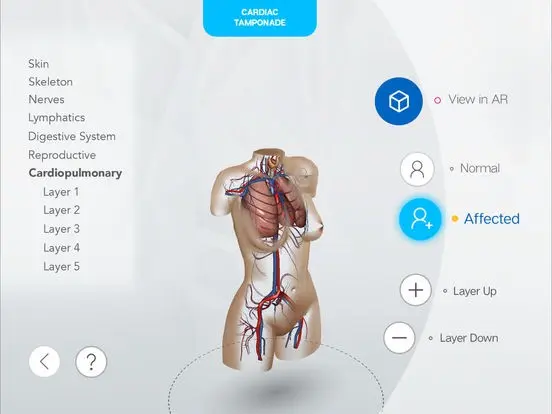
AR can also be used to enable learners to look inside objects too. In the example below, the learner points their device at the NHS logo on their colleague’s chest and is able to see an animated depiction of their vital organs. The implications for medical training are profound, enabling doctors and nurses to study anatomy in new ways and from any location.

Other learning applications include:

  • Correct use of equipment and machinery: By pointing their device at a piece of equipment or machinery, learners can access ‘just in time’ content about key safety features or handy tips for correct use. By accessing this content at the point of need, learners are supported in their on-the-job performance. Rather than sitting at a computer to access learning, the workshop environment itself can now become a vast library of interactive content.
  • In-situ support for product knowledge: In a retail environment it can often be challenging to ensure all staff maintain a robust level of product knowledge, especially if product lines are regularly changing. AR can be used to provide in-situ, at-a-glance information about key product selling points. When a customer is asking about the differences between distinct models, shopfloor staff can rapidly bring up key product information, matching the right product to customers’ needs and, ultimately, selling more effectively.
  • Interactive customer manuals: Our customers are also often our learners. AR is increasingly being used as an alternative to traditional customer manuals and handbooks, for example in the automotive sector. When drivers want to know how to use a particular feature of their vehicle they no longer have to dig out a weighty manual. Instead they can simply slip their phone out of their pocket and point it at the vehicle feature in question in order to access the information they need.

Virtual Reality (VR)

While Augmented Reality overlays content on the physical world, Virtual Reality provides an entirely computer-generated environment for the learner to step into. By tracking the learner’s head movements the VR application allows learners to look and move around the virtual environment, interacting with virtual objects and people as they would do in real life.

While AR is typically used to allow learners to understand more about objects in their day-to-day life, VR transports them to locations and situations that might otherwise be inaccessible or unsafe.

In the example above, learners are transported to the International Space Station to learn more about how it works and experience what it feels like for astronauts to travel into space. VR can enable learning about any kind of inaccessible location like this – whether studying a volcano or travelling back in time to explore ancient civilisations.

There are many applications for business too:

  • Working in hazardous environments: Training learners to act swiftly and safely when facing potential hazards is a key application for VR. The virtual environment enables learners to rehearse responding to hazards without ever placing their personal safety at risk. Applications for this kind of VR include fire safety, military training, electrical engineering and preparation for emergencies in locations like oil rigs, airplanes and power plants.
Examples of hazard training in workshop and office environments.
‘Urban Escape’ VR app developed for military or security personnel working in theatres of conflict, exploring how to respond in a kidnap situation.
  • Engineering know-how: While AR is good for providing information on using smaller tools, VR is a more effective way to overcome the practical challenges of training employees on using large-scale machinery (such as drilling and other extraction equipment) in a consequence-free environment.
  • Advance product training: VR models of new products can be used to train salespeople (and consumers) on the features and benefits of a new product before it has even been released.

By building understanding of how the new product will differentiate itself in the market, organisations can better support pre-orders and ensure that salespeople are equipped to sell effectively from the outset.

360° Video

360° Video places the learner in the center of a fully immersive environment in the same way as VR, but shows a film of a real location, rather than a computer-generated one. The technology for filming 360° Video has improved massively over the last two years, meaning that the workflow is now almost as fast and straightforward as traditional video.

The video can also be made fully interactive, allowing learners to discover information in the environment around them and make decisions about the events that are unfolding in real-time.

  • Virtual tours and comms: In the same way that VR can take learners to sites that it would be impossible to visit in real life, 360° Video enables them to visit far-off real-world locations without ever leaving their seat. This might be to tour a corporate headquarters as part of an induction programme, to visit a factory, or to preview a new shop layout that will be coming soon. Learners can also visit sites that it might be impractical to visit in real life, such as exploring the inside of a power station or a laboratory.
  • Environmental awareness: Health and safety training is a common application for 360° Video. Rather than simply trying to spot potential hazards in a photo as they would do in traditional elearning, learners are asked to identify emerging dangers in real time as they unfold around them. For example, a 360° Video might place learners in the center of a construction site with workers walking past in all directions. By asking the learner to try to spot emerging hazards and intervene swiftly they can be trained to be more vigilant and alert to dangers in the real world.
  • Time-based decision-making: The use of interactive 360° Video for time-sensitive decision-making extends to soft skills training too, such as leadership, sales and customer service. For example, in retail sales training staff can step onto a busy virtual shop floor where they must make real-time decisions about how to deliver the best possible service to a range of different customers with different needs. Similarly, managers can enter a virtual office where they must decide how to lead the different members of the team around them to deliver against an impending deadline.

Ensuring accessibility

Many of our customers are excited by the opportunities that these new technologies offer, but are put off by the cost of buying hundreds of headsets for their learners. We’ve therefore been working very closely with our customers to ensure that all content we deliver is accessible to all the learners that need it.

Obviously, AR does not require a headset, but VR usually does. However, LEO Learning is able to publish the same VR solution for use without a headset too, thereby accommodating those learners that don’t have access to one.

If the learner has a VR headset they can access a fully immersive experience, but if they do not they can still interact with the same content on their smartphone or tablet, using touch-based navigation.

Similarly, to ensure that 360° Video remains accessible to all learners, LEO Learning can publish the same solution for use with a VR headset and for use on a normal PC, phone, or tablet.

Choosing the right enabler for learning

VR, AR and 360° Video are all powerful tools when used appropriately to deliver the right learning outcomes for the right learners. But it is important to remember that they will not always be the best channels for addressing all needs. Part of our work at LEO Learning is to help our clients understand which combination of approaches will be most suitable for their requirements. Sometimes this means using one of these technologies as part of a broader learning blend and sometimes it means using a different delivery mechanism altogether.

Nevertheless when VR, AR or 360° are the best tools for the job, experience has shown us time and again that the results can be revolutionary.

If you’d like to speak to a LEO Learning expert about VR, AR and 360° Video, get in touch today.

About the Authors

GP Strategies Corporation
GP Strategies is a global performance improvement solutions provider of sales and technical training, e-Learning solutions, management consulting and engineering services. GP Strategies' solutions improve the effectiveness of organizations by delivering innovative and superior training, consulting and business improvement services, customized to meet the specific needs of its clients. Clients include Fortune 500 companies, manufacturing, process and energy industries, and other commercial and government customers.

Get in touch.

Learn more about our talent transformation solutions.

Transformation doesn’t happen overnight if you’re doing it right. We continuously deliver measurable outcomes and help you stay the course – choose the right partner for your journey.

Our suite of offerings include:

  • Managed Learning Services
  • Learning Content Design & Development
  • Consulting
  • AI Readiness, Integration, & Support
  • Leadership & Inclusion Training
  • Technical Training
  • Learning Technologies & Implementation
  • Off-the-Shelf Training Courses


Dear Digital: It’s not you, it’s me

For many organizations that want to migrate to a digital leadership development strategy, making the move is like breaking up with a longtime love. You know the relationship has run its course, the romance is gone, and you aren’t learning anything new, but a comfort is there that you can’t quite let go of. And so you stay.

But it’s time. It’s time to take the bold leap to try something new and believe that it will be successful. It’s time to at least dip your toe into a digital learning experience and see how warm and inviting the water can be. It’s time to look at what you’ve put up as obstacles to digital and discover if they are truly obstacles, or just excuses that keep you in a place of comfort.

Let’s debunk the top five challenges from those who are leery of jumping into the digital leadership pool:

  • Our people are just used to learning this way. It’s what they know. Yes and no. While engaging in a digital learning experience at work may be new for many, your learners already exist in a digital world. Across all generations, watching short videos, reading quick articles, and viewing infographics on a computer or phone are the norm. Regardless of generation, your people are already there and increasingly expecting the information and education they receive to be delivered anywhere, anytime, through any device.
  • We can’t teach leadership skills without people. Yes. True. Leaders lead human beings, at least for now, so figuring out how to interact with human beings is important. What’s also true is that those people are accessible in a digital experience. Fifty-one percent of learners in GP Strategies’ Voice of the Learner Survey indicated they prefer to learn with a peer, mentor, or friend who teaches them new skills and knowledge. It is possible to create community, get input, and feel supported by others even if you are not in the same room with them. Through the thoughtful use of discussion boards, collaboration platforms, video, and same time sessions, you can create a network of supportive colleagues your learners will rely upon, but not only during a learning experience. These colleagues will become a part of your learners’ network of support beyond a one-time learning experience.
  • I don’t think they will really do it on their own. They will – if they have the motivation. Learners don’t lean in to an in-person learning experience because they are physically located together; they lean in when the content is relevant, they see something that is in it for them, and they feel the presence of their colleagues and a facilitator who supports them. When learners are presented with highly relevant content served up digitally, they click. When that information or education helps them personally, they watch. And when they are participating with others who hold them accountable for their contributions and help them along the way, they stay. You can be present in ILT and mentally “check out.” Seventy-three percent of learners we surveyed said personal development is what most motivates them to learn at work. It’s not the physical nature of training that causes learners to learn; it’s the relevancy, the WIFMs, and input of others that create the motivation.
  • We’ve done eLearning before. If we do it this way, our learners will click on the video and go do something else. Let’s face it: we’ve all done that. But that’s not what we are talking about here. Yes, there are videos and podcasts that you can click on and then multi-task. But when you are then prompted to share your insight about that video or apply something you heard in the podcast, you’re going to need the information that you glossed over while multi-tasking. By constructing an experience that draws the learner in and asks them to share their insights, apply what they’ve learned, and tell others how it went, we create a sense of accountability in our learners. This accountability helps drive motivation, engagement, and participation in digital leadership.
  • Our managers need to be connected to what their people are doing. Agree completely – without them, you will have limited success. The role of the manager in supporting learners remains a critical success factor. Seventy percent of individuals surveyed in GP Strategies’ research Tomorrow’s Leaders, Today indicated that mentoring was a development opportunity that would increase their effectiveness, followed by sixty percent who named coaching as desirable. Leaders want their manager to be a part of helping them learn and grow and want that feedback in real time. Manager awareness of what their learners will be experiencing is critical, but even more important is manager support in helping their people apply what they’ve learned on the job. By providing access to the virtual classroom, managers can share their stories, including how they’ve dealt with their own leadership challenges, in a way that helps them connect with their people and increase the relevancy of the learning. The manager’s role in supporting their leaders remains pivotal.

If you’re waiting to embrace a digital leadership experience until next year, consider this. Fifty-seven percent of learners want to be able to access their learning anywhere, anytime, through any device. Capture their attention where they live and breathe – in a world of online communities with engaging and snackable bites of learning. Get them to engage wherever they are with learners across the globe in a digital environment. They are already there, and you’re missing a big opportunity if you don’t keep pace with them.

Perhaps, then, there is but one insurmountable obstacle in migrating to a digital leadership journey. And it’s one I’ve heard before – my learners like the free lunch and afternoon cookies. For this obstacle, well, let me just say, yeah – I got nothing.


About the Authors

Leah Clark
Leah Clark is the Leadership Practice Lead at GP Strategies, as well as an author and the founder of LeaderConnect. With over 28 years of experience in her field, Leah brings a unique perspective on the mindsets and skillset that are critical to leadership success to her coaching and consulting. Her clients benefit from her collaborative approach to crafting a well-connected and thoughtful leadership development strategy. Leah holds a Master of Arts; Organizational Psychology, Columbia University and a Bachelor of Arts; English and Sociology, Boston College.

Get in touch.

Learn more about our talent transformation solutions.

Transformation doesn’t happen overnight if you’re doing it right. We continuously deliver measurable outcomes and help you stay the course – choose the right partner for your journey.

Our suite of offerings include:

  • Managed Learning Services
  • Learning Content Design & Development
  • Consulting
  • AI Readiness, Integration, & Support
  • Leadership & Inclusion Training
  • Technical Training
  • Learning Technologies & Implementation
  • Off-the-Shelf Training Courses


Webinar Q&A | 5 Learning Trends for 2020: Rehumanizing L&D for the Workforce of the Future

The needs of today’s learners are changing in challenging ways. On one hand, learners’ thirst for anywhere/anytime digital learning is increasing. On the other hand, they crave human connection and collaboration in the learning process.

The larger thrust of digital transformation is also changing the methods, places, and processes of work, requiring significant reskilling to remain competitive. With everything going digital, how do we rehumanize the learning process and build a future workforce that thrives in a competitive landscape?

  • Behaviorally focused digital apps
  • Design thinking
  • Immersive learning, including augmented reality (AR) and virtual reality (VR)
  • Artificial intelligence (AI)
  • Learning experience platforms (LXPs)

Of course, none of these learning and development trends for 2020 has any value unless it fits within the organizational culture and ties back to business outcomes. For these trends to align, organizations of the future also need to focus on leadership development, soft skills, better communication, coaching, and data literacy (among other skills) that make a human workforce more impactful than an automated one.

We’re at a critical juncture in building the workforce of the future. If you missed the learning trends 2020 webinar, a recording is now available for you to watch online.

After the presentation, several great questions came up from the audience that I want to share with you. Below are those questions and my best answers. This is an ongoing conversation, and I encourage you to keep the questions coming in via the comments section at the bottom of this page.

Q: Do you think that AR and VR are mature enough to trend? Are they more distracting than being disruptive?

A: I believe that AR and VR are definitely mature enough to trend. In September 2019, Fortune Business Insights released a study on the VR market that showed a 42% CAGR through 2026. Specifically, the report stated, “Training and Simulation is seen as a major contributing application to this growth.”

Q: The use of chatbots to improve the learning experience on adaptive learning strategy could be considered as a trend for the future. What are your thoughts?

A: I absolutely agree. We have successfully used chatbots in our Leadership Essentials MOOC with great feedback from the participants.

Q: Where do you think an instructional designer should focus their development time in the next year or two?

A: I would focus on design thinking and MOOCs.

Q: AR/VR seems hard to use those for leadership training. Any ideas?

A: Here is a great article from Forbes that was published in September 2019; it discusses using VR for diversity training, which is a critical part of leadership training.

https://www.forbes.com/sites/rebekahbastian/2019/09/11/using-virtual-reality-to-make-diversity-training-more-effective/#5a4f9f9a7932

Q: Do you see accessibility issues impacting the ability to implement AR/VR in your client organizations? How do you overcome them?

A: I think there are definitely challenges with accessibility in AR/VR. However, a number of VR apps are compatible with VoiceOver, TalkBack, and other popular screen readers, which can describe the environment with information from alt text in the images and videos. We can use AR apps’ own descriptive audio to describe surroundings and integrate other sounds as well. Or, most phones today provide several accessibility options, such as large print and triple-tap magnification, that can be enabled within the device.


About the Authors

Don Duquette, Executive Vice President
As the executive vice president of GP Strategies' global workforce excellence practice, Don Duquette is responsible for leading organizations in designing, implementing, operating, and supporting their talent management and workforce strategies, enabling them to gain greater competitive edge in their markets. His more than 30 years of international consulting experience includes the full spectrum of talent management including strategy, digital workforce, future of learning, and governance. He holds a bachelor’s degree in mechanical engineering from Johns Hopkins University and an executive MBA from Loyola University, Maryland.

Get in touch.

Learn more about our talent transformation solutions.

Transformation doesn’t happen overnight if you’re doing it right. We continuously deliver measurable outcomes and help you stay the course – choose the right partner for your journey.

Our suite of offerings include:

  • Managed Learning Services
  • Learning Content Design & Development
  • Consulting
  • AI Readiness, Integration, & Support
  • Leadership & Inclusion Training
  • Technical Training
  • Learning Technologies & Implementation
  • Off-the-Shelf Training Courses


GP Strategies Baseline Company: A Preconfigured SuccessFactors System

Baseline Company is a preconfigured SuccessFactors system developed by GP Strategies SuccessFactors subject matter experts and solution architects, each with at least 6 years of experience within their respective module or process area.

The Idea Behind Baseline Company
The idea behind Baseline Company is to provide a framework for guiding clients on how to get the most out of their SuccessFactors system. Instead of simply asking our clients what they have in mind and risk building a cluttered system with unnecessary customizations, we want to present our clients with a well-functioning starting point, allowing them to make qualified decisions based on an existing setup with minimal maintenance.

Common project challenges:

  • Extreme complexity in identifying requirements
  • Long implementation times with high cost as a result
  • High risk that end users do not adopt the solution

How does Baseline Company work?
Each module and process in Baseline Company is configured by combining our own best practice guidelines in combination with SAP best practice recommendations. The result is a simple, well-integrated solution that can be used as a starting point for either Fast Track or Enterprise level implementations. With Baseline Company, configuration and documentation are fully completed from the beginning of the project, saving both time and cost.

Who would benefit?
Whether you are an existing SAP SuccessFactors client or are starting your SAP SuccessFactors implementation journey, this is an opportunity for you. You can implement the full Baseline suite to ensure your modules are seamlessly integrated with each other, implement standalone modules or full processes (Recruit to Hire, Perform and Rewards, Core and Reporting, Learning and Development), or choose custom packages.

Baseline Company Highlights

  • Preconfigured system as a foundation to reduce implementation time
  • Based on GP Strategies best practices and experience with more than 700 SAP SuccessFactors projects in more than 80 countries worldwide during the last 15 years
  • Pre-delivered accelerators and documents to be reused by clients
  • Preconfigured system and sample data from day one, allowing early adoption for both the project team and end user

Business Impact
If you are interested in simplified internal processes and reduced implementation time, then Baseline Company is the right choice for your organization. Due to our stable and proven practices, risks decrease and implementation time is reduced up to 50%. All functionality in Baseline Company is aligned with industry experience and requirements.

How to Get Started
GP Strategies has completed more than 700 SAP SuccessFactors projects in more than 80 countries worldwide during the last 15 years. We cover all major industries, and we provide continued operational support and maintenance for more than 80 companies. We are an SAP gold partner, and we have been awarded SAP Recognized Expertise in all SAP SuccessFactors areas. Together with our customers, we have won 13 SAP Quality Awards in 4 years. Contact us to learn more about our SAP SuccessFactors Baseline Company.

About the Authors

Ashton Plusquellec

Get in touch.

Learn more about our talent transformation solutions.

Transformation doesn’t happen overnight if you’re doing it right. We continuously deliver measurable outcomes and help you stay the course – choose the right partner for your journey.

Our suite of offerings include:

  • Managed Learning Services
  • Learning Content Design & Development
  • Consulting
  • AI Readiness, Integration, & Support
  • Leadership & Inclusion Training
  • Technical Training
  • Learning Technologies & Implementation
  • Off-the-Shelf Training Courses


How to Manage Access in SAP SuccessFactors

When it comes to IT systems that store sensitive information, access is a hot topic these days. An HR system like SAP SuccessFactors is no exception.

Based on my experience with access management and SuccessFactors, I would like to share some knowledge and a few opinions on how I think role-based permissions in SuccessFactors should be addressed. Through our experience, we have acquired best practices around the subject. Furthermore, my team has developed an SAP Cloud Platform Extension to automate the process and remove large parts of the operational maintenance task from central super administrators.

Happy reading.

Role-Based Permissions

Access management in SuccessFactors goes under the term Role-Based Permissions (RBP). RBP is a robust framework that allows key super administrators to configure and grant relevant access required for all your SuccessFactors users.

At the core of SuccessFactors role-based permissions are two elements:

  • Groups: Users are defined either via a dynamic property such as a manager, country, or job code, or through a list of named users for those groups where no data point in your system can be used to easily identify a group.
  • Roles: Roles are defined by a set of permissions required by one or more groups to perform their expected tasks in the system.

If a user has not been granted access, they cannot perform any action in the system. They won’t even be allowed to log in and see their own data. Nothing!

Once the data model is in place, the first step of any implementation is to define your basic access:

  • Everyone: Basic permissions allow users to log in, see the org chart, see their peers, and perhaps even access the mobile app if your organization has matured to that stage.
  • Employee Self-Service (ESS): ESS includes any action the users should be able to perform for themselves, including being able to see their own data.
  • Manager Self-Service (MSS): MSS includes any action the users should be able to perform for their direct reports who are one or multiple levels down the org structure. MSS access also includes being able to see employment information.

An Extensive Framework

On top of these three roles are one or more HR and Admin accesses that your organization needs to define. The volume and complexity of these types of access depend largely on your organization’s size and geographical distribution, and how centralized or decentralized your organization operates.

The RBP framework is very extensive and is growing as SAP continues to expand the capabilities of SuccessFactors. To aid in the understanding of the settings, SAP has put a “List of Role-Based Permissions” describing the purpose of each setting in the framework on the SAP Help portal.

Best Practice Tips for SuccessFactors Role-Based Permissions

When defining your access model, keep these basic points in mind. I cannot count the amount of instances I have seen companies fail to follow one or more of the following:

  • Don’t give the same access twice. This will reduce your system performance and make it more difficult to debug potential issues later. However, it may be required to give the same permission twice, if it is being granted for different target populations. For example, the ESS role grants access to base salary information to the employee, and the MSS role grants access to the manager to view for their direct reports.
  • Reuse roles. If you have a local HR role, don’t create separate roles for each country; instead use the same role, but use different group granting to manage the access silos. Create add-on roles for local variations if required.
  • Define a naming convention. Do this early in your implementation process; take future implementations into account and allow for flexibility. Stick to it. Some organizations reach a situation in which they have more than 50 roles. If the naming convention is not solid, it will make maintenance and debugging difficult later on.
  • Keep your instances aligned. It is difficult to reproduce and find potential access-related root causes when the access rights in your test or development environment do not match your production environment. What is often perceived as a nuisance or waste of time is absolutely key to be able to resolve urgent issues rapidly and effectively down the line.
  • Always keep your documentation up to date. In my experience, it is a sad fact that documentation is always an afterthought for most clients. It is a critical concern when we talk about access management. It should be the first step in a best practice governance model and should be done before updating anything in an instance.

How to Document

Documentation is key to properly manage your access definitions in SuccessFactors. I venture to say that if you only follow one of my best practice recommendations, consider this as the most important one.

It is true that you would be “okay” if you granted the same permissions multiple times and had duplicate roles and no naming convention, and all your instances had different configurations, as long as all this information was properly documented. Not great, but your system would be able to function. The system would work, your users would be able to perform their tasks in the system, and you could easily identify issues or areas of improvement/changes, if required.

That being said, how should you document your RBP configuration setup in SuccessFactors?

GP Strategies operates with two models. They are both viable, and we don’t prefer one over the other. The decision of which approach we use depends on the client’s maturity and the complexity of their SuccessFactors landscape. Personally, I don’t think there is a right or wrong here, and I am sure you can find other models out there. So, take this as inspiration or direct guidance. As long as you document somehow, you’re good to go.

Option 1 – Document your access configuration in the relevant module workbooks.

This option is recommended for smaller implementations with low complexity or few modules. Balance the effort required to document your environment with the resources available to you and your team, and do not make the documentation too scattered or cumbersome to find.

In each workbook, add columns that will capture the relevant permissions for each role. This gives you a simple, consolidated overview of the access configuration for each module.

Additional tabs will need to be added to capture permissions not directly related to a field/data point. I recommend storing some of the core configurations, such as group definitions and role granting, in your Employee Profile/Platform workbook.

Option 2 – Consolidate all your RBP configuration in a dedicated workbook.

I recommend that large organizations with full suite SuccessFactors implementations capture access configuration in a dedicated workbook.

The workbook should as a minimum contain:

  • Role definitions: A matrix with all permissions available in SuccessFactors on the vertical axis and your access roles on the horizontal. Will this be a huge matrix? Yes, this matrix can easily reach the area of 5,000 to 10,000 cells.
  • Group definitions: A list of all your groups and how they are defined, and if named users, the full and up-to-date list of users assigned to the group.
  • Role mapping: A full overview of the group assignments of your roles in the system.

Your documentation can easily be extended to contain more information to make the document more readable for the consumer, for example, governance description, logic behind role design, etc.

This dedicated workbook allows you to quickly identify redundant roles, groups, and permission granting.

GDPR Consideration

It is not possible to talk access without talking GDPR, or data privacy and data protection. Many recommendations have been adjusted post GDPR, and new features have also been made available.

In my implementations prior to GDPR, my core message to clients was to keep it simple because the in-depth knowledge that any complexity added to the configuration short term would result in an end product that would be more time consuming to manage, enhance, and debug. Every extra role or group almost exponentially increases the workload in all these areas. Hence, if two HR roles were very similar in definition and only had minimal differences in access, I advocated to merge these roles.

Keeping it simple is no longer an option.

If clients are to be GDPR compliant, keeping it simple is not something I can recommend anymore. Access to personal data should be given only to users other than the owner if they have a valid need for this data. Ask yourself whether the role consumer would still be able to perform their job if they do not have this access.

For example:

  • Do managers need to see the home address of their direct reports? Perhaps.
  • Are there scenarios where this information would be informative or facilitating? Yes.
  • Is seeing the home address a requirement for the manager to effectively manage their direct reports and relevant HR processes they are responsible for? I think not.

I have heard examples like having the need to be able to send flowers, in case of sickness or other events, to an employee’s home address. Undoubtedly, this is a nice gesture, but does it justify sharing employee personal data? The process can still be supported via HR without the manager gaining access to the employee’s personal data.

Providing access for a limited time range is now available.

Another dimension that is possible since Q1 2018 in Employee Central is the ability to delimit the time range in which access is granted.

So, let’s revisit the home address example and assume that we did find a valid reason to give access to the manager. Does the manager need to see the full historical record of the employee’s home address stored in the system dating 2, 5, or 10 years back? Or is access to the historical record for the last 6 months sufficient for the task required?

These are questions that need to be addressed during any implementation or revision of your access model in any IT system. Failure to do so will probably not have any direct consequences here and now, but there’s a future risk of an immense financial impact in the event of a data breach.

Even if the worst-case scenario never happens, you will have still built a more streamlined HR system in which users can focus on the information that they need to perform their tasks instead of being distracted by unnecessary information.

Beware of Pitfalls

As a rule of thumb, if the user is not granted an access, then they cannot perform the action or see the data. If the user is not granted login permission, then they cannot log in. If the user is not given access to Employee Files, then they cannot see any data on this tab, as they cannot access it.

There are, however, exceptions to the rule. Here are a couple of examples:

The biggest exception to the rule, by far, is in the area of the Metadata Framework (MDF). This is where data and configuration for many Employee Central sub-modules, such as Time On/Off and Global Benefits, are stored and available. MDF is becoming increasingly apparent in other modules, as well. There are hundreds of objects in MDF, so in order to browse through them, you need a permission to access the admin page, Manage Data, which is a good thing, as most of these objects are by default not permissioned.

Determining the proper permissions related to MDF objects is essential.

When working with permissions related to MDF objects, you need to think in reverse: Do we need to restrict this object? If we grant access to the object, do we need to restrict fields stored on this object?

The most common issue I have seen related to this is with the two standard objects, Country and Currency. The issue with these objects not being restricted by default is that users can edit these core objects via the MDF-based Payment Details block.

I have seen this happen a couple of times; an end user was “playing” around and changed the Country Code or Currency of a country, impacting key integrations that were relying on this data to be mapped correctly.

Giving permission to all MDF objects is unfortunately not a viable option, so you have to work closely together with a knowledgeable partner to identify and properly manage this and other similar pitfalls.

Understanding permissions can help ensure accurate access.

Another quirk appearing more and more in the RBP framework involves permissions that remove or restrict access. For example, in the Recruiting module, you can hide certain features from the solution via the RBP settings shown below. This can feel counter-intuitive and requires you to have a deeper understanding of the framework.

Who should manage the RBP configuration?

Every client needs at least one business owner to be the subject matter expert (SME) of the RBP configuration across modules for the entire SuccessFactors landscape. Potentially two or three SMEs should be assigned depending on client size and the number of SuccessFactors modules in scope. The task of this role is to understand the business access needs, review requested changes to role definitions, own the workbooks, and have, as a minimum, a high-level understanding of the data stored in SuccessFactors.

If they are technically capable and have the time to perform these actions, the SMEs in this role might be responsible for configuration changes in the system as well. Note that the SMEs do require a fairly high knowledge of SuccessFactors from a configuration standpoint. Gathering this knowledge requires substantial effort for large implementations. Therefore, in many cases, additional resources are made available to support with the actual configuration design and implementation according to the workbook definitions.

For security and privacy reasons, only a select few users should have access to modify the RBP configuration in your system, especially since access configuration is system wide and cannot be granted for only a portion of your user base. It is possible to configure different access models per country or legal entity, but it is not possible to grant the permission to modify these models for only parts of your system. Hence, the super administrators in your system who can access and modify your access models should be part of a central administration team that has the proper training and trust to handle the keys to your system.

Tip: You can now review which external users from implementation partners and SAP have access to your SuccessFactors back-end and have super administrator accounts. To see the list, go to your Admin Center and search for “Manage Provisioning Access.” Reviewing this list should be added as part of a recurring system audit process.

By default, it is difficult to decentralize the administration of access management in large or siloed organizations with the available standard functionality. This is not just related to changes to the access model, but also to changes in your organization. More than 50% of all RBP Group definitions are named users. In other words, if a person changes roles, or a team expands, a request to the access team is required. The request must be manually logged in the workbook and updated in the system. This ineffective process is hard to audit properly.

As a solution to this problem, our team at GP Strategies has custom built the extension Heimdall, based on the SAP Cloud Platform.

Enhanced Access Management with Heimdall

Heimdall is a custom solution and offering available only via GP Strategies.

Heimdall allows you to automate the access request-and-approval process for key roles that you cannot grant based on dynamic groups.

The solution is built and hosted on the SAP Cloud Platform (Read More Here) and is fully integrated with SuccessFactors. All access categories, requests, and audit trails are stored and managed in the MDF, meaning that no data is stored outside of your SuccessFactors environment, and you can report on the data with the Online Report Designer.

The Heimdall solution comes with a range of features to fully support your organization’s access administration:

  • A simple access request configuration, including multi-step approval flows
  • Notifications via mails or to-dos directly on approvers’ SuccessFactors home pages
  • A pending requests overview page for users
  • Admin reports to centrally monitor all pending requests
  • The ability to be configured to support multiple languages
  • An enhanced user experience, with SAP’s Fiori-based solution and Single Sign-On (SSO) with SuccessFactors

Heimdall has multiple clear benefits:

  • Removes the time it takes for manual processing of access requests
  • Reduces the need for super administrators with RBP configuration access
  • Reduces the risk of human error and of users being added to the wrong group
  • Provides a full system audit trail of all requests, including who approved them and when

If you would like to know more about Heimdall and how to better manage your SuccessFactors access setup, contact us or don’t hesitate to reach out to me directly.

About GP Strategies 

GP Strategies SuccessFactors Practice has completed more than 650 SAP SuccessFactors projects in more than 80 countries worldwide during the last 15 years. We are covering all major industries, and we provide continued operational support and maintenance for more than 75 companies. GP Strategies is an SAP gold partner, and we have been awarded SAP Recognized Expertise in all SAP SuccessFactors areas. Together with our customers, we have won 13 SAP Quality Awards in 4 years. Contact us for expert guidance on any SuccessFactors subject.


About the Authors

Adam Kvist Lamaa
Adam Kvist Lamaa has been with GP Strategies for more than 5 years. Holding a professional Employee Central certification, he has lead multiple global EC implementations. Currently working as an Application Architect, Adam ensures that clients get the full value out of their SuccessFactors solution by integrating and extending it for full return on investment.

Get in touch.

Learn more about our talent transformation solutions.

Transformation doesn’t happen overnight if you’re doing it right. We continuously deliver measurable outcomes and help you stay the course – choose the right partner for your journey.

Our suite of offerings include:

  • Managed Learning Services
  • Learning Content Design & Development
  • Consulting
  • AI Readiness, Integration, & Support
  • Leadership & Inclusion Training
  • Technical Training
  • Learning Technologies & Implementation
  • Off-the-Shelf Training Courses