How to Use Data Insights to Shape Your Learning Strategy

This blog article was written prior to LEO Learning becoming part of GP Strategies.

Truly effective learning measurement is about what you do once you have the data and insights at your fingertips.

Once the data is flowing, L&D teams need to be able to leverage those insights in powerful, useful ways. Whether that’s to demonstrate business impact or to refine the delivery of digital learning programs, the insights gleaned from learning measurement must be leveraged in a systematic way that supports a culture of continuous improvement.

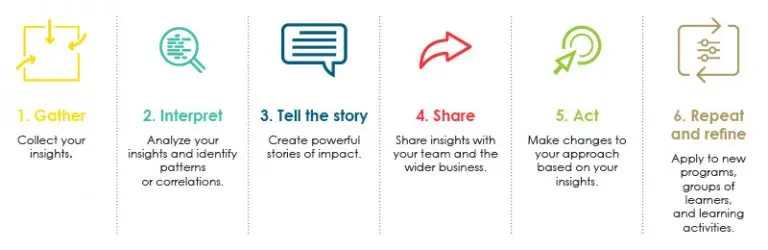
We know that sometimes organizations struggle to understand how to leverage learning measurement insights effectively. Below are simple steps that turn one-off insights into a continuous improvement process:

Leveraging Data Insights: Our Step-by-Step Process

You can apply this process in different ways depending on the maturity of your measurement strategy and tools available.
Getting Started: Describe What Happened

At the most basic level, use your learning data to describe the level of learner engagement and what happened as a result of a learning program. This could be using data from your LMS to find out how many learners completed the learning and identifying to what extent they applied their learning back in the workplace, using feedback and evaluation from managers or on-the-job assessment tools.

Don’t dismiss ‘happy sheets’—with the right questions they can provide very valuable information. And remember, the Kirkpatrick four-level framework is reasonably robust, and there are a myriad of techniques to collect qualitative and quantitative data that don’t involve a data analytics tool. Check out Brinkerhoff, for example.

Develop Easy-to-Understand Reports

Create focused, easily-digestible reports that tell the story of what you discovered in an engaging way. Focus on what’s been discovered and the next steps i.e. how you will use these insights to tweak approaches

“Good” Data Insights in Practice

Taking a sales training program as your focus, identify the impact the learning has had on on-the-job performance using a small data set, such as LMS data, manager feedback, and sales figures pre- and post-learning completion. Share your findings and posit how you can improve outcomes with refinements to learning design and delivery. Apply those changes to your next learning cohort.

Use Learning Data to Describe What Might Happen

Deepen your level of insight by moving from describing what has happened to what might happen. Develop a set of hypotheses during the learning design phase which can be thoroughly tested with learning data.

Broaden your approach to gathering insights by including data from a range of learning activities and look at different sources of performance and business data. This broader approach enables not just the ability to test what might happen but also enables your team to look at data to identify unexpected or unforeseen insights and patterns.

At this level, you’re looking to identify ways to make systematic improvements to learning design, and apply and test these insights in learning delivered to other learner groups in the business. This includes combining insights on learning impact with business data to understand the role learning plays on employee performance.

“Better” Data Insights in Practice

Continuing the sales training example above, ‘better’ here would be testing and then understanding which parts of the learning program had the most benefit and applying this approach to other related programs, territories, or job roles in the sales function. You would then examine the impact these changes had on these new test cases to further validate the approach or understand the difference in effectiveness.

Use Insights to Predict Performance

At the highest level of maturity, you should be looking to predict the impact a learning program will have on learner performance, having extensively modeled and tested different approaches to design and delivery across a range of learning activities and learner groups.

This insight should be used to engage in dialog with senior stakeholders on how learning can impact business performance by developing staff capability at a highly-targeted level.

Zone in on Data-Driven Learning Design and Delivery

While ‘Better’ is expanding your approach to gathering data insights by adding more data sources, at “Best,” L&D teams should be looking to zone in and take a more incisive approach to drilling into data. Once you’ve got to grips with the data that’s available to you, you can start identifying exactly which data sources can be used to refine and inform your approach to learning design and delivery.

That could mean looking at data to understand how to deliver more personalized learning based on a learner’s competence or confidence level, or using data to understand collective weaknesses across a specific function and designing learning to bridge that gap.

At this level, your data insights should be informing the design and delivery of learning and feeding into a culture of continuous improvement across the organization.

“Best” Data Insights in Practice

Continuing our sales training example, at this level, data insights would be used to understand areas of weakness in sales executive performance and suggest improvements not just to training but on accompanying business processes that may be impacting performance.

Learning data could be used to understand the factors that influence the impact of learning based on specific sets of criteria. This insight is then used to deliver highly personalized learning geared to individual preference and competency levels, driving down learning time and delivering efficiency savings to the business.

About the Authors

Geoff Bloom
Geoff is a Principal Consultant and has worked in learning technologies and learning design and delivery since 1980. He joined LEO (now GP Strategies) in 2008, and has worked with a comprehensive range of clients across industries to deliver learning content, and define and evaluate a variety of learning strategies. Geoff was heavily involved in designing the NHS Leadership Academy, working alongside KPMG and the Universities of Manchester and Birmingham to develop over 1,200 hours of blended online content for a Master’s in Healthcare Leadership program. In addition, he has worked on a range of blended leadership initiatives for clients including Volvo, British Airways, and BP. Geoff holds an MBA. He enjoys watching rugby, swimming, and going to see live music. Follow Geoff on LinkedIn.

Get in touch.

Learn more about our talent transformation solutions.

Transformation doesn’t happen overnight if you’re doing it right. We continuously deliver measurable outcomes and help you stay the course – choose the right partner for your journey.

Our suite of offerings include:

  • Managed Learning Services
  • Learning Content Design & Development
  • Consulting
  • AI Readiness, Integration, & Support
  • Leadership & Inclusion Training
  • Technical Training
  • Learning Technologies & Implementation
  • Off-the-Shelf Training Courses


5 Interesting Facts About Work Today

Did you know that the average employee spends approximately one-third of their life at work? That adds up to roughly 90,000 hours. Given that enormous commitment, it’s easy to see why career development plays such a powerful role in employee retention.  

As the expectations of the modern workforce shift, individuals are increasingly seeking opportunities for growth, purpose, and impact within their roles. Companies that prioritize and invest in their employees’ professional development will not only foster a more engaged and committed workforce, but also position themselves to attract top talent. 

Career Growth and Retention Drivers 

As you plan your organization’s career development strategy going forward, keep in mind these five career facts from our ongoing research. 

1: Professional Development Is More Important Than You Think

 Professional development is an essential element of employee satisfaction. Employees in our client organizations consistently cite growth as the number one thing that would improve their job satisfaction. 

2: Most Organizations Do Not Hire from Within

According to a 2023 report from The Josh Bersin Company and AMS, internal hiring rates have fallen to their lowest points in years. Internal hires now make up a dismal 24% of all hires, which is down significantly from 40% in 2020. If your organization fails to hire from within, you are essentially telling your employees that you do not value their development, which makes it very likely that you will lose them.  

3: Employees Are Often Unaware of Career Opportunities 

While 13% of employees feel they do not have career opportunities, more than a third neither agree nor disagree. These findings indicate a certain degree of ambivalence around career and the need for organizations to provide more clarity and guidance on the opportunities available to their employees. 

4: Lack of Opportunities Can Hurt Your Retention Rate 

 Career is the second most common reason employees consider leaving their organization, and those who feel they do not have career opportunities are four times more likely to leave in the next year. 

5: Development Means More Than Promotions & Raises 

Employees cite skills development and growth and formal career opportunities as top drivers of job satisfaction. This is consistent with findings in GP Strategies’ career research, which indicates that 85% of the workforce sees no problem with staying in careers that are interesting. As long as they can continue to develop their skills, these employees are content to remain in their current roles.  

The Strategic Power of Career Development in Employee Retention

GP’s research indicates that focusing on your employees’ career and professional development is a significant competitive advantage. Career has the power of driving deeper engagement and commitment to your organization, while setting the stage to attract outside talent looking for an inspiring workplace where they can make a difference. 

Learn more about equipping employees and managers with the skills they need to help build a culture of career growth

[1] Cappelli, Peter. May-June 2019. “Your Approach to Hiring Is All Wrong,” Harvard Business Review, Issue 3, p. 51. Available at: https://hbr.org/2019/05/recruiting. 

About the Authors

Colleen Casey
When I was about 8 years old, I made the obligatory pilgrimage of every born and bred New Jersey native to the Thomas Edison museum. The other children and I pummeled our patient tour guide with innumerable questions (mostly pertaining to whether or not Mr. Edison had died on the premises). Upon learning that Mr. Edison had not received much in the way of a formal education, I inquired “But how was he so smart if he never went to school?!” The simple and astute response of the guide – “He asked a lot of questions.” My career in public opinion and employee polling has led me to do just that – ask a lot of questions in order to better understand how others see the world and what shapes those perceptions. In my current role, I use the insights that I gain from engagement surveys to help our client organizations better understand how their employees view their work, their leaders and the organization’s culture in order to enable them to implement meaningful change based on employee feedback. I feel that my time spent studying sociology and living in France provided me with a unique opportunity to see the world through a different lens and understand how culture informs the way we view ourselves, the world around us, and the institutions that shape us. These academic and personal experiences have been highly valuable to me in my career, heightening my sensitivity and awareness of the necessity to bring a unique approach to client measurement strategies, an approach that aligns with and reflects their unique organizational culture.

Get in touch.

Learn more about our talent transformation solutions.

Transformation doesn’t happen overnight if you’re doing it right. We continuously deliver measurable outcomes and help you stay the course – choose the right partner for your journey.

Our suite of offerings include:

  • Managed Learning Services
  • Learning Content Design & Development
  • Consulting
  • AI Readiness, Integration, & Support
  • Leadership & Inclusion Training
  • Technical Training
  • Learning Technologies & Implementation
  • Off-the-Shelf Training Courses


6 Styles of Animation for eLearning—And How to Choose Them

This blog article was written prior to LEO Learning becoming part of GP Strategies. 

Choosing the right style of animation for eLearning is an art in itself – the style you choose can have a big impact on the tone and message that gets delivered to your learner. We caught up with Brigitte Sutherland, Animation and Video Manager at LEO Learning, to find out more about animation in eLearning and the different styles of video animation organizations can choose from.

Q: Why use animation for digital learning?

Brigitte: Animation’s real strength is being super concise. You can get really creative with the different approaches to animation. The way that you can break down something very complex into less than a minute of someone’s time is pretty amazing. Everybody can spare 60 seconds of their day, especially when it’s entertaining and stimulating, like an animation.

Q: How can animation speak to the heart of the learner?

Brigitte: It comes down to storytelling and giving people genuine situations that they can relate to. Animation for learning lets you deliver a message in a way that is tailored to resonate with a specific audience. For instance, we worked on a code of conduct-themed compliance course for a gaming company. They had a large, tech-savvy audience of game designers and wanted something fun, relatable and memorable that would engage learners without feeling onerous.

Animation was perfect for this! Every page of the learning journey included animation, and by using a variety of characters and humor, it made the learning memorable. For example, a tiger dining out on company expenses stuck with learners long after the training was completed.

Q: Are there any types of learning where animation works particularly well?

Brigitte: When it comes to visualizing processes or techniques, animation comes into its own. Anything with an end-to-end process benefits greatly from animation. We often see it used for ‘how-to’ guides on systems and software.

Process types include:

  • Breaking down complex, abstract processes – such as robotic process automation
  • Step-by-step process – such as making chocolate
  • Situational processes – for recreating situations that are hard or expensive to recreate in person or films – e.g. spot hazards on an oil rig
  • Processes that cannot be viewed directly – for example, the inside of a human body

Q: When is animation more appropriate to use than videos?
Brigitte: Animation is a better choice when you can’t film a subject matter. An example of this is illustrating the process of blood clotting. We had a project with the Hemophilia Federation of America where this process had actually never been visualized before, so we had Subject Matter Experts help us distill this complicated process into a clear and concise animation.

Discover more about using video for learning.

Q: Is animation cheaper than video?

Brigitte: Animation can be cheaper than video to produce, but this does, of course, depend on the length and complexity. But animation does come into its own when you compare it to video production scenes with expensive location costs or a large cast.

Q: Do different styles of animation suit different types of learning?

Brigitte: Trends come and go, but yes, certain styles of animation are better suited to deliver certain key points and messages. The style and effect you choose should be informed by your brand identity and the message you are trying to deliver.

6 animation video styles for eLearning: How to choose the right one for your needs:

To deliver impactful eLearning experiences through animation, it’s important to match the right animation style to your digital learning journey. Explore these styles of video animation for eLearning to understand the options available to your organization.

1) Hand-drawn images and real-world elements
This style of animation has a friendly, helpful feel that makes the viewer feel like someone is talking them through the content. By incorporating real-world elements, such as hands drawing on a whiteboard or notepad, it can feel more accessible.

2) Photography Themed
This style takes still images and makes them move on the page, also known as motion graphics. You can see an example of this below. You’ll notice that the photos have some form of motion – this can help add narrative to the story.

Animation that predominantly uses photos can help the learner relate to specific, real-life situations. We also find that it can help set a more serious tone, which suits certain brands or types of content. We often see this approach favored in the financial services industry.

3) Character Animation
Character animation can give a light-hearted touch and help make things more fun, and can be directly relatable to the learner because you can play out specific scenarios.

Character animation is also useful for getting your learners to empathize with characters. You may find that filming a video using real people or a specific location may be less relatable if the video contains geographical or cultural differences that not all of your audience can relate to. So animation can deliver a message that relates to a broader audience.

4) Infographic Style
This style lends itself perfectly for visualizing content that is more abstract. It’s a great way of bringing numbers and data analysis to life, and of course for highlighting statistics. We see this style used a lot in the finance industry, for example.

5) Typography/Kinetic Text
Focusing on words can compound their power and deliver strong, clear messages. In most cases, a concise and articulate script conveys the message, and use of imagery will be minimal.

6) Animation to Enhance Video
Animation added over the top of video can be a useful way to add interest and to illustrate points. We typically see this in a ‘Minority Report’ style, where slick annotations are added to a video to showcase important details to the viewer. Alternatively, they can also add a playful feel, such as adding informal sketches or doodles to lighten the mood.

About the Authors

GP Strategies Corporation
GP Strategies is a global performance improvement solutions provider of sales and technical training, e-Learning solutions, management consulting and engineering services. GP Strategies' solutions improve the effectiveness of organizations by delivering innovative and superior training, consulting and business improvement services, customized to meet the specific needs of its clients. Clients include Fortune 500 companies, manufacturing, process and energy industries, and other commercial and government customers.

Get in touch.

Learn more about our talent transformation solutions.

Transformation doesn’t happen overnight if you’re doing it right. We continuously deliver measurable outcomes and help you stay the course – choose the right partner for your journey.

Our suite of offerings include:

  • Managed Learning Services
  • Learning Content Design & Development
  • Consulting
  • AI Readiness, Integration, & Support
  • Leadership & Inclusion Training
  • Technical Training
  • Learning Technologies & Implementation
  • Off-the-Shelf Training Courses


The Gift of Being Wrong

Some of us found our way to L&D because we were happiest in the classroom, while others are here to challenge a learning environment that may not have worked for us. Whether we were the class anarchist or the teacher’s pet, we’re all pretty confident of what we know about learning.

And that’s where we’re wrong—or need to be. No matter how much experience we have, the fact that our careers are focused on learning makes us unlike the average learner we serve. As empathetic as we might be—and learning folks are a nice bunch—we’re simply not a representative sample.

I’ve written previously in support of design thinking methodology, particularly the opportunity it creates to meet learners who are nothing like us. The paradox, of course, is that our shared humanity makes connection inevitable. Even if we can’t imagine what it’s like to perform a certain job, we can absolutely relate to the joy of succeeding at a challenge.

But the practice I’m advocating for now is even more personal—and it precedes sitting together at the interview table. My challenge to you for 2020 is to learn a skill for which you have no immediate application, a skill you can’t translate into profit or add to your LinkedIn profile: a skill that, in short, has nothing to do with you. Revel in being wrong and learn from your inevitable mistakes.

Mine is the Georgian language. I visited the country in late 2018 and spoke two words at the time, hello and thank you, both of which I pronounced wrong. When I returned, I found an online tutor willing to take on a complete beginner. I struggled—and still struggle—to pronounce clusters of five consonants, some of which include gutturals and an epiglottal stop. I make the mistakes children do when they’re just learning to read and speak: I regularly mistake K for V and P for H. I learn one grammatical rule at a time, and I apply it to everything I say. It takes me weeks to memorize a single lesson’s worth of vocabulary because I don’t know any root words. I don’t know when, if ever, I’ll be able to have a spontaneous conversation. Almost no one besides my tutor will ever know when I improve.

So, what’s the point? Well, I was moved by the country, its people, and its history; I felt I wanted to commit something to it besides mere tourism. Georgia has the oldest winemaking tradition in the world and one of the oldest spoken languages and literary traditions. Georgian is one of the few remaining on the Kartvelian branch of the language tree. The alphabet, mkhedruli, is labyrinthine and lovely, and words are actually spelled phonetically. The Georgian people have survived invasions from all sides, and the remaining fortresses and hideouts are surprisingly serene. You can hear the triumph in the language: the word for “hello” is literally “victory.”

Above all, Georgian has nothing to do with me. It’s the first language I have undertaken without a concrete objective: to move abroad, to speak with family, to travel. The lesson that the self is not the center of the world is a fundamental one we have to master to grow up, but it’s always good to be reminded. It’s easy to get comfortable in our chosen silo and forget what it’s like to be new at something.

Not that there aren’t applications to my own silo—when L&D folks learn, we have the built-in advantage of discovering new instructional techniques—and borrowing them. My Georgian lessons give me fresh ideas about how to teach someone a skill from scratch. My tutor builds in a lot of small wins with related verbs, cases, and phrases I can apply as a set. When I need remediation, which is often, she prompts me with the rule so that I have another chance to answer correctly. I’m going to say more wrong than right for a while, but I’m also at the stage where any growth feels like a lot.

Language isn’t everyone’s area of interest, I know. But the experience of being humbled is worth pursuing, whether for a few hours or over the course of a lifetime. Along with the Georgian language, I’m learning about what it feels like not to be able to be my full self because I can’t say more than my name and some basic phrases. I’m also learning a bit about what it’s like to acquire literacy as an adult. It’s not a perfect laboratory, but it’s given me a new appreciation for the enormity of the task.

Most of all, being a novice reminds us never to take a deficit view of our learners. We’re all competent at something, somewhere. Take us out of the fragile, specific milieu where our competencies are valued, and we are all vulnerable. We speak about this vulnerability when we worry about the future of work and our own obsolescence. We’re all afraid of being replaced: to remain viable, we have to fight the complacency that comes with competence. In forcing ourselves to be novices, we become adaptable.

We talk about not being afraid to fail; or failing forward. Despite these claims, though, we remain captivated by the myth of the brilliant hero who instantly discovers the right path—whether it’s a literal journey or one of product, industry, or personal development. We’re drawn to superstars and instant successes: the story of trial, error, and iteration takes too long to tell—and has too many characters to name.

We can hope, even strive, for stardom and discovery. But, in the meantime, as we implement our New Year’s resolutions or bucket lists for the new decade, let’s challenge ourselves to confront what we don’t know. Let’s do what we ask of our learners and embrace the discomfort of being a novice—and accept evaluation, failure, and remediation with grace. In short, let’s give ourselves the gift of being wrong.

About the Authors

Tiffany Vojnovski
The idea that school could be different first came to me—as did most risky ideas—through fiction, specifically Notes on the Hauter Experiment, a futuristic novel set in an automated boarding school. Screens replaced teachers, and flashing lights cued students to move to their next class. Those who disobeyed were punished with grating alarms and foul odors. Whether the author, Bernice Grohskopf, had a background in instructional design or simply excelled at reimagining the boarding-school bildungsroman, one thing was clear: school was ripe for an LX intervention. I didn’t revisit the idea until I joined the New York City Teaching Fellows program; but this time, I was the teacher instead of the reader. Via a fast track to certification, I was charged with teaching in one of the highest-needs schools in the country. My challenge was to boost students’ achievement by several grade levels while adding rigor and interest to the high-school English curriculum. After a lot of trial, error, and reflection, I learned how to help my students succeed. However, I never felt comfortable enforcing the poorly thought-out procedures and meaningless paperwork our school leadership imposed upon students. I believed in the value of knowledge, and to organizations devoted to learning and exploration. What I wasn’t sure I believed in were the virtues of going through the system in a single “right” way. If anything positive came out of my complicity with the school’s—and district’s—lamentable LX, it was the empathy I developed for my students. If their job was to learn and follow the rules, my job was to make it as easy as possible for them to do so. Any procedure that caused confusion about what to do when they entered class, where to find learning resources, or how to turn in completed work needed to be redesigned. When students arrived in a classroom designed for professional learning, they acted—surprise!—like professional learners. My commitment to LX has been the link between my teaching and instructional design practices. Rather than despair that learners aren’t who we want them to be—more literate, more professional, more successful in whatever way we value—we should design learning tools that make these ends accessible. Learners themselves can teach us how: thanks to the design thinking model, we have a series of steps for engaging learners in empathy interviews and quickly prototyping solutions that might help them. It’s easy to view the learner as a faceless cipher sitting at the other end of an eLearning module. However, once you meet someone face to face, you can’t help but care about their experience. Not every learner is skilled in metacognition or speaks the language of academia, but all learners can tell us, in their own idiom, about the obstacles and fears that trouble them—and the interventions that would improve their lives. Learning is more than a system of rewards, punishments, and behavioral cues meted out by machines. My commitment is to maintain an open mind and to treat every learner as a sympathetic character.

Get in touch.

Learn more about our talent transformation solutions.

Transformation doesn’t happen overnight if you’re doing it right. We continuously deliver measurable outcomes and help you stay the course – choose the right partner for your journey.

Our suite of offerings include:

  • Managed Learning Services
  • Learning Content Design & Development
  • Consulting
  • AI Readiness, Integration, & Support
  • Leadership & Inclusion Training
  • Technical Training
  • Learning Technologies & Implementation
  • Off-the-Shelf Training Courses


10 Important Items to Consider When Building Compensation Statements

As a professionally certified SuccessFactors Compensation consultant, I would like to share some of my experience regarding compensation statements. Hopefully, this blog will provide answers to questions you may have about the process, helping to simplify your experience and deliver the best statements possible to your employees.

Typically, employees are so busy designing their worksheets that they forget about the statements until the last minute. The most important question to ask while you are still designing your worksheet is, which fields do I need on my statement? Including these fields in your template ensures that statement creation is seamless.

Below is a checklist of 10 important items to consider before you start creating compensation statements.

1.  Type of Statement

Different types of statements are available for Compensation and Variable Pay. You will need to decide what types of statement work best for you.

Type 1: Standard Personal Compensation Statement with a company logo, title, letter text, and compensation fields in a group to the right of the text. This statement includes elements from the Compensation Plan only.

Type 2: Standard Personal Variable Pay Statement with a company logo, title, letter text, and variable pay fields in multiple groups to the right of the text. This statement includes elements from the Variable Pay Plan only.

Type 3: Combined Statement with a company logo, title, letter text, and variable pay fields in multiple groups to the right of the text. This statement includes elements from both the Compensation and Variable Pay plans in one statement.

2.  Standard vs. Custom

You can download templates from the SuccessStore. To access the SuccessStore – from within the SucessFactors Application:

  • Go to Admin Center
  • Compensation
  • Actions for all plans
  • Manage Statement Templates
  • Add Template
  • Select from SuccessStore

In the following diagram you can see an example of what is available for Personal Compensation Statements.

Similarly, you can import Combined and Variable Pay statements form the SuccessStore.

You will have the option to customize the statement text and the block on the right, as shown below. You can insert additional blocks, define the heading, and select the fields that you would like to display in each block.

The standard look and feel and will typically look something like this:

You can also design your own layout. You will need someone with XML/XSL skills to assist you with this effort. Make sure that you ask about custom statements when you discuss the Statement of Work (SOW), as this may be a change order depending on the amount of work that will be required. Typical SOWs include only standard look-and-feel statements as described above.

The following is an example of a custom statement:

3.  Statement Fields

Make sure that all fields required for the statement are defined in your templates. For example, Merit %, while displaying on the worksheet, is not a field that is available to print on a statement; if that is something that you would like to show on the statement, you will need to define a separate custom formula field. Make sure that all statement fields are included in the worksheet.

It is common practice to add fields only used for statements to the end of the worksheet as HIDDEN fields. Keep in mind that you do not want to duplicate fields, so if it was already defined in your worksheet, you do not have to define a separate field specific for statements; use what you already have, as shown below.

4.  Number of Statements

I am often asked whether separate statements are required if some people have a Lump Sum and others don’t; some people have a Merit and others don’t.

You do not need separate statements. There are “formulas” that you can use in SuccessFactors that will only display a field if certain criteria are met. For example, only display Lump Sum if the Lump Sum value is greater than 0, as shown below.

You will need a separate statement if the wording/message of the statement is different. You will need a separate statement for each language.

Define as many statements as you need for a plan. Read the SOW carefully to ensure that the number of statements that you require is specifically called out.

I have seen customers use only one XML to produce different statements in multiple languages. This is custom and can only be accomplished using XML/XSL coding. The risk with this method is that if you make a change to one statement, it could potentially break something in a different statement.

5.  Statement Groups

You can group employees into statement groups and print different statements based on the groups.

For example, if employees in the United States need a different statement than the employees in the United Kingdom, and the United Kingdom needs a different statement than all other employees:

  • Create a dynamic group for United States Employees: Country Code = US
  • Create a dynamic group for United Kingdom Employees: Country Code = UK
  • Create three statements: one for US, one for UK, and one default for everyone else.

The following screen-print is an example of the two statement groups (first and second bullets above) that we create and the number of employees in each group:

You can define groups to be dynamic (preferred):

Or you can manually assign users to groups, as shown below. Use this method only when you cannot define the group dynamically. Manually assigned groups should be continually monitored to ensure that the people within the group are still relevant.

Statement groups can also be used to generate statements at different times for different groups of employees. For example, if statements are needed for China before they are needed for the rest of the world, you can create a group for China. You can assign the same statement to multiple groups with different visibility settings for each group. In other words, you can make the statements available to the employees in China before you make them available to the employees in the rest of the world using the statement permission (discussed in the following section).

6.  Visibility/Distribution

The compensation administrator has the ability to create default permissions for each statement, as shown below. This can be overwritten at the compensation template level and different for each group and statement combination attached to the template.

7.  Testing and Validation

It is important to test each statement thoroughly; allow enough time to test statements once the worksheets have been finalized. Keep in mind that statements are often tested while your worksheets are rolled out to managers, so you may run out of time to test if you don’t plan this out correctly. If you wait until the templates are rolled out, you no longer have the ability to make changes or add fields that are required for the compensation statements.

If you test the statements and your worksheets at the same time, you can move them to production at the same time, and you can validate and correct any errors prior to rolling out worksheets to your compensation planners.

Keep a running list of test scenarios to ensure that you validate that the correct statements are generated and the corrected data is displayed on each type of statement. For example, if there are different elements printed in the header for a promotion for China than a promotion in the US, then (1) make sure that the statement does not print for the US and (2) make sure that it does print for China.

Always include negative testing scenarios also.

8.  Translations

If you have a requirement to generate statements in multiple languages, allow enough time for translations. Your consultant can provide you with a Translations Workbook. Make sure that you have testers available to verify that items were translated correctly and that the statements make sense.

The following is an example of a Translation Workbook:

9.  Logo

A statement logo, shown below, cannot be updated by a consultant – you will have to create a support ticket with SAP to update the logo. Ensure the logo you provide is the size that should appear on the statement. They do not size the logo; they create a URL with the logo that you send them. Separate tickets are needed for test and production.

10.  Production Cutover

You have two options to move statements from your test environment to production:

  • Recreate the statements in PROD. With this option you are reimporting the fields into the new statement templates, so validate that the correct fields are pulled in, the correct checks are recreated (for example, only display a field and/or section if the values are greater than 0), etc.
  • Export the XML/XSL from test and import it into production. Compensation template IDs are different in test than in production, so update the IDs accordingly.

In either case, make sure that all changes to the worksheet in production that were not replicated in test are communicated to the consultant developing your statements. It may not seem significant to you, but these changes could affect your statements.

In Summary

  • If possible, plan and develop your compensation statements the same time you design your templates to avoid manipulation of data in the statement XSL code.
  • It is not recommended to change the code to accommodate items that you missed during development.
  • Keep in mind that all compensation and variable pay worksheets must be in a completed status before statements can be generated.

Reference:

  1. SAP Help Portal (you will need an S-ID to access): https://help.sap.com/

About the Authors

Vivian Reynecke
I started working on SAP in 1994 and I was hooked the first time I saw the system. I have worked in the HCM space right form the start, so I have evolved with the system. Because of my SAP experience, I had the opportunity to immigrate to the USA with my husband towards the end of 1995. I worked on all HCM modules but around 2005 my focus was the Talent Management modules (Learning Management, Compensation (including Variable Pay), Recruiting, Succession & Career Development and Performance Management). By the end of 2009 I was the Capability Lead for the SAP HCM Talent Management group. In 2012 (shortly after the acquisition of SuccessFactors by SAP) I started training on SuccessFactors. I was very excited because everything that was “missing” in SAP ECC, was covered in the SuccessFactors Modules. I was given so many wonderful opportunities over the years to expand my knowledge – I worked on proposals, resource allocations, project pricing and so many other things. As with everything else, life threw me a number of curveballs, but with the support and the encouragement of all of my colleagues, friends and family, I was able to overcome stumbling blocks. I recently became part of the GP Strategies family and I am very excited to see where this new adventure is going to take me.

Get in touch.

Learn more about our talent transformation solutions.

Transformation doesn’t happen overnight if you’re doing it right. We continuously deliver measurable outcomes and help you stay the course – choose the right partner for your journey.

Our suite of offerings include:

  • Managed Learning Services
  • Learning Content Design & Development
  • Consulting
  • AI Readiness, Integration, & Support
  • Leadership & Inclusion Training
  • Technical Training
  • Learning Technologies & Implementation
  • Off-the-Shelf Training Courses


Best Content of 2019: Thought Leadership to Help You Excel in the New Year

We made it to a new decade! 2020 is here and while each new year holds promise and a vision for what success looks like, it can only be reached by aligning strategy with execution and preparing your workforce for the future. Equipping the people who support these goals while continuously adapting to changes in the digital and global landscape is no small feat, but you are not in it alone: our content roundup of 2019 is here!

Our library of Employee Training & Development Resources offers content from the best thought leaders in the industry, providing insights and tools that help make ideas achievable. From our resource library, you can subscribe to our biweekly podcast or follow our blog. With nearly 70 posts published on the Performance Matters Blog in the past year, there is a lot of content to digest. Here are our top five posts to help you embrace and achieve success in the new year:

Our webinars, with interactive content and engagement from our audience, continue to offer a deeper dive on key topics. In 2019, our top webinars included:

Research also continues to be a key offering for our readers. Last year we surveyed global audiences and published the results in two research reports:

As we continue to share thought leadership in 2020, our resolution is to remain in collaboration with our customers and stay ahead of digital solutions. This approach ensures that we develop content that explores best practices and innovative insights to help you and your organization improve performance.

In 2020, the stage is set for transformative moves, and we look forward to continuing the journey with you.

About the Authors

Kayla Ratz
Kayla Ratz is the Digital Marketing Manager for GP Strategies and the editor of the GP Strategies Blog. Her focus is on sharing thought leadership and insights across digital mediums, and through collaboration efforts, to support performance improvement and enable knowledge sharing in the Learning Industry.

Get in touch.

Learn more about our talent transformation solutions.

Transformation doesn’t happen overnight if you’re doing it right. We continuously deliver measurable outcomes and help you stay the course – choose the right partner for your journey.

Our suite of offerings include:

  • Managed Learning Services
  • Learning Content Design & Development
  • Consulting
  • AI Readiness, Integration, & Support
  • Leadership & Inclusion Training
  • Technical Training
  • Learning Technologies & Implementation
  • Off-the-Shelf Training Courses


6 Steps to a Whole New Technical Organization

The start of a new year has people turning to diets, fitness, and self-improvement initiatives with the concept of a “whole new you” in the coming year. There are three types of people I see each year:

  • Consistent Carl – Carl has had the same diet and exercise plan his whole life. It hasn’t been as effective as he’s gotten older, but it’s all he knows.
  • Fad Francine – Francine watches all the latest infomercials and Instagram influencers. She’s constantly trying the latest and greatest fad diets and exercises. Sometimes they work, sometimes they don’t, but there’s never a lack of new methods to try.
  • Strategic Sam – Sam is strategic. She goes for a checkup once a year to ensure that she is running in tip-top shape. She adjusts her diet and exercise plan each year to target specific goals she is looking to achieve, and gets results.

These concepts should seem familiar. But how often do we think about “self-improvement” in our technical organization? Whether we are producing power or manufacturing products, we should spend some time considering how we can move better, faster, and more efficient in the New Year. With that in mind, here are my six technological organization steps to a achieving a whole new technical workplace.

To start, much like in our physical well-being, we need to address both diet and exercise to get results; the same applies to our technical facilities. Within our technical facilities we have very important assets that support our day-to-day work. These assets are not just the physical equipment, but also the people who operate it. As we look to improve in 2020 through technological organization, we will need to focus on both to drive results.

People Focused:

  • Technology Use: Your organization has likely made significant investments in the purchase of technology, but how much time did you invest in enterprise technology adoption? Don’t let your new technology be the pieces of gym equipment sitting in your basement unused. Spend some time in 2020 focusing on change management, user adoption, and training to ensure you are maximizing the technology investment in the future.
  • Organizational Analysis: Technology can often change what your organization looks like as well. We don’t like to talk about it, but technology can make humans redundant in some areas or may require enhanced skillsets. I often hear the phrase, “right people in the right places.” The year 2020 is a great time to look at developing an operational excellence approach across people, processes, and the plant to establish some short- and long-term goals for optimization and sustainability.
  • Workforce Optimization: You could have the best designed facility, with optimized processes and technology, and still have errors. It’s been stated that 80% of errors are human induced. Prepare your workforce with better plans for training and performance support to ensure they can effectively and safely operate your facility.

Equipment Focused:

  • Data Integrity: Much like the old adage “garbage in, garbage out,” how accurate and clean is your equipment data? Do you know what your most critical pieces of equipment are? This heightened attention on data can help you prioritize your investment and focus in 2020.
  • Asset Strategies: Not unlike your people, your equipment needs some “talent management” as well. Do you maintain your equipment on a consistent basis (think of your yearly training requirements)? Do you wait until a failure occurs before you maintain (think of your more urgent training updates)? Or do you simply run to failure and replace what’s broken when it fails? You can actually decrease your operational costs between 15% and 40% while capacity utilization improves by 5% to 10% by optimizing your asset strategies.
  • Root Cause: When an issue does occur in your organization, do you take the time to ask why? By conducting a proper root cause analysis, you can ensure that your corrective actions are solving the real issue so that in the future you might prevent the issue from reoccurring. Stop the guessing games and improve your overall equipment effectiveness with the rigor of root cause analysis.

Now, let’s think about those three types of people again … which one do you want to be in 2020?

  • Consistent Carl – Carl has run his business the same way for his entire career. He doesn’t always get the best results, but he is consistent in his approach.
  • Fad Francine – Francine jumps on all the latest buzzwords and implements them each year. Some of them work, some of them don’t. But she never has to worry; the New Year will always deliver new things to try.
  • Strategic Sam – Sam is strategic in how she runs her business. She conducts proper assessments, identifies her key challenges, and implements action plans to solve them.

As you enter 2020, I encourage you to be like Sam. Sam is strategic in how she goes after her goals and you should be too.

About the Authors

Sheri Weppel
Sheri Weppel started her career as an art teacher covered in finger paint, clearly teaching people about out-of-the-box thinking (or at least off-the-construction-paper thinking). While working on her master’s degree in Instructional Design and Development at Lehigh University, she realized that we could learn a lot from the public-school classroom. Concepts like micro-learning, learning styles, gaming, and training on demand were common in grade school, but were considered new concepts in the corporate sector. Because one degree is never enough, Sheri continued her studies at Lehigh with a focus on Gaming for Instruction. In her spare time, she spent her evenings losing to her husband in Scrabble and wanting to throw the letter Q across the room, making her realize the emotional attachments we can have to games. If we could harness that desire to succeed, compete, or win to a learning environment, what impact could we have on learner motivation? Countless games of Scrabble later, Sheri started at GP Strategies as an Instructional Designer and was able to inject those concepts into solutions for her customers. This is often a challenge for customers that want to use gaming but often don’t believe they have the time or budget required to successfully launch into the gaming space. Sheri is driven to help these clients find a balance in embedding gaming elements into instruction in a practical manner. In the past nine years, Sheri has held many roles within the organization, from instructional designer to sales lead for blended learning, and is now focusing on the off-the-shelf product GPiLEARN+, growing the product into a true blended learning solution. Regardless of her role, Sheri is always focused on working with customers to help build impactful training solutions that focus on the needs of all populations. She helps clients determine specifically when to incorporate gaming versus using hands-on, traditional approaches. When she is not working, Sheri enjoys having adventures with her dog Olivia, attending barre classes, and learning new three-letter words that begin with the letter Q.

Get in touch.

Learn more about our talent transformation solutions.

Transformation doesn’t happen overnight if you’re doing it right. We continuously deliver measurable outcomes and help you stay the course – choose the right partner for your journey.

Our suite of offerings include:

  • Managed Learning Services
  • Learning Content Design & Development
  • Consulting
  • AI Readiness, Integration, & Support
  • Leadership & Inclusion Training
  • Technical Training
  • Learning Technologies & Implementation
  • Off-the-Shelf Training Courses


Webinar Q&A | Learning Trends for 2020: Rehumanizing L&D for the Workforce of the Future

The needs of today’s learners are changing in challenging ways. On one hand, their thirst for anywhere/anytime digital learning is increasing. On the other hand, they crave human connection and collaboration in the learning process.

The larger thrust of digital transformation is also changing the methods, places, and processes of work, requiring significant reskilling to remain competitive. With everything going digital, how do we rehumanize the learning process and build a future workforce that thrives in a competitive landscape?

During a recent Training Industry webinar, I shared 2020 learning trends that build on the best of both worlds: human connection and digital efficiency. During the session, I explored future-focused tools and talent strategies, such as:

  • Behaviorally focused digital apps
  • Design thinking
  • Immersive learning, including augmented reality (AR) and virtual reality (VR)
  • Artificial intelligence (AI)
  • Learning experience platforms (LXPs)

Of course, none of these trends has any value unless it fits within the organizational culture and ties back to business outcomes. In order for these trends to align, organizations of the future also need to focus on leadership development, soft skills, better communication, coaching, and data literacy (among other skills) that make a human workforce more impactful than an automated one.

We’re at a critical juncture in building the workforce of the future.

After the presentation, several great questions came up from the audience that I want to share with you. Below are those questions and my best answers. This is an ongoing conversation, and I encourage you to keep the questions coming in via the comments section at the bottom of this page.

Q: How does employee comfort mode fit the new learning picture?
A: I think of employee comfort as the company taking a genuine interest in their employees’ personal health and professional growth. Learning plays a significant role in professional growth if companies have implemented learning journeys that allow employees to visualize and experience the learning required to continue to advance in their careers.

Q: Any thoughts about maintaining employee emotional stability with the new work-and-learn process/work-life balance aspects?
A: Today, with the pace of change, we expect that employees need to continually learn to maintain the skills required to do their jobs. As learning professionals, we can help to maintain a good work-life balance if we can make learning available when the employee wants it. If we can create that mobile learning environment and the employee can access their training on their phone, laptop, or any personal electronic device, then the employee chooses the best time to learn and their work-life balance is improved.

Q: Do you have any more information on design thinking?
A: You can find more detailed information and examples in our 5-step guide to design thinking.

Q: Can you speak to empathizing with both learner needs and business needs in learning design?
A: The learning professional also plays a consultative role when designing the solution for an organization’s training need and aligning to business goals. Once that is determined, then we turn our focus to the design thinking process and empathizing with the learner.

Q: Do you have any examples of a design thinking plan broken out by each of the five steps?
A: You can find more detailed information and examples in our 5-step guide to design thinking.

Q: Do you have any suggestions for the best L&D technology for a small independent consultant?
A: With the iPad’s embedded AR capabilities, it is easy to create demos that can show the benefits of this modality.

Q: What are some of the current software systems used to develop AR training?
A: You can find an extensive list of AR software here: https://www.capterra.com/augmented-reality-software/.

Q: In the electronic age, employees are tied to their jobs on a 24/7 basis. Any thoughts on keeping the employees from burnout?
A: Minimize the amount of required learning, and maximize the employee’s curiosity to learn.

Q: Any suggestions for how these tools can be used for teaching language (i.e., English as a second language)?
A: From a VR standpoint, you can create an immersive experience by placing the individual in a workplace that allows them to converse with other individuals and practice their language skills without causing embarrassment.

Q: Can you speak to use of these strategies with professional/soft skills vs. technical “hands-on” skills?
A: VR and AR make great tools to teach soft skills. Here is a recent article from Forbes on making diversity training more effective using VR: https://www.forbes.com/sites/rebekahbastian/2019/09/11/using-virtual-reality-to-make-diversity-training-more-effective/#680cb7e57932

Q: For AR, did you have to create a 3D model to sit in the “real world”?
A: No, you can use the real world and superimpose the learning directly on the image.

Q: Do you have any ROI regarding AR and VR to help build the business case when it comes to getting upper management buy-in?
A: I do not have any AR and VR ROI case studies that I can share.

Q: What is embedded intelligence?
A: Embedded intelligence is also sometimes called “embedded analytics.” The idea is that a system can monitor itself with specific analytics that fine-tune its own operations in some way. A simple example of this is a digital camera. The camera is able to sense the image, automatically focus, and make corrections for low light conditions.

Q: Can you please explain the prediction that career planning and mobility are tied to relationship?
A: The thought behind that prediction was that individuals would have scores based on their mobility, qualifications, and work experience similar to Glassdoor for companies. That score would help determine the best career path for individuals.

Q: What was the platform you mentioned you used to improve learner experience?
A: We use the Intrepid platform to create improved learner experiences. More information about the platform can be found here: https://www.intrepidlearning.com/product

Q: What role will AI play in L&D?
A: AI will play a significant role in L&D, from adapting courses in real time to improve the learning experience to understanding what learning will be needed and offering it up for learners to consume.

Q: Can you share examples of financial companies you’ve worked with related to AR/VR techniques – where content is highly regulated and cloud access is highly restricted?
A: With the new AR/VR systems, all data can be stored on the device with no need to access the cloud.

Q: We’re still seeing a split in the way our learners prefer to learn; some are still ILT focused and others want more digital. How should we navigate this balance going into 2020 as the trends continue to lean towards digital?
A: Ideally, if you can provide learners with the option to consume learning digitally or in the classroom, then you are in a great place. However, today most companies can no longer afford the cost of instructor-led training and must use online options. Also, learners today find they do not have the time to attend ILT sessions.

Q: Where can we get more information about the SME-created portal in terms of software used, rules of engagement for SME and learners, metrics involved, etc.?
A: The example I showed was developed in SharePoint, and there were no rules of engagement. The vision was to create a YouTube-like experience in the company where SMEs could easily share their expertise. The metrics tracked were based on elements that drove usage, including the most viewed and highest rated.

About the Authors

Don Duquette, Executive Vice President
As the executive vice president of GP Strategies' global workforce excellence practice, Don Duquette is responsible for leading organizations in designing, implementing, operating, and supporting their talent management and workforce strategies, enabling them to gain greater competitive edge in their markets. His more than 30 years of international consulting experience includes the full spectrum of talent management including strategy, digital workforce, future of learning, and governance. He holds a bachelor’s degree in mechanical engineering from Johns Hopkins University and an executive MBA from Loyola University, Maryland.

Get in touch.

Learn more about our talent transformation solutions.

Transformation doesn’t happen overnight if you’re doing it right. We continuously deliver measurable outcomes and help you stay the course – choose the right partner for your journey.

Our suite of offerings include:

  • Managed Learning Services
  • Learning Content Design & Development
  • Consulting
  • AI Readiness, Integration, & Support
  • Leadership & Inclusion Training
  • Technical Training
  • Learning Technologies & Implementation
  • Off-the-Shelf Training Courses


Toward a More Modern eLearning: Putting a Nimble Spin on Traditional Courseware

Modern eLearning is evolving.

We’re in an incredible time in organizational learning. Between the collision of modern technology and the increased need to upskill people in different geographies effectively and efficiently, we’re seeing a seismic shift in what learning and eLearning look like. Until the last few years, when we onboarded or upskilled employees, it usually meant logging into an LMS from a computer and clicking Next between pages, reading, or being read to, and completing quizzes. Our modern learners demand a better experience. While eLearning experiences definitely aren’t going away any time soon, the potential certainly has evolved. The modern learner demands a blended, social experience that provides in-the-moment performance support and learning that they can complete where they are, when they are. What does this brand of modern eLearning look like?

 How can modern eLearning look in today’s learning ecosystem?

Imagine a fresher delivery by incorporating more targeted eLearning elements into journey-based learning experiences that happen over time, or in the moment, served up by a learning experience platform (LXP).

Experience platforms can be curation-based, like Degreed or EdCast, or program-based, like Intrepid. How are they different? The modern eLearning components are shorter and more impactful and have moved away from the more legacy “course” feel. They’re woven together to create cohesive experiences that build, extend, and serve multiple purposes. These experiences include brief, micro-assets blended with opportunities to think about and reflect on. Learners can do something with what is being learned, collaborate with others, and connect directly with SMEs. While these platforms certainly help to make more nimble eLearning experiences, you don’t need an LXP to modernize eLearning.

 So, what can these fresh, more modern eLearning experiences look like?

When we’re developing Digital Learning Solutions for our clients, we encourage them to design and build for the future. This includes experiences that render well on any device; can be easily updated; offer more learner control regarding how, when, and the amount of training consumed; and provide the ability to easily retrieve key items that learners may want to reference later in the flow of work. For example, instead of a 45-minute seat time, break up the course into its components that are designed to standalone after the learner completes them. This could be done as easily as “chunking” topics and content in smaller, more nimble ways. Here are a few examples of what more modern eLearning experiences could look like:

  • Instead of a longer Storyline menu-driven course, consider a set of standalone exercises and interactions with opportunities to reflect and share (say, on a Program page in JAM or as a curriculum in other platforms). Each exercise includes an appropriate interaction or infographic paired with a job aid, an opportunity to practice what was learned in the real world, and a link to a Yammer page that is moderated by a SME—quick to create, targeted, and social.
  • Instead of a Captivate course on a specific process or set of steps in a system, create a PDF of a text document and embed quick, downloadable software simulations that mirror the steps within the body of the document—simple to create and update, a great performance support tool, and easily accessed inside or outside of an LMS, given the need.

Each of these examples:

  • Allows the necessary system communication for performance analytics and measurement
  • Can incorporate links to existing social constructs, like Yammer or JAM to infuse some social learning elements into what could otherwise render as a flat, individual-only experience
  • Provides content that could have been part of a traditional course-driven experience into a learner-driven one

 Let’s take a look ahead…

In the coming quarters and years, the notion of the traditional course will become more and more obsolete as the technology evolves and enables us to more readily do things differently. While many are still creating and deploying more traditional eLearning courses and may for some time, keep in mind that there are so many great opportunities for modern eLearning today. Your learners are already expecting it.

Consider experimenting on your next project with chunking, “microtizing,” and assembling assets so that they can be used for more than just courseware. Think about how you can space the content over time and add a social element to it that creates greater connection. These approaches will add shelf life to the eLearning experiences you create and give you the creative freedom to better serve the needs of your learners.

To see eLearning in action, visit our Innovation Kitchen.

About the Authors

GP Strategies Corporation
GP Strategies is a global performance improvement solutions provider of sales and technical training, e-Learning solutions, management consulting and engineering services. GP Strategies' solutions improve the effectiveness of organizations by delivering innovative and superior training, consulting and business improvement services, customized to meet the specific needs of its clients. Clients include Fortune 500 companies, manufacturing, process and energy industries, and other commercial and government customers.

Get in touch.

Learn more about our talent transformation solutions.

Transformation doesn’t happen overnight if you’re doing it right. We continuously deliver measurable outcomes and help you stay the course – choose the right partner for your journey.

Our suite of offerings include:

  • Managed Learning Services
  • Learning Content Design & Development
  • Consulting
  • AI Readiness, Integration, & Support
  • Leadership & Inclusion Training
  • Technical Training
  • Learning Technologies & Implementation
  • Off-the-Shelf Training Courses


SAP SuccessFactors Q4 Release On Demand Webinars

The Q4 release is here and full of new features and functionality! We have broken down the updates in a series of 10-15 minute SuccessFactors webinars for you to quickly learn what to expect in your updated environment. You can also explore our full catalog of on-demand webinars here.

  • Successfactors Employee Platform Q4 Release Webinar
  • Successfactors Recruiting Q4 Release Webinar
  • Successfactors Employee Central Q4 Release Webinar
  • Successfactors People Analytics Reporting Q4 Release Webinar
  • Successfactors Compensation Variable Pay Q4 Release Webinar
  • Successfactors Onboarding Q4 Release Webinar
  • Successfactors Learning Q4 Release Webinar
  • Successfactors Performance Goal Succession Development Q4 Release Webinar

About the Authors

Erik Ebert
For the past 25 years, Erik Ebert has supported organizations across diverse industries and geographies to implement digital transformation strategies, improving business performance within human capital management (HCM). Erik has a track record of building lasting relationships through a consultative approach, resulting in happy clients, successful projects, and effective teams. Erik works as a Business Development Director with HCT at GP Strategies in Copenhagen, Denmark.

Get in touch.

Learn more about our talent transformation solutions.

Transformation doesn’t happen overnight if you’re doing it right. We continuously deliver measurable outcomes and help you stay the course – choose the right partner for your journey.

Our suite of offerings include:

  • Managed Learning Services
  • Learning Content Design & Development
  • Consulting
  • AI Readiness, Integration, & Support
  • Leadership & Inclusion Training
  • Technical Training
  • Learning Technologies & Implementation
  • Off-the-Shelf Training Courses