Best Practices for Virtual Facilitation: Three Key Roles for Effective Online Training Delivery

We all watched it happen before our very eyes. Organizations around the world, many with limited use of virtual instructor-led training (VILT) in their programs, were thrust into a pandemic-defined world where training had to be delivered through web-based training (WBT), VILT, or some other virtual means.

Programs that were traditionally facilitated in person now had to be adapted to online—and fast. And so many in the industry just did whatever was necessary to keep learning flowing. No doubt, they met with mixed success.

One thing that’s clear is that, after years of occasional use, virtual facilitation is here to stay. And as a necessary pivot now turns into standard practice, it’s critical to get it right. Well-constructed VILT can save money and time, enable larger and global audiences, ensure consistency through the organization, provide just-in-time learning, facilitate better measurement, offer a more personalized learning experience, and more. With advances in delivery platforms and modern best practices for design and strategy, you can build powerful and effective programs that eclipse the results you’ve gotten in the past.

Virtual facilitation is a team effort consisting of three critical roles.

The virtual environment presents challenges in-person sessions do not. For one thing, facilitators need to add some different skill sets to their toolbelt to shine in a virtual environment. Also, it is vital for the technology to run smoothly and for learners, their breakouts, and their questions to be well managed.

Once a program has been designed to optimize the virtual environment, there are three key roles needed to deliver that content online:

  • Virtual facilitator/coach: The virtual facilitator/coach’s role is to deliver learning content in an engaging way, foster learner discussions, provide feedback, and encourage insight and reflection. They have an expert understanding of the content and are instrumental in creating a virtual community where participants are connected to both the coach and to other participants.
  • Virtual producer: The virtual producer is responsible for the overall success of virtual events from a technical standpoint. They are a vital resource, providing assistance before, during, and after your training. They can help transform the training into trouble-free, fast-moving, interactive events that keep learners involved and the facilitator on track.
  • Moderator: The moderator has a visible presence, providing a human element to a digital experience. Their main purpose is to foster learner engagement through online and offline communication. They are the primary point of contact for learners, supporting and encouraging participation throughout the digital experience.

In virtual facilitation, each role enables the next, with the facilitator setting the mood and energy to ease the jobs of the producer and moderator, the producer ensuring technology cooperates for the facilitator and moderator, and the moderator corralling students for orderly facilitation and logistics.

You may already have the staff you need for successful virtual facilitation.

Each of the three roles above requires specific online skills that are different from what you find in other learning modalities. But that doesn’t mean you need to hire a whole new staff. Virtual facilitation can be easily learned by a traditional ILT facilitator, for example. Not all will have the right demeanor for the job, but you probably already have the right person on staff.

Likewise, you may have someone with tech expertise and a troubleshooting mind who would make a good producer. Or a socially adept extrovert who would make a good moderator. So start looking at your own training staff with different eyes. There may be some looking for new responsibilities or to further their resume with virtual training experience. Keep your eye out for further blogs in our Best Practices for Virtual Facilitation series as our experts share the tips and trends driving virtual learning. Or if you’d like to see virtual training in action and learn more about developing a successful virtual training and delivery practice, GP Strategies can help.

About the Authors

Fran Colavita
Fran Colavita is a senior manager at GP Strategies, leading the instructor resource management teams and global associates network, which includes facilitators and producers.

Get in touch.

Learn more about our talent transformation solutions.

Transformation doesn’t happen overnight if you’re doing it right. We continuously deliver measurable outcomes and help you stay the course – choose the right partner for your journey.

Our suite of offerings include:

  • Managed Learning Services
  • Learning Content Design & Development
  • Consulting
  • AI Readiness, Integration, & Support
  • Leadership & Inclusion Training
  • Technical Training
  • Learning Technologies & Implementation
  • Off-the-Shelf Training Courses


How and Why You Need to Shift Your Mindset for Hybrid Learning

This blog article was written prior to LEO Learning becoming part of GP Strategies.

In this article, we cover the basics of hybrid learning, why it’s important (and inevitable), and most importantly, the way you need to shift your mindset to adopt and excel with hybrid learning.

What Is Hybrid Learning?

It’s helpful to start with a definition.

In simple terms, hybrid learning is the simultaneous live delivery of learning in both virtual and in-person environments. In a hybrid session, you can deliver learning to, say, eight people in the room with you and another 15 online. Or any other number combination. Everyone is sharing a learning experience, but joining from different places.

While it may feel like a new concept, hybrid learning has been in place in a variety of organizations for years. For example, it’s always been particularly useful for geographically disparate workforces. However, the importance and inevitability of hybrid became incredibly clear during mass remote working throughout the COVID-19 pandemic. Hybrid wasn’t caused by the pandemic, but it has been accelerated by it.

The future of work is hybrid. So, too, is the future of learning.

The Case for Hybrid Learning

Here’s a common misconception about hybrid learning programs: if some people are learning in person and some are online, then it’s easy to just plan for one and then the other. They may be online at the same time but the activities will be different, right?

No, not really.

Hybrid learning is all about blending those two experiences together. The experience should be of the same quality for all learners, regardless of where they’re learning from. For example, usually, learners who are physically present get to see the facilitator/expert talking the most clearly. If instead, you use a video of the expert explaining a concept, then everyone has the same experience of the expert and content.

Deliberately designing a hybrid style of learning merges virtual and in-person delivery through technology. Learners joining virtually aren’t just joining in at a distance. If you adjust the learning style and experience for everyone involved, you create a more inclusive and accessible environment where everyone, regardless of their ability or desire to attend in person, can experience learning the same way.

More workplaces, and higher ed institutions, are taking a hybrid approach to work. With more fully remote recruits, geographically dispersed teams, and a higher uptake of optional remote working, it’s important that our facilitation skills can keep up. Adapting to hybrid learning can also reduce your training costs as you can save on the need to pull everyone into one place across states and countries, venue hire, and manage other geographical logistics.

In order to pull this off, here’s some help adjusting your mindset!

The Mindset Shift for Hybrid Learning

In order to design effective hybrid learning, you’ll need to move away from the online or in-person dichotomy. Regardless of where the majority of your learners are (in person or virtual), you need to shift your focus in order to create worthwhile learning experiences for everyone involved.

The key is to think about delivering a shared experience versus separate experiences based on your location. And actually, it’s going to look a lot like planning for virtual learning. This may come as a surprise but hear me out…

People often have virtual experiences while they’re physically next to each other. They may share funny photos with a friend who’s sitting right next to them, watch videos together on a phone, tablet, or laptop, or send each other digital content while they’re in the same room. Communicating and engaging in virtual content while being physically together is nothing new. It’s a part of how people make meaning together in the modern, hyperconnected world. 

To succeed at hybrid learning, you’ll be planning a lot of virtual delivery of content—but where the mindset shift really comes in is how you tie this all together. How can you use technology to not only reach those attending virtually but level the playing field for every person attending? How can you maintain the spontaneity of collaborating in person with the practical benefits of virtual learning tools?

Ultimately, the key is in meticulous planning and rehearsing. Hybrid learning requires not just facilitation, but choreography (there’s more on that in the eBook).

This shift will help you approach learning in a new, evolved way. And LEO Learning can help you get started.

We’ve created a model for hybrid learning to help clear up some of these things. This five-stage model can help you create a hybrid learning program, whether a transformation of something existing or from the ground up. It covers everything from planning to execution and comes in four key overlapping parts.

About the Authors

Rose Benedicks

Get in touch.

Learn more about our talent transformation solutions.

Transformation doesn’t happen overnight if you’re doing it right. We continuously deliver measurable outcomes and help you stay the course – choose the right partner for your journey.

Our suite of offerings include:

  • Managed Learning Services
  • Learning Content Design & Development
  • Consulting
  • AI Readiness, Integration, & Support
  • Leadership & Inclusion Training
  • Technical Training
  • Learning Technologies & Implementation
  • Off-the-Shelf Training Courses


6 Tips to Get Your Measurement Mojo Back

Re-engage in your employee listening strategy and make the most of your data

Has it been a while since your last employee survey? Are you ready to re-engage in your listening strategy but just don’t know where to start? Your organization may have put off checking in with your workforce in the recent past, and this is understandable. With all the events that have upended business as usual, who has had the time to listen?

Although the world might feel like a very different place since your last survey, the principles and best practices for running a successful listening initiative haven’t changed. 

As you chart your course for your next employee survey, keep in mind these six fundamentals for successfully re-engaging with your employees.

  1. Don’t let the tail wag the dog. Said another way, don’t survey just because you can without clarifying your overall measurement strategy. Your measurement strategy needs to provide usable insights for your engagement, culture, or performance strategy. Remember the context: What are your organization’s mission-critical imperatives? How are you trying to shape or sustain your culture? How does engagement fit with your other employee experience initiatives? How can a more engaged workforce deliver the results you need?
  2. “Shorter, faster, easier, more often” is the way to go. We have always encouraged organizations to step away from the 100-item survey that takes months to process and leads to analysis paralysis. Technology now makes it easier to conduct targeted pulse surveys more frequently and present the findings more quickly to leaders and managers online, enabling your organization to be more agile in responding to your employees’ needs.
  3. It’s not about the data, it’s about the dialogue. Employee feedback needs to inform conversations about improving engagement and performance. Those conversations must include all members of your workforce. If you start gathering information through a continuous listening strategy, make sure you have a way to close the feedback loop and involve employees. Our research suggests that asking for input without taking action can lead to lower response rates (people are not “survey weary”; they are “weary of nothing happening”) and disengagement.
  4. Find the cadence that works for you. Consider the following when determining your listening pace: What kind of change management is required to manage and reset expectations of leaders and employees? Historically, what was your organization’s track record for action so far? Will people have enough time to take action before you measure again? How will more frequent measurement overlap with your business or talent management cycles? There is no one-size-fits-all; make sure your measurement strategy resonates in the context of your organization.
  5. Provide findings down to the lowest level possible—managers and their teams. Although organization-wide initiatives have their place in your engagement strategy, in our experience change happens most quickly when managers and their teams take ownership of findings and determine what they can do within their control or influence. This means that continuous listening or pulsing strategies need to provide managers with relevant insights about their teams. Forget about random sampling. If you want every member of the workforce to own their part of your engagement or culture strategy (and yes, you do want that), you need to be able to give them their data—not a high-level sentiment sampling.
  6. Understand the limitations of people analytics. This is just one metric that can be combined with others you track in your organization. Kick up your opinion analysis by exploring how retention and performance metrics, exit interview, and promotion data relate to the employee survey. And don’t forget, it’s not just about the numbers. Looking at survey results through the prism of the day-to-day reality of your organization and recent events will deepen your analysis and help you determine actions that will lead to meaningful change for your employees.

Revisiting your listening strategy after a long pause can feel daunting, but sticking to the fundamentals will ensure a successful implementation and rollout of your survey. Just keep your eye on the reasons your organization cares about engagement in the first place, as well as what’s going to work best in your culture.

About the Authors

Mary Ann Masarech
Mary Ann Masarech spent the first third of her career writing, designing, and marketing skills training for top-notch consulting firms. She acquired a broad Mary Ann is the Lead Consultant for GP Strategies’ Engagement Practice. In this role, she leverages her extensive experience with instructional design and client experience to create practical tools and strategies that clients apply worldwide to create successful businesses and thriving workplaces. She is also co-author of The Engagement Equation: Leadership Strategies for an Inspired Workforce (Wiley, Oct 2012), and a founding member of the Norma Pfriem Urban Outreach Initiatives, a not-for-profit that addresses food insecurity and education for underserved adults and children. Mary Ann is a graduate of Wesleyan University. 

Get in touch.

Learn more about our talent transformation solutions.

Transformation doesn’t happen overnight if you’re doing it right. We continuously deliver measurable outcomes and help you stay the course – choose the right partner for your journey.

Our suite of offerings include:

  • Managed Learning Services
  • Learning Content Design & Development
  • Consulting
  • AI Readiness, Integration, & Support
  • Leadership & Inclusion Training
  • Technical Training
  • Learning Technologies & Implementation
  • Off-the-Shelf Training Courses


4 Ways to Design Blended Learning Around How People Already Learn

This blog article was written prior to LEO Learning becoming part of GP Strategies.

It can be easy to approach workplace learning as an entirely new entity.

However, in order to design truly effective blended learning journeys, we have to look at how people are already learning. One of the reasons that blended learning is so effective is that it includes a variety of ways to learn and participate as well as to contextualize and personalize the experience. 

Ultimately, you can set as many learning and business objectives as you like. But without a real understanding of how your people already learn, where will it get you?

Opportunities to Practice Are Key

One of the most important parts of any learning process is the opportunity to put your theoretical knowledge into practice. Learning about something from an eLearning module, in a classroom, or a conversation with your line manager is one thing. But you won’t really know how well the information has sunk in until it’s time to take some action and your learners have had the opportunity to adapt their learnings to brand new situations. 

On top of that, putting learning into practice early on in the learning process actually improves information retention and transfer of learning into the workplace. Muscle memory and repetition of tasks are incredibly important to move information from our short-term to our long-term memory and keep the information ingrained in our behavior.

Whether you’re training a colleague to restock items on a shop floor, a bank employee to detect financial crime, or a sales team to improve its client relation skills, it’s important to combine the practical with the theoretical in any blended learning program.

Scenario-Based Learning

Scenario-based learning taps into the brain’s natural inclination towards narrative and storytelling. This type of learning allows for that practical action discussed above, but in a low-consequence, safe environment. Take our sales team as an example. Scenario-based learning could be used to improve product knowledge and help them choose the right solution for their fictional clients’ needs. This allows the salesperson to practice these skills without the risk of losing prospects.

Branching scenarios can also be a great option to consider, although this will depend on your budget. Shallow branching, if you’re on a tighter budget, can still be effective, allowing for decision-making opportunities and for learners to see the outcomes before returning to a central narrative thread.

They can, however, get fairly complicated quite quickly to allow a deep exploration of a topic. Deep branching scenarios can absolutely be worth the investment, as they work on learners’ problem-solving and critical-thinking skills as well as encouraging them to make informed decisions under pressure. Branching also allows them to follow the culmination of their choices through to the very end to see one of multiple outcomes.

See Branching Scenarios In Action

A great example of a branching scenario from the world of popular culture would be Netflix’s Black Mirror: Bandersnatch. Watch the short video below to get an idea of how the branching scenarios work.

Knowledge-Sharing and Social Learning

One of the most important elements of a blended learning journey, whether fully digital or with in-person elements, is the opportunity to collaborate. People already learn from each other. In almost any work environment where you interact with your colleagues, one of the most common sources of information is the people you work with. Make the most of this.

Designing for collaboration will look different depending on how digitally-led your blended learning program is. If you’re managing blended learning at a distance, virtual whiteboards like Miro or MURAL are excellent tools for collaboration and can allow for much wider participation than in-person workshops and group activities. Breakout sessions are also really valuable, regardless of the environment, as they allow your learners to work in smaller groups to achieve a shared goal. You can also incentivize engagement with learning and collaboration through competition.

Learning games also provide some great ways to learn socially, either through collaboration, competition, or sometimes both.

Buddy Systems and Mentoring

People seek to learn from each other. Learning through stories, from elders, and through communal teachings, has been part of our societal structures since humans first formed tribes. It’s a natural way for people to learn, and in the workplace, employees will automatically seek guidance from others.

Introducing a buddy system and/or mentoring makes that integration easier. By giving your learners a specific person or people to go to, it encourages this very natural way of learning with the added benefit of direction and clearer behavioral reporting.

Including a go-to person or people for your learners will allow them to make the most of their blended learning journey in a way that feels supportive and less obviously tied to their training. It allows for opportunities to discuss how the things being taught work in the real world and in their specific role. This opens up the chance to really tailor the learning application. This does need a bigger commitment, though, of at least 3-6 months for it to be effective.

About the Authors

Alex Steer

Get in touch.

Learn more about our talent transformation solutions.

Transformation doesn’t happen overnight if you’re doing it right. We continuously deliver measurable outcomes and help you stay the course – choose the right partner for your journey.

Our suite of offerings include:

  • Managed Learning Services
  • Learning Content Design & Development
  • Consulting
  • AI Readiness, Integration, & Support
  • Leadership & Inclusion Training
  • Technical Training
  • Learning Technologies & Implementation
  • Off-the-Shelf Training Courses


Automotive Dealers: Let Your Customers Out of the Box!

The days of forcing auto buyers into the dealership to sit across the table from a separate finance and insurance (F&I) manager (colloquially known as putting them “in the box”) are over.

Customers have repeatedly demonstrated they want the power to buy products without dealer intervention. In fact, US car buyers who completed most of their deals online were 35 points more satisfied in the J.D. Power 2020 Sales Satisfaction Index study than those who didn’t do any paperwork online. More specifically, research from Cox Automotive shows that 41% of shoppers prefer to select F&I products online or at home.

But American dealers, almost all of whom have added digital retailing (DR) capabilities to their online presence, have been slow to adopt the available tools when it comes to the F&I function. Even when we look at the significant findings from 2020—surely the most closely watched and quantified year in automotive history—dealers are reluctant to let go of traditional F&I approaches for fear of leaving money on the table at one of the last profit centers in variable operations.

My recommendations to dealers are simple:

  • Recognize the power of DR systems and embrace them
  • Let the DR tools sensitize customers to the available F&I products
  • Be proactive and transparent with digital tools—even in the dealership

Why should dealers follow this advice? Simply put, they’ll make more money this way. Dealerships who support customer self-service when it comes to F&I see higher back-end gross profits and higher product penetration. According to research from Roadster and NADA, only 61% of in-dealership-only customers buy F&I products. “However, when customers complete the entire purchase online, F&I penetration increases to 90%.” When buyers have the time and space to virtually test products through online payment calculators or other configurators, they’ll opt into the products they can use.

Just as important, those buyers will be happier as a result. Customer and sales satisfaction numbers rise in tandem with the amount of the deal customers conduct online. J.D. Power’s SSI Study points out that, “the take rate among buyers who reviewed [F&I] products online is higher compared with those who reviewed products in the showroom, especially for extended warranty (36% vs. 28%); prepaid maintenance (23% vs. 16%); and tire protection (18% vs. 12%).”

In-dealership use of DR tools is also speeding and simplifying deals for both the dealer and the customer. Cox found that 61% of dealers said using DR tools reduced their time spent per sale, and 84% of shoppers say completing steps online gives them a “seamless in-store experience.” Another often-overlooked benefit to DR in F&I is the data-driven opportunity to upsell. Just like Amazon, which can see what products we put in our carts and don’t buy, digital retail adopters can see which products car shoppers consider and abandon. They can then prepare subtly convincing selling points to present to the customer if they come to the dealership to sign.

We’re also seeing customers increasingly look online for financing origination. The 2020 J.D. Power US Consumer Financing Satisfaction Study showed the satisfaction score among buyers who applied for their loan online was 45 points higher than those who applied in-dealership. Patrick Roosenberg, the director of automotive finance intelligence said, “To improve satisfaction and lower the cost to serve … providers need to build a robust digital platform that addresses borrower needs, from research and origination through account management and billing.”

One more benefit to digital F&I; more opportunities to educate customers and give them the opportunity to buy. Increasing transparency through DR tools means products can be shared with shoppers early in the deal process—with the intent to inform—and again at the end to reinforce the benefits of buying. In a 2020 Automotive News article, Modal founder and CEO Aaron Krane said it perfectly: “Every moment is a good moment to offer F&I products. The key is simply offering them while the buyer feels like they’re in control.” Give buyers the ability to close their own deal. Let them fully execute their transactions, and accept their choices. They’ll be happier, and that will reflect positively in the dealership’s bottom line.

About the Authors

Cathy Palochko
Cathy serves as GP Strategies’ Senior Vice President and global lead to the automotive industry. Leveraging her extensive knowledge of wholesale and retail operations (including traditional and next-generation dealership sales and aftersales processes), she is committed to helping clients modernize the retail experience. Prior to joining GP in 2007, Cathy served in various training and development roles focused on computing, workforce automation, and process improvement, including spending 10 years serving as director of development and training for a multi-line dealer group. A passionate advocate for the opportunities that automotive retail careers offer, Cathy has a strong personal commitment to improving the perception of the industry and the reputation of its leaders and workers.

Get in touch.

Learn more about our talent transformation solutions.

Transformation doesn’t happen overnight if you’re doing it right. We continuously deliver measurable outcomes and help you stay the course – choose the right partner for your journey.

Our suite of offerings include:

  • Managed Learning Services
  • Learning Content Design & Development
  • Consulting
  • AI Readiness, Integration, & Support
  • Leadership & Inclusion Training
  • Technical Training
  • Learning Technologies & Implementation
  • Off-the-Shelf Training Courses


Exciting News for the Future of GP Strategies

We at GP Strategies are excited to share exciting news for the future of our company and our journey. Today we announced that GP Strategies has entered into a definitive agreement to be acquired by Learning Technologies Group. We are thrilled for this next step in our company’s long-term growth, and wanted to share some of the opportunities the transaction brings for our valued clients and teams.
By combining with Learning Technologies Group, we will become one of the world’s largest workforce transformation companies, with access to broader product and services offerings, and a larger global footprint to serve a larger client base. This important milestone accelerates our shared vision to be the global leader in workplace transformation, bringing together a unique mix of best-in-class products and services to help our clients and partners build the workforce capabilities they need to prosper now and in the future.

Over the past year, we have focused on launching our new brand positioning as a workforce transformation partner. This acquisition further supports and enhances our workforce transformation positioning that now include enabling learning technologies that are needed to transform workforces and allows us to unlock substantial value and growth opportunities driven by greater scale, diversity and balance across all products and services and geographies.
As always, we remain focused on providing solutions that are designed to improve the effectiveness of organizations by continuing to deliver innovative and superior training, consulting, and business improvement services that are customized to meet the needs of our clients. We’re excited for what the future holds and can’t wait to provide you with further updates on the development of our combined company.

The transaction is subject to certain regulatory and other approvals, and until the deal closes, we are operating as separate companies as usual. When we combine with Learning Technologies Group, which we expect to be later this year, ensuring a smooth integration is our top priority. We expect to continue to go to market as “GP Strategies” even when we’re part of the Learning Technologies Group family but will have a broader offering and geographic footprint.

If you’d like to read more about the details of the transaction, please view our recent press release here.

Additional Information about the Proposed Transaction and Where to Find It

In connection with the proposed transaction, GP Strategies will be filing documents with the SEC, including preliminary and definitive proxy statements relating to the proposed transaction. The definitive proxy statement will be mailed to GP Strategies’ stockholders in connection with the proposed transaction. BEFORE MAKING ANY VOTING DECISION, INVESTORS AND SECURITY HOLDERS ARE URGED TO READ THE DEFINITIVE PROXY STATEMENT AND OTHER DOCUMENTS FILED WITH THE SEC IN CONNECTION WITH THE PROPOSED MERGER OR INCORPORTED BY REFERENCE IN THE PROXY STATEMENT WHEN THEY BECOME AVAILABLE BECAUSE THEY WILL CONTAIN IMPORTANT INFORMATION ABOUT THE PROPOSED TRANSACTION. Investors and security holders may obtain free copies of these documents (when they are available) and other related documents filed with the SEC at the SEC’s web site at www.sec.gov, and on GP Strategies’ website at www.gpstrategies.com and clicking on the “Investors” link and then clicking on the “SEC Filings” link. In addition, the proxy statement and other documents may be obtained free of charge by directing a request to GP Strategies Corporation, Secretary, 70 Corporate Center, 11000 Broken Land Parkway, Suite 300, Columbia, Maryland, 21044, telephone: (443) 367-9600.

Participants in the Solicitation

GP Strategies and its directors and executive officers may be deemed participants in the solicitation of proxies from the stockholders of GP Strategies in connection with the proposed transaction. Information regarding GP Strategies’ directors and executive officers can be found in GP Strategies’ Form 10-K/A filed on April 30, 2021 and other documents subsequently filed by GP Strategies with the SEC. Additional information regarding the interests of GP Strategies’ directors and executive officers in the proposed transaction will be included in the proxy statement for proposed transaction described above when it becomes available. These documents are available free of charge at the SEC’s website at www.sec.gov and GP Strategies’ website at www.gpstrategies.com.

Forward-Looking Statements

This press release includes “forward-looking statements” within the meaning of the “safe harbor” provisions of the United States Private Securities Litigation Reform Act of 1995. Forward-looking statements may be identified by the use of words such as “anticipate”, “believe”, “intend”, “expect”, “estimate”, “plan”, “outlook” and “project” and other similar expressions that predict or indicate future events or trends or that are not statements of historical matters. These statements are based on current expectations and assumptions that are subject to risks and uncertainties. Actual results could differ materially from those anticipated as a result of various factors, including: (1) conditions to the closing of the proposed transaction, including the obtaining of required regulatory or stockholder approvals, may not be satisfied; (2) the proposed transaction may involve unexpected costs, liabilities or delays; (3) the business of GP Strategies and Learning Technologies Group may suffer as a result of uncertainty surrounding the proposed transaction; (4) the outcome of any legal proceedings related to the proposed transaction; (5) GP Strategies and Learning Technologies Group may be adversely affected by other economic, business, and/or competitive factors; (6) the occurrence of any event, change or other circumstances that could give rise to the termination of the Merger Agreement; (7) the ability to recognize benefits of the proposed transaction; (8) risks that the proposed transaction disrupts current plans and operations and the potential difficulties in employee retention as a result of the proposed transaction; (9) other risks to consummation of the proposed transaction, including the risk that the proposed transaction will not be consummated within the expected time period or at all; and (10) the risks described from time to time in GP Strategies’ reports filed with the SEC under the heading “Risk Factors,” including, without limitation, the risks described under the caption “Risk Factors” in GP Strategies’ Annual Report on Form 10-K filed on March 12, 2021 and as amended April 30, 2021, and as may be revised in GP Strategies’ future SEC filings. In light of these risks, uncertainties and assumptions, the future events and trends discussed in this current report may not occur and actual results could differ materially and adversely from those anticipated or implied in the forward-looking statements. None of GP Strategies or Learning Technologies Group undertakes any obligation to revise or publicly release the results of any revision to these forward-looking statements, except as required by law. Given these risks and uncertainties, readers are cautioned not to place undue reliance on such forward-looking statements.

About the Authors

GP Strategies Corporation
GP Strategies is a global performance improvement solutions provider of sales and technical training, e-Learning solutions, management consulting and engineering services. GP Strategies' solutions improve the effectiveness of organizations by delivering innovative and superior training, consulting and business improvement services, customized to meet the specific needs of its clients. Clients include Fortune 500 companies, manufacturing, process and energy industries, and other commercial and government customers.

Get in touch.

Learn more about our talent transformation solutions.

Transformation doesn’t happen overnight if you’re doing it right. We continuously deliver measurable outcomes and help you stay the course – choose the right partner for your journey.

Our suite of offerings include:

  • Managed Learning Services
  • Learning Content Design & Development
  • Consulting
  • AI Readiness, Integration, & Support
  • Leadership & Inclusion Training
  • Technical Training
  • Learning Technologies & Implementation
  • Off-the-Shelf Training Courses


Creating Learning Momentum with the Flywheel Model

Impact discussions of the baby boomer generation retiring from the workforce have been going on for a long time. This and the advancement of technology are examples of why executives have been looking to automation for product manufacturing and service capacity help within their firms.

I recently participated in a project where my client wanted to transform their workforce to remain competitive as they confronted the clash of the increasing use of technologies (e.g., artificial intelligence [AI]) to replace repetitive and mundane tasks and a shrinking labor pool.

This background set the stage for an aha moment I had along the journey. It began, as usual, with a few questions:

  1. How do you know if your training solution is really moving the needle for the business?
  2. Where do training requests originate and under what conditions?
  3. How do you design a sustainable impact that shows real results?

My experience is that often a business problem emerges because some business metric doesn’t meet its desired measurement threshold. This is discussed within the business. Frequently, this discussion leads to a request for a learning solution. The learning department develops a training course. Everybody is happy, right? Maybe.

My experience is that training is NOT a “field of dreams.” It is not inherently true that when you build something, people will come. Rather, my experience is that even with the best content, an entire learning and engagement ecosystem is necessary to realize training’s true value to the business.

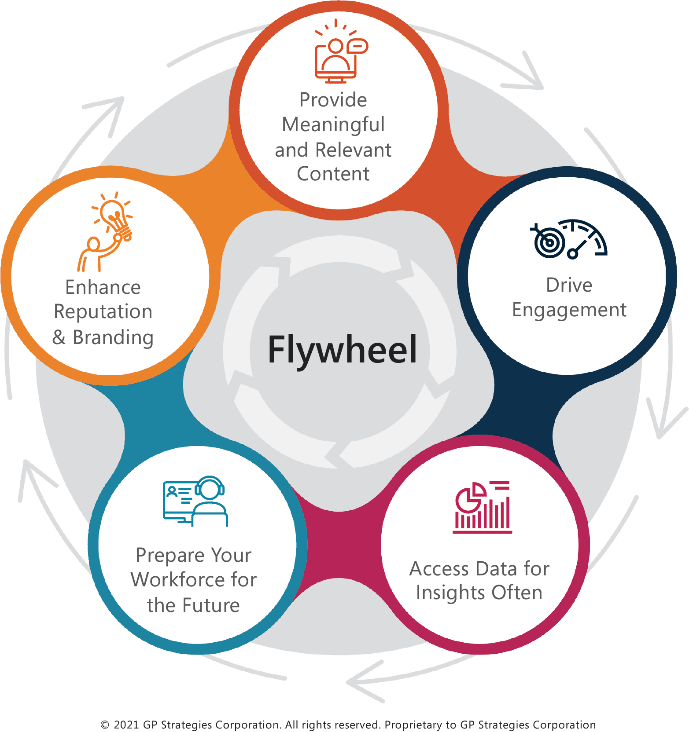
The Flywheel Model1 is a simple way to visualize a holistic engagement strategy.

A flywheel keeps an engine turning between sparks when the fuel is ignited and force is applied to run the engine. The flywheel consists of weighted nodes that generate momentum. With each progressive application of force, the flywheel velocity increases. As with an engine, the same principles apply to learning.

Consider Amazon, a company that began with selling books. First, it focused on improving its point-of-sale (POS) systems, its inventory tracking systems, and its supply chain. After it achieved its goals and had confidence in the performance of these critical systems, it added retail. Amazon’s success in retail proved the repeatability of the model. Now, it has groceries. As it added new features and products, it applied “force” to its nodes. As a result, its flywheel spins faster and generates more revenue and market share.

Figure 1. Flywheel Model—Learning Engagement Strategy has five nodes:

Figure 1. Flywheel Model—Learning Engagement Strategy

At GP Strategies, we have adapted this model to more efficiently and effectively assist our clients on their learning transformation journeys.

  1. Provide Meaningful and Relevant Content: This node is where we provide learners access to content that builds foundational knowledge, skills, and experiences.
  2. Drive Engagement: This node is where we build content awareness, interest, and engagement.
  3. Access Data for Insights Often: We use data to gain new insights and provide the necessary information to inform evidence-based decisions.
  4. Prepare the Workforce for the Future: We help associates apply new learnings and insights within their work environment.
  5. Enhance Reputation & Branding: Our learners share with their peers the content value and they demonstrate to their business leaders how the learning impacted their performance and mindset.

Each node in our flywheel impacts each of the other nodes. For example, the Access Data for Insights Often node informs:

  1. The Provide Meaningful and Relevant Content node, by telling us what content is viewed most valuable as well as when content needs to be refreshed.
  2. The Drive Engagement node, by helping us track overall program engagement progress or, when using trackable links, which communications are most effective. Additionally, this node becomes an engagement multiplier when we apply a systematic experimentation approach that identifies best practices and informs evidence-based decisions.
  3. The Prepare the Workforce for the Future node, which tells when the learners effectively integrate their new knowledge and application into skills. This node also helps us know how well our training and support products are being integrated into the flow of work.
  4. The Enhance Reputation & Branding node helps capture qualitative comments about the content. This information can be used to determine how much internal guerrilla marketing is going on, and which business leaders are really promoting content.

My aha moment came during a discussion with several colleagues while comparing our approaches to training. My colleague’s program was organized and funded to focus only on the top node, building meaningful and relevant content, while the GP Strategies approach integrated a plan to execute the Flywheel Model.

We provide data that demonstrates not only the level of engagement with our content, but could illustrate how applying “force” to multiple nodes at the same time can result in stacked benefits. This approach has led to our ability to show the rate of acceleration over time in high fidelity, bringing lasting change and learner adoption for the organization.

Consider how your organization could benefit from a similar flywheel approach.


1 Adapted from Jim Collin’s book Turning the Flywheel, Harper Business, Feb 2019.

About the Authors

Rocky Ellens
Rocky Ellens is a GP Strategies Sales Enablement Practice leader, helping drive client business-to-business sales team performance. Rocky has over 15 years of experience providing innovative thought leadership and performance consulting across Fortune 100 clients in Manufacturing, Retail, Finance, Food and Beverage, and IT market segments. He holds an MS in Human Resources and Organizational Development. He is a retired Army Colonel experienced at providing a foundation of leadership training and teaming designed to pull work groups together in pursuit of a common objective or goal. Follow Rocky on LinkedIn

Get in touch.

Learn more about our talent transformation solutions.

Transformation doesn’t happen overnight if you’re doing it right. We continuously deliver measurable outcomes and help you stay the course – choose the right partner for your journey.

Our suite of offerings include:

  • Managed Learning Services
  • Learning Content Design & Development
  • Consulting
  • AI Readiness, Integration, & Support
  • Leadership & Inclusion Training
  • Technical Training
  • Learning Technologies & Implementation
  • Off-the-Shelf Training Courses


The Definitive Blended Learning Guide: Resources to Improve Your Approach 

Blended learning has been a popular strategy in L&D for a long time. The term gained popularity around 20 years ago, and since then has become synonymous with multi-channel learning journeys and projects in the workplace. This blended learning guide is here to help you get to grips with it—from the very basics to detailed design and blended model techniques. Take a look through our curated list of blended learning resources below, which includes useful articles, ebooks, webinar recordings, and research. 

We’ll keep adding to this guide as we find and create new blended learning resources, so be sure to check back often! 

Blended is a vital part of many L&D strategies. As with many areas of learning, the COVID-19 pandemic shifted the way we thought about learning blends. Traditionally considered a combination of in-person and online learning, it’s now widely accepted that blended is in fact learning that takes place through a variety of mediums. And sometimes, like when the majority of your workforce is working remotely, all of these elements will be conducted virtually. 

As a blended learning strategy encompasses so many aspects of learning and can include so many modes of teaching, we’ve included some additional related resources at the bottom of this guide covering things like learning games and virtual workshops. For more information on virtual learning in particular, please see our Virtual Learning Definitive Guide

Blended Learning Basics 

Whether you’re just starting your journey or you want to get to know it a little better, these blended learning resources will help you to understand and articulate the key benefits of a blend, why we recommend it, and what other L&D professionals have to say. 

Blended Learning Design & Content 

Now that you’ve gotten to grips with the basics of a blended learning program, it’s time to start your journey. These resources are here to help you think more critically and strategically about how you design your blended learning journeys. Designing content for a blended approach can be a complicated process, but with enough information behind you, there’s so much potential. 

Here, we have everything from blog posts to webinars, and even a couple of case studies so you can get a taste of the blended learning resources and content we’ve created for our customers over the years. 

Blended Learning Strategy 

In this section, we’re talking blended learning models and technology as part of your strategy to help you ensure that you’re using the right tools in the right way to optimize engagement. Your strategy will help you get all the components in place to make the most of your design. These resources focus on models, behavior change, and technology for blended learning. 

Additional Blended Learning Resources & Research 

A few extra bits from us on related topics and some of our favorite articles and books we’ve found during our own research. 

Want to start or enhance your journey with blended learning? Get in touch with one of our experts

About the Authors

Andrew Joly
Andrew leads the strategy and consulting faculty in the Learning Experience team, which is at the frontline of delivering creative, innovative and effective learning solutions. He focuses on his personal passion: how technology-enabled learning experiences and communication blends can transform behaviors and performance in the workplace. Andrew has a passion for exploring how new modes and strategies for learning and connection can make a real difference to people, teams, and global organizations.

Get in touch.

Learn more about our talent transformation solutions.

Transformation doesn’t happen overnight if you’re doing it right. We continuously deliver measurable outcomes and help you stay the course – choose the right partner for your journey.

Our suite of offerings include:

  • Managed Learning Services
  • Learning Content Design & Development
  • Consulting
  • AI Readiness, Integration, & Support
  • Leadership & Inclusion Training
  • Technical Training
  • Learning Technologies & Implementation
  • Off-the-Shelf Training Courses


Using Influencers to Drive Your Learning Strategy

Whether it’s a Kardashian, sports star, or a travel connoisseur, influencers have become more and more visible in the last few years, even if you are not looking for them intentionally. They have some of the most visually appealing photos or videos depicting a version of their life that appears so ideal that we can’t help, if even for a moment, having a little pang of envy. After all, that’s their job—to sell us on an idea, a lifestyle, or a product. Being an influencer has become a common sought-after job to which many aspire, but influencers are not for social media alone. We can identify influencers throughout our organizations and engage them to help us drive intentional change and further a preferred strategy.

Organizational empowerment refers to providing authority to employees to make decisions and act without having to seek approval. This means people use their own intelligence, experience, intuition, and creativity to get involved in the operations of the organization and help the organization improve and succeed. The implementation of strategies involves all the functions and people of a company, which is where influencers become valuable. Influencing is an art or process to encourage people to carry out a certain activity or way of being. People follow those who are bearers of satisfaction of their needs and interests. Specifically, the role of internal influencers can be influential (pun intended) in executing any internal strategy.

Influencers in the workplace are people who have exceptional communication skills and attract an audience naturally. An influencer is a person who has a certain credibility on a specific topic. They have the capacity to generate ideas on a continual basis. Influencers are not people who simply obey orders. They are users who break the traditional barriers and way of thinking in the workplace. An influencer may model the behavior expected from co-workers, understand human behavior, communicate properly, motivate, and lead.

Humans are social creatures by nature, and we take any opportunity to socialize, even in the workplace. We create networks that go alongside the formal organizational chart, and it’s in this spirit that most tasks get done. In an economy where ideas and intangibles drive value creation, leaders need to understand and acknowledge there exists this complex web of social ties from across divisions and functions.

These networks often have one or more members that connect the other members together and drive most of the conversations. These key members are influencers. They can become gatekeepers and build positive movement, or they can create confusion and complexity. Employees seek these influencers out for reliable information about strategies being implemented in a company. Because of this, they can catalyze or sabotage an organization’s newest endeavor; that’s why it is essential to identify influencers.

Here are three tactics to identify your influencers:

  1. You have to dig deep. Sometimes the influencers are the most prominent people. The employees that come to mind first can be those that are naturally social with their colleagues, actively engage in communications, and make an effort to connect with others outside of work. However, sometimes the usual suspects are not the ideal influencers. A case study from McKinsey found that firms miss three of the top five influencers in their organization.
  2. Push them to identify themselves. Create opportunities for these influencers to come forward to you. For instance, you can put out a call across multiple channels letting employees know you’re looking for people willing to play a part in your communications initiative, but that does not require a significant increase in professional responsibilities.
  3. Use snowball sampling. A low-tech yet effective tool is to send out anonymous surveys asking questions on who people turn to in specific scenarios. For example, “Who do you turn to for information to get your work done?” “Whose advice do you trust and respect?” Asking respondents to nominate one or more colleagues quickly maps out true influencers.

A true influencer is a person who has values. Formal leaders should respect the values ​​of the natural influencers in the workplace if they want to establish a fruitful working environment. Internal influencers are people who put a face to the company. Influencers can represent a company, but they will not promote anything that does not fit with their own values.

In order to motivate and empower the influencer in the company, managers and executive leadership must create a climate that induces workers to achieve certain objective and organizational results. It is necessary to create an environment that promotes and develops positive behavior patterns. To influence the behavior of employees, managers need the power to help the informal influencers in the company to correctly implement a given strategy.

How can leaders support influencers?

Here are five ways to empower influential employees:

  1. Change of roles: Assign the influencer with an extension of functional activities, which contribute to strengthening their work performance.
  2. Leadership thinking: Empowerment flourishes in an atmosphere of openness, good communication, and trust. Therefore, shorten the lines of communication between company managers, break down job barriers, and develop better understanding and cohesion in the organization.
  3. Training: Identify the gaps between what an employee should do and what they are currently doing. Once the gaps have been identified, train employees under an orientation towards a change in knowledge, skills, and attitudes.
  4. Performance evaluation: Empowerment requires development of the company’s employees. The evaluation of influencers is a comprehensive feedback process on the performance of their functions or responsibilities to develop or promote them to other responsibilities, levels of hierarchy, or areas of the company.
  5. Self-direction: Self-direction is an immediate consequence of empowerment, but it does not take place unless managers release the control they exert over individuals and work teams. In your first discussions about self-direction, it is necessary to establish the degree of freedom that the person or team will have when making decisions. Every organization must seek the right balance of freedom and its policies or regulations.

Here are three tips to boost influencer development by leaders and formal managers:

  1. Genuine conversations
    Talking with influencers and being open to their ideas is, without a doubt, the first step in the implementation of actions in favor of empowerment. A conversation that allows an influencer to feel comfortable in their workplace establishes a productive and trustworthy environment.
  2. The greater the autonomy, the greater the commitment
    The leader can create processes that increase the autonomy of the influencers. This is extremely important, as employees will feel much more committed and confident. Committed people want to do excellent work and want to be able to correct problems without a lengthy bureaucratic process. By empowering the team, satisfaction is multiplied and company perception is positively transformed.
  3. Train employees to make decisions
    Employees must be able to identify the results of their actions within the organization. Understanding which levels are affected by their decisions enlightens them when making future choices. This can only be achieved with absolute transparency about the current situation of the organization, that is, completely open communication by the leaders.

In an economy where ideas and intangibles drive value creation, leaders need to acknowledge there exists this complex web of social ties across divisions and functions. To sell a strategy to employees, companies need to leverage their organization’s energizers. Influencers are phenomenal change agents that can bridge an organizations’ strategies to their various groups and therefore should be part of an organization’s modern work model. Leaders that leverage their internal influencers and understand the power of their organization’s social networks are on the right track to implement strategies and transform their entire organization.

About the Authors

Keith Keating
With a career spanning over 20 years in learning & development, Keith Keating holds a Master’s Degree in Leadership and has experience in a myriad of areas ranging from Instructional Design, Leadership Coaching, Operations Management, and Process Transformation. More recently Keith has been leading clients on the development and execution of their global learning strategies. Regardless of the role, at the heart of everything Keith does centers around problem solving. He studied Design Thinking at MIT’s Sloan School of Management and found Design Thinking was a perfect tool to add to his problem solving "toolkit". Since then, Keith has been utilizing Design Thinking to help clients tap into understanding and resolving unmet customer needs.
Alex Kummerow

Get in touch.

Learn more about our talent transformation solutions.

Transformation doesn’t happen overnight if you’re doing it right. We continuously deliver measurable outcomes and help you stay the course – choose the right partner for your journey.

Our suite of offerings include:

  • Managed Learning Services
  • Learning Content Design & Development
  • Consulting
  • AI Readiness, Integration, & Support
  • Leadership & Inclusion Training
  • Technical Training
  • Learning Technologies & Implementation
  • Off-the-Shelf Training Courses


My Journey as an Ally

I would like to share the journey of being an ally and how it has had a fundamental impact on my professional and personal life.

I live in Brazil, a country that ranks highest in the world for violence against LGBTQ+ people, in a region, Latin America, that has deep roots in discrimination and prejudice. Being an ally of the LGBTQ+ cause is much more than necessary in this scenario; it is a matter of citizenship and human rights. It is inconceivable, in my opinion, for someone not to be an ally, or not to take a strong position in this regard.

For me, who was born with the privilege of being white and heterosexual, it is vitally important to be an ally and bring discussion, education, knowledge, and openness to all possible places where I can help This means more than simply identifying myself as an ally; it’s by example, the attitudes and real empathy of my everyday actions, that I can make a difference.

At work, my team members are aware of my attitudes and behavior. Receptively, but firmly, I always try to clarify and show why some behaviors that some people consider innocent or just “jokes” are pejorative, aggressive, and inadmissible in an inclusive and diverse environment. The same goes for my personal life. I am deeply proud to say that over time, and with many conversations and clarifications, I saw my parents’ behavior change. They became natural allies, correcting the behavior of people in their circle of friends, as well as being extremely welcoming and supportive of people who came to them for advice about being an ally. So, everyone can be an ally. You just must have the mindset for this direction, and your contribution, even if you think it could be small, can change lives.

There is no recipe or prerequisite to be an ally. All that is needed is empathy, genuine concern for other human beings, and an openness to never stop learning, knowing that doubts appear every day. Every time I have a conversation with an LGBTQ+ person or assist one of GP Strategies’ Employee Resource Group (ERG) sessions, I realize how little I know—but even this little can make a big difference in the environment in which I live. If you have any doubts, ask! If you feel someone is different from you and it makes you feel uncomfortable, seek knowledge and understanding and open your mind. The more diverse our world, the richer it becomes!

About the Authors

Vanda Cunha

Get in touch.

Learn more about our talent transformation solutions.

Transformation doesn’t happen overnight if you’re doing it right. We continuously deliver measurable outcomes and help you stay the course – choose the right partner for your journey.

Our suite of offerings include:

  • Managed Learning Services
  • Learning Content Design & Development
  • Consulting
  • AI Readiness, Integration, & Support
  • Leadership & Inclusion Training
  • Technical Training
  • Learning Technologies & Implementation
  • Off-the-Shelf Training Courses