Learning Games: Multiplayer Mechanics, Subtext, and Gameplay

This blog article was written prior to LEO Learning becoming part of GP Strategies.

When was the last time you watched Jurassic Park? If I was to ask you what it was about, chances are you’d say dinosaurs. And yes, to an extent, it is about dinosaurs. On the surface. However, if you look for the deeper subtext, Jurassic Park is really about parenthood.

The main characters start by looking at dinosaurs on a screen that closely resembles an ultrasound and become guardians to some children through the duration of the film. There are a variety of subtle messages throughout the film that point to the subtext of preparing for parenthood.

You can find out more about this reading of Jurassic Park in this great talk from Mike Hill.

What does this have to do with learning games? Well, games can be all about the subtext too.

The Importance of Subtext in Learning Games

Where a film may use cinematography, dialogue, and multiple storylines to explore a range of themes, games use mechanics, structure, graphics, and progression to do the same. The gameplay becomes a vehicle for the message of the content.

It can be a common misconception among L&D communities and/or stakeholders that learning games need to be specific to their audience. For example, that a game for an automotive company has to revolve around cars or be set in the head office. But this simply isn’t true. The subtext is where the lessons lie.

Let’s look at an example.

An Example: Overcooked

Overcooked is a cooperative multiplayer game set in a restaurant. Each player takes on a different role covering the food preparation, dishing up, cleaning, and dealing with customers. In this, players need to work together to progress through gradually harder services that feature more dishes, changes in layout, and more customers.

Does this game teach players how to cook? No. It teaches them teamwork, coordination, and, critically, the importance of clear communication. So while on the surface, the game may be about cooking or working in a restaurant, the subtext runs deeper.

The Value of Multiplayer Learning Games

Multiplayer games, like Overcooked, provide so many fantastic opportunities for social learning. A lot of this comes not only in the thematic subtext of the game but also in the mechanics of gameplay.

We can look at collaborative, competitive, or combined multiplayer games as they all provide different mechanics and benefits. Overcooked is a great example of a collaborative multiplayer game, where every player has a different purpose to reach a collective goal.

Games tend to encourage problem-solving and critical thinking regardless of how many players are involved. But when we use multiplayer gameplay, they also tap into different areas of motivation and other skills like teamwork, communication, and leadership. This adds to the layers of learning and subtext available, improving the effectiveness of the game for learning.

The Mechanics of Multiplayer Learning Game Design

When designing multiplayer learning games, we can think of the mechanics in terms of three separate dials that we can control to influence the gameplay:

  • Time
  • Goals
  • Rules

Each of these dials pertains to a different part of the game’s structure. When we talk about the Time dial, we mean whether the game is played live, at the same time as other players (synchronously), or at different times to other players (asynchronously).

The Goals dial covers whether the game is collaborative, competitive, or a bit of both. Are the players working towards a shared goal, competing against each other for an individual goal, or working together as a team to compete against another team?

The Rules dial is where things can get particularly interesting. This dial controls whether the gameplay is symmetrical. By this I mean if the players are each following the same rules, processes, and overcoming the same barriers. Is each of the players fulfilling the same role and facing the same challenges?

Each of these three dials can be adjusted according to the needs of your learning game and create different gameplay mechanics.

The example I gave earlier of Overcooked, is played synchronously and collaboratively but with asymmetrical rules as each player serves a different function within the team. Chess, on the other hand, is played synchronously, competitively, and symmetrically.

About the Authors

Rich Calcutt
Rich Calcutt is a Director of Consulting Learning Experience, and also chairs the Game Design team at GP Strategies. Rich's team brings together the science of learning design with the art of play, helping global brands create immersive and impactful experiences that change both mindsets and behaviors. Rich is a believer in the power of games to educate individuals, engage communities, and transform organizations.

Get in touch.

Learn more about our talent transformation solutions.

Transformation doesn’t happen overnight if you’re doing it right. We continuously deliver measurable outcomes and help you stay the course – choose the right partner for your journey.

Our suite of offerings include:

  • Managed Learning Services
  • Learning Content Design & Development
  • Consulting
  • AI Readiness, Integration, & Support
  • Leadership & Inclusion Training
  • Technical Training
  • Learning Technologies & Implementation
  • Off-the-Shelf Training Courses


Getting Started with Learning in the Flow of Work: Make Learning a Part of Your Everyday

Learning & Development in Today’s Environment

The shift to virtual learning over the past decade, and especially in 2020, has transformed the way businesses conduct training. It’s no secret that learning organizations are required to be more agile now than ever before. Gone are the days of browsing endless course catalogs or designing classroom-centered curricula. Instead of in-person learning, we use an LMS, LXP, and social platforms to interact with content. Instead of live workshops, we have virtual sessions on Zoom or Teams. Technology, the great enabler, has given us a wealth of resources to use, and businesses are diving in. But the results can be mixed. While these digital tools were (and are) necessary changes to the way training is delivered, there are other elements to consider in the broader learner experience.

Innovative delivery aside, training is often still viewed as separate from work. At its worst, training is considered distracting, irrelevant to learners’ jobs, and can negatively affect productivity. But in reality, learning typically isn’t separate from work at all.

According to the 70-20-10 learning model (McCall, Lombardo, and Eichinger), learning happens in three ways. Up to 70% of the best, most effective learning happens directly on the job, whether informally or through self-directed practice and experience. Another 20% of effective learning occurs through social collaboration, or learning through others, and just 10% of learning happens in a formal, structured setting like a conference or within an LMS. This makes it clear: in order to make learning more effective, more resources should be dedicated to the 90% that makes up on-the-job and collaborative training. Companies should consider capitalizing on the informal and experiential learning that happens organically.

Looking Beyond the LMS, LXP, and Video Conferencing

It’s important to consider some of the challenges that may arise when transitioning away from formal learning. Research conducted by LinkedIn indicates that time is the #1 reason employees feel held back from learning. Yet while organizations feel employees need to make more time to learn, 58% of learners want to do it at their own pace, and 49% want to learn in the flow of work, or at the point of need. The average learner struggles to set aside just 1% of a typical work week for formal learning. This suggests that it’s not just when we learn, but the way we learn, that makes a difference. It’s become critical to learn both “on the job” and “in the job.”

Compounding the issue of time, there are often many systems for employees to navigate through to access learning. Multiple platforms and training portals can be overwhelming, forcing the learner to search through endless content. Sifting through a collection of web-based trainings, courses, and exams doesn’t deliver the just-in-time training needed. Even microlearning can leave employees lacking if the content is buried among bells and whistles. It’s essential to create a connected learning environment, with the tools employees know and use on a regular basis. A learning technology ecosystem including learning administration can offer the structure and integration learners need.

Finally, virtual learning can isolate employees as they train on their own. Tools like Zoom and MS Teams can help with collaboration and engagement, but they don’t guarantee feedback. Some LXPs and LMSs also have social tools, but they aren’t usually viewed as an integral part of training.  As a result, the opportunity for connection is missed; relegated to the background of the learning experience. There is a better way.

“For learning to really happen, it must fit around and align itself to working days and working lives.” – Bersin

Why Learn in the Flow of Work?

“Learning in the flow of work,” a phrase coined by Josh Bersin, is an evolution of the paradigms in L&D that used to include online universities, talent management, and continuous learning. It involves seamlessly incorporating learning into the employee workday, with content that is accessible, relevant, and engaging. It’s crucial to focus on the descriptors here: seamless, accessible, relevant, engaging. They aren’t just ways to describe the training – they are key to making learning in the flow of work, work. Content must be easily searchable and available at all times. It must be personal. It must meet the moment of need.

Adopting this method has several benefits at the micro and macro level. First, it ensures what employees learn is applicable to their work. It improves knowledge retention by being easy to consume. Learning in the flow of work also enables learners to be more productive as they receive the right information at the right time. Active learners are also shown to be happier and more engaged. They have greater confidence, are more likely to take on additional responsibilities at work, and are more likely to know where they want to go in their careers. It’s not just beneficial for the individual, but for the company as well.

Obstacles to Learning in the Flow of Work

The primary challenge of learning in the flow of work is delivering the right piece of information at the right time. Succeeding in this serves both individual and business goals. But the traditional approach of creating a content library or curated resources creates extra work for employees. They need to invest more time and resources in understanding the tool, which poses a risk of abandoning the platform if learners become frustrated or discouraged. If the content is outdated or irrelevant, the risk is even greater.

Shifting the Focus Inward

It’s clear that not everything an employee needs can be found in an LMS, LXP, or knowledge management system. Much of the time, employees turn to the informal learning, or the 90% referenced above. They can almost always find answers or solutions to their questions and challenges from other people in the company. The richest, most relevant source of information in an organization is not hidden inside the training content but resides within its people. The key, then, to creating learning in the flow of work is delivering the right information, at the right time, from the right person.

Consider leveraging the many tools within the learning technology landscape to connect people with their organization’s experts. Simple lookup directories could highlight areas of expertise for easy searching. Consultation scheduling and management software, and commercial apps and platforms can all meet this need in some way. With this approach, employees receive answers and help on what they need, when they need it, and the experts have an opportunity to showcase their value. Capitalizing on your organization’s internal expertise can translate to real business outcomes and results.

A Roadmap for Change

Other solutions may be a better fit for your organization, so companies should take a strategic approach to implement changes at both the personal and organizational level. Your corporate knowledge systems should be up-to-date and centered around ease of access for the learner. Carefully curated content is paramount, with intentional rollouts of information to employees. Content should also be shared internally (perhaps within in a specific social channel), especially the tribal knowledge and organic learning that can remain siloed in one part of the organization. Integrating external content into the flow of work is also easier than ever, thanks to APIs and system integrations that are practically an industry standard.

Pulling the lever of learning in the flow of work has been a long time coming, but it’s not too late to adopt this new model. Make sure you and your company are benefitting from it, and don’t forget to leverage your organization’s most valuable asset–your people.

About the Authors

Greta Gatzke
Greta Gatzke is a Learning Technology Specialist with GP Strategies Corporation. She works with clients to align business strategy with the ever-changing technology landscape. Her expertise centers in leading platform onboarding and implementation, as well as business and operational change management support. Greta has over 15 years’ experience in the automotive, life sciences, professional services and hospitality industries, working for and with Fortune 500 organizations.

Get in touch.

Learn more about our talent transformation solutions.

Transformation doesn’t happen overnight if you’re doing it right. We continuously deliver measurable outcomes and help you stay the course – choose the right partner for your journey.

Our suite of offerings include:

  • Managed Learning Services
  • Learning Content Design & Development
  • Consulting
  • AI Readiness, Integration, & Support
  • Leadership & Inclusion Training
  • Technical Training
  • Learning Technologies & Implementation
  • Off-the-Shelf Training Courses


BLEND it: Drive Human Connection with Blended Learning for Leadership Development

The challenge―you want to move to a digital learning approach for leadership development, but you are concerned about keeping human connection alive. You need something that uses technology, but you are teaching soft skills. You want to make it fun and engaging, but you want learners to take it seriously.

The answer? A blended learning approach to leadership development. Or, if you prefer—a BLEND approach.

Blended leadership learning journeys have been around for years―that’s nothing new. What is new is the range of options available to create a truly blended journey, fueled by new digital learning solutions, in an ever-increasing number of expanded options. It can be overwhelming and hard to know where to start.

The key is in finding a strategic way to bring different elements of learning together to accomplish your learning outcomes, while simultaneously engaging and exciting the learner. At the same time, ensuring applicability of the learning is critical. 

Just as great chefs must determine the best way to balance the combination of food, seasoning, and cooking techniques, so too must learning professionals bring together content, learner needs, and modalities to create the right blend. And while learner tastes are varied, there are a few essential ingredients that can guide any new creation.

The BLEND Approach to Blended Learning in Leadership Development


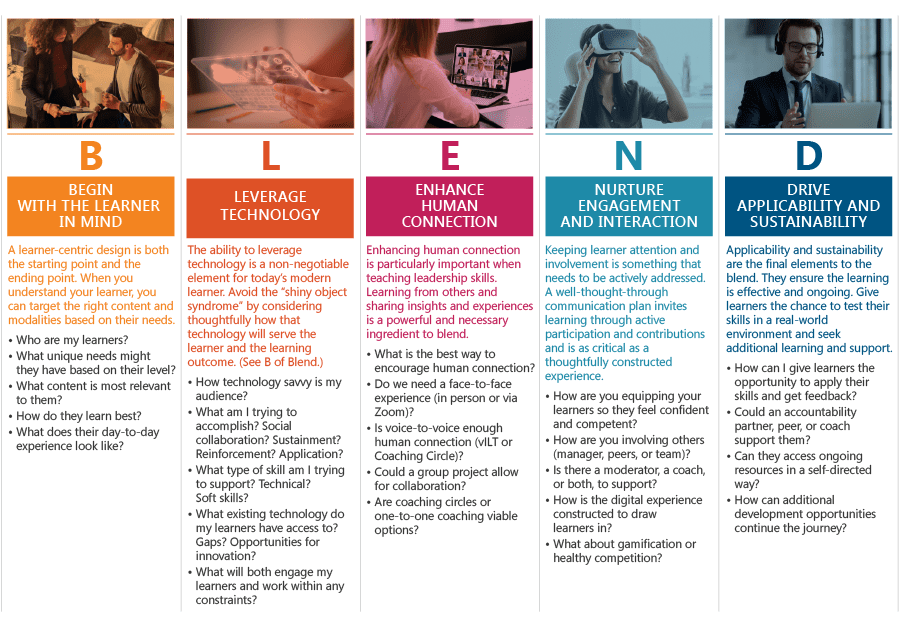
What are those ingredients, exactly? We’re brought them all together in one easy-to-remember framework—or recipe—called BLEND:

B: Begin with the Learner in Mind

A learner-centric design is both the starting point and the ending point. When you understand your learner, you can target the right content and modalities based on their needs. Ask:

  • Who are my learners?
  • What unique needs might they have based on their level?
  • What content is most relevant to them?
  • How do they learn best?
  • What does their day-to-day experience like?

L: Leverage Technology

The ability to leverage technology is a non-negotiable element for today’s modern learner. Avoid the “shiny object syndrome” by considering how thoughtfully that technology will serve the learner and the learning outcome. (See above.) Ask:

  • How technology savvy is my audience?
  • What am I trying to accomplish? Social collaboration? Sustainment? Reinforcement? Application?
  • What type of skill am I trying to support? Technical? Soft skills?
  • What existing technology do my learners have access to? Gaps? Opportunities for innovation?
  • What will both engage my learners and work within any constraints?

E: Enhance Human Connection

Enhancing human connection is particularly important when teaching leadership skills. Learning from others and sharing insights and experiences is a powerful and necessary ingredient to blend. Ask:

  • What is the best way to encourage human connection?
  • Do we need a face-to-face experience (in person or via Zoom)?
  • Is voice-to-voice enough human connection (vILT or Coaching Circle)?
  • Could a group project allow for collaboration?
  • Are coaching circles or one-to-one coaching viable options?

N: Nurture Engagement and Interaction

Keeping learner attention and involvement is something that needs to be actively addressed. A well-thought-through communication plan invites learning through active participation and contributions and is as critical as a thoughtfully constructed experience. Ask:

  • How are you equipping your learners so they feel confident and competent?
  • How are you involving others (managers, peers, or team)?
  • Is there a moderator, a coach, or both, to support?
  • How is the digital experience constructed to draw learners in?
  • What about gamification or healthy competition?

D: Drive Applicability and Sustainability

Applicability and sustainability are the final elements to the blend. They ensure the learning is effective and ongoing. Give learners the chance to test their skills in a real-world environment and seek additional learning and support. Ask:

  • How can I give learners the opportunity to apply their skills and get feedback?
  • Could an accountability partner, peer, or coach support them?
  • Can they access ongoing resources in a self-directed way?
  • How can additional development opportunities continue the journey?
Infographic: Details of the BLEND model, including the headlines. Begin with the learner in mind. Leverage technology. Enhance human connection. Nurture engagement and interaction. Drive applicability and sustainability.

Why is the BLEND more important than ever?

Digital solutions that create more collaboration but less connection can leave leaders feeling like they’ve been offered a feast, but walk away from the table still feeling hungry. We need to appeal to all learners—those who want more technology and those who crave greater human connection. We need to engage extroverted learners who thrive on conversation, and introverts who need time to process their thoughts and express themselves using the written word. We need to keep the experience interesting and varied to avoid learner fatigue.

One thing that the pandemic taught us is the way we work doesn’t need to be an “all-or-nothing” proposition. Blending thoughtfully and intentionally isn’t hard if you follow a few core principles, ensure you have the right ingredients, and season to taste.

About the Authors

Leah Clark
Leah Clark is the Leadership Practice Lead at GP Strategies, as well as an author and the founder of LeaderConnect. With over 28 years of experience in her field, Leah brings a unique perspective on the mindsets and skillset that are critical to leadership success to her coaching and consulting. Her clients benefit from her collaborative approach to crafting a well-connected and thoughtful leadership development strategy. Leah holds a Master of Arts; Organizational Psychology, Columbia University and a Bachelor of Arts; English and Sociology, Boston College.

Get in touch.

Learn more about our talent transformation solutions.

Transformation doesn’t happen overnight if you’re doing it right. We continuously deliver measurable outcomes and help you stay the course – choose the right partner for your journey.

Our suite of offerings include:

  • Managed Learning Services
  • Learning Content Design & Development
  • Consulting
  • AI Readiness, Integration, & Support
  • Leadership & Inclusion Training
  • Technical Training
  • Learning Technologies & Implementation
  • Off-the-Shelf Training Courses


Diversity & Inclusion: Growing Regulatory Expectations for Financial Services

This blog article was written prior to LEO Learning becoming part of GP Strategies.

As diversity and equality move up the list of global societal priorities, they’re also becoming increasingly central to the global regulatory agenda in the financial services sector. Regulators have a responsibility here both as public bodies and employers and as regulators of financial services firms and markets.

The Responsibility of Regulators as Public Bodies

Public bodies should lead by example. Their workforce should be as diverse and inclusive as possible, reflecting the communities in which they’re located and those they serve.

Many regulators, such as the Financial Conduct Authority (FCA) in the UK, have published their own commitments to increased equality and diversity in their own workforce at all levels.

Diversity and Inclusion Supports Growth and Success

Research increasingly provides a strong business case for diversity. According to McKinsey, for example, the most diverse firms are 35% more likely to outperform those that are less diverse.

Of more specific interest to financial services, a study published by the Cass Business School suggests that greater gender diversity improves a company’s risk management culture. This link is illustrated in the study by the relatively low levels of misconduct fines imposed on the European banks with the highest gender diversity.

Despite this type of research and the tangible commercial benefits it suggests, the financial services industry has been slow to change. Research shows that fewer than 1 in 10 management roles in financial services are held by black, Asian, or minority ethnic people. The lack of women of color in senior positions in financial services is a particular concern.

The Lack of Diversity in Financial Services

This lack of diversity at the top not only raises questions about risk management and culture but also about firms’ ability to understand the different communities they serve. The FCA’s ‘Our Financial Lives’ research, for example, shows that black, Asian, and minority ethnic adults are disproportionately represented among the growing number of vulnerable consumers and are therefore at greater risk of financial harm.

The pandemic has shown that women are less likely than men to have the savings needed to weather financial hardship and their employment tends to be more precarious. As a result, FCA’s recent guidance on vulnerability emphasized that all firms need to understand the needs of their customers and be able to respond to them through product design, flexible consumer service, and communications. That is difficult to achieve without the “diversity of background and experience required to overcome biases and blind spots”.

Regulatory Responses to This Lack of Diversity

In response, global regulators are beginning to build diversity and inclusion into their supervisory work. For example, the FCA suggested in a recent speech on the topic that they are considering asking questions such as, “Is your management team diverse enough to provide adequate challenge” and “Do you create the right environment in which people of all backgrounds can speak up?” These types of questions are broader than just representation—they are concerned with culture. 

The FCA has also made it clear that should it see no improvement, it won’t hesitate to use the regulatory tools that it has at its disposal. For example, the diversity of management teams and the inclusivity of the management culture they create could become part of its consideration of senior manager applications.

Taking the Next Steps

The need for inclusion and diversity has impacts beyond regulated firms to the way in which capital markets work. In the US, Nasdaq has taken the lead with its listing rules, which will require all firms listed on its US exchange to have, or explain why they do not have, at least two diverse directors. Other global regulators may decide to follow this lead.

Many investors, including investment banks that underwrite IPOs, are already setting such standards.

Workplace Learning for Diversity and Inclusion

Improving diversity and inclusion in the workplace goes far beyond learning, but it is a good place to start. Whether you want to focus on unconscious bias for hiring managers or creating a more inclusive workplace culture, digital learning can lay the groundwork for further development in this area.

If you want to learn more about what you can do to support diversity and inclusion in your workplace, get in touch with one of our GRC experts.

About the Authors

Renato Hoxha

Get in touch.

Learn more about our talent transformation solutions.

Transformation doesn’t happen overnight if you’re doing it right. We continuously deliver measurable outcomes and help you stay the course – choose the right partner for your journey.

Our suite of offerings include:

  • Managed Learning Services
  • Learning Content Design & Development
  • Consulting
  • AI Readiness, Integration, & Support
  • Leadership & Inclusion Training
  • Technical Training
  • Learning Technologies & Implementation
  • Off-the-Shelf Training Courses


Tone From Within: What Does It Mean for Compliance Learning Programs in the Finance Sector?

This blog article was written prior to LEO Learning becoming part of GP Strategies.

Since the financial crisis, the global financial services industry has been on a mission to rebuild trust through demonstrating sustainable behavioral and cultural change. Changing behavior and embedding those changes within a corporate culture has, however, proved to be a tough challenge and that journey continues.

The journey so far can perhaps be broken into three stages.

Stage 1: The Tone From the Top

In the wake of the financial crisis, there was public disbelief that senior management and executives had not been held accountable. Existing regulatory tools proved to be blunt instruments, unable to pin personal responsibility and accountability on the most senior individuals—a prerequisite to personal fines and other sanctions.

In the UK, in response to the public outcry, the Parliamentary Commission on Banking Standards (PCBS) published a report called ‘Changing Banking for Good’. This in turn shaped the UK’s Senior Managers and Certification Regime (SMCR).

Central to the SMCR is the identification and regulatory approval of a small group of individuals at the top of a financial institution, termed Senior Managers. Key regulatory responsibilities are then formally allocated to each Senior Manager together with an enforceable statutory duty to take ‘reasonable steps’ to ensure that their firm complies.

Although the personal liability here is not strict or vicarious, its imposition has led to a major change in the way that firms are governed. Indeed, self-interest, in the form of self-preservation, has increased the volume of the tone from the top.

Stage 2: The Tone From Above

However, there’s widespread recognition that the tone from the top is a starting point and not the end destination. More recently, the regulatory spotlight has begun to shine on those in management roles at all levels of a firm. Both on their own personal conduct and the way that they manage their teams.

In its November 2018 report “Banking Conduct & Culture, A Permanent Mindset Change”, The G30 refers to the ‘tone from above’. This report found:

“For permanent and ongoing change to occur, banks now need to focus on embedding culture awareness and stewardship at all levels of the organization, with a particular focus on middle management and frontline businesses. Only by making culture stewardship a permanent and integral part of how business is conducted will organizations avoid culture fatigue and backsliding.” (Executive Summary, page xi)

The tone from the top sets the parameters, expectations, and examples. The tone from above, however, is needed to reinforce and sustain them at a local level and ensure that controls, oversight, and culture are cascaded downward.

Stage 3: The Tone From Within

The next stage in the journey, labeled recently as the ‘tone from within’ in a speech published by the Financial Conduct Authority (FCA), the UK conduct regulator, is not connected to management. Instead, it is very much focused on the personal accountability and engagement of individuals at every level of a firm.

The tone from within recognizes that controls and leadership can only get you so far: “the point of failure is not necessarily a failure of compliance […] it is human nature that is the real challenge.”

What Does This Mean for Compliance Learning Programs?

The current regulatory focus on the ‘tone from above’ and the ‘tone from within’ is shaping the approach taken by global compliance learning programs.

Whereas ‘traditional’ compliance learning may have focused primarily on knowledge transfer and the need to prevent a ‘failure of compliance’, current best practice is increasingly focused on ‘human nature’ and the factors that may drive poor behaviors in apparently ‘good’ people.

This focus opens up the possibility of a paradigm shift in the approach taken to compliance learning and the chance to adopt some of the best practices used successfully in other areas of learning.

It’s worth noting the following three trends.

1. Tailored Learning for Line Managers

The tone from above calls for the development of leadership and management skills, beyond what would usually be considered compliance learning. This is especially important when line managers are managing at a distance.

In addition, the tone from above can be explored through the creation of separate learner journeys in digital courses that provide tailored learning for line managers. This approach enables the line manager to interact with the scenarios in courses from the perspective of a line manager and to explore how their conduct can influence the conduct of their team. 

2. Making Knowledge Available On-Demand

One of the key messages taken from non-compliance learning is that mandatory learning downloads are not always the best way to deliver content, particularly technical information. Making learning available on-demand can be a very effective strategy. Learners are used to watching YouTube videos at the point of need—for everything from fixing a bathroom leak to writing a will.

Making knowledge available on demand is a big step for compliance learning, but a valuable one. It does, however, rely on the ability to embed behaviors that drive individual responsibility for learning and competence.

3. Spaced Learning

Spaced learning is another option for moving away from knowledge-crammed, digital one-stop compliance courses. Short ‘bites’ of spaced learning can effectively replace annual courses, keeping topics fresh and front of mind.

Want to learn more about behavioral change learning programs in financial services and other regulation-driven sectors? Get in touch with one of our governance, risk, and compliance experts.

About the Authors

Renato Hoxha

Get in touch.

Learn more about our talent transformation solutions.

Transformation doesn’t happen overnight if you’re doing it right. We continuously deliver measurable outcomes and help you stay the course – choose the right partner for your journey.

Our suite of offerings include:

  • Managed Learning Services
  • Learning Content Design & Development
  • Consulting
  • AI Readiness, Integration, & Support
  • Leadership & Inclusion Training
  • Technical Training
  • Learning Technologies & Implementation
  • Off-the-Shelf Training Courses


Rebuilding, Reskilling, and Reenergizing the Commercial Airline Workforce

Nearly every industry in America was impacted by the unexpected events of 2020, but with the majority of Americans on “lockdown” in their homes, the commercial airline industry—and with it, its workforce—was significantly impacted.

Even with federal relief funds that were contingent on limiting layoffs through September 2020, airlines in the United States had approximately 60,000 fewer employees at the end of the year compared with the beginning of the year (US Bureau of Transportation statistics). On July 14, 2020, Delta announced that it was shaving its workforce by 20 percent through buyouts and early retirements. At the time of the announcement, CEO Ed Bastian commented that he believed it would be more than two years before the industry would recover. In October, United Airlines and American Airlines each furloughed more than 32,000 employees.

As the country continues to increase vaccinations across the population, the commercial air travel industry is seeing a rapid rise in travel. Is the industry ready to handle this surge considering the diminished staffing levels? According to Airlines for America, passenger volume on US carriers was down 53 percent in mid-March compared to pre-COVID-19 levels, but up from the lowest points of 2020.

More travel means that airlines need to begin staffing up once again, but how do airlines replace the knowledge and skills that exited the industry in 2020? Further, how do they enable their workforce to be efficient, effective, and deliver great customer service, while balancing additional safety guidelines, more contactless technology, and so forth?

Step 1: Develop a Workforce Recovery Plan
As airlines begin to adjust their business plans, the workforce must be reskilled and reshaped to meet the needs of a world and industry that have changed drastically. It’s important for airlines to understand how their workforce currently operates versus how their recovery business plan needs them to function. It will be imperative to identify the gaps that exist and the skills needed to fill those holes.

With additional OSHA regulations tied to the ongoing health crisis, a proper road map must include many critical factors; how will airlines balance the need to ramp up their talent quickly to meet rising demand, while also ensuring safe operation of the aircraft and passenger safety?

Step 2: Identify and Develop the Most Critical Skills Needed
Airlines should assess the talent that currently exists within their organization, determine where gaps exist, and develop a plan to fill those gaps. From a cost and time-saving standpoint, it is important to determine how existing skills and capabilities among current staff can be deployed to help achieve desired business outcomes, and which skills need to be hired, trained, or developed. Partnering with a workforce transformation expert can expedite this process.

Step 3: Create a Continuous Workforce Transformation Road Map
Even with high-quality initial training, workers need continuous support if they’re to be successful. Developing a road map that involves frequent check-ins with practical feedback about what’s working and what needs improvement will ensure future success. Sticking to a deliberate and measured approach to building a workforce of the future will provide the right skills to the right people at the right time.

GP Strategies can help you rebuild, reskill, and reenergize your workforce. Contact us to get started on the road to sustainable, forward-thinking change.

About the Authors

Chad Vyhlidal
Chad is VP, Aerospace, Defense & Government Industry Leader at GP Strategies. Prior to GP Strategies, Chad led global teams to consult with and sell to Chief Human Resource Officers and members of the CXO. Chad has 25 years’ experience in the defense, healthcare, information technology, pharmaceutical and professional services industries, working for and with multi-national organizations.

Get in touch.

Learn more about our talent transformation solutions.

Transformation doesn’t happen overnight if you’re doing it right. We continuously deliver measurable outcomes and help you stay the course – choose the right partner for your journey.

Our suite of offerings include:

  • Managed Learning Services
  • Learning Content Design & Development
  • Consulting
  • AI Readiness, Integration, & Support
  • Leadership & Inclusion Training
  • Technical Training
  • Learning Technologies & Implementation
  • Off-the-Shelf Training Courses


SAP SuccessFactors H1 2021 Release On Demand Webinars

The H1 2021 release is here and full of new features and functionality! We have broken down the updates in a series of 10-25 minute On Demand webinars for you to quickly learn what to expect in your updated SuccessFactors environment.

About the Authors

GP Strategies Corporation
GP Strategies is a global performance improvement solutions provider of sales and technical training, e-Learning solutions, management consulting and engineering services. GP Strategies' solutions improve the effectiveness of organizations by delivering innovative and superior training, consulting and business improvement services, customized to meet the specific needs of its clients. Clients include Fortune 500 companies, manufacturing, process and energy industries, and other commercial and government customers.

Get in touch.

Learn more about our talent transformation solutions.

Transformation doesn’t happen overnight if you’re doing it right. We continuously deliver measurable outcomes and help you stay the course – choose the right partner for your journey.

Our suite of offerings include:

  • Managed Learning Services
  • Learning Content Design & Development
  • Consulting
  • AI Readiness, Integration, & Support
  • Leadership & Inclusion Training
  • Technical Training
  • Learning Technologies & Implementation
  • Off-the-Shelf Training Courses


Campaign-Based Learning: Where L&D and Marketing Combine Forces

This blog article was written prior to LEO Learning becoming part of GP Strategies. 

Alongside challenging expectations, pivoting entire strategies, and adapting to a number of sudden changes to the workplace, L&D professionals have also had to reconsider their role within organizations since the pandemic began.

In order to make learning in the workplace sustainable, scalable, and more engaging at a time when we’ve been further apart, a number of roles and responsibilities have had to be adapted. More than anything, there has been a push for a focus on the ‘human element’ of workplace learning.

Part of this includes adapting the way we work and sometimes, combining forces with other departments.

The Crossover Between L&D and Marketing

When we ran knowledge-sharing sessions with senior L&D professionals, several of them said that they’ve been restructuring or re-thinking their L&D function.

Some were looking to combine forces with their marketing and communications teams in the form of integrated learning campaigns. This allows them to drive learning engagement as well as improve internal comms and the uptake of their key learning initiatives.

What Can L&D Learn From Marketing and Communications?

While in many organizations, L&D, marketing, and communications operate as separate functions, there’s clearly a wide range of benefits to joining forces. Whether you’ve engaged in campaign-based learning before or not, there’s a lot each of these departments can learn from each other. 

Marketing is all about driving engagement. It’s about getting your message, your product, or, in this case, your learning initiative, to the right audience at the right time, in a way it will be engaged with. Marketing focuses on understanding your audience, what makes them tick, and the sorts of messages they’re likely to connect with and why.

The level of audience research involved in marketing, as well as their expertise in campaign planning and execution, means that the marketing department can make the perfect partners for the L&D function.

Similarly, communications teams specialize in getting the word out. These are the people who will know organizational dynamics, how people respond to and engage with different types of materials, and how best to get the word out to your employees about upcoming changes and initiatives that live outside of L&D.

What Is Campaign-Based Learning?

While single-event training is, for the most part, a thing of the past, how often do you genuinely plan your learning as if it were a behavior change campaign?

Campaign-based learning is possible without the help of your marketing or comms departments, but bringing them into the process can result in higher engagement levels and an increase in behavioral change.

One of the key components of any learning campaign is what takes place pre-launch. This is also where the marketing department can really help you shine. Pre-launch activities or materials for a new learning initiative can include:

  • Teaser trailers
  • Emails (talk to your marketing team about nurture)
  • Social media
  • Competitions
  • Prizes
  • Posters
  • Billboards

Ultimately, campaign-based learning, and the launch campaign that runs before it, can be a great way to get your learners engaged and immersed in their learning experience. One of the best motivators you can tap into here is the competitive nature of your employees. Creating leaderboards or competitions between individuals, branches, and departments can be a great way to encourage people to engage in your learning campaign.

Spreading the news of your new competition or campaign is where your communications team comes in. It’s one thing to put a poll out on social media, but it’s a whole other thing to entice people to take part with the chance to win a prize. Or even just bragging rights.

How you approach this will depend on the culture of your organization. But it can be well worth talking to the departments who are responsible for getting people engaged in your news, products, and services. They can be an incredibly valuable resource and can help you to measure engagement with your campaign.

Key Takeaways about Campaign-Based Learning

  • Combining forces with your marketing and internal comms departments allows you to make the most of each department’s skillset.
  • Campaign-based learning can be a fantastic way to increase engagement.
  • Competitiveness can be a fantastic motivator and engagement tool.
  • Teasing the new initiative in a pre-launch campaign can boost engagement and interest.

About the Authors

Andrew Joly
Andrew leads the strategy and consulting faculty in the Learning Experience team, which is at the frontline of delivering creative, innovative and effective learning solutions. He focuses on his personal passion: how technology-enabled learning experiences and communication blends can transform behaviors and performance in the workplace. Andrew has a passion for exploring how new modes and strategies for learning and connection can make a real difference to people, teams, and global organizations.

Get in touch.

Learn more about our talent transformation solutions.

Transformation doesn’t happen overnight if you’re doing it right. We continuously deliver measurable outcomes and help you stay the course – choose the right partner for your journey.

Our suite of offerings include:

  • Managed Learning Services
  • Learning Content Design & Development
  • Consulting
  • AI Readiness, Integration, & Support
  • Leadership & Inclusion Training
  • Technical Training
  • Learning Technologies & Implementation
  • Off-the-Shelf Training Courses


Live vs On-Demand Learning: How to Know What’s Best for Your Initiatives

This blog article was written prior to LEO Learning becoming part of GP Strategies. 

When it comes to delivering learning, whether virtually or in person, one of the key things to consider is whether to present it live or provide it for on-demand access. And sometimes, the answer will be both. However, the key here is to understand the benefits of each as well as what your learners need from the content and when they need access to it.

Deciding whether you want to conduct live (synchronous) or on-demand (asynchronous) learning requires a lot of thought. And there are of course opportunities for both. You can record a webinar and distribute it, for example. Recording video has become common practice for many organizations as we’ve been learning remotely.

There are occasions when choosing one or the other simply makes more sense. I’ll take you through a few of each. These are not rules by any means, they are considerations that can point you to live and/or on-demand.

When to Choose Synchronous (or Live) Learning

Examples of synchronous learning include in-person training events, conferences, webinars, coaching, and virtual workshops. Learning is considered synchronous when the facilitator and the learner are experiencing the event at the same time.

There’s a wide range of reasons why synchronous learning or training may be the best approach, and it all comes down to circumstance and context. Check out these three examples.

1) Real-Time Interaction and Visibility

In some circumstances, a facilitator needs visibility of assessments and completion of training. There are also considerations for hands-on training—whether that’s for a certain piece of equipment or learning involving other people. For example, I recently took part in Mental Health First Aider training which involved working directly with others, so this had to be completed live. Additionally, a facilitator may be required to observe certain skills or behaviors as part of the learning.

2) Time-Sensitive Training

This can include sessions with guest speakers or experts who are only available at specific times, or when your employees need training by a specific deadline. Sometimes, it’s simply quicker to get someone on a broadcast than to produce a digital module. This is particularly common for regulation-focused training or if there’s a pending internal rollout of software, systems, or processes.

3) Unpredictable Needs of Knowledge Gaps

This all comes down to how you can best support your learners through the process. If you don’t know which questions may come up—or are unsure of the pain points in what you’re teaching—it’s important that you’re there to support the learning process. Additionally, if the training is particularly complex and some elements may prove difficult for the learners, your presence there with them, whether virtually or in-person, can do a lot to ease that pressure and aid the learning.

When to Choose Asynchronous (or On-Demand) Learning

Examples of asynchronous learning include eLearning modules, webinar recordings, offline components of blended learning, and digital learning games.

Live training doesn’t always fit the purpose of the learning or the needs of the participants. A common misconception is that in order to generate contributions, a session needs to be delivered live. However, there are a variety of reasons why on-demand learning is more suitable.

Let’s look at a few:

1) Needs and Priorities of Your Learners

Learning needs to be learner-centric, so you have to consider their circumstances. Maybe they’re across time zones or, for myriad reasons, they can’t gather into the same space at the same time. My favorite reason to use asynchronous learning is when learners need their own time and pace to consume and reflect on the learning before they can contribute.

Learning styles are critical and we tend to cater to the more outgoing personalities thinking that, because they’re more active, they’re more engaged. This is simply not true. For many learners being engaged is an internal process. In this sense, asynchronous learning supports the learning style.

2) Repetition and Access

It’s also worth considering whether this is training some people may need repeat access to. For example, if it’s covering something particularly detailed or complex, it’s worth creating a resource or training mode that allows for repeat access. Additionally, breaking the learning up into smaller chunks, either through learning or a wider blend, can be really useful if there is a lot of information to retain. Creating learning that’s available at the point of need can also be incredibly useful for both engagement and effectiveness of the learning in a variety of situations—for example, product-knowledge training for salespeople.

3) Consistency and Tone

On-demand learning gives you more time to prepare and keep every element of your learning consistent. This is particularly important for mandatory and/or regulatory training. It means you can apply the exact same message in each element of the learning. Additionally, consistency in how your message is being received or delivered can be hugely important in communication around business transitions, cultural changes, and internal systems/software changes.

Deciding Between Live vs On-Demand Learning

Consider the above as guidelines to help you make your choice. By no means are these direct or specific rules; they are considerations for a more effective learning journey. You may have seen this coming: my advice is that the best option is often a blend of synchronous and asynchronous learning. Hopefully these considerations can help you decide which elements are most suited for your learners.

About the Authors

Rose Benedicks

Get in touch.

Learn more about our talent transformation solutions.

Transformation doesn’t happen overnight if you’re doing it right. We continuously deliver measurable outcomes and help you stay the course – choose the right partner for your journey.

Our suite of offerings include:

  • Managed Learning Services
  • Learning Content Design & Development
  • Consulting
  • AI Readiness, Integration, & Support
  • Leadership & Inclusion Training
  • Technical Training
  • Learning Technologies & Implementation
  • Off-the-Shelf Training Courses


Learning Technology Selection: Where to Find Your Tiny Needle in the Industry’s Very Large Haystack

A Process for Selecting the Right Technology at the Right Time

Let’s face it: It’s easy to be overwhelmed by the sheer number of learning technologies out there. Especially now, with the emphasis on digital transformation and explorations into artificial intelligence and rich media, new vendors and tools are hitting the market daily making learning technologies selection a challenge for any organization. Training Industry created a graphic of the players in the space and it is simply mind-boggling.

The fact is, the more digital we go, the more technology we need. As you try to make sense of all the different platforms, devices, content management solutions, analytics tools, learning assets, and experience boosters, consider this: The best, most admired industry-leading tool may not be the best tool for you. And ultimately, that is what makes technology selection so hard. The risks of selecting a technology that doesn’t quite work for your needs are increased costs, poor user adoption lower, engagement rates, systems integration and security issues, and missed learning goals.

Additionally, once you have the technology or set of technologies for your needs, the next challenge is bringing them together into holistic learning experiences and seamless integrations across systems. It’s easier said than done.

So how do you sort through all these tools and platforms? Which are right for your learners? And which align best with your:

  • Desired learning experience?
    • Technology constraints and existing systems?
    • Business needs?
    • Timeline?
    • Budget?

The art of the possible through a 5-step innovation process

GP Strategies’ Innovation Kitchen is a digital laboratory, of sorts, where practitioners and stakeholders can explore the art of the possible through strategic testing and piloting, allowing them to identify viable innovative platforms, methodologies, and partners. To vet a technology or approach, we employ a five-step process:

  1. Discover. In this phase, you learn about the available technologies for what you are trying to accomplish.
  2. Refine. Use your stated objectives or business needs to vet the technologies against your needs, thereby refining your list of prospective solutions.
  3. Experiment. Test your solution and see if it is viable for your needs.
  4. Reflect and share. Review what you have learned and share your results across your organization.
  5. Integrate. Choose the solution best suited to your needs and incorporate it.

We admit it’s not as easy as it sounds. So let’s take a look at the process in action.

How one company got their game on in just a few short weeks

To illustrate the process further, one of our clients is planning a major product launch and they will soon be planning their pre-, during and post-launch training. They are looking to expand their gamification capabilities beyond what their current solution allows. So they came to us asking which technologies they should look at. They wanted an answer fast. We handed over their options in three weeks.

Learning technologies selection: First things first

The first thing we did was ask them a question: What does gamification mean to you? This is a critical first step, because its meaning and value are different for everyone. It can mean game-based learning, in which the game itself is the content. It can mean gamifying the content or learning, adding in game elements. It can mean both. Or perhaps neither approach matters as much as the benefits you want to achieve, such as:

  • Increasing learner engagement
  • Assessing complex activities
  • Changing behaviors
  • Incentivizing and motivating learners
  • Capitalizing on the addictive nature of games
  • Demonstrating ROI

Our client wanted an approach that allowed for both push and pull engagement approaches, that leveraged the competitive nature of their sales force, encouraged continued access, and included a feedback mechanism for continual improvement of the program. Looking deeper, we established seven need-to-have criteria against which all options would be measured.

Selection criteria:

Sorting through the options

The next step was drawing up a list of options. For this, we consulted the experts in our own Innovation Kitchen who have vetted and experimented with hundreds of platforms and solutions. Beyond that, we undertook some web-based research, consulted the Association for Talent Development (ATD), searched learning industry sites, and more. The result was a list of 20 prospective solutions.

Our team then assessed those solutions based on the seven criteria established with the client and ranked each platform according to whether the team recommended it—yes, no or maybe. Only eight solutions made the cut. Then we reviewed those eight and chose the top four candidates.

Drilling down even further

Our team now had four solutions, any one of which we would be happy to recommend to the client, but we wanted to assess them further. We did a strengths and weaknesses comparison of each platform. Here is an example (the strengths and weaknesses may be different for each company):

We compared features. (Platform Seven was the client’s existing gamification solution.)

We created a heat map using client criteria and the Likert scale for measurement.

We also created a radar chart that allowed us to visualize where each option was strong or unique.

Finally, we compared prices–always a challenge with different pricing structures.

After we amassed all the data and made all the comparisons, we were able to present the client with four options, two that could double as primary learning platforms and two that were interstitial tools.

Things to keep in mind for your own assessments

Just as it’s important to view every vendor and solution through the lens of the business need you’re trying to fulfill, it’s also important to be consistent in how you conduct your review and collect data. Keep these tips in mind as you assemble your team:

  • Informed opinion. The opinions, votes, and rankings provided by your team members should reflect informed opinion, supported by research, experience and knowledge.
  • Consistent reviewers. Use the same team members throughout the process.
  • Consistent criteria. Establish a fixed set of criteria you will use and assess based on that criteria throughout.
  • Strengths/weaknesses. Measure the strengths and weaknesses of the solution in the context of the client’s criteria. A solution that may not have been originally made for your intended purpose may actually do a better job than an industry leading solution. You are not looking for the best solution. You are looking for the best solution for you.
  • Likert scale. Use the 5-point Likert scale to measure the capability of each solution:
    1. Does not have/support this feature
    2. Has feature, with noted limitations
    3. Has and can support the feature
    4. Has feature & intent/ability for improvements, but requires additional work
    5. Strongly supports feature, easy to use, easy to implement/build

Ultimately your goal is to improve the overall learner experience with whatever solution you choose. Doing a thorough assessment will help you avoid shiny objects, focus on business impact and provide a tool that meets the shifting needs of the modern learner.

For more on learning technologies

Future Workplace: Viability of Virtual and Augmented Reality for Business and Learning Professionals

About the Authors

Tom Pizer
Director of Learning Technologies for GP Strategies Learning Solutions Group, has over 20 years of experience in the technical digital media field. He has an extensive background in a variety of creative and technical media, including digital media specification, production, testing, and implementation. During his career, Tom has created, specified, directed, and/or managed hundreds of hours of educational, instructional, and entertainment-based media and has served clients in a wide variety of markets including the federal government, trade associations, commercial organizations, and educational institutions. A key aspect of Tom’s responsibilities includes staying abreast of emerging technologies and in-tune with the latest development methodologies, standards, and practices. To this end, he takes part in monthly advisory meetings for several of GP Strategies clients to ensure that their courseware is of the highest caliber and meets rigorous development requirements. Tom is also the technical lead for several proprietary GP Strategies technologies that are designed to reduce overall development time while increasing the creativity and diversity of GP Strategies body of work.
Cara Halter
Cara Halter is the Director of Innovation Research & Development for GP Strategies, where she consults with clients on digital learning transformation, creation of innovative digital learning experiences, and learner-centric design principles to maximize business impact through learning. Cara has 20+ years of experience working with Fortune 500 companies and a masters degree in instructional design & technology (UGA). She has split her professional experience between an internal L&D team at a financial services company and as a consultant with top learning companies, giving her a true customer-focused approach in designing, developing and delivering learning solutions. She has worked with clients in finance, pharmaceutical, insurance, technology, and retail to transform their learning operations, optimize their learning systems, and create award-winning programs. Her deep knowledge and experience in digital learning technologies and instructional design continue to drive her passion for finding creative ways to address the needs of the modern leaner.

Get in touch.

Learn more about our talent transformation solutions.

Transformation doesn’t happen overnight if you’re doing it right. We continuously deliver measurable outcomes and help you stay the course – choose the right partner for your journey.

Our suite of offerings include:

  • Managed Learning Services
  • Learning Content Design & Development
  • Consulting
  • AI Readiness, Integration, & Support
  • Leadership & Inclusion Training
  • Technical Training
  • Learning Technologies & Implementation
  • Off-the-Shelf Training Courses