The Imperative of Cultivating a Culture of Continuous Learning and Development

In the ever-evolving landscape of the professional world, one thing remains—and will always remain —constant: the need for continuous learning and development. As modern-day leaders, it’s not just a matter of keeping up with trends; it’s about setting the stage for innovation, growth, and sustainable success.

The Paradigm Shift

Gone are the days of static knowledge and one-size-fits-all solutions. Modern-day leaders must embrace a growth mindset that thrives on curiosity, adaptability, and resilience. Why? Because the business world is a dynamic ecosystem where change is not just inevitable but also an opportunity for those who are prepared.

The Power of Learning

Imagine a team where every member is not just proficient but constantly pushing the boundaries of their expertise. This is the power of continuous learning. It fosters creativity, problem-solving abilities, and a culture of excellence. When leaders prioritize learning, they empower their teams to innovate, experiment, and find novel solutions to complex challenges.

Embracing Diversity and Inclusion

A culture of continuous learning is inherently inclusive. It values diverse perspectives, experiences, and backgrounds. By encouraging learning at all levels, leaders create an environment where everyone feels valued, heard, and motivated to contribute their best. This inclusivity drives innovation and drives the organization forward.

Navigating Uncertainty with Confidence

In today’s volatile world, uncertainty is the new norm. However, leaders who prioritize learning are better equipped to navigate ambiguity and uncertainty with confidence. They encourage their teams to embrace change, learn from failures, and adapt swiftly to new realities. This agility is a game-changer in a fast-paced, competitive landscape.

Future-Proofing Your Organization

The future belongs to those who are prepared. Leaders future-proof their organizations by fostering a culture of continuous learning and development. They ensure that their teams are equipped with the skills, knowledge, and mindset to thrive in tomorrow’s challenges. This proactive approach not only mitigates risks but also unlocks new opportunities for growth and innovation.

Strategies for Cultivating a Learning Culture

  1. Lead by example: As a leader, your actions speak louder than words. Demonstrate your commitment to learning by investing in your own development and sharing your insights and learnings with your team.
  2. Empower your team: Provide resources, support, and opportunities for learning and growth. Encourage cross-functional collaboration, mentorship programs, and continuous feedback to foster a culture of shared learning.
  3. Celebrate learning: Recognize and celebrate achievements and milestones related to learning and development. Create a culture where continuous improvement is celebrated, not just expected.
  4. Embrace technology: Leverage technology to facilitate learning initiatives such as eLearning platforms, virtual workshops, and artificial intelligence (AI)-driven analytics to personalize learning experiences and track progress effectively.
  5. Create a Feedback loop: Establish a feedback loop where employees can provide input, share their learning needs, and contribute to shaping the organization’s learning priorities and strategies.

The Imperative of Cultivating a Culture of Continuous Learning and Development

In conclusion, the imperative of cultivating a culture of continuous learning and development cannot be overstated. It is not just a competitive advantage; it is the lifeline of modern organizations. As leaders, it’s our responsibility to champion learning, embrace change, and create a future where success is not just achieved but sustained. Let’s unlock the full potential of our teams and organizations by embracing the power of continuous learning. The journey starts today!

About the Authors

Rajdeep Dutta
With 25 years of diverse professional experience, Rajdeep is a seasoned manager and operations expert who is deeply passionate about people, learning and development, and leadership growth. His career has spanned across renowned organizations like GE, HSBC, as well as smaller enterprises. His roles have ranged from operations and capacity management to analytics and learning & development. Rajdeep is passionate about his work and views his team and the individuals within it as his greatest assets, prioritizing their growth and well-being above all else. His personal and professional development are intricately linked to their progression, making their success his ultimate goal. Beyond his professional life, he proudly plays the role of "Mr. Bean" to his 21-year-old daughter and a four-legged feline friend. He’s a certified herpetologist, driven by a passion for reptiles, particularly snakes. This passion has taken him to some extraordinary places, creating indelible memories and even a few bites along the way. In addition, he is an amateur photographer who captures the beauty of the natural world.

Get in touch.

Learn more about our talent transformation solutions.

Transformation doesn’t happen overnight if you’re doing it right. We continuously deliver measurable outcomes and help you stay the course – choose the right partner for your journey.

Our suite of offerings include:

  • Managed Learning Services
  • Learning Content Design & Development
  • Consulting
  • AI Readiness, Integration, & Support
  • Leadership & Inclusion Training
  • Technical Training
  • Learning Technologies & Implementation
  • Off-the-Shelf Training Courses


5 Steps to Creating Better Learning Events

Whether you are bringing together thousands of people from all around the world for a hybrid all-employee conference or hosting 20 team members for a half-day off-site training course, there’s a big difference between learning events that are good enough and those that are truly memorable.

Based on our experience designing, developing, and delivering learning experiences for clients around the world, there are five steps you should take to create better training events.

#1 Determine Your Why

Planning is a central component of every learning event, but what you do before you plan the intricacies of an event can make or break your results. Every good event has clear objectives, scopes, timelines, and budgets. But the most important element to align on in the beginning is why. Why do you want to produce this experience?

As I was thinking about how to communicate the importance of why questions, my brother introduced me to an old TEDx talk by Simon Sinek titled “Start with why,” which sums up the concept beautifully. When you understand the why, you can establish discipline in your decision-making. It creates a space to explore, be creative, and have productive discussions—and it also creates a guide every individual supporting the event can keep top of mind in any decision or action they take throughout the event process.

The why planning phase will set your team up for success as a whole and as individuals. Failing to prepare at this stage is not only preparing you for failure (as the expression says) but setting up your team for failure. Without proper goals, scope, and parameters, how can they deliver a winning event? Good planning gives clear direction, enables people to work more efficiently and effectively, and aligns the team toward clear, shared goals.

#2 Carefully Choose Project Managers and Sponsors

Once you have tackled your why and know what you will be working toward in the coming weeks or months, it’s time to structure your team. Organizations often start this phase by defaulting to a formal hierarchy, placing executives or managers in charge. But that’s not always the right approach for hosting a great learning event.

Instead, take a step back and build your team around the scope of your event. Who are the right people to ensure all the actions, tasks, and communications will happen as planned? Once you determine who that is, you can start your project planning. Set clear deadlines and put processes in place before you begin the day-to-day work; these keep your aim true. At this stage, you need an experienced project or program manager.

It is critical that your project manager does not allow the project timeline to slip. You put those deadlines in place for a reason and must hold to the schedule as much as possible. Recruiting an executive sponsor can help to set expectations about how the team will work and reaffirm alignment on the why. At first, this may seem like a recipe for conflict, but in our experience, it has built surprisingly strong partnerships and relationships across the organization.

#3 Create a Risk Mitigation Plan

After identifying your why and choosing your project leads, you need to develop your risk planning and mitigating strategies. In the risk planning phase, you should consider everything that could go wrong. What could cause your deadlines to slip? Could there be a delay in reviews or approvals, and if so, how would you mitigate that?

Challenges always arise when planning training events—people get sick, they have car trouble, they lose internet access—but don’t let that stop you! Ensure your team members know it’s all right when something unexpected happens. Your plan includes processes for this very reason. If you lay the groundwork upfront, it will be easier to stay on track.

Even after all your planning, you may still be surprised when something does not go quite to plan. Encourage your team to lean into the discomfort—something better than you planned may come from solving problems that pop up. If this happens, your team can forge stronger relationships and partnerships based on the shared experience of solving a challenge, and it will be satisfying to recognize those innovative solutions when the experience is over. Being part of these situations can also be invaluable to junior colleagues, imparting problem-identifying, problem-solving, and collaboration skills that will help them weather the inevitable storms in their careers.

#4 Identify Event Support and Staffing

Whether your event is fully virtual, hybrid, or in-person, it needs to be adequately staffed with team members who are collaborative, flexible, calm, proactive, and understand the why of the event. The event support staff will interact with people who, whether taking part by choice or by requirement, value their time and want to ensure that what they are doing is meaningful.

When determining how much support staff is necessary, think of the participants’ experience from the beginning of the event:

  • What will it feel like when they arrive at the building or join your online event?
  • How will they know where to go to?
  • Who will greet them?
  • Where do they get their itinerary?
  • Will they know where to go if they have a unique issue and need help?

Ensure your learning event support staff includes enough people. We often encounter sponsors who imagine they can run a good event with just a couple of people. But our general rule is to bring in at least one more team member than your intuition tells you. Unforeseen issues will arise, and you will need that additional help.

Your team’s ability to adapt to evolving circumstances is what will make your event successful. Regardless of all the planning you have done, the event will fall short if your team does not respond correctly in the moment. This means your event staff should be considered early on and should not just be a group you pull together at the last minute.

#5 Select an Event App for Data-Driven Insights

We often recommend the use of event applications (apps). There are several event apps on the market, each with distinct features to enhance an event and help organizers achieve their goals.

Integrating an event app brings events into the digital world, adding to the comprehensive experience for participants. We also live in a tech-driven society, and we know participants will be on their devices during the event. Rather than struggle against technology, embrace event apps by using them to:

  • Give attendees critical information, like itineraries and important locations.
  • Create opportunities to make connections and build engagement.
  • Send updates and other communications to participants.
  • Capture attendee reactions in real-time, whether they are joining online or physically.

As the organizer, you can also generate reports before, during, and after your event to identify where you are and are not aligned with your why. For example, you can discover the participants who drive the most engagement (while also learning who may not be as invested) and send surveys, the results from which can inform what you do in your next program.

Making Training Events Meaningful and Effective: Embracing the Why

Learning events that make an impact embrace the why before, during, and after the event. These events are the ones where—from the first communication the participant receives to the questionnaire they take at the end—they feel that the experience was catered to them. And that is how your learners should feel.

At all stages of your event—from the design, development, and delivery of your learning event—remember that the why should drive every action your team takes.

About the Authors

Emily Walker
Emily Walker, Global Learning Events Manager, has been with GP Strategies since starting our McKinney Rogers division in 2017, supporting C-suite clients with their vision and mission planning, elite performing teams, and end-of-year conferences. She moved to our Managed Learning Services practice in 2019 to lead the professional services learning administration team, managing our approach to leadership learning and training events. Since then, Emily has built a global learning events management team supporting partnerships across multiple industries.


Get in touch.

Learn more about our talent transformation solutions.

Transformation doesn’t happen overnight if you’re doing it right. We continuously deliver measurable outcomes and help you stay the course – choose the right partner for your journey.

Our suite of offerings include:

  • Managed Learning Services
  • Learning Content Design & Development
  • Consulting
  • AI Readiness, Integration, & Support
  • Leadership & Inclusion Training
  • Technical Training
  • Learning Technologies & Implementation
  • Off-the-Shelf Training Courses


Using Vision to Drive Program Success

Leading programs can sometimes feel like sailing a ship through a storm. Much like ship captains, program managers face enormous pressure in bringing large groups of people together to deliver value on time and on budget, while fighting to stay afloat in an ocean of ever-shifting priorities, complications, and delays.

With tight deadlines and a significant financial investment at stake, it’s critical for organizations to get things right from the start. A strong vision provides your program with a guiding light that unites teams and forges successful program outcomes. Program management can greatly raise the likelihood of success by crafting a quality vision statement, aligning objectives with existing business goals, and cultivating a team that embraces innovation and adaptability to achieve the program vision.

Lead with Strong Vision

When launching any company initiative, your first step should be creating a vision that defines exactly what it is that you’re trying to achieve. A vision is a short message that maps out the future of your initiative. It should be memorable, aspirational, and easily consumable.

The vision serves as your program’s North Star. It clarifies the initiative’s purpose and provides direction to stakeholders at all levels of the organization. A strong vision will help align leaders on the program’s scope, prioritize the proper resources, and enable leaders to focus the team on the key outcomes for the program and organization.

Creating a Vision Statement

Creating a vision statement may sound simple at first, but the task is typically not that straightforward. Crafting a vision is a process, and one that should not be shortchanged. The key to a quality vision is that it must inspire team members to engage in the program and deliver value for the organization.

Start by assembling key stakeholders and influencers from across your organization to gather their input. Individuals in different roles and functions will bring their own unique perspectives and priorities to the initiative. It’s not unusual for this process to inspire passionate debate—and that’s a good thing. The more input and effort that goes into your vision, the more accurately it will reflect the value and desired outcomes the program will bring to the organization.

There are several activities that can help with crafting a vision, like creating a Future Press Release. In this exercise, the group envisions a future in which the program has been successfully completed. This serves two purposes: First, it provides a method for collecting key messaging for the vision. Then it can be used to develop the plan by working backward to establish the steps that led to that success. This technique is useful for identifying potential disruptions that could occur during the program. Most important, it will help you craft a vision strong enough to guide the team through the challenges of achieving the intended program outcomes.

Ensure Real Value Through Strategic Alignment

Once the vision for the program has been defined in terms of the organization’s strategic goals, the next step should be breaking the vision down into program goals and objectives. It is critical that a connection be made between the vision, the program’s goals and objectives, and the organization’s strategy. This enables the team to focus on smaller objectives that roll up with a clear path to the organization’s strategic goals. That may seem obvious, but it is common for teams to divert from the program’s desired outcome and strategic objectives. A good vision enables the team to stay focused on the reason the organization is investing in the program.

Much like with a vision, a set of aligned goals brings all stakeholders together with a clear line to established priorities. Returning to the ship metaphor for a moment, think of these goals as critical stops on your program’s journey. Providing a map to well-established ports will help everyone on board to understand precisely where they are headed. The same logic applies in an organizational setting. Tying your program goals to established objectives will greatly improve your stakeholder management efforts by providing clear path forward that can be understood by everyone.

Building Strategic Alignment

Once you’ve understood the organization’s objectives and aligned your program outcomes to them, you can then focus on creating goals for the program itself. Start by defining value-added outcomes that will impact the organization’s objectives. If your organization uses Objectives and Key Results (OKRs), select the OKRs that your program directly supports and build your goals accordingly.

A “walking deck” is a key tool to reinforce strategic alignment. This is a short slide deck (typically no more than three slides) that outlines the program’s vision, goals, and OKRs that correspond to the organization’s strategic objectives. The walking deck serves as a map that keeps stakeholders and program teams focused on the same goals as the program moves forward.

Prioritize Innovation and Adaptability

Program team members function like a crew made up of diverse individuals navigating the unknown in pursuit of a shared goal. Ships function best when individual crew members take ownership of their role and are empowered to solve their own problems. The same overriding principles apply here as well. Use the program vision and walking deck to provide the reason why the program exists and the intended outcome of the solution the team will develop. It is critical to let the teams defining the solution to determine how the solution will be developed. Then, validate that the solution being developed will result in the intended outcome, achieving the desired organizational objective.

As the team works to determine how they will develop the solution, encourage them to be innovative and adaptable. This makes it more likely that they will develop a business solution that meets or exceeds the desired program outcomes. Unfortunately, innovation and adaptability rarely happen organically; they need to be purposely cultivated.

Cultivating Innovation and Adaptability

Experimentation is a key component of innovation. To cultivate innovation, leaders need to create an environment that empowers teams to work locally and solve their own problems. Building opportunities for employees to experiment in their work fosters creative problem-solving and enhances program outcomes.

Innovation goes hand in hand with adaptability. The more creative your team members are, the more efficiently they’ll be able to react to challenges. Creating an adaptable work culture goes beyond equipping your team for change. By embedding change into the way team members work, you create a culture in which change is not seen as something to be feared, but as an opportunity for continuous improvement.

While encouraging program managers to foster innovation and adaptability in their programs, emphasize that the solution being developed will achieve the program vision, drive the desired outcome, and result in supporting the organization’s strategic objectives.

Building Vision and Change Through Collaboration

Leading programs can be a voyage into the unknown. As with any journey, your program requires a well-defined destination, a solid plan, and a trusted team able to adapt to changes and be innovative when possible. Vision is the critical component that unites teams and ensures that the organization’s investment results in a full realization of benefits. Achieving program outcomes and strategic objectives is never easy, but by stating your vision as clearly as possible, you can focus the team to achieve your intended business results.

For more, learn about The Value of Burndown Charts to Manage Project Costs.

About the Author

Bill Loudon
Bill Loudon, Director Business Consulting, has over 20 years of delivering solutions for Fortune 500 companies. He specializes in defining and executing initiatives, programs and projects that enable companies to achieve their strategic goals and objectives. Specifically focused on increasing productivity. He works with organizations to develop, implement, and adopt solutions to business problems. With a focus on people, process, technology, and data to bring those solutions to life. Bill is an expert in program/project management, agile at the team level and agile at scale. He has his MBA from Wake Forest University and Bachelor of Arts degree in Political Science from Humboldt State University. Among his certificates are Six Sigma Black Belt and Project Management Masters Certificate from Villanova University.
Rocky Ellens
Rocky Ellens is a GP Strategies Sales Enablement Practice leader, helping drive client business-to-business sales team performance. Rocky has over 15 years of experience providing innovative thought leadership and performance consulting across Fortune 100 clients in Manufacturing, Retail, Finance, Food and Beverage, and IT market segments. He holds an MS in Human Resources and Organizational Development. He is a retired Army Colonel experienced at providing a foundation of leadership training and teaming designed to pull work groups together in pursuit of a common objective or goal. Follow Rocky on LinkedIn
James Carpenter
A solver of complex problems, James is a Principal Business Consultant for GP Strategies, specializing in organizational change management, sales optimization, Agile program management, and large-scale project management. His industry expertise encompasses retail, global manufacturing, telecommunications, health insurance, global food services, defense contracting, and technology. In his time with the company, James has implemented a new-associate onboarding redesign for a global retailer (with 80,000 new hires annually) that improved employee retention, customer satisfaction, and time to sales proficiency. He’s also established a strategic workforce planning framework for a United States federal agency to ensure critical cyber security training and defined the portfolio of projects for a large manufacturer to realize $98 million in savings.

Get in touch.

Learn more about our talent transformation solutions.

Transformation doesn’t happen overnight if you’re doing it right. We continuously deliver measurable outcomes and help you stay the course – choose the right partner for your journey.

Our suite of offerings include:

  • Managed Learning Services
  • Learning Content Design & Development
  • Consulting
  • AI Readiness, Integration, & Support
  • Leadership & Inclusion Training
  • Technical Training
  • Learning Technologies & Implementation
  • Off-the-Shelf Training Courses


Maximize Your Compliance Training Using the Apply/Learn Model

To truly engage learners and create a meaningful, lasting impact, we must transform our approach to compliance training. We do this by introducing the Apply/Learn model—an innovative approach that redefines the conventional compliance training paradigm and transforms the way we engage and educate.

The Shortcomings of the Traditional Compliance Training Model

Compliance training typically follows the Learn/Apply model. Learners start by working through tutorial content, laying a foundation of theoretical knowledge. Learners then apply this knowledge through unscored scenarios or knowledge checks. For modules that include an end assessment, the process becomes Learn/Apply/Apply, in which learners first absorb the tutorial content, then practice through unscored scenarios, and, finally, attempt a scored assessment drawn from a question bank.

While this method ensures learners receive comprehensive information before they are tested, it can be tedious and often fails to engage them fully or highlight the real-world importance of compliance.

Flipping the Script: Unlocking the Benefits of The Apply/Learn Model

The Apply/Learn model turns the traditional approach on its head. Instead of starting with tutorial content, learners immediately dive into practical, scenario-based learning. This method might feel counterintuitive, but it significantly enhances the learning experience.

3 Benefits of the Apply/Learn Model

The Apply/Learn model is akin to a Netflix trailer for learning: it grabs your attention and draws you in, making learning more engaging and effective for several reasons.

  1. Emotional Engagement: We learn best through storytelling and emotional engagement. Apply/Learn scenarios and knowledge checks pique interest by presenting real-world challenges right from the start. Stories with relatable characters and compelling narratives make abstract compliance concepts tangible and memorable.
  2. Safe Learning Environment: Since these scenarios and questions are unscored, learners are not penalized for incorrect answers. You can include options like “I don’t know” or “Maybe,” making questions more nuanced and thought-provoking. This approach encourages learner exploration and critical thinking without the fear of failure.
  3. Motivation to Learn: Getting an answer wrong or realizing a gap in knowledge triggers an emotional response akin to the tension in a Netflix trailer. This emotional engagement creates a strong desire to learn and fill knowledge gaps, making subsequent tutorial content more relevant and more accessible for learners to absorb.

Beyond Traditional Methods: Embracing Adaptive and Immersive Learning in Compliance Training

The Apply/Learn model paves the way for adaptive learning techniques, where storytelling and questions are still at the forefront, but the learners’ responses drive their path through the course. This makes learning a truly personalized experience.

Adaptive learning is a burgeoning trend in compliance training. It combats learner fatigue and reduces seat times by creating tailored learning paths based on a learner’s role, jurisdiction, choices, and responses. Techniques range from pre-tests that allow learners to test out of content they already know to fully adaptive courses that adjust in real time. This personalized approach not only makes training more relevant and efficient but also increases learners’ retention and application of the learned concepts.

The Apply/Learn technique can also extend beyond simple scenarios and knowledge checks to include various interactive and storytelling approaches, such as:

  • Predictive Observations: This approach involves observing an event or actor and predicting the outcome of their choices. This encourages learners to think ahead and understand the consequences of different actions.
  • Role-Playing: This approach involves acting as an advisor, guiding a character toward the right outcome. This technique helps learners practice decision-making skills and see the impact of their advice in a simulated environment.
  • Guided Exploration: This approach involves steering an actor or interviewee to uncover key inputs, values, and actions. This allows learners to dive deeper into specific issues and understand the underlying principles of the topic at hand.

Video or animation can enhance these approaches further, creating a more immersive and engaging experience. Visual storytelling can also simplify complex concepts, making them more accessible and relatable.

Turn Your Compliance Training Upside Down

The Apply/Learn model offers a fresh, engaging approach to compliance training that captivates learners and makes the learning process more effective. By leading with practical application scenarios, learners are more likely to be motivated, engaged, and ultimately successful in their compliance training.

So, why wait? Embrace the Apply/Learn model and turn your compliance training upside down today!

About the Authors

Liz Hornby
Liz joined the GP Strategies Learning Experience team (previously LEO Learning) 13 years ago and acts as an in-house compliance content specialist. After studying at Nottingham and Cambridge Universities, Liz qualified as a barrister and went on to work for both the London Stock Exchange and The Securities Association (a predecessor of the Financial Conduct Authority). She then moved into compliance, working for Nomura International plc and Goldman Sachs, before becoming a compliance consultant in 1994. As a consultant, she advised and worked with a broad range of financial services firms. Liz has a Masters Degree in International Business Ethics and Corporate Governance from the University of London and a PhD on whistleblowing in the UK banking industry. Liz was Deputy Chairman of the Compliance Forum Committee of the Chartered Institute for Securities and Investments (CISI) for many years and is a part-time lecturer in Corporate Governance and Ethics at the University of London.

Get in touch.

Learn more about our talent transformation solutions.

Transformation doesn’t happen overnight if you’re doing it right. We continuously deliver measurable outcomes and help you stay the course – choose the right partner for your journey.

Our suite of offerings include:

  • Managed Learning Services
  • Learning Content Design & Development
  • Consulting
  • AI Readiness, Integration, & Support
  • Leadership & Inclusion Training
  • Technical Training
  • Learning Technologies & Implementation
  • Off-the-Shelf Training Courses


The Power of Recognition: Fostering Engagement in the Workplace

In today’s labor market, where organizations struggle to effectively engage their employees, the role and impact of recognition cannot be overstated. Recognition has a transformative impact on organizational culture, morale, and ultimately, business outcomes.

GP Strategies’ research and client data of over 50,000 respondents across many industries (financial services, professional services, government, retail, insurance, and energy) show significant correlation between employee recognition and engagement. Most eye-opening is its impact on turnover. Employees who do not receive regular recognition for their achievements are three times more likely to leave organizations than those who receive regular support from their immediate supervisors.

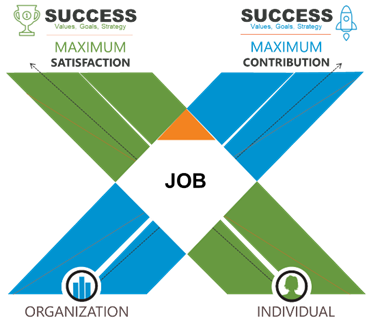
We define engagement as the intersection of maximum contribution and maximum satisfaction. Engagement levels are not labels or characteristics that define people. They describe a current situation, a moment in time. It is possible for someone to feel fully engaged one day and slip into disengaged territory a month or even a week later. Factors both within and outside the organization influence where people appear on the model. Challenges on the job, shifts within the organization, market dynamics, and even world events can impact how employees feel about their job, manager, and senior leaders. People leaders need to focus on both the performance (or contribution) side as well as the satisfaction side of this X Model of Employee Engagement. A key driver of engagement is recognition.

Recognition is more than just acknowledging employees for their contributions; it’s about affirming their value, fostering a sense of belonging, and reinforcing desired behaviors. When employees feel appreciated and genuinely valued for their efforts, they are more likely to be engaged, have stronger satisfaction with their work, are clearer on work priorities, and have stronger perceptions of career opportunities within their organization as compared to employees who do not feel recognized.

The Impact of Recognition

We know that engagement, whether positive or negative, is contagious. Disengagement may even be more contagious than positive engagement, so we need to be especially aware of and intentional about how we impact those around us. Our research shows significant positive correlation between engagement and recognition. Employees who receive recognition are more than twice as likely to be engaged than those who don’t receive regular acknowledgement. 87.6% of engaged employees report regularly receiving recognition and rewards for their achievements as compared to only 39.3% of disengaged employees.

Two key drivers of engagement are job satisfaction and having a clear understanding of immediate work priorities. These factors align directly to the satisfaction and contribution sides of the X Model of Employee Engagement. It is difficult to be engaged if you are not satisfied with the work and culture—and it is harder to be productive if you are not clear on the work that needs to be done.  Employees who receive regular recognition have higher job satisfaction (86.9% as compared to 53.8%). Employees who receive regular recognition and are clearer on their immediate work priorities than those who do not receive regular recognition (93.2% as compared to 68.1%).

Effectively acknowledging employees not only has an impact on engagement and key engagement drivers, but it also influences employees’ perceptions of career and development opportunities within the organization. Employees who receive recognition report having more career opportunities than those who do not receive regular acknowledgement (70.3% as compared to 33.6%).

As we explored above, lack of recognition also has a significant impact on turnover. Employees who do not receive regular recognition for their achievements are three times more likely to leave organizations than those who receive regular support from their immediate supervisors. 2.4% of employees who receive recognition report wanting to leave their organization. 7.7% of employees who do not receive recognition would leave. While there are many reasons that employees may leave organizations, we see higher rates of engaged employees leaving for personal reasons such as retirement or relocation. Disengaged employees are more likely to leave due to a lack of ideal working conditions, compensation, and development opportunities.

We can see the impact of recognition through many different lenses. Next, we explore how to effectively provide recognition.

Creative Ways to Incorporate Employee Recognition

So, how can managers and organizations provide effective recognition?

  • Personalized Approach: Take the time to understand each employee’s unique strengths, contributions, and preferences. Whether it’s a handwritten note, a public acknowledgment during team meetings, or a personalized token of appreciation, it’s important to say thank you for good work. Tailor your recognition efforts to resonate with individual employees.
  • Timely Feedback: Recognition should be timely and specific. Don’t wait for quarterly conversations or annual performance reviews to recognize achievements. Instead, provide regular feedback and acknowledgment for small wins and significant milestones. Beyond this, be sure to recognize well-intentioned mistakes. Employees are human and sometimes efforts do not have the desired or intended outcomes. In those moments, we need to be certain to share constructive feedback.
  • Peer Recognition: Encourage a culture of respect and appreciation where staff recognition flows not only from managers but also among peers. You may consider establishing platforms or channels where employees can publicly recognize and applaud each other’s efforts. Peer recognition fosters a sense of camaraderie and reinforces a culture of appreciation at all levels of the organization.
  • Reward and Incentive Programs: While verbal praise and acknowledgment are essential, tangible rewards and incentives can further reinforce recognition efforts. Consider implementing reward and recognition programs such as employees of the year or month, performance-based bonuses, or personalized gifts to celebrate significant achievements.
  • Align Recognition with Values and Goals: Ensure that recognition initiatives align with the organization’s core values and guiding principles. Recognize behaviors and accomplishments that align with these established values and contribute to the organization’s overarching goals or strategy. This recognition reinforces desired behaviors and reinforces the organizational culture.

Recognition Can Revolutionize Your Workforce

Recognition is a powerful tool for fostering engagement and commitment in the workplace. By implementing personalized, thoughtful, and meaningful individual and team recognition initiatives, we can create a culture where employees feel valued, appreciated, and motivated to perform at their best. Best of all, recognition costs virtually nothing to implement, but can have a powerful impact on employee satisfaction and retention, while driving tangible business results. Are you looking for a way to cultivate a more engaged and productive workforce? Recognition may be the answer.

About the Authors

Annie McManus
Annie McManus leads GP Strategies’ employee engagement practice. She provides consulting on measurement strategy, data analysis, and partners with her clients to equip their employees to have more great days at work. Over her 12 years with GP Strategies (and formerly BlessingWhite), she has had many roles including intern, Client Services Manager for leadership and engagement programs, Employee Engagement Project Manager, Consultant, team lead, and now is leading the practice. She grew up having an interest in psychology, which she majored in at Hobart and William Smith Colleges in upstate New York. One of her core values is helping others--and she is proud of her ability to contribute to bettering the lives of our client’s employees globally. In her free time, she enjoys travelling with her husband, young son, and two pit bulls in their camper around the United States. Additionally, during the pandemic she briefly got into running and is reportedly still recovering from a 10-mile run she barely made it through.

Get in touch.

Learn more about our talent transformation solutions.

Transformation doesn’t happen overnight if you’re doing it right. We continuously deliver measurable outcomes and help you stay the course – choose the right partner for your journey.

Our suite of offerings include:

  • Managed Learning Services
  • Learning Content Design & Development
  • Consulting
  • AI Readiness, Integration, & Support
  • Leadership & Inclusion Training
  • Technical Training
  • Learning Technologies & Implementation
  • Off-the-Shelf Training Courses


How Coaching Can Help You Optimize Your Workforce

Coaching is a highly flexible methodology that can be adapted to organizations of any size. The use of coaching can be long-term, short-term, or incorporated as part of a larger learning journey. Additionally, coaching conversations can be applied one on one or in a group setting.

The success of any organization is tied directly to the performance of its workforce, yet many organizations fail to prioritize employee development. Coaching could be the missing piece that propels your employees past obstacles and pushes them to new heights.

Defining the Role of Coaching

Coaches are not the same as mentors, nor do they function like cheerleaders. Mentors provide in-depth concrete solutions for their mentees to follow, while cheerleaders offer comfortable reassurance. Coaches, on the other hand, function more like guides. They listen, ask questions, and reframe issues to help steer an individual into discovering the answer for themselves.

  • Mentors tell you exactly how to reach your destination.
  • Cheerleaders assure you you’re capable of reaching your destination.
  • Coaches help you develop the skills to reach that destination on your own.

3 Ways Coaching Improves Employee Performance

#1: Driving Personal Development

Organizational training is made up of two distinct, yet deeply intertwined types of learning: self-focused learning, which prioritizes developing skills, and goal-focused learning, which applies those skills towards achieving some specific action or career goal.

If we look at learning through the lens of a mountain expedition, the skills we take with us resemble the supplies climbers keep in their backpacks, while the goal represents the traveler’s final destination. Obviously, it would be impossible to climb a mountain without first packing ropes, boots, and other essentials, yet that is exactly how many organizations approach institutional learning. It is remarkably common for individuals to become stuck in a mindset that focuses on the big goals, without first developing the skills needed to reach them.

Coaches help bridge this gap by providing accountability. Self-development isn’t just about building skills; it also requires assessing one’s flaws. A skilled coach will steer employees into identifying blind spots and confronting weaknesses, which is the critical first step in any learning journey. Once an employee has taken an honest assessment of their abilities, they have the essential equipment they need to shift their focus to larger organizational goals.

#2: Assisting with Career Development

Career development is valuable for both individuals and organizations. Investing in an employee’s future makes them feel valued and more likely to remain with the company, which, in turn, helps the organization retain talented employees and lower attrition rates.

Navigating a career journey can be challenging. Some employees may have no identifiable career goals, while others may have distinct career plans, but lack the development strategies necessary to attain them. Coaches provide an independent point of view that can help employees work out what they excel at and what they are qualified to do. For those with distinct goals, coaches can help put them on the path to achieving them.

Action plans are invaluable tools for career development, enabling employees to set goals and identify the steps necessary to advance in their careers. To be successful, however, an individual must actively participate in the activities they have mapped out. Coaches play a valuable role in this process by checking in with employees and ensuring that they follow through on critical development activities.

#3: Helping Individuals Transition into Leadership Roles

The first year in management is one of the toughest phases of any career journey. New leaders face challenges that require skills that are often quite different than those used in their previous role. Skills such as delegating responsibility, motivating teams, and handling conflict are critical to leading effectively, yet if there are no leadership development resources in place, managers are forced to develop these competencies on their own.

Leadership coaching can help ease new managers through this difficult transition by providing a valuable sounding board for them to work out stress and talk through potential solutions. A coach will help new leaders identify their strengths, as well as their opportunities, and assist them in determining where they should prioritize personal development. They can also guide managers on the road to developing their own unique style that takes advantage of their unique strengths as a leader.

Coaching: A Simple Way to Optimize Your Workforce

Employee development is critical to organizational success, but what can you do if your organization lacks the resources to create a dedicated career development program? Coaching is an ideal solution that is cost-effective, easy-to-integrate, and can be incorporated in one-on-one, group, and virtual sessions. Prioritizing ongoing development helps unlock the full potential of your people, leaving them better equipped to deal with disruptions and respond to industry changes.

About the Authors

GP Strategies Corporation
GP Strategies is a global performance improvement solutions provider of sales and technical training, e-Learning solutions, management consulting and engineering services. GP Strategies' solutions improve the effectiveness of organizations by delivering innovative and superior training, consulting and business improvement services, customized to meet the specific needs of its clients. Clients include Fortune 500 companies, manufacturing, process and energy industries, and other commercial and government customers.

Get in touch.

Learn more about our talent transformation solutions.

Transformation doesn’t happen overnight if you’re doing it right. We continuously deliver measurable outcomes and help you stay the course – choose the right partner for your journey.

Our suite of offerings include:

  • Managed Learning Services
  • Learning Content Design & Development
  • Consulting
  • AI Readiness, Integration, & Support
  • Leadership & Inclusion Training
  • Technical Training
  • Learning Technologies & Implementation
  • Off-the-Shelf Training Courses


5 Ways Synchronizing Project and Change Management Enables Successful Solution Adoption

The development and implementation of organizational initiatives is often governed by two separate yet equally important functions: project management teams who focus on building the business solutions for use in the organization and change management teams who prepare the organization to adopt the solution. Traditionally, these two teams work separately, with one team passing the project to the next team once their role is completed. This approach, while common, often creates many problems.

Why Integrate Project Management and Change Management?

At first glance, it’s obvious why organizations typically silo their project and change management efforts. In many ways, they are completely different functions, with project management focusing on building and activating the solution and change management being responsible for activation and realization of value.

In light of that, separating their efforts seems to make sense, but let’s look at the situation from a slightly different perspective. Envision a scenario in which two couples are sharing a vacation in a place that neither group has visited before. The first couple is handling the travel and lodging accommodations, while the second couple is planning the daily itinerary. Let us further imagine that these two pairs will be traveling separately, with no communication during the planning process. Bearing all that in mind, how successful do you think their vacation will be?

This scenario, though imaginary, bears a striking resemblance to the way that many initiatives occur: they are managed by vastly different groups pursuing completely different goals with minimal communication between the groups. Creating a strategy in which the project and change management teams work together will drive efficiencies in the following five areas and greatly improve the likelihood of the organization successfully adopting the new way of working.

Integrating Project and Change Management Helps Boost Adoption Rates

1. Unite on Intent, Purpose, and Goals

The key problem in the vacation scenario is a lack of alignment. Project and change management professionals approach projects from very different perspectives with very different priorities. That is why it is critical to align them using a shared intent, purpose, and final goal. When launching any enterprise-level project, the first step should be clearly defining its goal. Once both teams are aligned, it will be much easier to clarify roles and ensure that everyone is moving in the same direction. Without that shared destination, a project is much more likely to suffer delays, frustrations, and disjointed results.

2. Identify and Minimize Resistance Factors

Risk management is an essential component of project and change management. For project management, risk focuses on scope, cost, and schedule. As projects usually represent significant investments, reducing risk to those investments involves delivering the intended solution on time and on budget. Typically, it is the change management team’s responsibility to identify and mitigate potential obstacles to adoption. If both teams work in silos, however, it means that the change management team will not be able to identify these friction points until after the project management team has finished building the solution for use within the organization.

An adoption can be successful only when obstacles are addressed early. The change management team must be involved during the development of the solution to identify these obstacles and collaborate with the project management team to remove them during solution development. If you eliminate that collaboration, you risk making it difficult for both teams to work efficiently.

3. Provide Sufficient Time for Readiness Activities

The change management team’s goal is to move employees through several different phases to get them ready for the new way of working. Typically, that means changing employees’ mindsets from awareness of the solution to understanding it; accepting it; committing to it; and, finally, adopting it. When both project management and change management teams work together to remove potential obstacles during the development stage, they will greatly accelerate the speed of adoption.

Even if an organization is incredibly adaptive to change, there still may be significant steps—such as upskilling efforts and structural changes—that often must take place before the organization introduces an enterprise-level change. When the change management team has visibility on what the project management team is doing, they can put these steps into place early to ensure a much smoother transition.

4. Streamline Communication

Communication is critical to keeping teams focused on the project outcomes and how they will deliver value to the organization. The change management communication plan focuses on overcoming resistance and driving effective adoption. The sooner the change management team is brought in, the sooner the project team and employees begin moving toward an attitude of adoption. That can happen only when the change management team is involved in the initiative from the beginning. An effective communication management plan should flow in all directions, providing stakeholders with the insights necessary to do their best work.

For instance, change management teams routinely administer employee assessments that provide valuable insights into employee comments and concerns. Sharing these insights with the project team will improve their ability to create a solution that aligns with employee needs. Likewise, the project team has access to valuable development details, which the project team can share with the change management team, who can use them to overcome resistance and create employee buy-in. Clear, ongoing communication benefits everyone involved in the project. Now, imagine how effective an organization’s project and change management efforts will be when those teams remain in silos.

5. Create a Seamless Transition from One Team to the Next

Traditionally, once the project management team has completed their work, they pass the project  to the change management team for implementation. This transition can be incredibly disruptive, as one team scrambles to pick up where the other left off. Active collaboration between the project management and change management teams can replace this sudden shift with a more gradual transitioning of responsibilities over time. In this model, the project management team performs most of their activities on the project’s front end, then begins winding down their role while change management ramps up their activities. This overlapping of responsibilities ensures a smooth transition with fewer delays, established workflows, and clear intentions.

Without collaboration, it takes longer to adopt the new ways of working. A hard handoff will require considerable time to brief the change management team on what the project team has been doing and why. Worse, it is possible that the project team members may have moved on to other projects. For these reasons, it is much better for the project manager and change manager to work together and collaborate from the beginning.

Integrate Project and Change Management to Maximize Adoption

Far too often, the project management and change management teams function in isolation, creating unnecessary delays, miscommunications, and clumsy transitions. Embracing a more collaborative approach that aligns the efforts of both teams vastly increases the rate of adoption by providing a shared goal, identifying and minimizing resistance factors, providing sufficient time to introduce new ways of working, streamlining communication, and ensuring a smooth adoption.

About the Authors

Cheryl Jackson, PhD
Organization Design & Change Practice Lead
For over 15 years, Dr. Cheryl Jackson has been supporting transformational efforts in Fortune 500 organizations across a variety of industries including retail, manufacturing, healthcare, and food and beverage. With a doctorate in Industrial-organizational psychology, she combines her experience with scientific methodology and research techniques to create practical solutions that drive meaningful change in the workplace. Cheryl is driven to create effective solutions that help the organization as well as its employees thrive. Her focus is organizational effectiveness strategies supported by organization design, change management, assessment and development, employee engagement, leader development, and performance management. Cheryl is driving the development of the OD and Change Management practice within and across GP Strategies through the development of offerings and solutions, internal and external education, and supporting client initiatives. She remains actively engaged in the practice by contributing to whitepapers, blogs, articles, conferences, and podcasts on organizational design and change management and serving as a lecturer in the Master of I/O program at Texas A&M University.
Bill Loudon
Bill Loudon, Director Business Consulting, has over 20 years of delivering solutions for Fortune 500 companies. He specializes in defining and executing initiatives, programs and projects that enable companies to achieve their strategic goals and objectives. Specifically focused on increasing productivity. He works with organizations to develop, implement, and adopt solutions to business problems. With a focus on people, process, technology, and data to bring those solutions to life. Bill is an expert in program/project management, agile at the team level and agile at scale. He has his MBA from Wake Forest University and Bachelor of Arts degree in Political Science from Humboldt State University. Among his certificates are Six Sigma Black Belt and Project Management Masters Certificate from Villanova University.

Get in touch.

Learn more about our talent transformation solutions.

Transformation doesn’t happen overnight if you’re doing it right. We continuously deliver measurable outcomes and help you stay the course – choose the right partner for your journey.

Our suite of offerings include:

  • Managed Learning Services
  • Learning Content Design & Development
  • Consulting
  • AI Readiness, Integration, & Support
  • Leadership & Inclusion Training
  • Technical Training
  • Learning Technologies & Implementation
  • Off-the-Shelf Training Courses


The Power of Chaos: Embracing Cognitive Diversity and Healthy Debates in the Workplace

In the bustling arena of modern workplaces, where ideas clash like gladiators in an intellectual coliseum, one concept stands out as a beacon of innovation and progress: cognitive diversity. Imagine a workplace where everyone thinks alike, nods in unison, and echoes each other’s thoughts like a chorus of well-programmed robots. Sounds like a nightmare, right? Well, that’s where cognitive diversity swoops in like a superhero to save the day—or rather, the decade!

What Is Cognitive Diversity?

Cognitive diversity is the act of bringing people together who think differently and have varied perspectives from their personal experiences.

Cognitive diversity isn’t just a fancy buzzword thrown around boardrooms to impress the higher-ups. It’s the real deal—the secret sauce that fuels innovation, fosters creativity, and drives breakthroughs in the ever-evolving business landscape. Simply put, it’s about bringing together minds as diverse as the colors of a rainbow, each with its unique perspective, experience, and way of thinking.

Now, picture this: you’re in a meeting, discussing the next big project that will revolutionize your industry. You have the analytical wizard crunching numbers, the creative genius painting visions with words, the pragmatic realist grounding everyone with hard facts, and the empathetic soul ensuring that human values aren’t lost in the pursuit of profit. It’s a symphony of minds, each playing its part to perfection, yet harmonizing in beautiful chaos.

How Does Cognitive Diversity Impact the Workplace?

But wait, there’s more! Healthy debates are the spice that adds flavor to this already tantalizing dish of cognitive diversity. Gone are the days of monotony and echo chambers where ideas go to die a silent death. In today’s world, a healthy debate is like a jousting match between knights of intellect, each armed with logic, wit, and a thirst for truth.

Why are healthy debates so crucial, you ask? For starters, they challenge the status quo, shatter echo chambers, and prevent groupthink from creeping in like a stealthy ninja. When minds clash in a respectful and intellectually stimulating manner, ideas evolve, solutions improve, and innovation thrives like a wildflower in the desert of mediocrity.

Empathy and Cognitive Diversity

Let’s not forget the magic ingredient in this recipe for success: empathy. Empathy is the superpower that allows us to step into someone else’s shoes, see the world through their eyes, and understand their perspective. In the battlefield of healthy debates, empathy is the shield that deflects personal attacks, fosters mutual respect, and ensures that every voice is heard and valued.

Now, I know what you’re thinking. “But Raj, won’t all this chaos lead to conflicts and tensions in the workplace?” Conflicts are not the enemy; they are the catalyst for growth and transformation.

Embracing cognitive diversity and encouraging healthy debates isn’t just about fostering a dynamic work environment; it’s about future-proofing your organization in a rapidly changing world. According to a study by McKinsey & Company, companies with diverse teams are 33% more likely to outperform in terms of profitability. Now, if that’s not a compelling reason to embrace the chaos, I don’t know what is!

But wait, there’s more evidence to back this up! A survey by Harvard Business Review found that teams that engage in healthy debates make better decisions, are more adaptable to change, and are better equipped to handle complex challenges. So, if you’re still on the fence about embracing cognitive diversity and healthy debates, it’s time to jump off and join the winning team.

Now, let’s address the elephant in the room: fear. Yes, fear of conflict, fear of being wrong, fear of stepping out of your comfort zone. But as Franklin D. Roosevelt famously said, “The only thing we have to fear is fear itself.” So, let go of fear, embrace the chaos, and watch your organization soar to new heights of success.

In conclusion, the imperative needed to embrace cognitive diversity and encourage healthy debates in the current professional landscape is not just a suggestion; it’s a survival strategy. So, roll up your sleeves, sharpen your wit, and dive headfirst into the delightful chaos of diverse minds clashing like thunderstorms in the sky of innovation. After all, as the saying goes, “In chaos, there is opportunity.”

About the Authors

Rajdeep Dutta
With 25 years of diverse professional experience, Rajdeep is a seasoned manager and operations expert who is deeply passionate about people, learning and development, and leadership growth. His career has spanned across renowned organizations like GE, HSBC, as well as smaller enterprises. His roles have ranged from operations and capacity management to analytics and learning & development. Rajdeep is passionate about his work and views his team and the individuals within it as his greatest assets, prioritizing their growth and well-being above all else. His personal and professional development are intricately linked to their progression, making their success his ultimate goal. Beyond his professional life, he proudly plays the role of "Mr. Bean" to his 21-year-old daughter and a four-legged feline friend. He’s a certified herpetologist, driven by a passion for reptiles, particularly snakes. This passion has taken him to some extraordinary places, creating indelible memories and even a few bites along the way. In addition, he is an amateur photographer who captures the beauty of the natural world.

Get in touch.

Learn more about our talent transformation solutions.

Transformation doesn’t happen overnight if you’re doing it right. We continuously deliver measurable outcomes and help you stay the course – choose the right partner for your journey.

Our suite of offerings include:

  • Managed Learning Services
  • Learning Content Design & Development
  • Consulting
  • AI Readiness, Integration, & Support
  • Leadership & Inclusion Training
  • Technical Training
  • Learning Technologies & Implementation
  • Off-the-Shelf Training Courses


Navigating the Virtual Jungle: A Guide to Identifying and Cultivating Future Leaders

Greetings! Let’s embark on a whimsical journey into the virtual jungle of leadership development. In a world where Zoom calls are the new water cooler chats, and emojis are the preferred language, identifying future leaders and nurturing leadership talent has become both a challenge and a delightful comedy. So, grab your virtual binoculars and let’s explore how continuous learning can turn you into a leadership Tarzan in the digital wilderness.

Chapter 1: The Elusive Species – Future Leaders

Identifying future leaders is like trying to find a unicorn in a sea of emojis. They might be the ones who miraculously turn a boring email thread into a GIF-fueled conversation or those who can turn a mundane virtual meeting into a stand-up comedy show. Keep an eye out for individuals who make the virtual space their playground, effortlessly juggling tasks and handling challenges with a touch of humor.

But beware! Future leaders often masquerade as “office clowns” until you realize they’ve been cleverly managing to bring joy and productivity to the team. Look for the ones who can meme their way through a crisis or turn a spreadsheet into a masterpiece of data art. These are your future leaders, and they’re lurking behind the guise of virtual witticism.

Leaders must embrace the power of humour. The ability to inject laughter into virtual meetings, presentations, and even serious discussions can transform a team’s dynamics.

Encourage your team to attend virtual improv classes or indulge in a bit of stand-up comedy on the side. A leader who can turn a mundane presentation into a comedy special is a leader who can keep the team engaged, motivated, and laughing all the way to success. After all, who said leadership can’t be a laughing matter?

Chapter 2: Virtual Safari – The Art of Continuous Learning

In the wild world of the internet, navigating the virtual safari of continuous learning is a true adventure. To separate the leaders from the lurkers, encourage your team to embrace the chaotic beauty of online courses, webinars, and interactive workshops.

Picture this: a leader who can seamlessly switch from discussing the latest industry trends to sharing their newfound expertise in bread making from an online cooking class. Continuous learning isn’t just about acquiring knowledge; it’s about turning your team into a dynamic, ever-evolving group of Renaissance men and women – or as I like to call them, Jack of all Trades and “Masters-of-Memes.”

Chapter 3: The Vine Swing – Adapting to Change

The ability to swing from one digital vine to another without losing your cool is the mark of a true leader. The pace of change in the online realm is fast, and future leaders must master the art of adaptability.

Encourage your team to embrace change. The ability to pivot between tasks, platforms, and communication styles is crucial. Remember, in the virtual world, if you’re not adapting, you’re probably still using dial-up internet. Adaptable employees can make great leaders.

Chapter 4: The Emoji Decoder Ring

The virtual landscape is teeming with emojis, those colourful hieroglyphics that add a dash of personality to our digital conversations. Future leaders must be fluent in emoji-speak, able to decipher the subtle nuances between a thumbs-up and a fist bump, and understand the tone of text.

Hold virtual workshops to hone your team’s emoji communication skills. It’s the secret language of the virtual jungle and mastering it can turn a monotonous Slack conversation into a hilarious masterpiece of wit and charm. After all, a well-placed emoji is worth a thousand words – or at least a handful of LOLs. Keeping up with trends and understanding the nuances of the workplace can be a good quality in a future leader.

Chapter 5: The VR Team Building Expedition

Identifying future leaders can begin with team building.

Building a cohesive team in the virtual world is like assembling a puzzle without the picture on the box. To foster a sense of unity, embark on a virtual reality (VR) team-building expedition. Whether it’s a digital escape room, a VR cooking class, or a virtual paintball game, these experiences can bring your team together in ways unimaginable in the real world.

Just be prepared for the occasional glitch – nothing says team bonding like everyone simultaneously freezing mid-dance move in a VR disco. It’s these shared virtual misadventures that create lasting bonds and turn your team into a band of intrepid explorers in the digital wilderness.

The Virtual Leadership Odyssey

In the ever-evolving landscape of virtual leadership, identifying future leaders and cultivating talent is an exhilarating odyssey. Equip your team with the skills to navigate the digital jungle, swing from the vines of adaptability, decode the language of emojis, and lead with a dash of humour.

Continuous learning is the compass that guides leaders through the twists and turns of the virtual world. So, embrace the chaos, laugh in the face of technical difficulties, and remember, the future belongs to those who can dance their way through a virtual meeting while simultaneously solving complex problems.

In the end, as we raise our virtual glasses to the leaders of tomorrow, let’s celebrate the ones who can effortlessly surf the waves of change, master the art of emoji diplomacy, and turn every virtual encounter into a memorable experience. Here’s to the digital pioneers, the leaders of the virtual revolution, and the champions of continuous learning in the comedic arena of the online world. May your memes be ever relevant and your leadership skills forever evolving in this delightful digital wilderness!

About the Authors

Rajdeep Dutta
With 25 years of diverse professional experience, Rajdeep is a seasoned manager and operations expert who is deeply passionate about people, learning and development, and leadership growth. His career has spanned across renowned organizations like GE, HSBC, as well as smaller enterprises. His roles have ranged from operations and capacity management to analytics and learning & development. Rajdeep is passionate about his work and views his team and the individuals within it as his greatest assets, prioritizing their growth and well-being above all else. His personal and professional development are intricately linked to their progression, making their success his ultimate goal. Beyond his professional life, he proudly plays the role of "Mr. Bean" to his 21-year-old daughter and a four-legged feline friend. He’s a certified herpetologist, driven by a passion for reptiles, particularly snakes. This passion has taken him to some extraordinary places, creating indelible memories and even a few bites along the way. In addition, he is an amateur photographer who captures the beauty of the natural world.

Get in touch.

Learn more about our talent transformation solutions.

Transformation doesn’t happen overnight if you’re doing it right. We continuously deliver measurable outcomes and help you stay the course – choose the right partner for your journey.

Our suite of offerings include:

  • Managed Learning Services
  • Learning Content Design & Development
  • Consulting
  • AI Readiness, Integration, & Support
  • Leadership & Inclusion Training
  • Technical Training
  • Learning Technologies & Implementation
  • Off-the-Shelf Training Courses


Unleash the Power of Human+AI: 4 Takeaways of AI in L&D

We had an exhilarating two days with L&D and HR leaders from a variety of industries at the GP Strategies Client Forum. Both days were full of keynote presentations, workshops, success stories, demonstrations, and lively discussions on how and where to apply artificial intelligence (AI) strategies and technologies for the greatest effect.

Here are four takeaways we identified for AI in learning and development.

#1: AI Is Evolving Enterprise Skilling

AI is reshaping how many HR leaders view job roles and skills, and how to deploy them within an organization. In addition to optimizing job tasks of individuals themselves, some enterprise AI integrations are creating new ways to identify, analyze, and deploy skills.

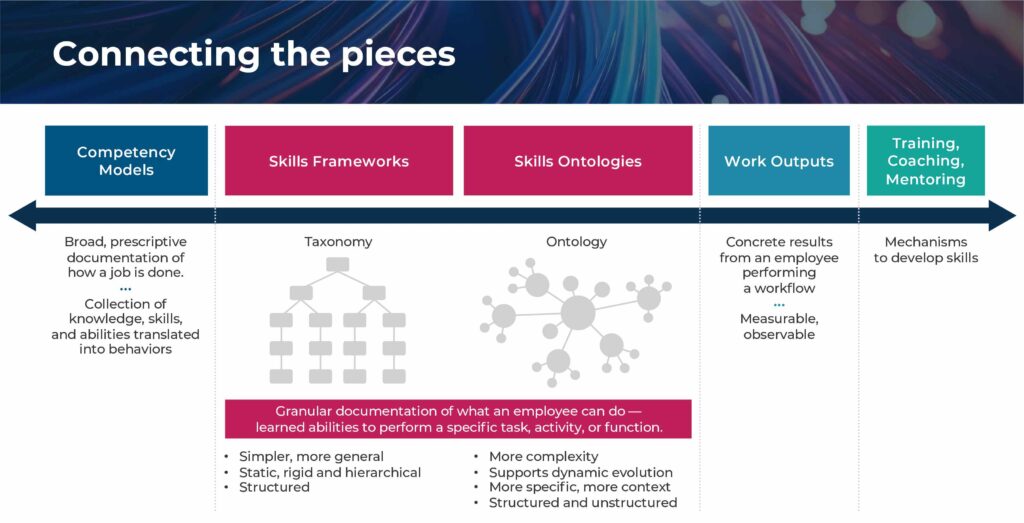
AI excels at analyzing and organizing large sets of data. AI can make skills models and structures more dynamic, such as analyzing and making faster connections in clustered skill structures and skill marketplaces.

However, AI is only as good as the data it has to work with. It is critical for organizations to prepare their data for these types of integrations. The following chart highlights how the full continuum of how skills are expressed in an organization from competency models to the specific work outputs the employee generates on the job.

#2: Reprioritizing Leadership Soft Skills in an AI-Enhanced World

Large-scale and fast-paced changes, as the result of AI technologies, inevitably create fear and uncertainty. The media is full of headlines about jobs going away and how remaining jobs will evolve. Unfortunately, humans often fear the unknown and are resistant to change.

A recent poll from the American Psychology Association highlights the fear and uncertainty related to AI and its effect on jobs.

Percentage of workers intending to look for a new job in the next year by worry about AI making some or all job duties obsolete.

  • 33% overall
  • 25% not worried about AI
  • 46% worried about AI

These number are worse among younger workers.

How Do Leaders Help Alleviate Fear and Drive Adoption?

Leaders can help their employees overcome the fears and unknowns surrounding AI by refocusing on uniquely human soft skills, gaining knowledge of AI, and communicating the benefits of AI to employees.

The following chart from Leah Clark outlines an approach leaders can take to help their employees embrace AI and enable efficiencies.

WhatHowWhy
Audit your thinking
Go first
Integrate AI into team’s efforts
Understand reskilling implications and opportunities
Training
Shared experimentation
Team assignments
AI learning discussions
Involvement
Reduce the fear factor
Stay relevant
Gain efficiencies
Gain knowledge of AI capabilities and possibilities

A key human differentiator in an AI-enhanced world are soft skills such as empathy. When leaders develop both soft skills and learn AI tools and capabilities, they will be able to help reduce the fear and unknowns of these technologies.

Understanding will help leaders alleviate fear among their teams with support and communication. As teams learn to embrace AI and upskill for it, they will realize new opportunities.

#3: AI Can Be an Expensive Investment: How and Where Should Organizations Get Started?

Developing and implementing AI, such as LLMs with company data and within protected company environments, can be costly projects. Many industries are split between taking a “wait and see” approach and implementing pilot AI projects within their organizations. However, it can be challenging to sit back and get left behind.

Getting Started with Individual AI Technologies

Employees and their teams should at least experiment with available AI tools and learn about short term productivity gains at a minimum. There are many AI technologies available and more emerge every day, but here is a quick list of tools to get started:

  • ChatGPT, Microsoft Copilot, or Google Gemini. These tools can help write, generate ideas, summarize text, conduct research, and more.
  • ElevenLabs. This tool has a limited free version where users can choose from a variety of AI voices and create text to voice audio. Human voices can also be cloned to create AI audio versions of real people.
  • 7Taps. This platform includes multiple templates and features to quickly create microlearning courses. Features include quizzes, audio, video, and more. There is a free version to get started.

Getting Started with Enterprise AI: An Integrated LLM for Learning Content Libraries

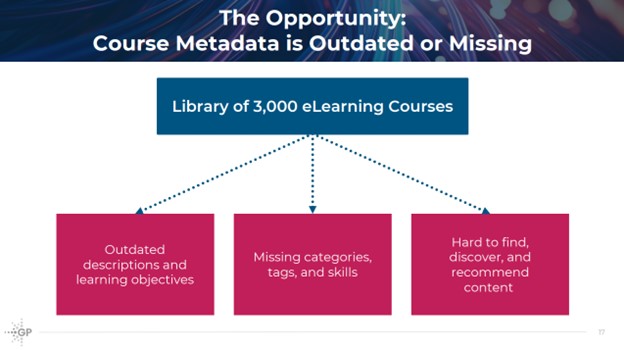
Many organizations have challenges managing their learning content libraries and their components, such as eLearning, microlearning, videos, job aids, and more. It can be a daunting and tedious task to keep these resources updated, publish new resources, maintain records, and keep everything organized and easy to administer.

In a similar fashion to the evolution of skilling we mentioned earlier, AI excels at consuming, analyzing, and organizing vast amounts of data. Integrating AI technologies like an LLM within your learning content libraries and related platforms can solve many of these issues in an incredibly accelerated timeline.

The following chart outlines the challenges a recent customer was experiencing with their learning library of over 3,000 eLearning courses.

As a commercial learning provider, it is critical for this company’s users to quickly find courses they need to take via search or from recommendations. By integrating an LLM, the company solved these issues and continues to discover new capabilities, such as generating organization-specific quizzes, outlines, and more.

The benefits of integrating AI into their system can be organized into three key areas:

UsabilityIncreased RevenueFuture Proof
Reduce time to access content
Improve discoverability of new content
Blend different modalities
Non-L&D stakeholders and customers
Improved licensing
New bundles and packaging of content
Speed of deployment
The way people want to learn is changing
Generative AI
Skills
Mobility

#4: Measurement is a Continuing Challenge

The learning and development industry has always had a challenge in measuring and proving the impact of learning. This challenge persists in the L&D and HR industries even with AI, where measuring and quantifying the impact of AI is not a structured process.

Establishing a measurement strategy along with baseline metrics to monitor and improve at the beginning of an implementation is critical to demonstrate the impact.

The following chart can help outline key criteria to set up a measurement plan.

The Human+AI Future Is Now

With adoption and technological advancement happening quickly, L&D and HR professionals need to respond, and fast. AI can offer capabilities that were not possible before, however, they need to be implemented carefully to be effective.

It is critical to not lose sight of the human component and human differentiators in the process. With careful considerations, organizations will be able to develop their AI-enhanced workforce and excel.

About the Authors

Matt Donovan
Chief Learning & Innovation Officer
Early in life, I found that I had a natural curiosity that not only led to a passion for learning and sharing with others, but it also got me into trouble. Although not a bad kid, I often found overly structured classrooms a challenge. I could be a bit disruptive as I would explore the content and activities in a manner that made sense to me. I found that classes and teachers that nurtured a personalized approach really resonated with me, while those that did not were demotivating and affected my relationship with the content. Too often, the conversation would come to a head where the teacher would ask, “Why can’t you learn it this way?” I would push back with, “Why can’t you teach it in a variety of ways?” The only path for success was when I would deconstruct and reconstruct the lessons in a meaningful way for myself. I would say that this early experience has shaped my career. I have been blessed with a range of opportunities to work with innovative organizations that advocate for the learner, endeavor to deliver relevance, and look to bend technology to further these goals. For example, while working at Unext.com, I had the opportunity to experience over 3,000 hours of “learnability” testing on my blended learning designs. I could see for my own eyes how learners would react to my designs and how they made meaning of it. Learners asked two common questions: Is it relevant to me? Is it authentic? Through observations of and conversations with learners, I began to sharpen my skills and designed for inclusion and relevance rather than control. This lesson has served me well. In our industry, we have become overly focused on the volume and arrangement of content, instead of its value. Not surprising—content is static and easier to define. Value (relevance), on the other hand, is fluid and much harder to describe. The real insight is that you can’t really design relevance; you can only design the environment or systems that promote it. Relevance ultimately is in the eye of the learner—not the designer. So, this is why, when asked for an elevator pitch, I share my passion of being an advocate for the learner and a warrior for relevance.

Get in touch.

Learn more about our talent transformation solutions.

Transformation doesn’t happen overnight if you’re doing it right. We continuously deliver measurable outcomes and help you stay the course – choose the right partner for your journey.

Our suite of offerings include:

  • Managed Learning Services
  • Learning Content Design & Development
  • Consulting
  • AI Readiness, Integration, & Support
  • Leadership & Inclusion Training
  • Technical Training
  • Learning Technologies & Implementation
  • Off-the-Shelf Training Courses