4 Questions to Consider When Creating Engaging Hybrid Event Experiences

Hybrid events are becoming a popular event-planning solution because they provide a global reach for companies who wish to deliver across time zones and locations. Hybrid events can offer flexibility and cost savings but also present potential challenges.

We’ve seen many organizations give up on the idea of hybrid events out of fear or “analysis paralysis.” It’s not uncommon to get hung up on an idea of what a perfect event should look like, and those pesky, constant “what-ifs?” might creep in and limit your ability to move forward with planning.

But hybrid events don’t always need to seem so daunting. We created the following list of questions that you can ask yourself to ensure you deliver engaging and successful hybrid events.

What Is a Hybrid Event?

As the world continues to adapt to rapidly changing technologies and disruption, hybrid events offer a seamless way to connect and accommodate people with diverse needs and preferences. They make engagement easy for those who are unable to travel or prefer the convenience of virtual attendance. Hybrid events mean everyone can still participate fully, ensuring a more inclusive experience.

Key features of hybrid events may include:

  • Virtual Platforms: Hybrid events leverage various virtual platforms, such as video conferencing software, live streaming platforms, or virtual event platforms to facilitate real-time interactions with remote attendees.
  • In-Person Venues: Physical venues are selected to host in-person attendees, providing a space for face-to-face networking, presentations, workshops, and other traditional event activities.
  • Content Delivery: Presentations, keynote speeches, and workshops can be delivered both to the in-person audience and virtually, ensuring that remote participants have access to the same content and experiences as on-site attendees.
  • Interactive Features: Hybrid events often incorporate interactive features, such as Q&A sessions, polls, and chat functionalities, allowing virtual attendees to participate and engage with the event actively.
  • Networking Opportunities: The event may offer networking opportunities for both in-person and virtual attendees, enabling meaningful connections and collaborations regardless of physical location.

By embracing the hybrid event format, organizations can enhance their reach, engagement, and impact while adapting to the ever-evolving dynamics.

4 Questions to Consider When Planning Your Next Hybrid Event

Organizations should consider four fundamental questions when planning their next hybrid event to fully engage and captivate attendees.

While it’s important to have attention to detail and develop contingency plans, you don’t want to let fear or too many “what-ifs?” take over and prevent your organization from enabling a great experience. These questions should serve as a compass, guiding you to create immersive hybrid event experiences that leave a lasting impact.

What Technologies Are You Using?

Hosting a hybrid event isn’t as simple as setting up a Zoom or Teams meeting. Selecting the right platform and tool to meet your needs and objectives is necessary to create an engaging and interactive experience for both groups of participants.

Many event management platforms are readily available, so you’re not short of choices. Each platform offers different capabilities depending on your objectives. If you’re hosting a workshop with group activities, you’ll need a platform with tools and features that support group exercises, such as whiteboards and breakout rooms. If you’re hosting a seminar with an audience of a few hundred participants or more, you’ll need a platform that can support a large group and include some quick engagement tools like question-and-answer sessions or polling.

You should also consider what audio/visual (A/V) equipment you can access. Access to suitable microphones and speakers is critical to ensure that participants can hear and communicate, in-person or virtually. Additionally, you’ll want to consider how to display the visual components of the event. Ensure that both groups of participants can clearly view content without experiencing unnecessary complications. 

Once you’ve identified the right platform and determined what A/V equipment to use, become familiarized with the functionality of other tools at your disposal by carrying out a dry run of your hybrid event to ensure the platform and equipment supports your needs as intended.

What Kind of Support Do You Have?

Special attention should be brought to what and how technology is used, and having the right support team is critical for the success of your hybrid event. But remember: the expectation that an event must be perfect is long gone. Event participants are now much more forgiving of technical challenges or slight hiccups than before the world migrated to a hybrid or remote work environment.

Even so, appoint the following team members to ensure your event runs as smoothly as possible and  those inevitable hiccups are taken care of promptly.

  1. Technical Point Person: When selecting your support team, identify someone with the technical and system expertise to handle real-time issues with the platform and participant access. This could be someone from IT or otherwise well-versed in the technology. They’ll be responsible for troubleshooting any issues before and during the event and determining next steps.
  2. Virtual Producer: Some remote event attendees may need to become more familiar with the platform or the digital tools you’ve selected. A virtual producer can kick off an event by reviewing instructions and critical features the virtual participants need to know to engage fully. This person can also help manage the interactive tools, communicate with participants, and discuss technology issues with the technical point person.
  3. Facilitator: The facilitator’s role is to lead exercises and activities, keep the program on track with the agenda, and engage the audience to maximize participation. The facilitator and virtual producer will work together as a team and should conduct an alignment meeting to review roles and responsibilities before an event.

How Are You Creating Immersive Experiences?

A poorly planned hybrid virtual event can become dull and lifeless, making people switch off mentally and literally. Crafting an agenda, setting clear goals, and integrating engaging activities can help organizations overcome this challenge.

While crafting your agenda and activities, think of how this will be achieved for both groups of participants. If you’re hosting a small group activity, consider how this will be accomplished with both in-person and virtual groups. When mapping out your agenda, think through the frequency of audience interaction.

To keep virtual attendees engaged, you’ll want to interact with the audience more frequently than if it was an all in-person event. Thanks to virtual and augmented reality and gamification techniques, you can quickly connect, intrigue, and entertain the remote audience, but be sure to also identify tools that will help you keep your in-person audience engaged.

While interactivity is critical to engagement, so are scheduling and timing. Consider any competing priorities, time zones, or engagements that might hinder full participation. For instance, scheduling an event the same week as performance reviews are conducted across your organization might not be a good idea.

Combining all these aspects requires meticulous planning and organizing, especially when a team of producers, facilitators, instructors, and systems must be synchronized. However, by streamlining these elements, your event’s delivery management will ultimately succeed, and you’ll provide attendees with an effortless experience.

How Are You Collecting Feedback and Taking Action?

Feedback is a gift. As part of your planning process, consider how you’ll obtain feedback from both groups of participants. You can provide survey access in multiple ways. You can give surveys to in-person participants on paper, you can provide them a QR code accessible by phone, or you can send an email with a link after the event. You can also review your virtual platform functionality to see if a tool can help you collect feedback data for the virtual participants and if it has any reporting dashboards or reports.

After your hybrid event, pull together and ask the following questions as you analyze your data: What went well? What could be improved? When did we experience lower levels of interactivity? How can we create a more engaging experience next time? Use your answers to these questions to inform future events you host.

Another Option: Outsourcing Hybrid Event Delivery

Ideating, producing, and delivering events with specific needs and budgets can be difficult. For some organizations, outsourcing their event management can significantly improve their events’ effectiveness and results. For example, we supported a major aerospace organization with their hybrid summit and helped to make the event an engaging, interactive, and fun experience for all participants. Contact us for more information on delivering hybrid events, or learn more about our event management solutions.

About the Authors

Megan Bridgett
Megan Bridgett, a leader in training and talent development for over a decade, helps organizations implement, optimize, and increase capabilities in their learning management initiatives.

Get in touch.

Learn more about our talent transformation solutions.

Transformation doesn’t happen overnight if you’re doing it right. We continuously deliver measurable outcomes and help you stay the course – choose the right partner for your journey.

Our suite of offerings include:

  • Managed Learning Services
  • Learning Content Design & Development
  • Consulting
  • AI Readiness, Integration, & Support
  • Leadership & Inclusion Training
  • Technical Training
  • Learning Technologies & Implementation
  • Off-the-Shelf Training Courses


A Quick Guide to Chatbots for Learning in the Age of AI

Welcome to the world of chatbots and learning—and artificial intelligence (AI). Let’s explore the history of chatbots in relation to learning and development (L&D) processes and solutions and unpack the current uses of chatbots and how the evolution of generative AI impacts them.

The Evolution of Chatbots

A chatbot is a computer program designed to simulate conversation with human users, which is beneficial and relevant for today’s modern learners.

While the term chatbot was not used until the 1990s, the integration of chatbots with learning has been around for a while. Early forms of “chatbots” developed in the early 1950s were simple text-based programs that could only respond to a limited number of prompts. And people questioned whether a computer program could talk to a group of people without them realizing the speaker was artificial.

ELIZA is a well-known example of a primitive chatbot developed in 1966 by Joseph Weizenbaum at MIT. Although ELIZA was not explicitly intended for educational purposes, it showcased the potential of interactive conversational systems by responding to user inputs based on pattern matching.

Other examples, like PLATO, used machine learning to incorporate conversational elements into a machine that delivered instructional content. These early educational systems used scripted dialogues and question-and-answer interactions to guide learners through educational materials.

Fast forward to the twenty-first century, and the chatbot industry has evolved into sophisticated tools with learning applications that are seamlessly built into smartphones, such as Siri, Watson, Google Assistant, Alexa, and Cortana. With the development of natural language processing (NLP) technology, chatbots—like ChatGPT, Bard, and Bing—have become more interactive, adaptive, and personalized, and they can understand and respond to human language more naturally.

Types of Chatbots

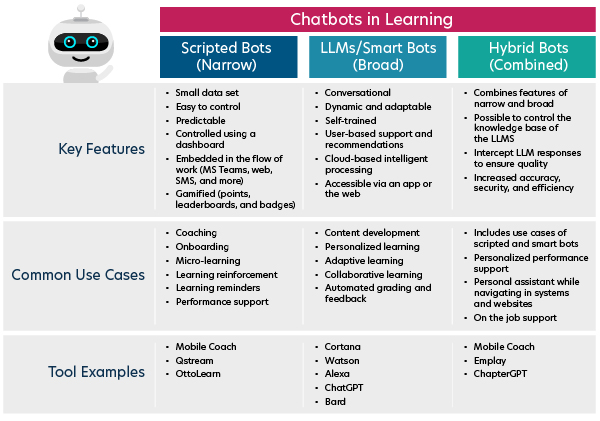
We can categorize chatbots used for learning purposes into three key areas based on how they generate responses. Below are the key features, common use cases, and tool examples for the three key categories.

Scripted Chatbots

Scripted chatbots follow a predetermined set of rules within the boundaries of a scripted conversation. Some scripted chatbots allow you to create structured, personalized learning paths for the learner, and these chatbots don’t necessarily have to use high-powered AI. Scripted chatbots can be deployed in many channels like SMS text, MS Teams, and Web widgets to drive user engagement in the flow of work. They also provide integrated reporting and typically come with a dashboard that allows you to view analytics around the engagement and use of the chatbots as well as the users’ inputs. Scripted chatbots use a smaller data set, are easy to control, and are more predictable.

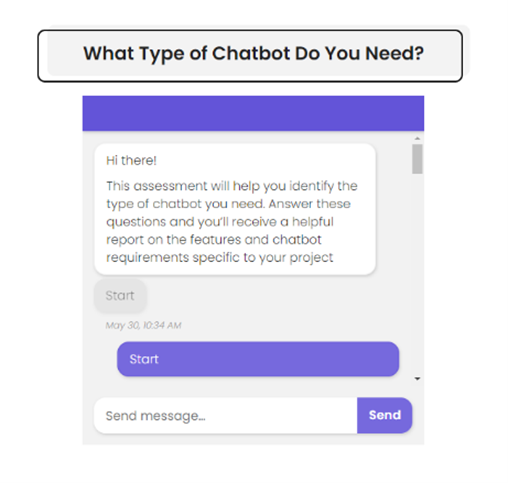
Try a Scripted Bot

This scripted chatbot developed by Mobile Coach helps you identify the desired critical attributes for the chatbot you need. Make sure to select START to begin. You need to answer about ten questions to get an assessment report with your requested chatbot features.

LLMs or Smartbots

LLMs (large language models) or smartbots fall under the category of generative AI because they use techniques such as natural language processing (NLP) and machine learning to understand and generate responses. These techniques allow for more dynamic and adaptable conversations and learning paths. The fact that responses are generative means that their output might not always be accurate and must be validated against other sources. The responses are also based on broad, publicly available content and are not specific to an enterprise’s context or knowledge base. However, LLMs are powerful tools for generating, adapting, and personalizing content based on the prompts provided by the user. LLMs are accessible via the web and through mobile apps.

Try a Smartbot

Add the following structured prompt in the LLM of your choice (ChatGPT, Bard, Bing, etc.) to get input on generating a scenario-based activity for a topic of your choice.

Act as an Instructional Designer. Create a scenario-based activity for <topic of your choice> in <context>. The scenario should be short, highly realistic, challenging for the learners, and well-structured

Hybrid Chatbots

Hybrid chatbots take the best of both worlds by combining elements of scripted and AI-powered chatbots to handle more complex queries or scenarios. This means they balance structure and adaptability in the learning process. Hybrid chatbots can also provide the possibility to control the knowledge base of the LLMs by connecting it to a company’s unique data and knowledge base and by monitoring the output of the conversation.

Try a Hybrid Bot

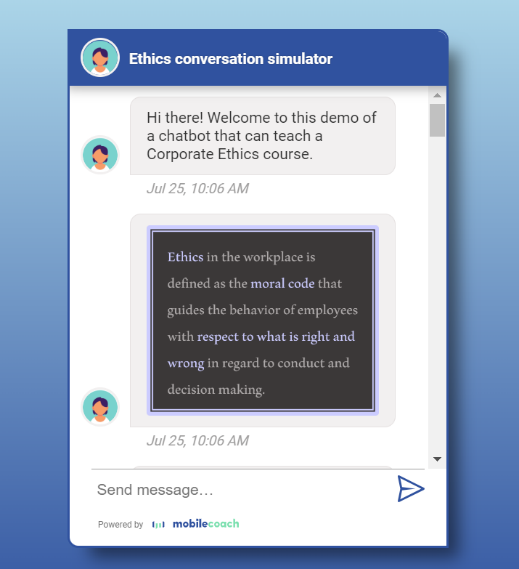
Here is an example of a hybrid chatbot with a ChatGPT-powered conversation simulator. This type of chatbot can be used in a microlearning course and delivered in the flow of work. Once you load the chatbot, please wait for it to give you some introductory information and present a scenario before you begin interacting with it.

Chatbots Are Powerful Learning Tools

While different types of chatbots have different strengths, some benefits make all chatbots powerful learning tools:

  • On-demand, 24-hour availability
  • Learning in the flow of work and at the point of need
  • Increased learner engagement and motivation
  • Intelligent learning personalization based on a learner’s profile and inputs

Choosing the Right Chatbot for Your Learners

AI is powerful, but it can’t solve every problem. It can be overwhelming to research and test the vast number of technologies and explore if they will help with your teams’ unique needs.

Some regulated industries, like the pharmaceutical industry, might prefer the greater control a scripted chatbot offers because they require all content to be pre-approved and regulated. If they used an AI-driven chatbot that dynamically creates content, there would be no way to guarantee what it would say. Other companies that use publicly available information to train their chatbot might prefer to go for a smart bot or a hybrid bot.

As you consider which type of chatbot is right for your learners, keep the following guidelines in mind.

  1. The best type of chatbot is the one that helps you address your business challenge effectively and provides relevant content for your learners.
  2. Whatever chatbot you choose, ensure it is used according to your organization’s guiding principles and in a safe, secure, and transparent way.

The future looks bright for chatbots and learning with the new generative AI tools. Subscribe to our AI Resource Center for deeper dives into AI and chatbots.

About the Authors
Ellen Schmidt
Ellen is a Learning Consultant on the Innovation Learning Team at GP Strategies. She has over twenty-five years’ experience as a learning professional in various industries and companies. She continually strives to incorporate innovative learning design, relevant content, and appropriate learning technologies into the learning solutions she creates for learners in corporate settings. Ellen received her Bachelor of Science in Music Education from Butler University and her Master of Science in Instructional Systems Technology from Indiana University. She is active in ATD, the Association for Talent Development nationally and locally. She is also a member of the International Society for Performance Improvement (ISPI) where in 2003, she received her ISPI Certified Performance Technologist (CPT) designation. 
Theodora Michaelidou
Theodora is an Innovation Learning Consultant based in Cyprus with global multifaceted experience in the Learning & Development space. She has served as an Instructional Designer, a Training Manager, a University Lecturer, and a Schoolteacher. She is a Fulbright scholar with a bachelor’s degree in Elementary Education from the University of Cyprus and an MSc in Instructional Systems Technology from Indiana University Bloomington. Theodora is passionate about turning innovative ideas into tangible outcomes that address business challenges and meet the client’s learning needs. She has a strong focus on designing human-centric learning experiences that are harmonious and relevant for the learner.

Get in touch.

Learn more about our talent transformation solutions.

Transformation doesn’t happen overnight if you’re doing it right. We continuously deliver measurable outcomes and help you stay the course – choose the right partner for your journey.

Our suite of offerings include:

  • Managed Learning Services
  • Learning Content Design & Development
  • Consulting
  • AI Readiness, Integration, & Support
  • Leadership & Inclusion Training
  • Technical Training
  • Learning Technologies & Implementation
  • Off-the-Shelf Training Courses


Managing Change Fatigue: Avoiding Change Saturation and Collision Amidst Constant Transformation

In the ever-changing landscape of the modern world, change has become the new norm, driving organizations to embark on numerous initiatives—often at the same time—in the name of growth and success.

A formidable adversary has emerged amidst the relentless pursuit of progress: change fatigue. As Gartner researchers revealed in their recent study, people’s support for enterprise change has significantly declined from 74% in 2016 to a mere 43% in 2022. Many organizations are feeling this resistance, so these results are not that unexpected.

But what is causing this phenomenon, and what are some effective strategies for managing change fatigue to ensure organizational and individual success?

The Collision Course of Change

Imagine a bustling 26-lane highway, where each lane represents a change or transformation within an organization. As the lanes converge, too many changes lead to a “change collision.” This is the tipping point, where change saturation and change fatigue cause projects to collide, leading to inefficiencies, resistance, and decreased productivity.

Choosing to ignore change fatigue and change saturation can have severe consequences for both individuals and organizations, such as:

  • Reduced productivity and efficiency due to overwhelmed and stressed employees
  • Adverse effects on customer service and overall business outcomes
  • Resistance to adopting new solutions due to lack of capacity and burnout
  • High employee turnover and a potential loss of top talent
  • Stagnation in organizational growth and innovation

When organizations overlook the importance of managing change fatigue, they open the floodgates to a host of consequences. The toll on employee well-being becomes evident in their physical and mental state, affecting overall productivity, customer service, and the organization’s ability to achieve desired outcomes.

The Root Causes of Change Fatigue

The pace of change has accelerated in the modern business environment, and with it, the sheer volume of initiatives has risen exponentially. Following are several factors contributing to the emergence of change fatigue within organizations.

1. A Lack of Prioritization

In the quest for maintaining a competitive edge, organizations tend to prioritize numerous change initiatives, each deemed critical to the bottom line and an immediate need. As new opportunities arise to save money or gain a competitive advantage, yet more initiatives are added to an already long list of projects, leading to an unmanageable workload.

If each new project is deemed vital to the organization’s bottom line, leaders are constantly challenged to balance short-term gains with long-term sustainability. The never-ending stream of important initiatives has led to an “everything is important” mindset that pushes the limits of an organization’s people—their greatest capability.

2. Resource Constraints and Overcommitment

Teams are continuously pulled in multiple directions, often needing help to balance their day-to-day responsibilities and contributions to these transformative endeavors. The cumulative effect of numerous projects puts an immense strain on resources, leading to a saturation point that triggers change fatigue.

A lack of prioritization and understanding of how these changes impact people within an organization exacerbates the problem. As resources are stretched thin, employees may find themselves juggling multiple roles while they are still expected to fulfill their regular job responsibilities. The shrinking resource pool combined with the relentless push for change amplifies the saturation effect, leaving employees overwhelmed and mentally drained.

3. Frequent “New Solution” Implementations and Mergers

In an era where technology evolves rapidly and mergers are commonplace, organizations face constant opportunities to implement solutions that drive business value or can sustain a new organizational structure brought on by mergers and acquisitions. And, in this fiercely competitive world, organizations will continue to seek any advantage they can grasp.

It is vital that organizations are prepared for the impact these changes have on their employees as more and more changes contribute to the possibility of saturation and fatigue. Frequent change is overwhelming. This is why strategies and plans to manage and mitigate change saturation, collision, and fatigue are crucial to the success of significant changes and the well-being of people within the organization.

3 Strategies to Manage Change Fatigue

Change collision occurs when too many changes intersect at once, leading to a state of complete saturation. Organizations must strive to manage change initiatives to minimize collision and ensure a smoother transition process. To combat change fatigue effectively, organizations can implement the following strategies:

  1. Prioritize and Stagger Projects: By staggering projects and providing employees with breaks between initiatives, organizations can give their workforce time to recharge mentally and emotionally. Limiting the number of projects each resource can work on simultaneously protects their well-being and enhances overall productivity.
  2. Build in Recharging Scenarios: Encourage employees to take breaks and recharge personally. Mandate work-hour restrictions and foster a culture that discourages working beyond set hours. Such practices will help maintain a healthy work-life balance and prevent burnout.
  3. Understand Resource Constraints: Leaders and decision-makers must know the potential impact of change fatigue on employees. Organizations should be prepared to shift resources, bring in new team members, and adjust project timelines to ensure optimal outcomes without compromising employee well-being.

Prioritize Well-Being for Sustainable Success

Understanding and mitigating change fatigue is not just a strategic choice—it is a crucial investment in the well-being of your workforce and the future of your enterprise. Only by acknowledging the reality of change fatigue and responding to it with compassion can we ensure that our organizations thrive in constant transformation.

About the Authors
Julyan Lee
Julyan is the Organizational Change Management Practice Lead at GP Strategies within Platform Adoption. His focus is on executing the OCM disciplines of Prosci, ADKAR, SAP Activate, Infor IDM Methodologies in both waterfall and Agile project environments. He is responsible for building GP standard OCM processes and methodologies, and ensuring uniformity in their application across OCM resources and their projects. He also supports business development teams in their sales pursuits, in formulating OCM solutions and proposal responses, and presenting to clients.

Get in touch.

Learn more about our talent transformation solutions.

Transformation doesn’t happen overnight if you’re doing it right. We continuously deliver measurable outcomes and help you stay the course – choose the right partner for your journey.

Our suite of offerings include:

  • Managed Learning Services
  • Learning Content Design & Development
  • Consulting
  • AI Readiness, Integration, & Support
  • Leadership & Inclusion Training
  • Technical Training
  • Learning Technologies & Implementation
  • Off-the-Shelf Training Courses


3 Strategies for Managing Culturally Diverse Teams

When individuals from different cultures come together, they bring with them unique perspectives shaped by their upbringing, values, beliefs, and experiences. These diverse perspectives are often shaped by cultural norms formed outside of the dominant culture of the organization, and this diversity can act as a catalyst, potentially propelling the organization toward innovation and growth.

By embracing cross-cultural collaboration in the workplace, organizations tap into a vast reservoir of knowledge and creativity, unlocking new solutions to complex problems and expanding their range of possibilities.

3 Strategies to Develop Culturally Diverse Teams and Encourage Collaboration

In today’s interconnected and diverse world, understanding and harnessing diversity is crucial for organizations to stay competitive and thrive in an ever-evolving business landscape.

Here are three ways leaders can grow and develop their teams with this in mind.

1. Build Psychological Safety

Fostering psychological safety is vital in creating an environment where team members feel comfortable sharing their thoughts and ideas. Simply diversifying the workforce is not enough; ensuring that individuals feel safe enough to challenge the status quo and bring their unique perspectives to the table is equally important.

Leaders play a crucial role in creating psychological safety by being vulnerable themselves and supporting their team members to embrace experimentation and take risks. This involves inviting challenges, questions, and new ideas. When team members see their leaders being open and supportive, it signals that sharing their thoughts and taking risks is safe. This, in turn, encourages a culture of open collaboration where individuals feel valued, supported, and motivated to contribute their diverse insights and experiences.

2. Practice Cultural Sensitivity

To effectively manage culturally diverse teams, leaders must embark on a learning journey to understand the experiences and needs of team members from various communities. This involves educating themselves about different cultures, identities, and backgrounds represented within their team and beyond it.

Leaders should proactively offer support and make necessary adjustments to accommodate individual differences. Considering how specific cultures may influence working styles, communication preferences, and work-life integration is essential. For example, flexibility in working hours might be necessary for caregivers, or providing resources and training on LGBTQ+ inclusivity might be necessary to support LGBTQ+ employees.

When leaders actively practice cultural sensitivity, it creates an inclusive and supportive environment where team members can bring as much of their authentic selves as they desire to work. It allows individuals to feel respected and understood, therefore fostering a deep sense of belonging.

3. Be Adaptable and Flexible

Leaders must understand that employees are not monolithic and should consider how to interact with each individual to make them feel valued and safe. Varying your leadership style to accommodate for different cultures and communication styles is crucial for effectively managing diverse teams.

Being adaptable and flexible also involves acknowledging and respecting cultural differences in decision-making processes and conflict-resolution approaches. For instance, in some cultures, direct confrontation may be considered disrespectful, while others may value open and direct communication. Leaders can foster a culture of mutual respect and understanding by being aware of these differences and having open conversations.

Furthermore, leaders should be adaptable and flexible to accommodate individual preferences and create an environment where everyone can thrive. Some team members excel in one-on-one settings, while others prefer group deliberation. Leaders can help each team member reach their full potential by providing tailored support and guidance.

Cross-Cultural Collaboration as a Competitive Advantage

Building and managing culturally diverse teams is more than just a checkbox exercise for organizations. It requires creating an inclusive environment where team members feel safe, accepted, and empowered to contribute their unique perspectives. Organizations must do the groundwork to lay the foundation for collaboration rather than placing the burden on individuals to create their own environment.

Embracing cultural diversity provides a competitive advantage in today’s globalized world. Organizations that prioritize and effectively manage culturally diverse teams are better equipped to innovate, adapt, and succeed in a rapidly changing business landscape.

About the Authors

Taniya Sonko
Taniya is a highly skilled Diversity, Equity, and Inclusion professional with experience in consultancy and training in both the public and private sectors. Her passion for social justice has led her to work with organizations from grassroots community collectives to large multinational organizations and intergovernmental bodies such as the United Nations. She is currently a Global Account Director in the DEI division of GP Strategies.

Get in touch.

Learn more about our talent transformation solutions.

Transformation doesn’t happen overnight if you’re doing it right. We continuously deliver measurable outcomes and help you stay the course – choose the right partner for your journey.

Our suite of offerings include:

  • Managed Learning Services
  • Learning Content Design & Development
  • Consulting
  • AI Readiness, Integration, & Support
  • Leadership & Inclusion Training
  • Technical Training
  • Learning Technologies & Implementation
  • Off-the-Shelf Training Courses


Lights! Camera! Action! Why Compliance Training Needs More Drama

A key aim of compliance training is to ensure its content is retained effectively. Organizational psychologists have conducted research that suggests this is where dramatic storytelling can help. Read on to learn why storytelling is paramount for your learners and how to incorporate drama into your compliance training solutions.

People Learn Best from Stories

Peg Neuhauser’s work shows that learning delivered through a well-told story is remembered better, and for longer, than learning delivered through factual text. This finding is supported by Jerome Bruner’s work, which shows that facts delivered through a story may be 20 times more likely to be retained.

As most compliance-related legislation and regulation continues to focus on individual conduct and decision-making, compliance training is increasingly adopting the successful storytelling techniques used to change behavior in other corporate learning environments such as health and safety; customer service; diversity, equity, and inclusion (DEI); and leadership.

Why Is Storytelling Paramount?

Because humans identify deeply with stories, storytelling in compliance videos enables people to imagine and explore how they would act in specific circumstances, learn from mistakes, and examine behaviors in a risk-free environment.

Storytelling is an effective way to demonstrate the consequences of poor decision-making. While compliance may lack drama, noncompliance carries significant consequences, as numerous organizations have discovered. Stories also enable organizations to showcase values and decision-making in context, rather than as abstract concepts. It is equally important to show the consequences of good decision-making. A story that shows the prevention of a major problem delivers a powerful and positive message.

The Importance of the Right Story

Using alarming stories and news in traditional compliance training is typical. But is this approach landing with the learners?

By the time news stories make it into course content, they are often “old news.” They feel distant from the learners, creating a perception of, “It would never happen here!” The traditional style of featuring fictitious scenarios in compliance training is also problematic. Let’s face it—they have a reputation for being dull and lifeless by simply presenting straightforward facts. Both styles fail to elicit the level of emotional engagement that actively changes behavior, nor are they memorable.

How Do You Get the Best from a Story?

It is important to choose the right story and to tell it in the right way. What is “right” will depend on many factors, including the topic, audience, learning objectives, and, of course, your budget.

Following are considerations when planning to use storytelling in your compliance training:

Learning Objectives

Identifying the key learning objectives is essential in all types of learning. These objectives should be the focus of the drama. For compliance training, these would typically include:

  • Personal responsibility and accountability
  • The importance and impact of a particular rule or piece of legislation
  • How to recognize “red flags”
  • When and how to escalate concerns

Format

Dramatized video will garner the biggest impact, but illustrated graphics or stories built from photo stills are also impactful alternatives. The important thing is to draw the learners in with recognizable characters and situations and the right level of jeopardy to keep their attention.

Location, Location, Location

Setting the story within your firm delivers the most impact. However, this approach may sound alarms. The argument against this approach is based on the notion that we should avoid depicting our own people engaging in improper behavior. This is understandable, but most compliance breaches are not due to individuals deliberately doing bad things; instead, these breaches result from mistakes, a lack of understanding, or failures to follow a process or escalate concerns.

Techniques

There are a variety of techniques to maximize the emotional impact of a compliance drama:

  • Netflix-style trailers released ahead of the learning
  • Spaced learning with a cliff-hanger at the end of a multiple-part drama
  • Recurring characters whose personalities and backstories can be developed
  • “Sliding doors”-style alternate endings
  • Blended learning that uses the same characters in posters or other learning materials—lifting the characters and their dilemmas off the screen and into the workplace

Compliance Training in Action

A financial services organization required a course on trade and transaction reporting. This compliance topic is characterized by its high level of technicality and complexity, presenting substantial risk that frequently leads to significant regulatory fines.

The learning objectives were derived from the repeated failures listed in the disciplinary notices published by the regulators—inadequate procedures, manual mistakes, a misunderstanding of the rules, and a failure to monitor and raise concerns.

Here, traditional compliance training would fail to engage the learners or change behaviors. The situation called for drama!

Our solution includes a three-part video-drama set in the client’s office. The course captures the learners’ attention from the start by jumping straight into the drama.

Part 1: Opening Scene

A senior executive receives a call from the regulator who is preparing to launch an investigation. The executive schedules an urgent meeting with their team to formulate a response. To capture the learners’ attention, we start by focusing on the negative outcomes that arise from making errors.

Tutorial Content

The subsequent tutorial content delves into examining the purpose and significance of the rules. This information is now contextualized with the underlying motivation that nobody wants their boss to receive a similar distressing call from regulators.

Part II: Second Scene

In this scene, the learner becomes part of the meeting. They rewind the clock to see what went wrong and how the errors occurred.

Tutorial Content

The tutorial content provided in this section encompasses a comprehensive overview of the rules, existing processes, roles, monitoring, and other related aspects.

Part III: Third Scene

The internal investigation uncovers a manual error that a junior employee had detected. Despite the employee raising a concern, their line manager failed to address it appropriately.

Tutorial Content

The tutorial content for the final scene focuses on personal responsibility and escalation. It looks at the importance of escalating and acting on concerns and the consequences of failing to do so.

The drama brought a dull compliance topic to life, and the three scenes addressed all the learning objectives. Stills and images of the characters could then be used to extend the learning experience through blended-learning resources. The story is memorable, and being reminded of the scenes immediately brings back the emotion of that call, that meeting, and the training about how to avoid becoming an extra in that drama!

Compliance Training—Let’s Bring It to Life!

Compliance training is a vital part of most organizations’ learning strategies. To equip your learners with the right knowledge in a way that leads to sustained behavior change, it is vital that your training is memorable.

Interested in incorporating drama and storytelling into your compliance training? Get in touch today.

About the Authors

GP Strategies Corporation
GP Strategies is a global performance improvement solutions provider of sales and technical training, e-Learning solutions, management consulting and engineering services. GP Strategies' solutions improve the effectiveness of organizations by delivering innovative and superior training, consulting and business improvement services, customized to meet the specific needs of its clients. Clients include Fortune 500 companies, manufacturing, process and energy industries, and other commercial and government customers.

Get in touch.

Learn more about our talent transformation solutions.

Transformation doesn’t happen overnight if you’re doing it right. We continuously deliver measurable outcomes and help you stay the course – choose the right partner for your journey.

Our suite of offerings include:

  • Managed Learning Services
  • Learning Content Design & Development
  • Consulting
  • AI Readiness, Integration, & Support
  • Leadership & Inclusion Training
  • Technical Training
  • Learning Technologies & Implementation
  • Off-the-Shelf Training Courses


Understanding Training Video Costs: How to Use Video for Learning, No Matter Your Budget

We are all steeped in visual media, but few entertainment mediums grip us quite like video, with more streaming subscriptions than ever before, and the prolific tendency to “binge-watch” a favorite show is evidence of this.

Video excites people and can help them remember information, which means learning and development (L&D) professionals can leverage video to drive meaningful behavior change.

Creating engaging and effective learning videos can be a game-changer for your organization, but there is a common misconception that creating learning videos requires a large budget. However, there are many ways to create and use video depending on your learning needs and organizational budget. Let’s explore the impact learning video can have, the different types of learning videos as well as the costs of training video production, and ultimately which kinds may be right for you.

Video as an Engaging, Gripping Learning Medium

Video is an effective, exciting learning delivery medium in today’s world, and every organization can benefit from using video as a component of its learning solutions. The use of narrative can enable learning—and retaining information—in a way that few other methods can. It is also the most powerful medium available to us for behavior change (rather than, say, the learning of a mechanical process).

There is now some solid scientific evidence on the effects of emotion on memory—the two have strong links. So, a dramatic scenario in which the viewer feels empathy, for example, is far more likely to “stick” than a simple rendering of learning points.

Well-crafted narratives can engage learners in the most profound way, capturing their attention before involving them in whatever needs to be learned. Relatable and emotive storytelling makes video a powerful tool to drive behavior change for your learners.

There is currently something of a renaissance for video as a medium for learning, likely because of increased streaming speeds and the relative cost reduction in film production in recent years.

It is an excellent time to consider what video can offer your organization and learners.

How Much Does it Cost to Make a Training Video?

Learning videos have traditionally been regarded as a relatively expensive medium compared to interactive learning modules or other methods of delivery. In real terms, however, costs have plummeted over the last decade or so. Equipment meets higher specifications at no greater cost than before, and advances in software have reduced editing time.

There are many different levels of quality in video, and assuming that your learners’ expectations are met, you can consider any quality level. For example, footage shot on your smartphone can be entirely appropriate—after all, most YouTube videos are produced this way. For cinematic-level and dramatic storytelling , however, a higher quality may be needed.

There are many variables involved within a video budget, so offering even ballpark figures without specification is difficult. But many of our clients now regard video as perfectly viable within their training budgets, and some of our most creative solutions have emerged from restricted budgets.

Video Comes in Different Forms and with Different Price Points

Documentary Video

Something of a catch-all term, a documentary can take many forms—from a formal interview with a CEO to a voiced-over presentation created with stock footage. There is a wide range of options in between, including advertorial communications pieces, case studies, and product explainers.

As with dramas, non-fiction formats are varied and can include the following:

  • Interviews with cutaways
  • Case studies
  • Product explainers
  • Vox-pops
  • Advertorial
  • Mixed media presentations

While it is possible to create any of the formats listed above, it is more effective to create a blend of these that fits the project’s precise needs. So, many of our documentary products include combinations of different formats—for example, stock footage with voice-over and animated elements or vox-pops with B-roll footage in a case study style.

The Benefits of Documentary Video

The documentary format is particularly effective for showing complex physical processes, like the various tasks on an assembly line. These tasks can be clarified quickly and precisely when filmed.

A documentary also gives context and authenticity to your messaging, which can be vital. The British Army, for example, usually prefers documentary to drama videos. Because it is easy for soldiers to spot people who are not in the service, service members can easily tell actors are being used in a training video, which can reduce the authenticity and lessen the impact of the training.

The Investment for Documentary Video

Documentary tends to be less expensive than scripted drama because, with drama, the usual “minutes per day” of final footage is higher than with documentary footage. There are also fewer costs for actors, wardrobes, props, and so on.

The design phase of documentary videos is also much quicker. Producing scripts isn’t usually necessary, though you will still need a detailed structure.

Scripted Drama Video

Drama video contains a cast of characters, played by actors, in a realistic setting. The characters act out a scripted story. Many disciplines and workstreams are involved in a drama video, all of which eventually combine during the shoot.

Dramas can take place in naturalistic settings, such as a home environment or your office, but they can also play out against a “green screen” backgrounds or in a studio. Dramas are most commonly centered around a specific difficulty or crisis that the characters must work through—and overcoming that problem is the core of dramatic action.

The Benefits of Scripted Drama

At its best, learning dramas touch the viewer like no other medium. They can engage and stimulate minds and emotions in profound and long-lasting ways. Drama’s primary strength lies in its ability to show behaviors—human beings in all their complexity, with recognizable flaws, problems, and ambitions.

When behaviors are rendered truthfully and with an understanding of the audience’s culture, a sort of transference takes place. The viewer places themselves in the shoes of the characters they’re watching. This promotes engagement that surpasses merely understanding facts or principles.

In relation to workplace dramas, recognition is important. We work hard to create scenarios the learner will recognize as parallel to their own. Without this, engagement can be limited.

The Production Timeframe for a Scripted Drama

On a drama shoot, there are a lot of variables that can eat up the available time.

The number of setups is key—if filming in four or five different parts of an office building, then moving from one to the other and setting up again will have a significant time cost. But if shooting multiple scenes in the same room, the minutes-per-day output will rise.

There is also a cost/complexity axis. Filming a family dinner with six characters requires shooting from six perspectives, meaning there would be a far greater number of versions of that scene than there might be in a video with two perspectives. Every perspective needs to be lit and framed—which takes time.

A real “time-killer” is noise. Filming beside a railway line, for example, means frequent pauses to wait for trains to go by. This kind of thing is often a factor when we’re making films in industrial environments.

We take all these factors—and others—into consideration once we have a good idea of what the drama will involve. We can then form an accurate estimate of how many minutes per day of final footage we’re likely to capture.

The Investment for Scripted Drama

Scripted dramas can have a broad range of budgets. The cost varies depending on, for example, whether it’s a large shoot in an overseas locations with a big cast or a simpler scripted “talking heads” piece that can be shot with a single performer in half a day.

Mixed-Media Video: A Hybrid Option

What Is Mixed Media Video?

A third option for your learning video is to use mixed media. A mixed-media video uses elements created with different tools and techniques and may include animation, infographics, talking heads, and more.

The Benefits of Mixed Media Video

Mixed media video works well if you have a broad set of content that you’d like to include in your learning. Your video may start with a talking head clip of your CEO introducing themselves and then move into a diagram with a voice-over explaining a complex process, then change to show some footage from your company’s work in action. If the subject matter is broad and you don’t have the budget to shoot everything bespoke, a mixed-media video can be a great option.

The Cost Implications of Mixed Media Video

Mixed media has a wider range of potential costs than other video formats. It can be less expensive than even a basic documentary or on par with a high-end video shoot. This is because the range of media that can be included is so broad, and each of those types of media has its own associated costs.

So, for example, a three-minute piece using stock video, voice-over, and some fairly simple text on screen wouldn’t cost very much at all. However, the same three minutes with bespoke footage, interviews, and animated diagrams would require a larger budget.

Learning Videos Can Work for All Budgets

Whatever your needs and budget, video is one of the best methods for creating an engaging, effective learning solution for your people. Whichever medium you choose, bespoke video can cover your learning objectives and give your people a relevant, relatable medium through which to learn.

Get in touch if you’re interested in exploring how video can work for you and your learners.

About the Authors

GP Strategies Corporation
GP Strategies is a global performance improvement solutions provider of sales and technical training, e-Learning solutions, management consulting and engineering services. GP Strategies' solutions improve the effectiveness of organizations by delivering innovative and superior training, consulting and business improvement services, customized to meet the specific needs of its clients. Clients include Fortune 500 companies, manufacturing, process and energy industries, and other commercial and government customers.

Get in touch.

Learn more about our talent transformation solutions.

Transformation doesn’t happen overnight if you’re doing it right. We continuously deliver measurable outcomes and help you stay the course – choose the right partner for your journey.

Our suite of offerings include:

  • Managed Learning Services
  • Learning Content Design & Development
  • Consulting
  • AI Readiness, Integration, & Support
  • Leadership & Inclusion Training
  • Technical Training
  • Learning Technologies & Implementation
  • Off-the-Shelf Training Courses


Using AI Responsibly in Your Work

It seems any time you scan a news site or turn on the television, you hear something new about artificial intelligence (AI). While this may pose exciting new opportunities for your work, we at GP Strategies would like to offer some guardrails around engaging with generative AI to protect yourself, your company, and your clients.

The Need for Thoughtfulness

One of my leaders recently said, “If you’re not paying for the product, you are the product.” That shift in framing created a new perspective around the free versions of generative AI we use today like ChatGPT, YouChat, and Google Bard. Within a few clicks, I can find the open acknowledgment of this in ChatGPT’s website, which states: “ChatGPT… improves by further training on the conversations people have with it” (J, 2023, para. 11). Even if you turn this function off, your inputs are retained for 30 days (J, 2023, para. 2).

Inputting sensitive information into a generative AI is like writing your company secrets in the clouds.

So, what’s wrong with using generative AI in business? If you work in an environment where you communicate any protected information, owned either by your company or by clients, then inputting sensitive information into a generative AI is like writing your company secrets in the clouds. Literally, the storage for free chatbots is cloud-based, and your inputs can later become outputs for another user.

Outsmarting Intelligence

Does this mean I swear off all generative AI and refuse to use it? No. I simply work smarter, and so can you. When using AI in business, we must consider confidentiality, copyright concerns, bias, and accuracy. At GP Strategies, we’ve created a list of Rules of Engagement so anyone can begin engaging with AI and reduce the risks associated with using this technology.

Guidance Before Engaging with an AI Tool

✅ DoX Don’t
Discuss your AI approach with your internal team to assess if it is appropriate to use AI with a specific task or client.Discuss with clients your plan to implement AI elements in your work until your team leadership agrees.

Example:

“I believe AI could enrich our approach on this project. Can we talk about our strategy and how to discuss this with our client?”Don’t talk casually about AI use in your work. The client may be caught off guard and may not support the use of AI in their work. This could unintentionally affect the client relationship.
✅ DoX Don’t
Discuss with your clients your interest in using AI as part of your creative process while maintaining client confidentiality.Hide the fact that you use AI in your creative process.

Example:

“I have an idea. Let’s see how AI can help us generate new ideas to enrich this strategy (or topic or point). Let me work on that, then show you some examples, and we can partner together to decide what to use.”Not sharing the fact that you use AI in your process can erode trust and damage client relationships.

Guidance While Working with an AI Tool

Key Boundary: DO NOT COPY/PASTE INTO OR OUT OF AN AI PLATFORM.

✅ DoX Don’t
Use generalizations or fictional entities.Use specific company names.

Example:

“… for a large aircraft manufacturer.”“… for Boeing, Southwest, Delta, etc.”
✅ DoX Don’t
Create original prompts.Copy and paste from any client document.

Example:

Explain the different components of successful leaders, including leadership mindsets, leadership skills, and how to drive results.Don’t copy and paste the text from a real leadership course from the company.
✅ DoX Don’t
Use national regulatory policies and procedures.Use client-specific policies and procedures.

Example:

“What is the appropriate personal protective equipment (PPE) for someone outside an arc flash boundary using OSHA 1910.335?”“Which safety standards are suppliers responsible for using from the Microsoft Supplier Social and Environmental Accountability Manual?”
✅ DoX Don’t
Use AI as a brainstorming tool.Copy and paste any output from AI into any learning components.

Example:

Input: Explain the process for repairing a rusted pressure valve for compressed gas in an electrical utility environment. Include the step-by-step procedure for lock-out tag-out and donning appropriate PPE.
 
Action: Paraphrase and summarize concepts, compare output to how you understand the topic, rephrase how you explain something inspired by the output, and fact check your work with colleagues, subject matter experts, or other resources.
Don’t assume the information is 100% accurate.
✅ DoX Don’t
Create image prototypes.Copy and paste image outputs from AI into any learning components.

Example:

Ask AI to create an image of a Martian high-fiving an astronaut standing on the moon and then use that image as inspiration to create an image using your own authoring tools.Don’t ask AI to create an image of a Martian high-fiving an astronaut standing on the moon and then save that image and use it in a design.
✅ DoX Don’t
Ask AI to craft an agenda by listing all the key points you wish to cover and further prompt it to identify any gaps or to anticipate questions you may receive.Paste a meeting transcript to generate a summary.

Example:

“Outline a 30-minute agenda that covers the best way to improve company sales for a product using these topics: improve product knowledge, understand key sales concepts, and understand how to establish relationships with customers.”Don’t paste a meeting transcript into any platform to generate a summary of points. This can violate nondisclosure agreements, infringe on intellectual property rights, and increase exposure to privacy and security liability.
✅ DoX Don’t
Report any mistakes while using AI.Hide mistakes.

Example:

Reporting mistakes to your direct supervisor is an important step in continuing to learn the best practices while using AI in business. Some mistakes could include:
  • Inputting protected, company-specific information.
  • Copying outputs.
  • Failing to disclose use of AI to clients.
Don’t assume that you have changed the output sufficiently so there is no need to disclose your use of AI.

The Future of Work

By now, we all know AI is here to stay. We’re going to see it integrated into Microsoft and other office work applications, search engines, and as components of websites and apps we use daily. It is an undeniably powerful tool that can help boost creativity and efficiency. However, with power comes responsibility. While this is not an exhaustive list of what to do and what not to do while using generative AI, it can get you started. If you implement these Rules of Engagement, your company can begin harnessing the power of AI in your work thoughtfully and responsibly.

About the Authors

Lorraine Frazier-Aich
Lorraine Frazier-Aich is a performance improvement professional and award-winning instructional designer with 15+ years of adult learning experience. Her unique problem-solving abilities and collaborative spirit enrich her role as a Learning Content Designer at GP Strategies. She holds a Master’s in Organizational Performance and Workplace Learning and a Certificate in Workplace Performance Improvement from the School of Engineering at Boise State University. She lives in St. Louis, Missouri with her husband, son, and a couple rambunctious house cats.

Get in touch.

Learn more about our talent transformation solutions.

Transformation doesn’t happen overnight if you’re doing it right. We continuously deliver measurable outcomes and help you stay the course – choose the right partner for your journey.

Our suite of offerings include:

  • Managed Learning Services
  • Learning Content Design & Development
  • Consulting
  • AI Readiness, Integration, & Support
  • Leadership & Inclusion Training
  • Technical Training
  • Learning Technologies & Implementation
  • Off-the-Shelf Training Courses


The People-Centric Approach: Guiding Principles for Responsible AI Use

Emerging AI Technologies

There is a new class of artificial intelligence (AI) emerging—generative AI. Adopting these new technologies can be both exciting and challenging. We are committed to supporting our own organization as well as our valued customers through this exciting time and in the use of these technologies.

AI tools have significant potential to enable us to increase productivity, improve collaboration and efficiency, optimize our workflows, and deliver new and exciting value to our customers. In alignment with our values, we are taking a people-centric approach to the integration and deployment of generative AI across our service lines and platforms.

Personal and Professional Responsibility

We have shared with our staff the importance of the personal and professional responsibilities tied to the use of these emerging AI tools. We are making it a priority to adhere to our current technology usage policies and procedures and follow guidance on how to leverage these tools responsibly. We place high importance on ownership, responsibility, and accountability to align our staff to follow our company’s requirements on the use of these tools.

As we continue this journey, we will embrace a range of perspectives, promote continuous learning, and follow an agile process as AI, as a toolset, continues to evolve.

Our Guiding Principles for the Use of AI 

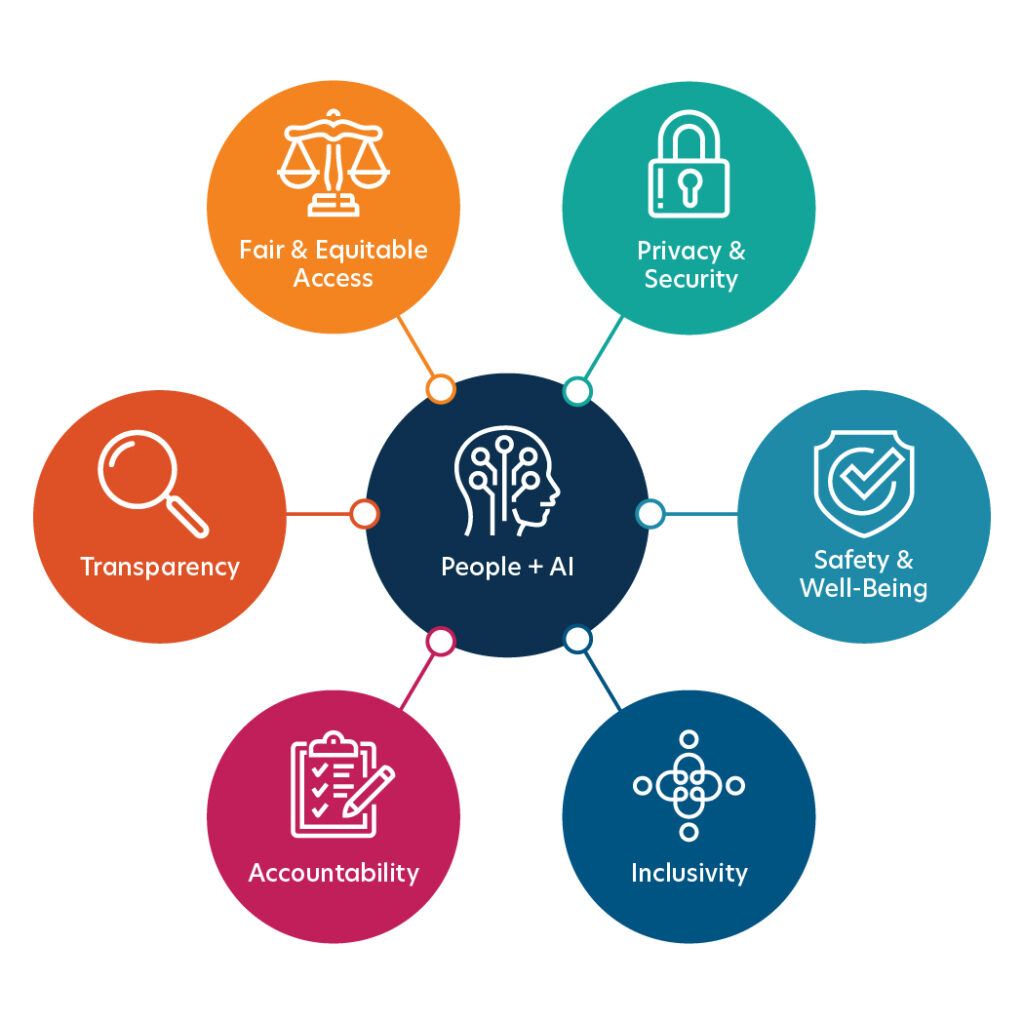
To guide GP staff through the integration of generative AI tools internally and for our customers, we have established the following principles that we are asking all GP staff to embrace.

The following guiding principles have been crafted in alignment with industry experts, clients, and partners who are leading in this space.

  • Maintain privacy and security: Al-enabled learning products and services should be secure, protect business information, and respect privacy by not exposing the confidential or restricted data of our clients, employees, affiliates, and partners. This is of utmost importance, as they trust us to protect their data and information.
  • Ensure safety and well-being: Al-enabled learning products and services should leverage data in a manner that promotes the safety and well-being of the learner or end-user. For example, AI-driven analysis and assessment outputs can be used for self-improvement or by a manager to evaluate a performer. There are risks and benefits associated with both approaches—it is important to provide not only the tools but also guidance on how they should be implemented.
  • Embrace diversity, equity, and inclusivity: AI-enabled learning products and services should reinforce our commitment to diversity, equity, and inclusion. For example, AI outputs and the underlying models should be assessed and monitored for cultural bias. How well does AI work in different regions of the world? Does it work effectively for both Japan and Brazil?
  • Drive accountability: Our team must be accountable for the quality, accuracy, and included intellectual property (IP) rights of AI-enabled learning and development products and services. This includes, but is not limited to, respecting IP rights, contractual obligations, and applicable laws and regulations. For example, when we are using AI to generate outputs for a client or end-user, is the generated content accurate, have the rights for copy and/or images been managed, and does it meet quality standards?
  • Convey transparency: Our team must be able to describe how AI-enabled learning products and services generate outputs and the source and nature of the data used. Additionally, we should be transparent as to when and how these tools are being applied. In addition to the possibilities from AI, we need to convey its limitations.
  • Promote fair and equitable access: AI-enabled learning products and services should be applied in a way that addresses skill gaps and productivity equitably across the organization. Does AI enable access to information, instruction, and performance support for those that otherwise would not have access to it?

GP Strategies is committed to the responsible use and application of AI, including but not limited to the protection of sensitive, proprietary, and confidential information.

Get More Information

Check out our AI Learning and Resource Center for current information about AI from GP Strategies.

About the Authors

Matt Donovan
Chief Learning & Innovation Officer
Early in life, I found that I had a natural curiosity that not only led to a passion for learning and sharing with others, but it also got me into trouble. Although not a bad kid, I often found overly structured classrooms a challenge. I could be a bit disruptive as I would explore the content and activities in a manner that made sense to me. I found that classes and teachers that nurtured a personalized approach really resonated with me, while those that did not were demotivating and affected my relationship with the content. Too often, the conversation would come to a head where the teacher would ask, “Why can’t you learn it this way?” I would push back with, “Why can’t you teach it in a variety of ways?” The only path for success was when I would deconstruct and reconstruct the lessons in a meaningful way for myself. I would say that this early experience has shaped my career. I have been blessed with a range of opportunities to work with innovative organizations that advocate for the learner, endeavor to deliver relevance, and look to bend technology to further these goals. For example, while working at Unext.com, I had the opportunity to experience over 3,000 hours of “learnability” testing on my blended learning designs. I could see for my own eyes how learners would react to my designs and how they made meaning of it. Learners asked two common questions: Is it relevant to me? Is it authentic? Through observations of and conversations with learners, I began to sharpen my skills and designed for inclusion and relevance rather than control. This lesson has served me well. In our industry, we have become overly focused on the volume and arrangement of content, instead of its value. Not surprising—content is static and easier to define. Value (relevance), on the other hand, is fluid and much harder to describe. The real insight is that you can’t really design relevance; you can only design the environment or systems that promote it. Relevance ultimately is in the eye of the learner—not the designer. So, this is why, when asked for an elevator pitch, I share my passion of being an advocate for the learner and a warrior for relevance.

Get in touch.

Learn more about our talent transformation solutions.

Transformation doesn’t happen overnight if you’re doing it right. We continuously deliver measurable outcomes and help you stay the course – choose the right partner for your journey.

Our suite of offerings include:

  • Managed Learning Services
  • Learning Content Design & Development
  • Consulting
  • AI Readiness, Integration, & Support
  • Leadership & Inclusion Training
  • Technical Training
  • Learning Technologies & Implementation
  • Off-the-Shelf Training Courses


A State of Belonging: Staying Curious and Building Connection in Pride Month and Beyond

I recently saw a TikTok video where the actor Dominique Fishback was being interviewed about a movie alongside her costars. The interviewer asked each cast member to state a fact about themselves and prompted the costars to guess whether it was true. When it was Fishback’s turn, she made the statement, “I know sign language.” Her peers quickly guessed that was not true, but to their surprise, she revealed it was completely true. The interviewer, also seemingly surprised, asked Fishback how it came about that she learned how to sign.

She replied that she pursued sign language in her college studies, explaining further that as a Black person who often must go into spaces where no one is forced to understand her lived experience and where she comes from, she wondered what it would be like to be deaf. What would it be like from that experience to navigate the world and nobody else is required to navigate with you, because they don’t have to?

Fishback thought learning sign language would be of help to others who felt like they did not have a space to belong, similar to her own experiences as a woman of color in the world. She went on to recount a story about working at a movie theater when a deaf customer came up with her daughter to order popcorn. As Fishback filled the popcorn bucket, she was turned away from the mother and asked, “Do you want butter on your popcorn?” The customer signed that she was deaf. When Fishback then signed the question for the customer instead, she lit up, signing to her daughter how exciting it was to encounter someone who could communicate with her during such a common event—going to the movies.

In that moment, Dominique Fishback created belonging for that mother.

Belonging Creates a Sense of Security and Improves Performance

Belonging is something our brains are hardwired to crave because it taps into our innate desire for connection. We are social creatures by nature, so experiences of belonging promote positive brain responses. To truly belong is a feeling unlike any other. We know this because many of us know what it feels like to not belong, to not fit in, and to not feel welcomed. Exclusion is a roadblock to belonging. When we find spaces where we belong, we are better for it. We gain a sense of increased comfort in our presence and our identities and can be our authentic selves, which typically guides us to more vulnerability in how we connect with others.

Connection drives connection. This is true in our personal lives and in the workplace. Across the globe, more companies than ever before are striving towards shaping environments that build the potential for belonging, the result of diversity and inclusion working in harmony. Belonging is not just a buzz word that is without measurable impact at work. Studies have shown that the power of belonging at work helps to reduce sick days and turnover while conversely increasing job performance and overall employee engagement and satisfaction. So, there is both an organizational and human value proposition for creating belonging at work, and so much can be done at the organizational level to foster belonging.

One of the ways organizations are cultivating belonging in today’s workplace is by recognizing monthly diversity celebrations such as Black History Month, Women’s History Month, Mental Health Awareness Month, Pride Month, etc. One goal of celebrating these events is to raise awareness across the organization for what life is like for individuals that identify with any given monthly celebration, how people can show up as allies for them, and generally celebrating the diversity these individuals bring to the workforce.

Diversity should be celebrated. As that awareness increases, so does curiosity. Employees that want to drive diversity, equity, and inclusion (DE&I) culture at work want to know more about how they can provide allyship to others. Staying curious about each other and acting on it is a great way to stay open to what makes us different and then value our unique qualities, but more importantly, to identify where we share common ground. That common ground creates belonging.

Getting Curious and Asking Questions

So, what do we do when we need answers, when we are curious about something or someone? We ask questions. How we go about asking questions is important to consider; despite being well-intentioned, our questions may create conflict between intention and impact.

As Pride Month ends in 2023, for anyone striving to be more inclusive at work and wanting to gain more awareness about their LGBTQ+ peers, it is advantageous to reflect on our approach to learning more and asking questions before we act. Hopefully, this helps us stay in the right intention, guiding us towards better ways to be allies and ultimately increasing belonging for others.

Before going to someone in the LGBTQ+ community to ask questions about their identity or lived experiences, consider these guidelines:

  • Stay curious, not interrogational: Be mindful of rapid-fire questioning or questions that carry a tone of challenge. As a cisgender, gay man who is married to a man and has two young sons, I know what it is like to be peppered with questions about my identity, family, and marriage. It can be overwhelming. People tend to welcome the opportunity to share insight about themselves, but if the approach is too assertive or they feel as if they are under a hot spotlight, the conversation tends to flatline. As you ask questions, set a calm, warm tone from the start and gauge whether the recipient seems ready to talk as well.
  • Do your own research first: LGBTQ+ people are not living encyclopedias just waiting to educate others on their orientation, identity expression, or gender. This applies to all equity seeking communities. A lot of questions can always be addressed by a quick Google search before going to a person directly. In fact, that search can often set you up for better dialogue and more connected questions later.
  • Consider the relationship: The excitement to be an ally can sometimes push us to come across as performative or too eager. We must take a moment to evaluate the relationship we have with someone before asking them a potentially personal question. Have you talked with this person about these types of topics before? Are you close colleagues or just acquaintances that say hello to each other in meetings a few times each month? How would you react if they were to come and ask you personal questions? Considering your current relationship with this person might compel you to still move forward confidently, cause you to wait until you have built the right connection, or not move forward at all.
  • Apply the question to similar scenarios: Reflect on whether this question would resonate or be appropriate with someone else not within the LGBTQ+ community. For example, if you wouldn’t ask a cisgender, straight man about the roles he and his wife play in their marriage, then you should not ask a transgender, gay man. Just because we are curious does not automatically give us permission to ask. Applying the question to a different person in the same scenario helps us vet the question’s appropriateness and helps us check any bias we might have.
  • Consider who benefits: If we want to show up as allies, then our questions and subsequent answers should benefit both us and the other person, but more so the other person. Otherwise, we are not being true allies and instead are making it about ourselves. Be sure to ask questions that will strengthen the relationship, help drive clarity for how to be an ally, or create a sense of belonging. If we just want to know something for the sake of knowing, it is a question probably better left unanswered.
  • Some questions will never be okay: Realize that even after we evaluate the relationship, conduct research, intend to set the right tone, check our bias, and see the benefits of asking the question—some questions are just off limits. Period. One of the best ways to identify an off-limits question is ask someone that you trust and have a close relationship with, likely outside of the workplace, who identifies as LGBTQ+ whether the question would make them uncomfortable or offend. If they say yes, then the question is a no-go.

Did you notice that we are not outlining a list of “Questions to Ask” versus “Questions NOT to Ask”? The reality is, things are not that simple or easy to define, because human beings are not that simple. Every person, whether LGBTQ+ or not, carries nuance, despite the near fact that we are typically more alike than we realize. Through shaping and confirming our intentions, quickly reflecting, and preparing our approach, we can ask questions that drive connection and hopefully result in more frequent feelings of belonging. This is not work we only do during Pride Month in June for our LGBTQ+ colleagues, but what we should do all year round, for everyone at work.

Learning more about each other by staying curious and asking questions helps us to better understand what it is like for those that are not like us to exist in the world each day, especially for people within marginalized communities. Maybe one day creating inclusion through meaningful connection will just be a thriving workplace habit—a workplace of unconscious inclusion, with everyone in constant and excited curiosity to know more about and include each other. Perhaps those are big expectations for our future workspaces and the concept of belonging.

Dominique Fishback was able to build an inclusive connection for a stranger over popcorn in a matter of seconds because she set that intention in motion when she decided to learn sign language. Surely each of us can find a small opportunity in our busy days at work to create connection with someone who is different from us and through those affirm for that individual: You belong here. We all want that. Happy Pride Month everyone!

About the Authors

James Garza
James Garza (he/him/his) currently serves as a Leadership and DE&I Consultant at GP Strategies. With 20 years in leadership, organizational, and content development, James helps organizations and leaders first understand the power behind belonging, fulfillment, and purpose at work, and then supports their journey in creating environments that produce those same ideas. He follows a fully consultative approach by clearly understanding current organizational objectives and identifying ways to align those goals against culture and leadership development, process efficiency, and overall future potential. Starting out in operational training, James has held leadership and consultant positions in the areas of customer experience, employee engagement, technical training, leadership development, and quality assurance. He has assisted companies in creating global leadership development programs from the ground up, with a continuous focus on Diversity, Equity, and Inclusion (DE&I). James has led organizational DE&I initiatives related to Employee Resource Groups (ERGs), diversity and inclusion training, policy and procedure equity review, and executive communication and coaching. He recently designed the GP Strategies DE&I product portfolio in partnership with a peer expert, Dwight Bailey, Owner of FirstServe Leaders, and most recently designed and hosted webinars on the topics of: Bias & Microaggressions, Impact of Racism, and Creating an Anti-Racist Organization. He brings a unique perspective to the world of DE&I as a gay, bi-racial man who is also a father to two special needs sons. Those life experiences motivate him to always work with others using empathy and kindness, believing that we are all more alike than we are different.

Get in touch.

Learn more about our talent transformation solutions.

Transformation doesn’t happen overnight if you’re doing it right. We continuously deliver measurable outcomes and help you stay the course – choose the right partner for your journey.

Our suite of offerings include:

  • Managed Learning Services
  • Learning Content Design & Development
  • Consulting
  • AI Readiness, Integration, & Support
  • Leadership & Inclusion Training
  • Technical Training
  • Learning Technologies & Implementation
  • Off-the-Shelf Training Courses


2023 Research Finds 4 Paradoxical Attitudes About Career Development

Attracting and retaining the best talent is crucial for any organization striving for success and growth. The changing workforce and ever-growing skills gaps make this more important than ever. In response to this, GP Strategies surveyed over 2,000 employees and people leaders across the globe in early 2023 to get a perspective on the current state of career development.

The findings from this survey led to the emergence of four paradoxical themes about career development. This article explores those four key paradoxes and how this information can help you attract and retain the best talent for your organization.

Paradox #1: I’m more engaged in my current job when talking about my future.

With voluntary turnover numbers at some of the highest on record, it is clear that people are not afraid to move toward new opportunities or resign from traditional employment in favor of contract or gig work. However, you don’t need to lose the best people in your organization, provided you put in place measures to prioritize career and skills development in a way that supports your people. Across all populations and regions, for a large proportion of the workforce, career development is a priority.

The high prioritization of career could indicate a workforce full of employees focused on their needs or actively searching for a new job instead of contributing to their current organization.

However, our survey revealed that most people feel that career development greatly impacts their engagement in their current role. Career development opportunities are emerging as a key to driving employee engagement now, not just in the future.

Paradox #2: My values and strengths are important in my current job, and financial reward is important for my next job.

During discussions with their managers, 61% of employees reported wanting to focus more on their values and strengths and finding themselves more likely to engage with work they find satisfying.

It is easy for employee-focused career conversations to get side-lined, especially when managers want to discuss deliverables. But for employees, values remain prominent in manager-employee conversations, surpassing considerations like past roles, experience, compensation, and promotions. Historical data also consistently highlights the paramount importance of values in these interactions.

By understanding your people’s personal values, strengths, and desired growth areas, you will learn what matters to them. A genuine exchange between a leader and an employee about what matters most to the employee might be the most significant retention tool available.

Having said that, there is a definite emerging trend toward employees ranking compensation as increasingly important to them. Respondents indicated that financial reward is the top factor they will look for in a new position. These findings indicate that meeting values are increasingly important to your people, but you should not ignore the issue of competitive compensation.

Paradox #3: I need to have frequent conversations about what I want and what the organization wants.

It is clear that employees want to discuss their careers regularly. Unfortunately, there is often a big difference between the frequency they would like and the frequency at which the conversations actually happen.

You can learn about your people’s unique values, strengths, and aspirations through regular career conversations. Your most critical role as a leader is connecting organizational needs with your people’s aspirations and values.

We have also learned that employees want leaders to be champions for them and to connect them to opportunities. In fact, a massive 96% of people want their leaders to play some role in their career development. You can best deliver on this desire by genuinely understanding what is important to each of your people and actively helping them achieve their aims.

Paradox #4: My current priorities prevent me from prioritizing my development.

Fewer than half of the people who responded to our survey indicated they were spending the right amount of time on their careers. Investing in your people’s development will have a hugely positive impact both on your employees and your organization.

When asked whether they would take advantage of professional development opportunities if they were offered, our respondents were overwhelmingly positive. Almost three-quarters of people leaders and 70% of individual contributors said that they are likely or very likely to take advantage of development opportunities.

Unfortunately, people also do not feel they have the support they need to invest in professional development—and lack of time and competing resources are at the top of the list. Supporting your people’s career development can be difficult if you work in a culture of seeing it as an extra to the “real work” of your organization. But by creating a way of thinking that supports career development as integral to your company’s agenda, you can truly be there for your people and encourage them to thrive.

Discover How L&D Teams Can Future-Proof Their Leadership Strategy and Support Employee Development

How employees consider what they want out of their careers has fundamentally changed. We have learned that people want to fulfill their desire for interesting and meaningful work, and they want compensation. They want to be in regular discussions with their leaders about their work, career development, and open opportunities.

To attract and keep the best talent in your organization, it is vital that you are aware of and actively working on these aspects for your people. Leaders need to view career development as a fundamental part of their organization and the most important way of retaining their most valuable asset—their people.

To learn more about this study in paradox and discover deeper insights into our research, please download the 2023 Career Perspectives Report.

About the Authors

GP Strategies Corporation
GP Strategies is a global performance improvement solutions provider of sales and technical training, e-Learning solutions, management consulting and engineering services. GP Strategies' solutions improve the effectiveness of organizations by delivering innovative and superior training, consulting and business improvement services, customized to meet the specific needs of its clients. Clients include Fortune 500 companies, manufacturing, process and energy industries, and other commercial and government customers.

Get in touch.

Learn more about our talent transformation solutions.

Transformation doesn’t happen overnight if you’re doing it right. We continuously deliver measurable outcomes and help you stay the course – choose the right partner for your journey.

Our suite of offerings include:

  • Managed Learning Services
  • Learning Content Design & Development
  • Consulting
  • AI Readiness, Integration, & Support
  • Leadership & Inclusion Training
  • Technical Training
  • Learning Technologies & Implementation
  • Off-the-Shelf Training Courses