
Emerging AI Technologies
There is a new class of artificial intelligence (AI) emerging—generative AI. Adopting these new technologies can be both exciting and challenging. We are committed to supporting our own organization as well as our valued customers through this exciting time and in the use of these technologies.
AI tools have significant potential to enable us to increase productivity, improve collaboration and efficiency, optimize our workflows, and deliver new and exciting value to our customers. In alignment with our values, we are taking a people-centric approach to the integration and deployment of generative AI across our service lines and platforms.
Personal and Professional Responsibility
We have shared with our staff the importance of the personal and professional responsibilities tied to the use of these emerging AI tools. We are making it a priority to adhere to our current technology usage policies and procedures and follow guidance on how to leverage these tools responsibly. We place high importance on ownership, responsibility, and accountability to align our staff to follow our company’s requirements on the use of these tools.
As we continue this journey, we will embrace a range of perspectives, promote continuous learning, and follow an agile process as AI, as a toolset, continues to evolve.
Our Guiding Principles for the Use of AI
To guide GP staff through the integration of generative AI tools internally and for our customers, we have established the following principles that we are asking all GP staff to embrace.
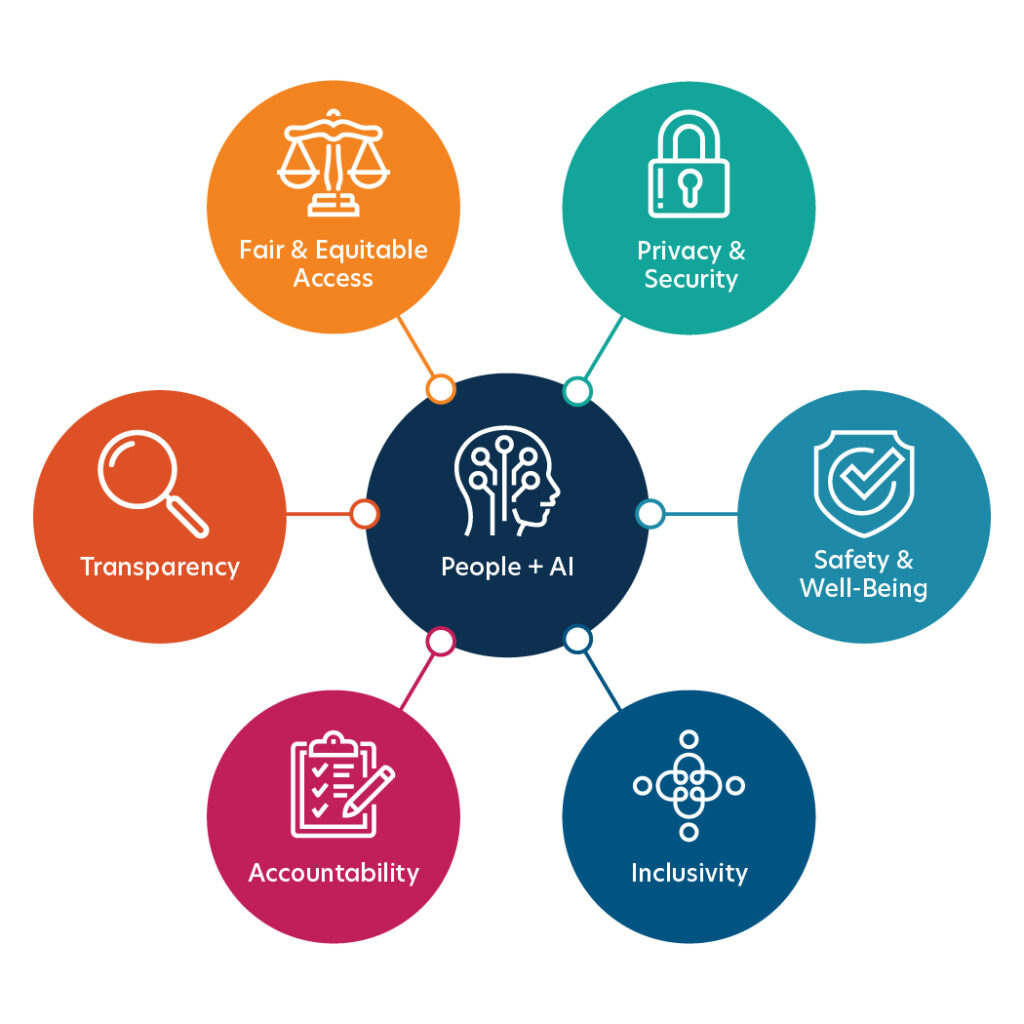
The following guiding principles have been crafted in alignment with industry experts, clients, and partners who are leading in this space.
- Maintain privacy and security: Al-enabled learning products and services should be secure, protect business information, and respect privacy by not exposing the confidential or restricted data of our clients, employees, affiliates, and partners. This is of utmost importance, as they trust us to protect their data and information.
- Ensure safety and well-being: Al-enabled learning products and services should leverage data in a manner that promotes the safety and well-being of the learner or end-user. For example, AI-driven analysis and assessment outputs can be used for self-improvement or by a manager to evaluate a performer. There are risks and benefits associated with both approaches—it is important to provide not only the tools but also guidance on how they should be implemented.
- Embrace diversity, equity, and inclusivity: AI-enabled learning products and services should reinforce our commitment to diversity, equity, and inclusion. For example, AI outputs and the underlying models should be assessed and monitored for cultural bias. How well does AI work in different regions of the world? Does it work effectively for both Japan and Brazil?
- Drive accountability: Our team must be accountable for the quality, accuracy, and included intellectual property (IP) rights of AI-enabled learning and development products and services. This includes, but is not limited to, respecting IP rights, contractual obligations, and applicable laws and regulations. For example, when we are using AI to generate outputs for a client or end-user, is the generated content accurate, have the rights for copy and/or images been managed, and does it meet quality standards?
- Convey transparency: Our team must be able to describe how AI-enabled learning products and services generate outputs and the source and nature of the data used. Additionally, we should be transparent as to when and how these tools are being applied. In addition to the possibilities from AI, we need to convey its limitations.
- Promote fair and equitable access: AI-enabled learning products and services should be applied in a way that addresses skill gaps and productivity equitably across the organization. Does AI enable access to information, instruction, and performance support for those that otherwise would not have access to it?
GP Strategies is committed to the responsible use and application of AI, including but not limited to the protection of sensitive, proprietary, and confidential information.
Get More Information
Check out our AI Learning and Resource Center for current information about AI from GP Strategies.
About the Author
