Engaging Compliance Training: Scenarios and Storytelling

This blog article was written prior to LEO Learning becoming part of GP Strategies.

Scenarios and storytelling are highly effective when it comes to learner engagement. They challenge, offer instant feedback, and test the ‘ray areas. Learn how you can build scenarios and storytelling into your compliance training to get learners to apply their knowledge to real-life scenarios.

Scenarios and Storytelling

We often combine the use of scenarios and stories with the design approaches we’ve already explored. But they are worth exploring in more detail on their own because of their critical role in driving up learner engagement and supporting behavior change.

Scenarios are a highly effective way of driving learning engagement because they provide a real sense of challenge. And with a complex branching scenario, they also enable you to create a much more immersive learning experience using storytelling techniques to create real drama and tension.

A scenario-based approach is also very effective for exploring the ‘grey areas’ of a subject or issue. We know that for compliance training to be effective, learners need to not only have the knowledge of what to do but how to apply that knowledge in real life. Scenarios are a valuable way to give learners that space to explore and practice.

What Are Scenarios?

Put simply, a scenario is a context-based question or activity. A typical scenario presents a realistic situation to a learner and then asks them to make a decision. These can be created using simple text and graphics, text and photos, or text and videos.

Scenarios challenge the learner to apply learning, rather than simply recall knowledge. A scenario can be a single question or learners can be challenged to make a series of decisions to create a more immersive learning experience.

A branching scenario is a multi-decision learning experience where the decisions learners make send them on different paths through the scenario. These are more complicated to implement but are very effective at demonstrating – in an in-depth way – the consequences of decisions. Alternatively, a multi-decision scenario can follow a single path, where learners have to make the right decision before they can progress.

From a behavior change angle, scenarios also support many of the conditions that we know can enable behavior change. B.J Fogg’s model of behavior change posits that three things are needed for behavior change to take place:

  • Triggers: what will trigger learners to make changes to their behavior.
  • Ability: what knowledge or skills do learners need in order to be able to change their behaviors.
  • Motivation: what is going to motivate learners to actually make changes to their behavior.

By portraying the impact of poor decisions, scenarios can be a powerful trigger for learners to change their behaviors. At the same time, they can also provide motivation for change by outlining the benefits of good conduct and behavior for themselves, their colleagues, and the firm as a whole.

Partnered with well-designed eLearning content that communicates the knowledge and skills required to achieve change, scenarios are a highly-effective design approach for achieving real impact with your training.

How It Works in Practice

The following screenshots are examples of how we can present an overarching story and scenario-driven approach to the design of an Anti-Bribery and Corruption topic of a Financial Crime-focused course.

In the course, the learner is tasked with playing the role of a member of staff investigating potentially suspicious activity. They follow the story throughout the whole of the course, receiving pieces of information (or ‘evidence’) and are tasked with making decisions. On making a decision, they receive detailed feedback interspersed with supplementary learning content on key regulations and learning points. The story then continues.

After a video introduction, the learner is put at the center of the story.

They are presented with information to help them make a decision.

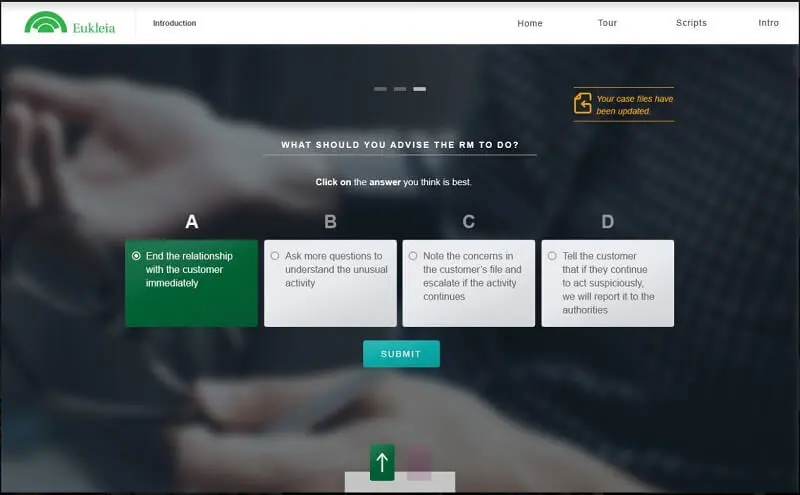
They are then presented with a decision to make and a range of options.

On choosing an action, they receive feedback. In this instance, they haven’t made the right decisions so they receive supplementary information on the correct course of action.

This design approach frames all of the learning within an overarching story, so rather than learners having to go through many screens of learning content on rules and regulations, this information is dispersed throughout the course and also placed in context, as it’s only presented at a relevant point in the story. This makes the whole experience far more immersive and grounds the learning in a real-life situation.

This type of approach can be used in conjunction with personalization, so that learners only see additional content if they are not making the right decisions, cutting down learning time for those staff who are demonstrating a high level of understanding and competence.

About the Authors

Ashley Laurence

Get in touch.

Learn more about our talent transformation solutions.

Transformation doesn’t happen overnight if you’re doing it right. We continuously deliver measurable outcomes and help you stay the course – choose the right partner for your journey.

Our suite of offerings include:

  • Managed Learning Services
  • Learning Content Design & Development
  • Consulting
  • AI Readiness, Integration, & Support
  • Leadership & Inclusion Training
  • Technical Training
  • Learning Technologies & Implementation
  • Off-the-Shelf Training Courses


Survey Says… Training Needs Human Connection and Interaction

In early 2019, we conducted a survey to discover the learning preferences of professionals. While we learned a lot about the skills people need to develop, what motivates them to learn at work, and more, two areas stood out to us as critical components to keep in mind as many organizations build their digital learning strategies.

How do you most prefer to learn?

42% – Learn in a classroom with a group.

22% – Learn one on one with a mentor, leader, friend, or peer.

18% – Learn on your own.

6% – Learn virtually with a group such as a webinar.

What can we learn from this?

People want to learn from others. We asked our respondents to select their most preferred learning modality. The forced ranking of these answers demonstrated that people simply like to learn with others. Shared experiences and learning together should represent a significant part of an organization’s strategy.

What are the top ways in which you prefer to learn?

Respondents were able to choose multiple options, but these were the top three.

What can we learn from these responses?

Learning that includes connection with others is still preferred and is perceived as more effective – regardless of whether that connection happens through technology or face to face. These results mirror what we heard in last year’s leadership research when we asked a similar question. Leaders and learners benefit from sharing with others, including facilitators, coaches, peers, and mentors. While a variety of interactive options can help facilitate learning, it is the interaction and guidance from other human beings that makes for a memorable learning experience.

Would you like more of this research?

This is an excerpt from our 2019 Voice of the Learner Report.

Learning preferences, preferred modalities, technologies, skills, and engagement


About the Authors

GP Strategies Corporation
GP Strategies is a global performance improvement solutions provider of sales and technical training, e-Learning solutions, management consulting and engineering services. GP Strategies' solutions improve the effectiveness of organizations by delivering innovative and superior training, consulting and business improvement services, customized to meet the specific needs of its clients. Clients include Fortune 500 companies, manufacturing, process and energy industries, and other commercial and government customers.

Get in touch.

Learn more about our talent transformation solutions.

Transformation doesn’t happen overnight if you’re doing it right. We continuously deliver measurable outcomes and help you stay the course – choose the right partner for your journey.

Our suite of offerings include:

  • Managed Learning Services
  • Learning Content Design & Development
  • Consulting
  • AI Readiness, Integration, & Support
  • Leadership & Inclusion Training
  • Technical Training
  • Learning Technologies & Implementation
  • Off-the-Shelf Training Courses


Even Socrates went to the Marketplace: Soft Skills for ISDs and Other Thinkers

Like many intellectuals and creatives, we ISDs tend to be a bunch of beautiful eccentrics. That’s a great thing: our perspective—dare I say genius—is what gets us invited into some of the most interesting and complex discussions. Those are fantastic places to be—until we don’t get invited back.

Why does that happen? Don’t our colleagues and clients value our passion and expertise?

Yes, and. Yes, they value our work, and they value it even more when they experience us as approachable and easy to work with.

As many of us discovered in middle school, the deepest thinkers don’t always project well socially. When we become engrossed in a project, or revved up about an idea, we’ve been known to bypass a few social norms. We don’t mean any harm; it’s all part of the passion we invest in our work. But our colleagues and clients may be put off by what they view as disrespect for process—and people.

We can nurture relationships without fundamentally changing our strange, beautiful souls. It just takes some empathy with the folks around us—and a couple of minutes to reflect. Asking myself following four questions has helped me remain humble, honest, and included in conversations I care about:

Are you on time?

Inspiration doesn’t happen on demand, but you should be able to estimate how long a deliverable will take to complete. Offering a reasonable estimate and following through is a straightforward way to endear you to any project manager. If you’re struggling with a deadline, communicate: the sooner, the better.

If, like me, you frequently find yourself in a quandary between two or more treatments, write the options into your high-level design. Your client will appreciate the extra thought you put into the project and the engaging discussion that ensues from weighing both options.

How—and how much—are you speaking?

Heavy citation of theory and other academic flourishes not only alienate business partners, they also erode their trust. Intellectualization is called a defense mechanism for good reason: it keeps others at bay. Try saying, for example, “We know people tend to remember the first and last things they learn,” rather than referencing the primacy and recency effects. The most intelligent people are able to adapt their idiom so that others feel comfortable, not condescended to.

Also consider how much you’re speaking: it’s natural to hold the floor while you’re presenting, but are you holding it hostage? The meandering, philosophical conversations we enjoy among our peers often sound dull and navel-gazing to clients. Worse, it gives them opportunities to veto ideas at the brainstorming stage, before we have a chance to polish them. Unless it’s a designated ideation session, resist the urge to pontificate in front of clients.

Are you fighting for face time?

Account and project managers are specialists, just as we are. They have a clearer sense of the client’s budget and risk tolerance, because they’re constantly taking the pulse of the relationship. We need to hear and incorporate their insights: they play a critical role in a client’s acceptance of our recommendations.

If your account team wants to present a learning design to the client, your job is to give them the tools to do so—not fight to be the “sage on the stage.” Trust their reading of the relationship, and make sure they understand the rationale behind your design.

If you’re frequently excluded from meetings, consider the possibility that your presentation style may not sit well with the client. Try asking your internal team for constructive feedback and rehearsing with them before your next client-facing presentation.

Do you pay your debts?

It’s important to acknowledge the shoulders we stand on. Those of us who work in a corporate environment enjoy job security founded upon contracts negotiated by others—and resources that cushion us from losses. Those in business for ourselves depend on our clients’ willingness to invest in our ideas and take risks. You can pay subtle homage by using “we” language in meetings and referencing conversations you’ve had with your team and client to underscore your respect for their contributions.

When you’re rewarded for a great idea or a successful implementation, enjoy that recognition: you’ve earned it! But stay humble. Success is fleeting, and it owes as much to business, economic, and global factors as it does to individual expertise. We may be thinkers by trade but, without a market, our craft would have no audience. Even Socrates, the quintessential teacher, philosopher, and questioner, had to hawk his learning programs at the agora. Appreciate everyone who sees the value in your work—and helps you sell it.

About the Authors

Tiffany Vojnovski
The idea that school could be different first came to me—as did most risky ideas—through fiction, specifically Notes on the Hauter Experiment, a futuristic novel set in an automated boarding school. Screens replaced teachers, and flashing lights cued students to move to their next class. Those who disobeyed were punished with grating alarms and foul odors. Whether the author, Bernice Grohskopf, had a background in instructional design or simply excelled at reimagining the boarding-school bildungsroman, one thing was clear: school was ripe for an LX intervention. I didn’t revisit the idea until I joined the New York City Teaching Fellows program; but this time, I was the teacher instead of the reader. Via a fast track to certification, I was charged with teaching in one of the highest-needs schools in the country. My challenge was to boost students’ achievement by several grade levels while adding rigor and interest to the high-school English curriculum. After a lot of trial, error, and reflection, I learned how to help my students succeed. However, I never felt comfortable enforcing the poorly thought-out procedures and meaningless paperwork our school leadership imposed upon students. I believed in the value of knowledge, and to organizations devoted to learning and exploration. What I wasn’t sure I believed in were the virtues of going through the system in a single “right” way. If anything positive came out of my complicity with the school’s—and district’s—lamentable LX, it was the empathy I developed for my students. If their job was to learn and follow the rules, my job was to make it as easy as possible for them to do so. Any procedure that caused confusion about what to do when they entered class, where to find learning resources, or how to turn in completed work needed to be redesigned. When students arrived in a classroom designed for professional learning, they acted—surprise!—like professional learners. My commitment to LX has been the link between my teaching and instructional design practices. Rather than despair that learners aren’t who we want them to be—more literate, more professional, more successful in whatever way we value—we should design learning tools that make these ends accessible. Learners themselves can teach us how: thanks to the design thinking model, we have a series of steps for engaging learners in empathy interviews and quickly prototyping solutions that might help them. It’s easy to view the learner as a faceless cipher sitting at the other end of an eLearning module. However, once you meet someone face to face, you can’t help but care about their experience. Not every learner is skilled in metacognition or speaks the language of academia, but all learners can tell us, in their own idiom, about the obstacles and fears that trouble them—and the interventions that would improve their lives. Learning is more than a system of rewards, punishments, and behavioral cues meted out by machines. My commitment is to maintain an open mind and to treat every learner as a sympathetic character.

Get in touch.

Learn more about our talent transformation solutions.

Transformation doesn’t happen overnight if you’re doing it right. We continuously deliver measurable outcomes and help you stay the course – choose the right partner for your journey.

Our suite of offerings include:

  • Managed Learning Services
  • Learning Content Design & Development
  • Consulting
  • AI Readiness, Integration, & Support
  • Leadership & Inclusion Training
  • Technical Training
  • Learning Technologies & Implementation
  • Off-the-Shelf Training Courses


Implementing Agile Methodology for Learning and Development Teams

When you think about implementing agile methodology practices, do you think of IT teams? If so, you are not alone. In practice, agile methodologies such as Scrum and Kanban have been predominately adopted by IT teams due to the type of work these teams release, but using agile methodology in learning and development can take your team to new heights. 

Key Agile Principles 

Iterative Development 

Non-IT teams may struggle with breaking down their work into smaller pieces to deliver within a shorter timeframe and therefore may be hesitant to adopt agile. As an instructional designer, I was used to the traditional waterfall approach; I could plan for all my deliverables up front and choose a designated time when they were all due, which was typically several months down the line. Instructors often cope with factors that can influence the development timeframe for any training document. Examples of common obstacles include a change of scope, the system not being ready, undefined processes, key decisions not yet made, role changes being in process, the unavailability of the subject matter expert, etc. It just did not seem possible to complete any substantial asset in a short timeframe—until I saw agile in action. 

Collaboration and Feedback

I’ve been working on a learning and development Scrum team with three other instructional designers to develop learner-to-performer journeys and training materials for a client whose IT organization is going through an agile transformation. What better way to design and develop training for newly forming agile teams than to work and progress as an agile team ourselves? Our team of designers act as the traditional development team in the Scrum model. Our team has a Scrum master who ensures the team follows Scrum practices, removes obstacles, manages risks, and provides an environment for continuous improvement. Instead of the traditional product owner, who owns the vision and requirements for the work (we do a lot of this as instructional designers), we have what we call a backlog manager. This role manages the intake of our work from the business and helps us track and prioritize what we work on. On many projects, the Scrum master and product owner split the work of a typical project manager. 

Though we had our challenges while adjusting to a new way of working, we are now a high-performing Scrum team, releasing deliverables every 3 weeks. In order to reach this point of success, however, our team needed to have the following criteria in place. 

Agile Best Practices for L&D

Establish a scrum master who removes barriers. Momentum can significantly slow if the team is not able to adapt and push through development blocks. Having a scrum master who is highly engaged, is willing to find answers, and knows how to help the team shift priorities allows the designers to continuously stay productive throughout each sprint. 

Having clear priorities filter down from project leadership is also critical for our team to manage the intake requests received from numerous business stakeholders. On our team, the backlog manager and Scrum master attend weekly priority meetings to provide and receive updates on work for our team. This helps us plan faster and more effectively for each sprint and provides the business with deliverables that will add the most value for them as quickly as possible. 

Aligning with Learning Goals

The notion of being pulled to the work is critical for our team to maintain momentum. This means that we only work on assets that align with current business needs so that our subject matter experts are engaged to support. Like many instructional designers, we were asked to develop certain assets but because the business did not have an urgent need for those assets, when we found gaps or had questions on the content we were provided, we struggled to get support because our subject matter experts were being pulled into higher priority tasks. This slows down design and development significantly.  

We solve for this through the stories we track on our Scrum board each sprint. We create a story solely for content review and curation, if sufficient content has not been provided, that is separate from design and development to ensure the designer has all that they need when it is time to develop. This not only puts more ownership on the business to provide the needed material before development can start, but it also helps limit rework for the designer if development starts too early. 

Accelerating Content Delivery

Using agile methodology in learning and development has been effective for our team to continually have a steady stream of work throughout the project. It also helps us manage scope and deadlines when we plan the work; we complete each sprint ahead of time, with stretch goals to take on more work if time allows. This helps ensure the team does not get overloaded but still challenges us to complete more within the sprint. Using the agile approach gives our team the ability to release training content quicker so our end users can start using the content when they need it. Agile also allows us to receive feedback early so we can iterate on it and apply that feedback to future assets we develop. 

Building Effective Agile Teams

Cross-Functional Collaboration

Agile is not just for IT developers. If implemented effectively, being agile is a fast and efficient way to produce on-demand training for our clients. Even if your team is not set up with a Scrum master and product owner, your project manager can fill this role by helping the team plan and prioritize work to focus on and complete within shorter timeframes.  

Continuous Improvement 

Even if your deadlines are months down the line, working in sprints can help ensure steady progress is made, and daily standup meetings allow all team members to stay informed of progress and any barriers that arise. At the end of each sprint, team members reflect on what went well and what did not, which helps the team to continuously improve the processes going forward.  

Optimizing L&D with Agile 

There are many benefits to working this way for both the project team and the client. Agile implementation can significantly enhance productivity and adaptability for an L&D team. By adopting Agile methodologies, L&D teams can do a better job of managing scope, deliver content more rapidly, and continuously improve through feedback and iteration. Even if a team isn’t fully structured with traditional Agile roles, incorporating Agile principles—like working in sprints and maintaining clear priorities—can lead to more efficient project outcomes. Embracing this approach positions teams to better meet business needs and deliver timely, impactful training solutions. 

Are you interested in implementing agile methodologies into your organization? Our program and project management experts offer solutions for initiatives of all sizes.  

About the Authors

Michelle Crowe
Michelle is a Business Consultant at GP Strategies who brings meaningful strategies and solutions to companies undergoing a transformational change. She works with enterprise leaders and managers to help drive, support, and sustain a change to lead to successful adoption within the organization.

Get in touch.

Learn more about our talent transformation solutions.

Transformation doesn’t happen overnight if you’re doing it right. We continuously deliver measurable outcomes and help you stay the course – choose the right partner for your journey.

Our suite of offerings include:

  • Managed Learning Services
  • Learning Content Design & Development
  • Consulting
  • AI Readiness, Integration, & Support
  • Leadership & Inclusion Training
  • Technical Training
  • Learning Technologies & Implementation
  • Off-the-Shelf Training Courses


Designing Technical Training With Precision

As the workforce continues to change, age, and retire, with new employees taking the place of long-serving technical workers, training is crucial in the transition to a new generation of technical worker. As mentioned in the previous blog post Bridging the Skills Trade Gap: Ways to Ensure Future Success, there is a near-term need to replace technical labor resulting from baby boomers retiring at record numbers. For these reasons, it is important that you design technical training with precision and structure, and that it provides both the ability to onboard new employees and to upskill incumbent employees.

To ensure that you are providing new hires with the knowledge and skills needed to integrate into an existing workforce and that your existing workers have the latest tools needed to perform efficiently and effectively, your technical training strategy should encompass a “living course design plan.” This means that your technical training design is not static, but rather reflects the latest updates in technology, terminology, and safety standards. It is important to transition from static print-out training to eLearning for knowledge components and refreshers, as eLearning better meets the needs of the up-and-coming generation and can be updated more efficiently to reflect current conditions, standards, practices, and techniques.

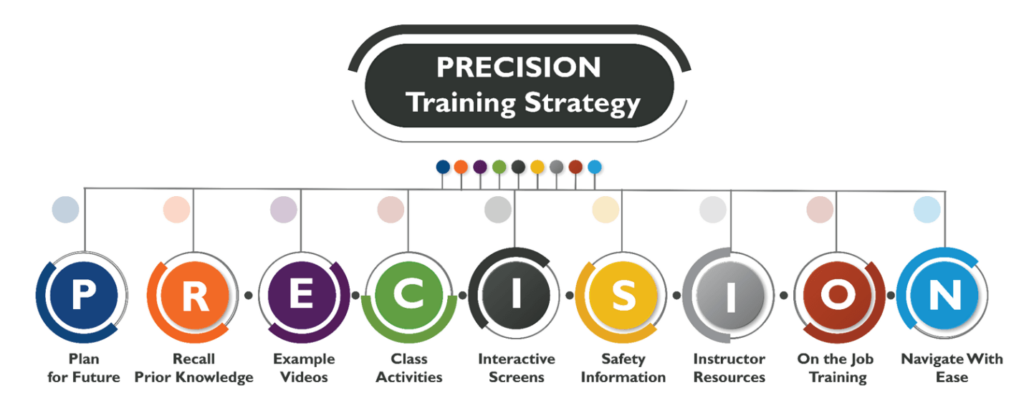
A precision training strategy, like the one below, should make full use of a wide array of training methodologies, including example videos, class activities, on-the-job training, and more.

Designing technical training that uses tools like example videos can incorporate site-specific imagery to bring the environment into the classroom and show correct (or safe) and incorrect (or unsafe) examples of performing tasks. Class activities can leverage a safe environment to demonstrate and perform tasks, use representative tools and equipment, and provide interactions during a presentation. Instructor-led and on-the-job safety should also be prioritized and reinforced through classroom activities.

Precise on-the-job training should also be provided, allowing workers to observe what needs to be done, how it needs to be done, and why it is being done (along with cause and effect). Training should be consistent and repeatable, have clear objectives, and tie back to the organization’s overall key performance indicators (KPIs). The technical workforce should understand how they contribute to the overall strategy and what actions they need to take to maximize the performance of equipment and assets. As discussed in the blog Improving Your Operator-Driven Reliability Strategy, front-line maintenance and operations staff is the closest to taking action to make improvements.

Finally, be sure to plan for the future and create a future-forward technical training design that can be easily transitioned to blended learning through a living course plan. Doing so will include many different methods of training, but when training is done with precision, it will lead to a more prepared workforce that is ready to succeed now and in the future.

About the Authors

Kayla Ratz
Kayla Ratz is the Digital Marketing Manager for GP Strategies and the editor of the GP Strategies Blog. Her focus is on sharing thought leadership and insights across digital mediums, and through collaboration efforts, to support performance improvement and enable knowledge sharing in the Learning Industry.

Get in touch.

Learn more about our talent transformation solutions.

Transformation doesn’t happen overnight if you’re doing it right. We continuously deliver measurable outcomes and help you stay the course – choose the right partner for your journey.

Our suite of offerings include:

  • Managed Learning Services
  • Learning Content Design & Development
  • Consulting
  • AI Readiness, Integration, & Support
  • Leadership & Inclusion Training
  • Technical Training
  • Learning Technologies & Implementation
  • Off-the-Shelf Training Courses


Bridging the Skills Trade Gap: Ways to Ensure Future Success

The most pressing issue facing North American manufacturing is the lack of qualified technical labor. According to the U.S. Census Bureau, there are more than 77 million baby boomers (people born between 1946 and 1964) in the U.S., and by 2030, this demographic will represent an estimated 20% of the population. This means that beginning in 2011, more than 10,000 baby boomers either have or will turn 65 years old each day, and this will continue until the year 2030 (Bureau of Labor Statistics).

Furthermore, manufacturing executives should expect 40% of their skilled workforce to retire within the next 5 years. For organizations with annual incomes spanning $10 million to $1 billion, this could mean an average loss of $52 million per company, and for larger companies this could be closer to $100 million. The National Association of Manufacturers (NAM) reported approximately 20% of companies with 2,000 or fewer workers consider this manufacturing skills gap to be their number one concern.

For the fifth year in a row, Manpower Group’s annual Talent Shortage Survey has reported skilled trade vacancies as being the hardest to fill. To further amplify this growing problem, Manpower Group also reports that only about 6% of students are expected to consider a career in the trades. Each year, up to 600,000 skilled jobs go unfulfilled.

This manufacturing skills gap creates two main dilemmas: first, periods where the technical staff, including maintenance, operations, and safety crews, may be understaffed and overloaded.  The second main dilemma is the need for an influx of new skilled trades personnel who will initially be unfamiliar with specialized systems, equipment, procedures, and failure modes. (Anyone familiar with the nuclear accident at Chernobyl can tell you that this is not a good problem to have.) Personnel should be knowledgeable on how to most effectively operate equipment and recognize equipment problems before they become critical. Examples of how to address the macro component of trade-skills support include:

  • Raising awareness of careers in skilled trades or promoting the image of skilled trades in order to attract a new generation of workers
  • Offering a training tax credit/financial assistance to employers
  • Developing national standards to recognize trades and promote ease of movement across the country
  • Adjusting legislation to make apprenticing more efficient and effective

Additionally, our recruiting, hiring, staffing, job design, and training practices need to change in order to properly address the manufacturing skills gap. Training for technical staff can be hands-on, instructor-led, or virtual, and can use an industrial workstation or a blended approach that includes most or all of the aforementioned methods. Training must be designed with precision and take into account the above-mentioned modalities to ensure learning is maximized. It is also important to pass on as much of the cumulative knowledge of exiting staff by offering coaching, mentoring, and apprenticeship programs (possibly including incentives that will encourage more participants).

One advantage to training the up-and-coming generation of workers is their intuitive grasp of and comfort with technologies. A millennial worker may have already used tools such as virtual reality sets at some point in their background and would be more comfortable with virtual training that is both safe and, since it requires neither a classroom nor an instructor, available at a lower cost than many traditional training methods.

The industry faces many challenges over the next decade, but with proper thought and analysis, combined with a focus on training and development, there is no reason that these challenges cannot be overcome.

About the Authors

GP Strategies Corporation
GP Strategies is a global performance improvement solutions provider of sales and technical training, e-Learning solutions, management consulting and engineering services. GP Strategies' solutions improve the effectiveness of organizations by delivering innovative and superior training, consulting and business improvement services, customized to meet the specific needs of its clients. Clients include Fortune 500 companies, manufacturing, process and energy industries, and other commercial and government customers.

Get in touch.

Learn more about our talent transformation solutions.

Transformation doesn’t happen overnight if you’re doing it right. We continuously deliver measurable outcomes and help you stay the course – choose the right partner for your journey.

Our suite of offerings include:

  • Managed Learning Services
  • Learning Content Design & Development
  • Consulting
  • AI Readiness, Integration, & Support
  • Leadership & Inclusion Training
  • Technical Training
  • Learning Technologies & Implementation
  • Off-the-Shelf Training Courses


Improving Your Operator-Driven Reliability Strategy

There is an old saying in the restaurant industry: when the food or service begins to break down, management or ownership should seek to solve the issue by talking to the people within 10 feet of the problem. The individuals who work in close proximity to systems that are bringing down performance are also the ones most likely to recognize whether equipment is causing diminished performance. If a cook can’t get as many orders out of the kitchen as they used to, it might be because one of the stovetops is not lighting, or another essential piece of equipment is malfunctioning. Major plants and facilities work in much the same fashion, and operators are generally going to be the people within 10 feet of the problem.

According to a study at the Penn State Applied Research Lab, North American industry could recover $200 billion to $500 billion annually through improved physical asset management. In other words, by eliminating the gaps between current and potential performance, businesses can create major improvements to their bottom line. Further, the people best equipped to recognize the problems with physical assets are those who operate them.

One way to improve the performance of these key assets is by examining the areas where the most problems occur, and then taking steps to find out exactly what is impacting the ability to operate at maximum efficiency. As seen in the example chart below, certain areas of the business clearly show more downtime than others.

In this example, the furnace operator, if properly trained, might be able to identify issues that can be easily solved and eliminate downtime in that area—leading to a rapid improvement in overall performance. Don’t underestimate the power of operator-driven reliability.

Operators must be completely prepared to quickly troubleshoot and correct problems before they negatively impact the business. Operators should be trained effectively and continuously to ensure they are operating with the latest knowledge. As mentioned in the blog Designing Technical Training With Precision, “living course design plans” are needed for operators to stay current. Their roles are critical. Operators must have intricate knowledge of the workings of systems and equipment, be able to identify problems before they get out of hand, and take the steps necessary to mitigate issues that would cause disruption or damage if left unchecked. Early detection of problems, such as overheating or vibration, can prevent expensive problems from occurring and eliminate downtime for key pieces of equipment.

The impact of most equipment failures can be mitigated when operators know their equipment inside and out, recognize what normal performance should look like, and determine when equipment needs maintenance or service. For more information on how you can improve operator-driven reliability, please contact GP Strategies here.

About the Authors

GP Strategies Corporation
GP Strategies is a global performance improvement solutions provider of sales and technical training, e-Learning solutions, management consulting and engineering services. GP Strategies' solutions improve the effectiveness of organizations by delivering innovative and superior training, consulting and business improvement services, customized to meet the specific needs of its clients. Clients include Fortune 500 companies, manufacturing, process and energy industries, and other commercial and government customers.

Get in touch.

Learn more about our talent transformation solutions.

Transformation doesn’t happen overnight if you’re doing it right. We continuously deliver measurable outcomes and help you stay the course – choose the right partner for your journey.

Our suite of offerings include:

  • Managed Learning Services
  • Learning Content Design & Development
  • Consulting
  • AI Readiness, Integration, & Support
  • Leadership & Inclusion Training
  • Technical Training
  • Learning Technologies & Implementation
  • Off-the-Shelf Training Courses


Navigating the Challenges of Learning Innovation

It’s no surprise that innovation is a hot topic in the learning space. With new technologies, methodologies, platforms, processes, and players entering the marketplace daily, disruption is everywhere. Learning organizations can’t adequately address these issues with today’s approaches, much less yesterday’s. So innovation has become a necessary element to build into your learning organization in order to move forward strategically.

Research from CLO indicates that staying on top of these trends is a top priority in corporations, but it’s also the initiative learning organizations are least prepared to undertake. So a couple of years ago, GP Strategies developed our own Innovation Kitchen and 5-step Innovation Processes to help our clients to address the complexities and harness the opportunities hidden within the disruption.

Rather than attacking innovation at the point of execution of a mission-critical initiative in your own organization, we recommend forming a separate, ongoing conversation around the elements of innovation. In other words, create a conversation that takes place outside of the pressures, emotion, and immediate needs of a specific initiative—one that nurtures ongoing discovery, explores what is possible based on existing and emerging trends, experiments with tactics and approaches, and builds a knowledge base around what is possible and what your organization can leverage to address any given initiative that may arise.

Even if you can’t form your own Innovation Kitchen staffed with industry experts, you can build a sustainable approach to incorporating innovation into your initiatives that your organization can support at some level, on any budget. Here are some of the challenges to look out for:

  • How are you going to fund your innovation effort? We suggest a right-sized approach. Whether you’re able to assemble a large cross-functional team focused on the mission, hire a couple of dedicated experts, or allocate one person from within who works on it on a part-time basis, you will be better prepared to respond from a place of strength, rather than just reacting to the crisis du jour. It’s not the size of the innovation exploration that matters. In fact, you don’t even have to originate all the innovation yourself, as you can harvest it from other internal initiatives or curate knowledge from outside resources. What matters is that you explore innovative approaches objectively.
  • This is about moving from the art of the possible to the business of the viable. Is your innovation going to yield the needed business results? Will it help you do things better, faster, and/or cheaper? We recommend a rapid prototyping approach. We have prototyped solutions for a few thousand dollars in the space of a few weeks. When you take a time-bound approach, the project doesn’t linger and utilize excess resources. It’s also important to understand that not every idea is going to produce revolutionary results. Sometimes your results will be evolutionary, offering lessons learned or incremental results over time.
  • Buy-in and ability to scale. How do you grow your innovation initiative and get stakeholder buy in? We group these together because the key to innovation initiative success is communication—promoting, publishing, and sharing your progress and conclusions. As your initiative progresses, you want people to know what you’re doing. It begins by letting your entire organization know that the initiative exists, it includes regular progress reports and/or relevant findings, and it climaxes with sharing any execution that results. The more interest you generate and value you demonstrate, the more resources you’ll be able to justify to grow your initiative. And the more positive attention you bring to the initiative, the more stakeholder buy-in you’ll receive.

Innovation seems like a tall order. And it can feel like you’re under the gun—“You’d better be brilliant, or else!” But, it’s really about researching and understanding what is possible so that when the moment comes to architecting a solution, you’ll have one foot in brilliance and another in expertise.

For more information, examples and resources, visit our Innovation Kitchen.

About the Authors

Matt Donovan
Chief Learning & Innovation Officer
Early in life, I found that I had a natural curiosity that not only led to a passion for learning and sharing with others, but it also got me into trouble. Although not a bad kid, I often found overly structured classrooms a challenge. I could be a bit disruptive as I would explore the content and activities in a manner that made sense to me. I found that classes and teachers that nurtured a personalized approach really resonated with me, while those that did not were demotivating and affected my relationship with the content. Too often, the conversation would come to a head where the teacher would ask, “Why can’t you learn it this way?” I would push back with, “Why can’t you teach it in a variety of ways?” The only path for success was when I would deconstruct and reconstruct the lessons in a meaningful way for myself. I would say that this early experience has shaped my career. I have been blessed with a range of opportunities to work with innovative organizations that advocate for the learner, endeavor to deliver relevance, and look to bend technology to further these goals. For example, while working at Unext.com, I had the opportunity to experience over 3,000 hours of “learnability” testing on my blended learning designs. I could see for my own eyes how learners would react to my designs and how they made meaning of it. Learners asked two common questions: Is it relevant to me? Is it authentic? Through observations of and conversations with learners, I began to sharpen my skills and designed for inclusion and relevance rather than control. This lesson has served me well. In our industry, we have become overly focused on the volume and arrangement of content, instead of its value. Not surprising—content is static and easier to define. Value (relevance), on the other hand, is fluid and much harder to describe. The real insight is that you can’t really design relevance; you can only design the environment or systems that promote it. Relevance ultimately is in the eye of the learner—not the designer. So, this is why, when asked for an elevator pitch, I share my passion of being an advocate for the learner and a warrior for relevance.

Get in touch.

Learn more about our talent transformation solutions.

Transformation doesn’t happen overnight if you’re doing it right. We continuously deliver measurable outcomes and help you stay the course – choose the right partner for your journey.

Our suite of offerings include:

  • Managed Learning Services
  • Learning Content Design & Development
  • Consulting
  • AI Readiness, Integration, & Support
  • Leadership & Inclusion Training
  • Technical Training
  • Learning Technologies & Implementation
  • Off-the-Shelf Training Courses


Engaging Compliance Training: It’s Time to Think Differently About Assessments

This blog article was written prior to LEO Learning becoming part of GP Strategies.

When it comes to compliance training, assessment in one form or another is hard to escape. Along with visibility on course completion rates, regulators also require evidence that your training is effective. And assessments are a reasonably robust way of demonstrating effectiveness as they can show that learners understand key rules and regulations as well as appropriate actions and behaviors.

So end-of-course assessments are a bit of a ‘necessary evil’ for any compliance eLearning course. And they often take the form of banks of multiple choice questions which challenge learners to recall knowledge from the main learning content.

But are there other ways we can assess learners? Can we make assessments more powerful and more valuable than simply assessing knowledge uptake? Can we make assessments more engaging?

At LEO Learning, we’re now thinking about assessments a bit differently. We’re asking ourselves these questions and coming up with different tactics, not only to test knowledge transfer but also how we can use assessment to drive behavior change.

Here are three examples of new approaches we’re taking:

Scenario-Based Assessments

Scenarios are a valuable way to drive engagement with your training content and we’re increasingly taking a scenario-based approach to assessments too. Because scenarios are challenging learners to apply rather than recall knowledge, they’re also a more robust approach to understanding training effectiveness.

How it works in practice:
In one course we’ve designed recently, we’ve taken a scenario-based approach throughout the course content and then extended this approach through to the final assessment.

In each topic, learners watch a short video drama and then have to complete a challenging scenario based on what they’ve seen. To complete the course, learners take a final ‘mastery test’. In this test, learners are challenged to complete a range of scenario-based questions and the questions they receive are based on their performance in the earlier scenarios. That means that if a learner answered incorrectly to a scenario in the main course, they receive extra questions related to this learning point.

Ethical Questioning and Psychological Safety

This is a new area we are currently exploring in response to an increased focus from regulators on the role that culture plays in enabling staff to behave appropriately and feel safe to speak up when they believe something might be wrong.

Recently, the concept of psychological safety has gained traction. In organizations where individuals feel a high level of psychological safety, they feel able to speak up and voice opinions. In contrast, in an organization where there is low psychological safety, there is a culture of fear and intimidation and staff feel very hesitant to speak up due to concerns about repercussions.

It’s been found that low psychological safety contributes to significant failures in performance and conduct within organizations.

Addressing the concept of psychological safety in your compliance training is not only a valuable approach to supporting positive culture change, it can also be a powerful way to engage learners on a side of compliance they may never have considered before. For many staff, compliance is simply rules and regulations and they may not have ever thought about the wider context and role that compliance training can play in supporting the culture of their firms.

How it works in practice:
A simple way to start exploring the concept of psychological safety in compliance training is to use questions to explore attitudes and assumptions.

It’s particularly effective to ask learners to consider situations outside of their normal working roles. Ask learners to decide how they would react to a situation where someone is behaving inappropriately in a different sphere and then compare this behavior to something that could take place within a firm. This could be focused around intimidation, bullying, or threatening behavior.

Post-Course Assessment

Assessment doesn’t always have to be confined to the end of the course.

End-of-course assessments are useful for understanding the immediate effectiveness of training, but this is only a short-term view. Following up training with further opportunities to assess how learners have retained knowledge is an effective way to maintain learner engagement as well as increase knowledge retention and the chances of learners making real changes to their behavior long-term.

How it works in practice:

Plan to deliver follow-up questions or mini-quizzes at set times post-course completion. These can be sent via email with a link to a short module hosted on your LMS. If you have access to learner analytics you could also personalize the assessment by sending questions on areas you know the learner struggled to grasp within the course.

If you’ve adopted a storytelling or scenario-based approach within the original course, you can continue this with your post-course assessment. Think about delivering follow-up ‘episodes’ featuring the characters from the original course.

About the Authors

Ashley Laurence

Get in touch.

Learn more about our talent transformation solutions.

Transformation doesn’t happen overnight if you’re doing it right. We continuously deliver measurable outcomes and help you stay the course – choose the right partner for your journey.

Our suite of offerings include:

  • Managed Learning Services
  • Learning Content Design & Development
  • Consulting
  • AI Readiness, Integration, & Support
  • Leadership & Inclusion Training
  • Technical Training
  • Learning Technologies & Implementation
  • Off-the-Shelf Training Courses


The Power of Integrations Within the SAP SuccessFactors Recruiting Platform: Part 3

Part 1: Recruiting Related Integrations   |   Part 2: RCM, RMK Integrations

This final installment of our three-part blog series on recruiting-related integrations and the benefits they can offer focuses on the final integration back to Employee Central (EC) or the SAP on-premise HRIS environment. Here again, a tremendous positive impact results from a well-thought-out and meaningful integration between Onboarding (ONB) and the master data system of record. As with the first two upstream integrations, this connection facilitates gains in efficiency, data integrity, policy, and process compliance and enhances the new hire/employee experience.

In an integrated recruiting environment, the process begins and ends with the master data system of record, whether that be EC or SAP. Vacant positions are approved and used to create requisitions, and in turn, once the applicant has been selected and onboarded, the vacant position must be updated to reflect the information associated with the newly hired employee. The master system must be satisfied in order for benefits to be processed, equipment provisioned, and the employee paid. Issues with missing or mis-formatted data can be a tremendous drain on HR and HRIS resources and slow the processing of the newly hired worker, leading to frustration with the organization.

In order to avoid this, recognize and plan from the start and throughout the implementation of the Recruiting Management (RCM) module and ONB that the master system is exactly that, master! Data collected in both RCM and ONB should be based on what data is required by the master system at the end of the process and how that data must be formatted to be accepted into that system. All data required to successfully process a new hire must be collected during the recruiting and onboarding processes. This will avoid dealing with incomplete records, wasting time tracking down required information, entering manual updates, and handling the associated consequences for the organization and employee.

In addition, we should always strive to configure the fields in RCM and ONB that will eventually be consumed in the master system to accept only data in the required format. This is not always possible; there are circumstances where mapping must include adjusting the format or routing multiple responses from upstream systems to a single selection in EC or SAP. However, sharp, detailed planning for the final integration reduces overall solution complexity and increases stability of the data connections. When data is collected in the proper format, it will be accepted by the master system without errors that slow the process and again have negative consequences for the organization and newly hired worker.

Analyzing the above, we can see that by ensuring all data required to process hires and satisfy vacant positions is collected, properly formatted, and made consumable to the master HRIS system, benefits can be realized across all relevant categories. Reducing, if not completely eliminating, the need for manual record entry and updates, and the time spent chasing down outstanding data elements or correcting formatting errors greatly increases efficiency. In turn, this can lead to a major reduction in the number of hires for which processing is delayed or incomplete records remain, keeping the company in a more advantageous position in terms of internal and government policy and process compliance. This all adds up to a better overall experience for both the organization and newly hired employee. With less focus and effort associated with the administrative aspect of hiring an employee and more on the strategic elements, new employees will be able to quickly and successfully assimilate into the organization and make a meaningful contribution.

About the Authors

John Bestgen
John has over 20 years of HCM experience with a focus on Recruiting processes, analysis, and optimization. This includes solution development, system implementations, and ongoing improvement and support. John’s has the ability to provide a holistic, automated solution supporting the entire Recruiting process, including best practice solutions based on client experience with some of the largest and most successful organizations in the world . He currently resides on Cape Cod for the summer and is an active musician in his spare time!

Get in touch.

Learn more about our talent transformation solutions.

Transformation doesn’t happen overnight if you’re doing it right. We continuously deliver measurable outcomes and help you stay the course – choose the right partner for your journey.

Our suite of offerings include:

  • Managed Learning Services
  • Learning Content Design & Development
  • Consulting
  • AI Readiness, Integration, & Support
  • Leadership & Inclusion Training
  • Technical Training
  • Learning Technologies & Implementation
  • Off-the-Shelf Training Courses