The Power of Integrations Within the SAP SuccessFactors Recruiting Platform: Part 2

Part 1: Recruiting Related Integrations   |   Part 3: Data Movement Between Systems

In our first installment of this three-part series on recruiting-related integrations, we focused on the advantages gained from a meaningful integration between a client’s SAP or Employee Central (EC) HRIS environment and the Recruiting Management (RCM) module. This installment focuses on the positive impacts that can be garnered by extending the integration path between RCM and the client’s Onboarding (ONB) module. Just as we saw with HRIS to RCM, this integration will facilitate gains in efficiency, data integrity, policy, and process compliance and will provide a more optimal experience for recruiting users and applicants/new hires alike.

Also as with the HRIS to RCM integration, meaningful data connections between the RCM and ONB modules allow for data captured in previous processes and other modules to be used downstream to prepopulate fields, support conditions and rules, and ensure data is captured in the proper format. All these impacts in turn create a more accurate, efficient, and customized process for all people involved in the process of onboarding new employees to the organization.

Fields used in RCM, whether coming from the requisition, application, or approved offer, can be mapped to relevant fields in ONB. Therefore, if data is entered in RCM, then it doesn’t need to be entered in ONB, lessening the burden on recruiting users and hired applicants alike. Mapped data, which we know should and will not change, can be mapped as read only, while those fields that need to be updated during onboarding can be configured as editable. The most common example is the start date of a new hire.

In addition to lessening the data entry effort across the board, mapping RCM field values to ONB fields also ensures that all required data for ONB captured in RCM carries over properly. The ONB field will be populated in the correct format, allowing it to be passed as is to the downstream HRIS environment without issues. This greatly reduces the time and effort spent chasing down information required to process new-hire records as well as that expended on data corrections in order for records to save properly.

Finally, by mapping data from RCM to ONB, those values captured in RCM can be leveraged in ONB to support the exact, specific onboarding process for each new hire across the enterprise. Field values such as country where hired, position number, job code, and employment type can be set against rules that control what overall onboarding process the hired applicant is placed into. Further, within that specific process, these and other data points coming from RCM (and in turn, in many cases, the vacant position in HRIS) can be used to control what specific panels, fields, and forms are presented. In this manner, we can ensure that only drivers are asked for their license and accident history information or that the forms required by our secure location regarding workplace security are active.

Overall, a meaningful integration between the RCM and ONB modules significantly reduces the effort required by all involved in the process of onboarding new employees to the organization. By limiting data entry to only new fields introduced as part of this process, eliminating incomplete and not properly formatted data records, and customizing the process for each new hire, the integration creates a much more efficient, accurate, and compliant workflow for this critical process within the organization.

For more information on SAP SuccessFactors Recruiting and Onboarding, or the integration between the two, please contact John Bestgen.

About the Authors

John Bestgen
John has over 20 years of HCM experience with a focus on Recruiting processes, analysis, and optimization. This includes solution development, system implementations, and ongoing improvement and support. John’s has the ability to provide a holistic, automated solution supporting the entire Recruiting process, including best practice solutions based on client experience with some of the largest and most successful organizations in the world . He currently resides on Cape Cod for the summer and is an active musician in his spare time!

Get in touch.

Learn more about our talent transformation solutions.

Transformation doesn’t happen overnight if you’re doing it right. We continuously deliver measurable outcomes and help you stay the course – choose the right partner for your journey.

Our suite of offerings include:

  • Managed Learning Services
  • Learning Content Design & Development
  • Consulting
  • AI Readiness, Integration, & Support
  • Leadership & Inclusion Training
  • Technical Training
  • Learning Technologies & Implementation
  • Off-the-Shelf Training Courses


The Power of Integrations Within the SAP SuccessFactors Recruiting Platform: Part 1

Part 2: RCM, RMK Integrations   |   Part 3: Data Movement Between Systems

This is the first installment in a three-part blog series focused on the power of integration within the SuccessFactors (SF) platform. We will explore the benefits achieved via meaningful integration of the three recruiting-focused modules and multimodule integration with the HRIS system of record, whether that be SAP or Employee Central (EC). Initially we will outline the impacts of integrating the position creation, approval, and management solution with the Recruiting Management (RCM) module.

The second of the three-part series is dedicated to the integrations between RCM, Recruiting Marketing (RMK)/Career Site Builder (CSB), and Onboarding (ONB) modules. The final piece covers the movement of data back into the EC or SAP Human Resource Information System (HRIS) solution from both the RCM and ONB modules. In each, we will highlight the benefits that can be realized exclusively via these integrations more than those more associated simply with a successful, well-thought-out implementation of any of the relevant modules in a standalone manner.

Through my implementation and consulting tenure, I have been fortunate enough to have worked on many client projects spanning multiple modules in the SF Human Capital Management (HCM) suite, involving significant and meaningful integration between both the modules and either EC or SAP HRIS solutions. Despite the vast differences in client profiles, geographies, business areas, etc., the definition of success for the implemented solution is usually quite similar.

Clients undertaking these initiatives are typically looking to move the needle in three main areas: efficiency, data integrity, and process/workflow compliance. As stated above, implementation of the modules, when done correctly, can lead to advances in efficiency. Now, let’s look at how the integration portion of the solution can increase advances significantly and facilitate meaningful positive impact to the other two areas: data integrity and process/workflow compliance.

Complex organizations of all types need robust tools to help them manage headcount, recruiting and hiring activity, and position structure to ensure they are effectively providing the required resources within the mandates of the overall corporate strategy, budget, and approved relevant processes. When a hiring need arises, managers need to know what positions they have currently approved for hire and/or how to create and request approval for a position to meet their current needs.

EC Position Management supports these efforts for companies by allowing positions to be easily and accurately created. Data can be pulled into the position object from various other objects in the BizX data structure and use rules logic where appropriate to auto-populate fields based on other field values previously associated with the position. Positions can also be copied and modified as needed to support position creation based on previous openings. Access to both data and functionality is controlled via permissions, providing a proper level of protection for sensitive data that can be associated with a position.

A robust workflow to support both ad hoc and rules/logic-based approval paths is also included and used to ensure that the proper process of headcount approval is applied to each potential opening. For clients without EC but rather a more traditional SAP HRIS solution environment, GP Strategies offers our own proprietary solution: Mana. Mana provides the same functionality as EC Position Management, supporting the entire position request, creation, approval, and management lifecycle.

Whether the client uses EC Position Management, or a blend of SAP HRIS system data and MANA or similar solution, thoughtful and meaningful integration with the downstream SF RCM module can provide significant benefits that are otherwise unable to be achieved. By working to align and map the fields on the various requisition form versions to fields within the position structure and then leveraging position data to create and populate requisitions via integration, clients can realize several significant benefits. This is especially true if the integration between the position management tool and RCM is the only mechanism by which requisitions can be created. Let’s look at the specific benefits of the three categories of success criteria.

Efficiency:

This solution architecture is rooted in leveraging existing approved data throughout the process lifecycle. Positions are created, and structural data is leveraged along with rules logic to populate other position fields to make the creation process less burdensome and ensure that positions conform to all corporate policies and standardizations. That data is then leveraged to support dynamic approval paths based on rules logic and values in specific position fields (for example, if field “Grade” > 14, add the CFO approval step).

Once approved, that same position data is reused to populate the vast majority of the fields on the requisition form and all that require organizational approval. The leads to not only a much more accurate and efficient requisition completion process, but more importantly, a significantly compressed requisition approval process, an area of challenge for many organizations. As the data has been previously approved in the position-focused solution and used to populate the requisition form in read-only manner, one can consider it approved. Most clients simply have a single route map step for the recruiter to create or modify the posting content and strategy documentation prior to approval and posting.

The elimination of a lengthy, multiuser approval process for the requisition allows for open positions to be brought to market faster, hopefully leading to shorter wait times for new productive employees to fill them. These benefits can be realized without giving up any control over position structure or the mandated approval process.

Data Integrity:

By reusing our foundational approved position data throughout the recruiting and onboarding processes, clients can ensure, through thoughtful integration configuration, that data is kept in alignment between the approved position, and any related requisitions, applications, and offers before being used to satisfy the vacant position post-hire in either EC or SAP. When foundational approved data is sent to the requisition, it will have already had all of your HRIS validation checks performed on the fields. This eliminates the burden of the recruiting system requiring mirrored validations on the data to facilitate the new-hire process. Not only does this decrease the amount of configuration required in recruiting, it also ensures that the data going back to your HR database is consistent with your existing rules and dependencies.

Clients can decide which, if any, fields should be modified on the requisition if changed on the corresponding position and vice versa. This ensures that data stays in alignment where needed to support organizational standards while still supporting the individual recruiting needs of each open position to ensure the proper resource is employed.

Process/Workflow Compliance:

When requisitions can only be created from approved positions via integration, overall process controls over headcount, budget, and recruiting/hiring activity can be better supported. While supporting dynamic approval roles is difficult and manual in the recruiting module alone, by leveraging your HRIS, you can traverse your organizational structure much more easily to dynamically determine approvers and route requests to them as appropriate.

By leveraging data-based rules logic to mandate approval paths based on attributes of the position and by only allowing requisitions to be created once these approval workflows have been successfully completed, the solution ensures that recruiting resources and budget are only expended on openings the organization feels are critical to be filled at any given time. By requiring changes to the requisition to depend on changes to approved data in the position, controls on hiring parameters can be maintained throughout the recruiting process, ensuring that no issues arise at the offer or hire steps of the process.

In conclusion, by integrating the position management and recruiting aspects of their SF/SAP HCM solution, clients are able to realize benefits that are otherwise unachievable. These benefits range across the three most common categories of success criteria: efficiency, data integrity, and process/workflow compliance. In our next installment, we’ll focus on how the integration between the RCM, RMK/CSB, and ONB modules can provide significant additional benefit than that realized from standalone implementation.

The Power of Integrations Within the SAP SuccessFactors Recruiting Platform

This is the first installment in a three-part blog series focused on the power of integration within the SuccessFactors (SF) platform. We will explore the benefits achieved via meaningful integration of the three recruiting-focused modules and multimodule integration with the HRIS system of record, whether that be SAP or Employee Central (EC). Initially we will outline the impacts of integrating the position creation, approval, and management solution with the Recruiting Management (RCM) module.

The second of the three-part series will be dedicated to the integrations between RCM, Recruiting Marketing (RMK)/Career Site Builder (CSB), and Onboarding (ONB) modules. The final piece will cover the movement of data back into the EC or SAP Human Resource Information System (HRIS) solution from both the RCM and ONB modules. In each, we will highlight the benefits that can be realized exclusively via these integrations more than those more associated simply with a successful, well-thought-out implementation of any of the relevant modules in a standalone manner.

Through my implementation and consulting tenure, I have been fortunate enough to have worked on many client projects spanning multiple modules in the SF Human Capital Management (HCM) suite, involving significant and meaningful integration between both the modules and either EC or SAP HRIS solutions. Despite the vast differences in client profiles, geographies, business areas, etc., the definition of success for the implemented solution is usually quite similar.

Clients undertaking these initiatives are typically looking to move the needle in three main areas: efficiency, data integrity, and process/workflow compliance. As stated above, implementation of the modules, when done correctly, can lead to advances in efficiency. Now, let’s look at how the integration portion of the solution can increase advances significantly and facilitate meaningful positive impact to the other two areas: data integrity and process/workflow compliance.

Complex organizations of all types need robust tools to help them manage headcount, recruiting and hiring activity, and position structure to ensure they are effectively providing the required resources within the mandates of the overall corporate strategy, budget, and approved relevant processes. When a hiring need arises, managers need to know what positions they have currently approved for hire and/or how to create and request approval for a position to meet their current needs.

EC Position Management supports these efforts for companies by allowing positions to be easily and accurately created. Data can be pulled into the position object from various other objects in the BizX data structure and use rules logic where appropriate to auto-populate fields based on other field values previously associated with the position. Positions can also be copied and modified as needed to support position creation based on previous openings. Access to both data and functionality is controlled via permissions, providing a proper level of protection for sensitive data that can be associated with a position.

A robust workflow to support both ad hoc and rules/logic-based approval paths is also included and used to ensure that the proper process of headcount approval is applied to each potential opening. For clients without EC but rather a more traditional SAP HRIS solution environment, GP Strategies offers our own proprietary solution: Mana. Mana provides the same functionality as EC Position Management, supporting the entire position request, creation, approval, and management lifecycle.

Whether the client uses EC Position Management, or a blend of SAP HRIS system data and MANA or similar solution, thoughtful and meaningful integration with the downstream SF RCM module can provide significant benefits that are otherwise unable to be achieved. By working to align and map the fields on the various requisition form versions to fields within the position structure and then leveraging position data to create and populate requisitions via integration, clients can realize several significant benefits. This is especially true if the integration between the position management tool and RCM is the only mechanism by which requisitions can be created. Let’s look at the specific benefits of the three categories of success criteria.

Efficiency:

This solution architecture is rooted in leveraging existing approved data throughout the process lifecycle. Positions are created, and structural data is leveraged along with rules logic to populate other position fields to make the creation process less burdensome and ensure that positions conform to all corporate policies and standardizations. That data is then leveraged to support dynamic approval paths based on rules logic and values in specific position fields (for example, if field “Grade” > 14, add the CFO approval step).

Once approved, that same position data is reused to populate the vast majority of the fields on the requisition form and all that require organizational approval. The leads to not only a much more accurate and efficient requisition completion process, but more importantly, a significantly compressed requisition approval process, an area of challenge for many organizations. As the data has been previously approved in the position-focused solution and used to populate the requisition form in read-only manner, one can consider it approved. Most clients simply have a single route map step for the recruiter to create or modify the posting content and strategy documentation prior to approval and posting.

The elimination of a lengthy, multiuser approval process for the requisition allows for open positions to be brought to market faster, hopefully leading to shorter wait times for new productive employees to fill them. These benefits can be realized without giving up any control over position structure or the mandated approval process.

Data Integrity:

By reusing our foundational approved position data throughout the recruiting and onboarding processes, clients can ensure, through thoughtful integration configuration, that data is kept in alignment between the approved position, and any related requisitions, applications, and offers before being used to satisfy the vacant position post-hire in either EC or SAP. When foundational approved data is sent to the requisition, it will have already had all of your HRIS validation checks performed on the fields. This eliminates the burden of the recruiting system requiring mirrored validations on the data to facilitate the new-hire process. Not only does this decrease the amount of configuration required in recruiting, it also ensures that the data going back to your HR database is consistent with your existing rules and dependencies.

Clients can decide which, if any, fields should be modified on the requisition if changed on the corresponding position and vice versa. This ensures that data stays in alignment where needed to support organizational standards while still supporting the individual recruiting needs of each open position to ensure the proper resource is employed.

Process/Workflow Compliance:

When requisitions can only be created from approved positions via integration, overall process controls over headcount, budget, and recruiting/hiring activity can be better supported. While supporting dynamic approval roles is difficult and manual in the recruiting module alone, by leveraging your HRIS, you can traverse your organizational structure much more easily to dynamically determine approvers and route requests to them as appropriate.

By leveraging data-based rules logic to mandate approval paths based on attributes of the position and by only allowing requisitions to be created once these approval workflows have been successfully completed, the solution ensures that recruiting resources and budget are only expended on openings the organization feels are critical to be filled at any given time. By requiring changes to the requisition to depend on changes to approved data in the position, controls on hiring parameters can be maintained throughout the recruiting process, ensuring that no issues arise at the offer or hire steps of the process.

In conclusion, by integrating the position management and recruiting aspects of their SF/SAP HCM solution, clients are able to realize benefits that are otherwise unachievable. These benefits range across the three most common categories of success criteria: efficiency, data integrity, and process/workflow compliance. In our next installment, we’ll focus on how the integration between the RCM, RMK/CSB, and ONB modules can provide significant additional benefit than that realized from standalone implementation.

About the Authors

John Bestgen
John has over 20 years of HCM experience with a focus on Recruiting processes, analysis, and optimization. This includes solution development, system implementations, and ongoing improvement and support. John’s has the ability to provide a holistic, automated solution supporting the entire Recruiting process, including best practice solutions based on client experience with some of the largest and most successful organizations in the world . He currently resides on Cape Cod for the summer and is an active musician in his spare time!

Get in touch.

Learn more about our talent transformation solutions.

Transformation doesn’t happen overnight if you’re doing it right. We continuously deliver measurable outcomes and help you stay the course – choose the right partner for your journey.

Our suite of offerings include:

  • Managed Learning Services
  • Learning Content Design & Development
  • Consulting
  • AI Readiness, Integration, & Support
  • Leadership & Inclusion Training
  • Technical Training
  • Learning Technologies & Implementation
  • Off-the-Shelf Training Courses


Quick Tips for SAP SuccessFactors People Analytics

Canvas/Employee Central Advanced Reporting: How to return a single row for each employee while reporting on multiple pay components

I hold training sessions and consult with clients on Canvas/Advanced Reporting and one of the most frequently requested topics that clients want to know more about is how to return a single row for each employee on a report that includes Pay Components. In this blog, I’ll show you how to do just that in the easiest and most efficient way.

The Challenge

Each pay component and corresponding monetary amount is stored on its own row in the compensation table. So, when you create a query that includes specific pay component amounts for each employee who has multiple pay components, multiple rows will be returned. Here’s an example for a single employee:

The Solution

To generate a report that shows an employee’s multiple pay components on a single line, use two features that aren’t too frequently used in Advanced Reporting: Table Duplication and Table Restrictions (or Table Filters).

Build Your Query

Start with the Job Information table, and then pull in Compensation:

Next, duplicate the Compensation table by clicking on the Edit Table icon:

And then click Duplicate Table:

Note: You cannot duplicate the first table that is added to a query, which is why we didn’t begin the query with the Compensation table.

You now have a second version of the Compensation table that is a replica of the first, including the same selected columns. Both of these Compensation tables are linked directly to Job Information:

For this example, Employee 455 has three Pay Components. In this case, you will need to duplicate the Compensation table to create a third:

Let’s pause and look at the results at this point.

Whoa—we’ve gone from three rows for this employee to … many more. There are 27 in total—for the mathematics fans reading this, each combination of those three pay components are returned: 3 x 3 x 3 = 27 rows.

Fear not—we’ll pare it back down!

Modify the Duplicated Tables

There are a couple more steps to reach our goal of a single row for each employee.

First, take a step back and note the ID/Name pairs for each of the Pay Components. We will use the ID in the next step:

  • 28 = BASIC BZ
  • 36 = Childcare Allowance Brazil
  • 119 = Transportation Allowance

Tip: The ID/Name pairs will vary for each implementation; be sure to note the specific ID/Name pairs for your instance.

For each Compensation table, use Table Restrictions so that only one Pay Component Amount is returned.

Start with the first Compensation table by clicking the Edit Table icon:

Then, click the Edit Restrictions filter icon:

Filter Designer is returned, which looks just like the Query Filter. Conceptually it is no different than the Query Filter, but this filter will be applied only to this Compensation table.

Here is the Table Restriction I’ve set up for BASIC BZ, which corresponds to ID 28:

Now, we require a couple of edits for this table. Rename the Amount column to BASIC BZ. Then remove the Pay Component and Pay Component (Name) fields. The result:

Finally, repeat these Modify the Duplicate Tables steps for Compensation (2) and Compensation (3) tables.

Final Result

Once you’ve made the above modifications to the remaining tables, your query will look something like this:

And more importantly, your result set is as follows:

Yes! The bliss of a single row for each employee!

Thanks for reading—hopefully you learned something new. Look for more to come!

If you have any questions, please feel free to reach out to me directly.

About the Authors

GP Strategies Corporation
GP Strategies is a global performance improvement solutions provider of sales and technical training, e-Learning solutions, management consulting and engineering services. GP Strategies' solutions improve the effectiveness of organizations by delivering innovative and superior training, consulting and business improvement services, customized to meet the specific needs of its clients. Clients include Fortune 500 companies, manufacturing, process and energy industries, and other commercial and government customers.

Get in touch.

Learn more about our talent transformation solutions.

Transformation doesn’t happen overnight if you’re doing it right. We continuously deliver measurable outcomes and help you stay the course – choose the right partner for your journey.

Our suite of offerings include:

  • Managed Learning Services
  • Learning Content Design & Development
  • Consulting
  • AI Readiness, Integration, & Support
  • Leadership & Inclusion Training
  • Technical Training
  • Learning Technologies & Implementation
  • Off-the-Shelf Training Courses


Content Grouping: A Fresh Approach to Driving Learner Engagement in Compliance Training

This blog article was written prior to LEO Learning becoming part of GP Strategies.

Put simply, when learners are engaged they learn better and retain knowledge for longer. Engaged learners are also more likely to change their behaviors and support the ethical cultures we know that regulators are now looking for.

The Challenge of Delivering Engaging Compliance Training

But increasing learner engagement can be tricky, and it’s historically always been a bit of a challenge with compliance training for a number of reasons:

  • Subject matter: Training has struggled to relate compliance themes to learners’ daily roles and the sense of shared responsibility in getting it right.
  • Mandatory nature: Compliance training is usually mandatory and many learners have to do it a few times a year, as well as each time they start at a new firm. This makes it seem like a ‘chore’ that has to be tolerated.
  • Bad reputation: Unfortunately, poorly designed compliance training has often been the norm for many learners. And even when designers have the best intentions, legal teams and overly keen subject matter experts often insist on packing training with as much information as possible. The result is dry, overly-dense, and very long training.
  • Training volume: The amount of training learners have to complete on what are often closely related topics and regulations can be significant. And then they have to do it again in a year’s time.

With such an uphill battle, it’s perhaps understandable that the goal of engagement is often deprioritized in favor of simply getting the training out and completed. Box ticked—next.

But there is a range of ways you can drive engagement with your compliance training—one of the design approaches we’re currently using, to great effect, is content grouping.

Content Grouping vs Microlearning

As mentioned above, we know that one of the barriers to learner engagement with compliance training is the fact that many learners have to complete a range of separate compliance courses on different topics. This volume of training, often amounting to many hours each year, can understandably lead to learner fatigue and ultimately, a steep drop-off in engagement.

Microlearning (delivering multiple short ‘bites’ of learning content) is an effective learning strategy in a lot of cases, especially if you’re striving to make learning as concise as possible. But counter-intuitively, when it comes to compliance training, we’ve found that the opposite approach tends to be effective at driving learner engagement. Because of the issue of training volume, condensing a range of courses into a single overarching ‘mega’ course is often a much more palatable and engaging way for learners to complete their compliance training.

Additionally, this approach also leverages the fact that many compliance topics share a common set of desired learning outcomes, particularly around behavior change. Creating a single course avoids repetition in content but allows you to explore behaviors in greater depth. Many of the most important behavioral shifts we hope to embed as a result of training—for example, speaking up and questioning suspicious behavior or activity—are behaviors we want to see in a range of different risk areas, from money laundering and financial crime to conduct and information security.

By grouping courses together, you can explore and interrogate these behaviors in different ways and contexts across a single course, helping to drive real behavior and culture change in your organization.

Learner Engagement and Content Grouping in Action

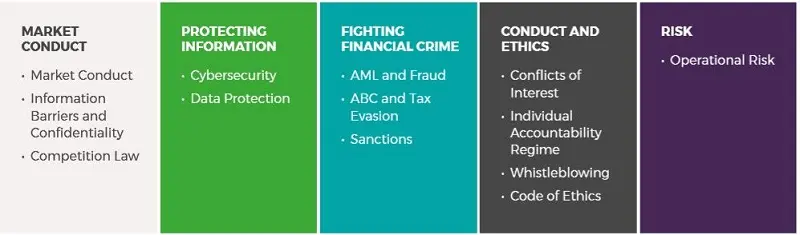
The following diagram shows how a single course can be designed to group together a range of different compliance topics.

Originally, the learners at this organization were taking 14 x 30-minute eLearning courses, a total of seven hours learning time. But with a combined course approach, they are now looking at a total learning time of around two hours.

You can see that each topic combines related regulations and risk areas together—for example, the Financial Crime course covers Anti-Money Laundering as well as Tax Evasion and Sanctions. These would otherwise be separate courses. This approach not only streamlines the training time but also means learners can explore rules and regulations in context and understand how appropriate behavior and conduct support compliance with these rules.

Additionally, by combining all of these topics into a single course, we can utilize the concept and benefits of spaced learning. This is achieved by surfacing and testing understanding of earlier learning points in later modules. For example, in the Financial Crime topic, we are including a scenario on a Market Conduct issue that appears in the first topic. This serves to reinforce key learning points and helps to combat the “forgetting curve.”

About the Authors

Ashley Laurence

Get in touch.

Learn more about our talent transformation solutions.

Transformation doesn’t happen overnight if you’re doing it right. We continuously deliver measurable outcomes and help you stay the course – choose the right partner for your journey.

Our suite of offerings include:

  • Managed Learning Services
  • Learning Content Design & Development
  • Consulting
  • AI Readiness, Integration, & Support
  • Leadership & Inclusion Training
  • Technical Training
  • Learning Technologies & Implementation
  • Off-the-Shelf Training Courses


GP Strategies’ SAP Business Technology Platform Extensions

With the forecast of new performance benchmarks, reduced operating costs, and HR systems that are continually evolving, organizations may need help. GP Strategies is fully committed to helping clients standardize their processes and technology solutions as they make the move to the cloud.

However, a standardized form does not work for everyone.

Some organizations may find that they are forced to extend the functionality provided by the cloud. Yet, you still want to support your organization from the cloud. Well, that is no longer a roadblock on your company’s journey to the cloud with the SAP Business Technology Platform. You can now customize your solution to fit your specific need.

Organizations should consider the SAP Business Technology Platform if they:

  • Want to optimize a critical process that has high volume and cannot be implemented efficiently in SuccessFactors
  • Need to support a complex process that cannot be simplified
  • Have higher requirements than normal for the user interface (UI) due to the target audience
  • Want to pull data from multiple systems into one overview/form/action

The SAP Business Technology Platform is a Platform as a Service (PaaS) and enables clients to host a custom-developed solution. This allows companies to extend SuccessFactors into areas of their organization where they either cannot or do not wish to use the standard solutions offered by SAP. In fact, the SAP Business Technology Platform can be used to extend any system with application programming interface (API) capabilities.

The SAP Business Technology Platform contains a powerful toolkit of services ranging from the Internet of Things (IoT), gamification, and machine learning to a fully web-based development UI. Applications are built to easily fetch and model data from OData APIs and align with the FIORI design guidelines to seamlessly support your organization’s processes in the cloud.

Ready to Get Started with SAP Business Technology Platform Extensions?

The GP Strategies SuccessFactors Practice has completed more than 700 SAP SuccessFactors projects in more than 80 countries worldwide during the last 15 years. We are covering all major industries, and we provide continued operational support and maintenance for more than 80 companies. We are an SAP gold partner, and we have been awarded SAP Recognized Expertise in all SAP SuccessFactors areas. Together with our customers we have won 13 Quality Awards in 4 years. Contact us for expert guidance on SAP Cloud Platform Extensions.

About the Authors

Ashton Plusquellec

Get in touch.

Learn more about our talent transformation solutions.

Transformation doesn’t happen overnight if you’re doing it right. We continuously deliver measurable outcomes and help you stay the course – choose the right partner for your journey.

Our suite of offerings include:

  • Managed Learning Services
  • Learning Content Design & Development
  • Consulting
  • AI Readiness, Integration, & Support
  • Leadership & Inclusion Training
  • Technical Training
  • Learning Technologies & Implementation
  • Off-the-Shelf Training Courses


The Disaster Recovery Reform Act of 2018

Natural disasters, oftentimes unavoidable, can have a catastrophic impact on individuals, communities, and the world. Following a significantly disruptive hurricane and wildfire season in 2017, the Federal Emergency Management Agency (FEMA) worked with Congress to consider what could be done to improve assistance before, during, and after a disaster.

In the fall of 2018, President Donald J. Trump signed the Disaster Recovery Reform Act (DRRA) into law. This new legislation has streamlined the functionality of FEMA and enhanced its benefit to disaster applicants by implementing an array of proactive measures to address and plan for disasters.

Via the DRRA, Congress sought to enable disaster applicants to build more resilient infrastructure and communities through increased funding, stronger building codes, and streamlined administrative procedures. Many of the provisions take effect retroactively to August 1, 2017, to bolster recovery efforts for Hurricanes Harvey, Irma, and Maria.

Below is a summary of what the Disaster Recovery Reform Act does:

A New National Infrastructure Pre-Disaster Hazard Mitigation Grant Program

  • The new program, Building Resilient Infrastructure & Communities (BRIC), replaces the Pre-Disaster Mitigation Grant program funded through fluctuating annual appropriations.
    • BRIC is funded through 6% set aside from the Disaster Relief Fund.
    • FEMA is eliciting public opinion on development of this new program.
    • In June 2019, FEMA is hosting four webinars regarding the topic areas key to BRIC program implementation, allowing for further citizen and stakeholder engagement.
  • Increased investment towards hazard mitigation is now allocated by a statute eliminating the need for separate legislative appropriation.

Amendments to the Stafford Act (FEMA Public Assistance Program)

  • Removes the reduction of assistance for alternate projects
    • Applicants may now elect to pursue alternate projects without facing a federal cost share reduction.
  • Limits a flood insurance deduction to one building within a multi-structure campus for disasters declared between January 1, 2016, and December 31, 2018
  • Prohibits required participation in the Public Assistance Alternative Procedures pilot program. As a special exception, Puerto Rico applicants have been required to opt into the program as a condition of assistance.
  • Creates a presumption within the Public Assistance Alternative Procedures for Permanent Work (Section 428) that a fixed-cost estimate certified by a licensed engineer and accepted by the FEMA administrator is “presumed to be reasonable and eligible cost”

Management Costs

  • The Stafford Act defined “management costs” as indirect and administrative expenses not applicable for reimbursement towards a specific project.
  • FEMA allows the state recipient a set percentage of funding for management costs that can trickle down to subrecipients. Of similar benefit to subrecipients are Direct Administrative Costs that are directly applicable to specific projects.
  • The DRRA consolidates all the above into management costs and establishes the following percentage rates for allowable funding:
    • FEMA Hazard Mitigation Grant Program under Section 404 to receive up to 15% of total amount of grant award
      • Recipient: up to 10%; subrecipient: up to 5%
    • FEMA Public Assistance Program funding for Sections 403, 406, 407, and 502 to receive up to 12% of total award under cited sections
      • Recipient: up to 7%; subrecipient: up to 5%
    • This revision shifts accountability over the administrative responsibilities associated with disaster grants to state recipients and applicants.
  • Codes & Standards
    • The Stafford Act allowed for reimbursement of eligible costs for repairs/rebuilding based on pre-disaster design, codes, and specifications (at time of disaster).
    • The DRRA amends the Stafford Act to fund work consistent with current codes and specifications “for the purpose of protecting health, safety, and general welfare of a facility’s users against disasters.”
      • Applies retroactively to disasters declared on or after August 1, 2017, or disasters in which the cost estimate has not yet been finalized on project basis or is under appeal
    • Right of Arbitration with the Civilian Board of Contract Appeals (CBCA)
      • DRRA Section 1219 provides for applicants with the right of arbitration (“Section 423 Arbitration”) to dispute FEMA determination of application.
      • Eligibility criteria
        • Dispute related to disaster declared after January 1, 2016
        • Dispute amount exceeds $500K (or $100K in rural areas)
        • Applicant filed first-level appeal with FEMA pursuant to time requirements set by 44 C.F.R. sec. 206.206
      • Defined time limit for filing second appeal
      • FEMA addresses the following fees: arbitration panel, retained expert, and arbitration facility fees
    • Closeout Incentives
      • Intended to motivate applicants to advance their projects and grant programs to closeout in a timelier manner through incentives or penalties that have yet to be fully defined

FEMA’s implementation of the DRRA necessitates modifications to existing policies (e.g., the Recovery Policy on Stafford Act Section 705), the FEMA Policy Guide, and the Public Assistance Program itself. As these gradual changes take place, GP Strategies will monitor FEMA’s issuance of policy interpretations and post them in additional blogs as they become available.

This legislation facilitates and encourages increased resiliency opportunities for communities to explore. Although we’ll never be able to eliminate disasters completely, these revisions will help communities take action sooner to be better prepared to respond to and recover quicker when a disaster strikes.

For further questions or inquiries, please contact:
Ondina C. Mendoza
Resilience & Recovery Support | (850) 238-0611 (office)

About the Authors

Josh Norman
Mr. Norman is the Director of Emergency Management for GP Strategies. He is a highly experienced Recovery Manager leading major engagements for the City of New Orleans Katrina Recovery, the State of Texas, Massachusetts, Florida, and South Carolina. As a pioneer in the field of Recovery Management services, Mr. Norman has supported the National Advisory Council Stafford Act Sub-Committee on policy changes to Debris, Emergency Protective Measures and Alternate and Improved Projects.

Get in touch.

Learn more about our talent transformation solutions.

Transformation doesn’t happen overnight if you’re doing it right. We continuously deliver measurable outcomes and help you stay the course – choose the right partner for your journey.

Our suite of offerings include:

  • Managed Learning Services
  • Learning Content Design & Development
  • Consulting
  • AI Readiness, Integration, & Support
  • Leadership & Inclusion Training
  • Technical Training
  • Learning Technologies & Implementation
  • Off-the-Shelf Training Courses


Using Design Thinking to Be Better L&D Business Partners

A senior manager in a learning organization recently said, “The business is our most important client; they have the money.” Pinching the back of my hand to hold my composure, I took a deep breath before I began the long journey of trying to change their misconstrued viewpoint. In L&D, saying the business is most important because they have the money is analogous to a doctor claiming that the insurance company is most important because they have the money. I recognize some doctors may hold this priority, as do some L&D organizations—but we know neither is correct. Patients should be the most important client and focus for doctors, just as our learners should be our focus and most important client.

More often than not, L&D requests do come directly from the business. The requests usually include a murky description of the problem accompanied by a very clear prescription of the solution. A common request might sound something like, “We want a 30-minute web-based training” or “Create a 2-hour virtual instructor-led training.” Having been molded into reactive order-takers, we oblige. After all, the business has the money, and the client “knows” what they want, right? Wrong!

I’ve tried this approach with my doctor: I research WebMD.com for my symptoms, read the remedy, and confidently relay this to my doctor, expecting a reward for the time I’ve saved him from doing his job. And yet, each time he reminds me that he’s the professional, explains how my 2-minute research fails in comparison to his 15 years in the medical profession, and warns how detrimental my self-diagnosis could have been to my health. Allowing our business partners to self-diagnose—and prescribe solutions for our learners—allows them to jeopardize the health or learner experience for our learners.

Although we would love to respond to the business in the same way my doctor responds to me when I self-diagnose, it’s probably not wise to remind our business partners that we are the learning professionals if we want to keep our jobs. So, what can we do when the business self-diagnoses and self-medicates on behalf of our learners? One approach we can take is to engage our business partners in co-engineering a remedy that maintains a keen focus on our shared priority—the learner. Using design thinking in this instance could be just what the doctor ordered!

Design thinking is a framework for creative problem-solving. It’s a methodology that focuses on the end user, the learner. Applying design thinking to the L&D setting helps to unlock the users’ needs and problems, even when they don’t know what the problem is or are not able to articulate them correctly. (Hello, business partners!) Historically, design thinking has been well known for helping to solve design problems with products. But a lesser-known secret is that design thinking can be applied to problems with services or processes. In fact, design thinking can be applied to a number of challenges around recruitment, performance improvement, employee engagement, and organizational development, just to name a few L&D applications.

Design thinking helps us be better business partners by providing a methodology to follow, evolving L&D from portraying reactive order-takers to proactive solution partners. Rather than accept the problem statement at face value, we empathize with our learners to understand, from their point of view, the challenges they face. And we maintain that connection with our learners throughout the solution design process.

Empathy and understanding are the foundation upon which all design thinking principles rest. Using design thinking helps us take a step back and start with problem-finding before moving into problem-solving. When we take orders without doing the due diligence of understanding the problem, we do a disservice to the business by potentially wasting their money. We do an even bigger disservice to our learners by not providing the right remedy to solve their challenges. Design thinking is a structured—but not too rigid—format that engages with our business partners and our learners to keep our focus right where it belongs: on the learner.

So, the next time your business partner self-diagnoses and dictates the remedy for their learners, consider applying the design thinking methodology. Making this recommendation will help you to serve the business as a better partner; ensure the business’s money is well invested; and refine the focus on the most important client: the learners. After all, whatever the business challenge or performance challenge is, it’s the learner we want to have impact on. Why would we design an experience that fails to serve their needs?

About the Authors

Keith Keating
With a career spanning over 20 years in learning & development, Keith Keating holds a Master’s Degree in Leadership and has experience in a myriad of areas ranging from Instructional Design, Leadership Coaching, Operations Management, and Process Transformation. More recently Keith has been leading clients on the development and execution of their global learning strategies. Regardless of the role, at the heart of everything Keith does centers around problem solving. He studied Design Thinking at MIT’s Sloan School of Management and found Design Thinking was a perfect tool to add to his problem solving "toolkit". Since then, Keith has been utilizing Design Thinking to help clients tap into understanding and resolving unmet customer needs.

Get in touch.

Learn more about our talent transformation solutions.

Transformation doesn’t happen overnight if you’re doing it right. We continuously deliver measurable outcomes and help you stay the course – choose the right partner for your journey.

Our suite of offerings include:

  • Managed Learning Services
  • Learning Content Design & Development
  • Consulting
  • AI Readiness, Integration, & Support
  • Leadership & Inclusion Training
  • Technical Training
  • Learning Technologies & Implementation
  • Off-the-Shelf Training Courses


Is Your SAP Environment Due for a Health Check?

Technology can be a welcome gift for any organization looking for a platform to support their workflows and processes. While it has the ability to enhance your business processes, technology can also cause problems if you don’t have the right support and mechanics in place. You may even have a software that just isn’t working due to minor defects. Unfortunately, companies are resorting to a “rip and replace” position anytime that they run into trouble with their current software or technology before taking a good look at the underlying problem. This may be the right answer for some, but others may just need a bit of TLC.

Remembering that the lifecycle of a technology implementation is never complete helps to keep your environment up to date and working properly. Even after go-live, there are steps that you should take to care for your implementation and keep it from becoming stale and outdated. Ongoing support is the most common measure that organizations take to ensure that their technology, processes, and people are taken care of after the initial go-live. However, for some companies, something a bit bigger and more invasive is required. For those companies that feel their system isn’t up to par or isn’t doing the job that it was intended to perform, a technology health check can be very beneficial.

A health check consists of a full assessment of your current technology and processes against your outlined goals. Your consulting partner will take a deep dive into all aspects of your solution and fully understand where things are working, where they are broken, or where a few tweaks may be needed. Depending on how big or complex your system is, this exercise can take anywhere from 2 days to a few weeks, depending on scope. After the initial assessment, your consulting partner will then propose a roadmap to get your organization and technology to where they need to be. This may include anything from small updates in the system to a full reimplementation of a single module or an entire platform.

Is it time for a system health check? Here are some things to consider.

  • Was your implementation more than 2 years ago?
  • Do you have regular checks on your system (support, maintenance, health statuses)?
  • Are you running into issues with your system that clog up day-to-day tasks?
  • Do you feel that your technology supports your processes, or do you feel that your processes depend on your system?
  • Do you have a support contract in place?
  • Have there been any significant business events such as a merger or an acquisition?

After reviewing the questions, do you feel that your organization would benefit from a quick assessment of your SAP environment to improve day-to-day activities?

To learn more about GP Strategies SAP health checks, visit us at: https://www.gpstrategies.com/successfactors-solution-health-check/

About the Authors

Ashton Plusquellec

Get in touch.

Learn more about our talent transformation solutions.

Transformation doesn’t happen overnight if you’re doing it right. We continuously deliver measurable outcomes and help you stay the course – choose the right partner for your journey.

Our suite of offerings include:

  • Managed Learning Services
  • Learning Content Design & Development
  • Consulting
  • AI Readiness, Integration, & Support
  • Leadership & Inclusion Training
  • Technical Training
  • Learning Technologies & Implementation
  • Off-the-Shelf Training Courses


Seeking Validation in Learning

The traditional implementation of a learning management system (LMS) is a solved problem domain. There is a certain amount of rigor involved, typically driven by compliance requirements, as well as some configuration steps, probably an integration or two, and various user testing. Once that’s done, it’s marked “complete” and the system can be sent on its way.

Validation turns the dial up to 11.

Validation is a process that usually comes into play with heavily regulated industries. Healthcare-related companies and power companies are prime examples. The driver for an increased amount of rigor is the safety of customers (for things like medical devices) and employees (for places like nuclear power plants). The failure of software in these fields could easily result in patient death or employee injury as well as opening up companies to costly legal action.

Lawsuits and investigations often follow these types of incidents. One of the first things that happens during an investigation is that the training history for everyone involved is pulled to ensure that everyone was properly trained. By extension, these audits also require the documentation that proves the learning system was properly implemented and supported.

Testing is not the focus of the software validation process; the emphasis is on documentation and sign-off during all phases of the implementation. Because documentation is central to proving that the system is correct, the relevant regulatory body (the Food and Drug Administration [FDA] for the health-related industries) develops and publishes standards that need to be followed to the letter. This helps to ensure that any potential for error is reduced during the project implementation and that risks are properly accounted for and minimized.

The key to the process lies in the word “validation.” The FDA, a major driver in validation process definitions, says that this is “confirmation by examination and provision of objective evidence that software specifications conform to user needs and intended uses, and that the particular requirements implemented through software can be consistently fulfilled.” [FDA, 2002] Essentially, the validation process is testing (manually or automatically) to ensure that the requirements for the project have been met.

The key steps to software validation during this process are the installation qualification (IQ), operational qualification (OQ), and performance qualification (PQ). [FDA, 2002] These steps have specific definitions, but when boiled down, they are:

  • IQ – A list of steps and commands taken when installing the software components
  • OQ – Testing that the system performs under normal parameters
  • PQ – Testing that the system performs to specification when the parameters are pushed hard

During the implementation of a validated learning system, the IQ and PQ steps are the most common. A combination of OQ and PQ is what most would equate with system testing in a typical non-validated implementation. These steps are stringently documented and require multiple sign-offs; this rigor is one of the differentiators of the validation process.

Of course, automation can help gain some efficiency. This is usually realized by automating formal testing during the OQ and PQ phases. Some companies (including GP Strategies) offer a full-blown Validation Toolkit product to test your project requirements to ensure that you are meeting them and that they are checked and tracked methodically.

The tradeoff to this process is, of course, time. The validation and sign-off steps needed add to the project schedule and are usually nonnegotiable in a truly validated project. You gain assurance at the cost of speedy delivery, but when safety is in play, it really pays to take your time.

To learn more about LMS validation or about the GP Strategies Validation Toolkit, contact us.

“General Principles of SoftwareValidation; Final Guidance for Industry and FDA Staff.” FDA. (2002, January 11). Retrieved May 22, 2019, from https://www.fda.gov/media/73141/download.


About the Authors

Chris Olive
“Specialization is for insects.” – Robert Heinlein, Time Enough for Love My parents were both technology focused teachers when I was a kid, and my father was a high school math teacher so in the ‘80s he was the “computer teacher” too. This meant I was lucky enough to have an actual computer in our house, an Apple //e. I clearly remember my father bringing home the sample programming exercises (in Basic!) for me to practice. From there, I moved on to entering the example programs from the back of computer magazines myself and tinkering with them. It was this that made me realize that the flexibility of the computer made it the ultimate tool to solve problems. I also read a lot of science fiction when I was a kid. They were mostly the “classics” of the genre from the 1950s or so. I clearly remember Heinlein’s exhortation and that the main characters were inevitably able to do just about anything they needed to do to survive with their wide-ranging knowledge of multiple subjects. They knew metallurgy, biology, survival skills, hunting, cooking, sewing, and more in a large array of skills. I resolved to do the same. While I have not come close to mastery in all these skills, the notion of the “Renaissance Man” drove my early desire to learn as much as possible about as many things as possible. This led me to the Jesuits and their idea of “care for the whole person” and eventually led me to have my undergraduate education at Loyola College in Baltimore (now called Loyola University Maryland). Combining both technology and the humanities helped put perspective on how computers and other technology really were just tools and that we were solving people problems even though we were using technology to do so. That remains true even now with the clients I help. They are just trying to overcome an obstacle and the method to fix it is immaterial. I happen to use technology as a tool for much of the time but there are human fixes that can be applied to human problems too. At the bottom of every request there is a person trying to do their job. Sometimes they don’t really know what the source of their frustration might be which is why I always start by asking “What is the problem you’re trying to solve?” I figured if it was good enough of a starting place for Richard Feynman it would have to be good enough for me. Once these problems are clearly outlined, they are solvable. I enjoy helping people and solving problems. These things all work together.

Get in touch.

Learn more about our talent transformation solutions.

Transformation doesn’t happen overnight if you’re doing it right. We continuously deliver measurable outcomes and help you stay the course – choose the right partner for your journey.

Our suite of offerings include:

  • Managed Learning Services
  • Learning Content Design & Development
  • Consulting
  • AI Readiness, Integration, & Support
  • Leadership & Inclusion Training
  • Technical Training
  • Learning Technologies & Implementation
  • Off-the-Shelf Training Courses


Leadership Mindsets: How Attitude Drives Innovation in Leaders

Understanding Leadership

Key Skills

To drive innovation, today’s leaders need to be more than just managers, they need to embrace an attitude of leadership that inspires, coaches, and equips their team members to navigate new technologies, roles, and ways of working. Mindsets are an invaluable tool leaders can use to reframe their thoughts, attitudes, and opinions. This self-awareness enables them to create environments in which team members feel heard, respected, and empowered to drive innovation by sharing their unique ideas and perspectives.  

Leadership Development

As leaders embark upon their development journeys, these mindsets serve as valuable guideposts to help keep them pointed in the right direction. GP Strategies’ research and work with clients across the globe have illuminated four mindsets that offer the most value for leaders. These include growth mindset, agile mindset, inclusive mindset, and enterprise mindset. Each mindset is critical on its own, but together they add additional value as they come together to drive a strategy of innovation. 

Leadership Mindsets

Growth and Inclusive Mindset

Growth Mindset

A growth mindset is the belief that skills and behaviors can be cultivated through effort. With this mindset, challenges, obstacles, and feedback become opportunities to grow and learn. Elemental to innovation is the willingness to see failures not as setbacks but as opportunities to grow. Failures that have turned into successes exist all around us. Even something as simple as the lubricant WD-40 got its name because it was the fortieth attempt to perfect that household product.  

A more spectacularly and well-known failure is Apple. While a consumer electronics icon today, Apple’s road to success was paved with many ups and downs. Steve Jobs had some colossal fails, including getting ousted as CEO. Instead of accepting defeat, Jobs channeled that failure into renewed energy, and today Apple is one of the most technologically advanced organizations on the planet. In the embodiment of a growth mindset, Jobs said in the book The Journey Is the Reward by Jeffrey Young, “Sometimes when you innovate, you make mistakes. It is best to admit them quickly, and get on with improving your other innovations.” 

Innovative leaders continue to chip away at solutions using the information they glean from their setbacks to spur innovation—even if it takes 40 tries! They recognize that failure is part of the process. What’s more, innovative leaders have a higher tolerance for failure among the people they lead—knowing that setbacks create the space for further growth. In growth mindset leadership, obstacles and setbacks are not byproducts of innovation, they are drivers of it. 

Inclusive Mindset

An inclusive mindset is the belief that a diverse and inclusive environment unleashes superior contribution and performance. When a leader has an inclusive mindset, they see differences in how others think and behave as advantages, leading them to consistently seek out diversity. They recognize that sameness breeds smallness. A leader with an inclusive mindset seeks alternate perspectives, thereby expanding the view of what is possible. Inclusivity opens the door to innovative ideas. It creates growth and expansion and invites what’s different and innovative. 

Inclusive leaders create psychological safety. When psychological safety is present, individuals feel comfortable surfacing ideas—including those that may be out of the ordinary. When an inclusive leader creates an environment of psychological safety, they show that ideas are valued, even if they are not chosen, which increases the likelihood that individuals will surface innovative ideas again in the future.  

But inclusivity is more than just a feel-good notion. Its impact, particularly on innovation, is very real. According to research by the World Economic Forum, more inclusive companies are 25-36% more likely to outperform their competitors in profitability. They also experience up to a 20% higher rate of innovation. 

Agile and Enterprise Mindset

Agile Mindset

An agile mindset is the belief that success in a complex and volatile world requires flexibility, adaptation, innovation, and resilience. With this mindset, we fail fast and achieve success by being nimble in the way we think and act. Leaders have massive amounts of information at their fingertips. An agile leader is able to take in, filter, and assimilate information quickly. They assess their decisions frequently and adapt, when necessary, at a pace that reflects the speed of business. 

An agile leader embraces new approaches. They come up with fast, creative responses and implement these new methods. This doesn’t mean that they lack discipline or vision. Agile leaders are clear on their final destination and their desired goals; they are simply more open to the fact that the path to those goals may take some unexpected twists and turns. 

In fact, research conducted by GP Strategies asked leaders what mindset they needed to be successful in the future. Leaders across all levels prioritized openness and adaptability, followed by discipline. While these three mindsets might initially seem contradictory (how can someone be disciplined if they are adapting?), they perfectly describe an agile leader. Agile leaders have a goal and are disciplined about reaching it. They also understand that being too attached to a particular plan can prevent them from adapting when it is needed to reach their goals.  

Enterprise Mindset

An enterprise mindset is the belief that we maximize success when we prioritize the needs of the larger organization. With this mindset, all decisions in a team or business unit are made with the benefit of others. A leader with an enterprise mindset reaches across the organization, breaking down barriers and making decisions for the greater good. When those barriers come down, greater organization-wide collaboration and innovation are possible. 

A leader with an enterprise mindset also reads the external environment, spotting or, better yet, anticipating trends. Assessing the external landscape can allow a leader to anticipate change and get ahead of it. They can choose being innovative over becoming obsolete. History is filled with stories of organizations that failed to pivot despite signs pointing to the need for change. By removing internal and external barriers in service of the greater organizational good, a leader with an enterprise mindset is clearing a path to doing things differently and drawing in a diversity of perspectives. 

Leveraging Mindsets to Create Innovation

Leaders often wrestle with what it means to have a mindset of innovation. But in looking for a singular way to “program” the mind of an innovative leader, we’re missing the point. It is the combination of these four key mindsets—growth, inclusive, agile, and enterprise—that shape leaders’ attitudes in a way that enables innovation to flourish. 

Learn how you can unlock your leaders’ full potential with our leadership and DEI training.  

About the Authors

Leah Clark
Leah Clark is the Leadership Practice Lead at GP Strategies, as well as an author and the founder of LeaderConnect. With over 28 years of experience in her field, Leah brings a unique perspective on the mindsets and skillset that are critical to leadership success to her coaching and consulting. Her clients benefit from her collaborative approach to crafting a well-connected and thoughtful leadership development strategy. Leah holds a Master of Arts; Organizational Psychology, Columbia University and a Bachelor of Arts; English and Sociology, Boston College.

Get in touch.

Learn more about our talent transformation solutions.

Transformation doesn’t happen overnight if you’re doing it right. We continuously deliver measurable outcomes and help you stay the course – choose the right partner for your journey.

Our suite of offerings include:

  • Managed Learning Services
  • Learning Content Design & Development
  • Consulting
  • AI Readiness, Integration, & Support
  • Leadership & Inclusion Training
  • Technical Training
  • Learning Technologies & Implementation
  • Off-the-Shelf Training Courses