The World Economic Forum identified critical thinking as an essential skill for leaders to be successful today and in the future. As organizations and leaders adopt artificial intelligence (AI) tools, there will undoubtedly be increased knowledge and productivity gains from technology-based information and decisions. This doesn’t mean leaders will be replaced, but it does mean skills like critical thinking are increasingly valuable and something that will distinguish leaders from bots.
Yet critical thinking and its associated skills are hard to define. Ask three different people what it means to be a critical thinker, and you will probably get three different answers, stressing analytics, strategy, and curiosity.
Why? Because critical thinking is complex and multilayered, and several aspects of critical thinking overlap. Critical thinking means examining challenges from different perspectives including being:
Fostering Critical Thinking in Leadership: Six Dimensions to Consider
Analyzing both the specific dimensions and less apparent aspects reveals a distinct definition and thought process for leaders, fostering critical thinking across all levels.
Analytical: A critical thinker can take things apart and put them back together. They look at the whole picture and at the parts and pieces to understand its discrete elements. Instead of taking challenges at face value, they push to understand the root causes. Analytical thinkers recognize patterns and make connections, sometimes between seemingly unrelated topics, which helps shape their approach.
Strategic: Critical thinkers see things from different perspectives and tactically move quickly back and forth between those perspectives. They see short-term goals while holding a long-term vision. They consider what’s on the surface and question what might be happening underneath. While they understand the internal dynamics of an organization, they also maintain an understanding of the larger economic, political, cultural, and competitive forces.
Curious: Questioning in a non-threatening way is the mark of a critical thinker. Critical thinkers wonder about how a situation or challenge came to be, and they ask about the potential solutions. Instead of immediately tackling a presenting challenge, they push to understand the root cause. They are smart about asking what solutions haven’t been considered and what else is possible from new perspectives.
Critical thinking also includes the need to be:
Inclusive: Inclusivity and critical thinking are not necessarily considered logical companions – but they are. Good critical thinkers are not afraid to seek other opinions and diverse perspectives. They recognize the wisdom of reaching beyond their inner circle or typical “go-to” people to hear diverse perspectives. They invite other opinions even if the individual providing that opinion lacks historical knowledge or comes from an unrelated discipline—they welcome the naïve expert.
Humble: Critical thinkers not only question others, they question themselves—that’s not a lack of confidence, but a measure of humility. They hold out the possibility, if not the likelihood, that their solution might not be the right way—or the only way. They aren’t afraid of wondering, “What if I’m wrong?” and seeking counter perspectives.
Emotionally intelligent: A critical thinker has emotional intelligence. They are self-aware enough to acknowledge their personal bias. They not only notice those biases but challenge themselves to confront them. They are flexible—not so wedded to their plan or idea that they fail to change paths when faced with new options. Self-aware leaders sense when they may not be looking at a situation objectively or accurately, and employ a skill known as reality testing. A leader who tests reality is a more effective critical thinker.
What Are Some Specific Things Leaders Can Do To Enhance Critical Thinking?
Challenge themselves to look at a situation from another point of view or perspective by adopting the mindset of a client, a team member, or even a competitor. What looks different from that viewpoint?
Don’t be surrounded by “yes” people. Find team members or colleagues who aren’t afraid to push back and challenge opinions they disagree with.
Always ask about other options. What is not being presented? Why is that? Ask what wasn’t considered.
Explore convergent thinking. Where have they seen similar patterns before, and what do they know based on their experience?
Explore divergent thinking. How can they take an innovative or different approach to this challenge?
Take a beat, pause, and don’t move too quickly. Moving too quickly makes leaders more likely to choose what’s in front of them instead of exploring other options.
The Imperative of Cultivating Critical Thinking Skills in Leadership
Artificial intelligence will continue to accelerate productivity and enable employees to get work done in different ways. But this new technology, offering access to unprecedented amounts of data, is best coupled with the critical thinking of leaders and their teams. Cultivating critical thinking skills and practicing perspective taking is imperative for organizations to survive and thrive in a dynamic world.
About the Authors
Leah Clark
Leah Clark is the Leadership Practice Lead at GP Strategies, as well as an author and the founder of LeaderConnect. With over 28 years of experience in her field, Leah brings a unique perspective on the mindsets and skillset that are critical to leadership success to her coaching and consulting. Her clients benefit from her collaborative approach to crafting a well-connected and thoughtful leadership development strategy. Leah holds a Master of Arts; Organizational Psychology, Columbia University and a Bachelor of Arts; English and Sociology, Boston College.
Get in touch.
Learn more about our talent transformation solutions.
Transformation doesn’t happen overnight if you’re doing it right. We continuously deliver measurable outcomes and help you stay the course – choose the right partner for your journey.
Imagine you’re a relatively new leader about to deliver difficult feedback to an employee. Despite having formal training, you struggle to recall the key aspects of giving tough feedback as the performance discussion approaches. You might consider avoiding the difficult topics because you’re worried your employees will become defensive and demotivated. As you are a fairly new employee in a hybrid role, waiting for one-on-ones to ask the advice of senior colleagues is an option but immediate insights would be more helpful.
Now, imagine that with a quick query of a generative AI tool, you can get targeted coaching to boost your confidence in these situations. With a smart prompt, you can view the crucial steps for giving feedback and receive tips on active listening, asking open-ended questions, and managing difficult emotions. What’s more, remote employees can learn various ways to connect with colleagues and how to interact professionally with senior management through consulting an AI.
Unlock the Power of Generative AI: Transforming Personalized Coaching for Everyone in Your Organization
These scenarios aren’t theoretical—generative AI has already emerged as a significant enhancer of personalized coaching. Data suggests its widespread use shows no signs of stopping. Generative AI can scale coaching, making benefits historically reserved for an elite few now accessible to all positions and locations within an organization. Guidance once available to a select group is now affordable and accessible with a few keystrokes. AI technology is continually advancing, with new coaching tools becoming more sophisticated and widely adopted, enabling personalized coaching based on individual goals, preferences, and performance.
The Benefits of AI Augmented Coaching
The potential of AI to enhance coaching is vast. Here’s how AI can augment coaching:
Performance Monitoring and Real-Time Feedback: AI tools can monitor employee performance and provide immediate feedback. Natural language processing can assess individual performance and suggest improvements instantaneously.
Personalization: Technology that analyzes data based on specific needs and goals can tailor coaching recommendations and learning opportunities. AI-powered coaches use machine learning and natural language processing to analyze communication and offer suggestions.
Continuing Education: AI can suggest models, frameworks, and steps to structure new behaviors or skills, similar to the way a human coach would. AI can provide reminders about key steps, such as setting SMART goals.
Suggesting Language or Approaches: An AI coach can quickly propose language for conveying critical messages, providing immediate access to smart approaches without waiting for in-person coaching sessions.
Follow-Up and Accountability: AI tools can suggest coaching follow-up options, track activities, set reminders, and prompt follow-up actions.
Much like a good human coach, an AI coach can support employees when they are stuck, need ideas, or want to pursue growth opportunities. Its omnipresence offers a significant advantage over leaders-as-coaches who cannot be everywhere simultaneously.
However, AI still lacks the ability to empathize with people, which is where human leaders-as-coaches have a real advantage. Human interaction factors in context, emotion, and interpersonal nuances.
The Power of Human Leaders-as-Coaches
Human leaders combine their knowledge of the organization and the job with an understanding of what drives and enables individuals to coach effectively:
Context: While AI can include context in a request, it cannot replace a human’s ability to synthesize multiple components of a coaching scenario simultaneously. Leaders-as-coaches understand multiple layers—industry, customer, organization, group, role, and individual—all relevant to a coaching moment.
Shared History: Leaders know what’s important to the individual, their strengths, and areas of struggle. They use this knowledge to inform coaching directions.
Prompting Self-Awareness: Good coaches help individuals reality-test and see situations clearly, insights an AI cannot provide because it lacks the ability to see and feel. Human coaches bring in their observations and feedback from others, enhancing self-awareness.
Flexibility: Leaders-as-coaches can pivot coaching conversations based on new insights or innovative ideas prompted during the discussion. They use intuition to adapt the conversation based on the moment’s needs.
Reading Body Language: Although AI advancements in reading body language are progressing, they are not yet widely available. Human coaches can notice changes in eye contact, posture, and other physical cues, and use these observations to navigate coaching conversations appropriately.
Most importantly, empathy is the ability to understand and share another person’s feelings. When a coach empathizes, they create a human connection, allowing the individual to feel heard, seen, understood, and valued. This combination of head and heart in meaningful conversations is the pinnacle of coaching success—a level beyond the reach of an AI.
About the Authors
Leah Clark
Leah Clark is the Leadership Practice Lead at GP Strategies, as well as an author and the founder of LeaderConnect. With over 28 years of experience in her field, Leah brings a unique perspective on the mindsets and skillset that are critical to leadership success to her coaching and consulting. Her clients benefit from her collaborative approach to crafting a well-connected and thoughtful leadership development strategy. Leah holds a Master of Arts; Organizational Psychology, Columbia University and a Bachelor of Arts; English and Sociology, Boston College.
Get in touch.
Learn more about our talent transformation solutions.
Transformation doesn’t happen overnight if you’re doing it right. We continuously deliver measurable outcomes and help you stay the course – choose the right partner for your journey.
Artificial intelligence is steadily transforming job roles, a phenomenon we’ve witnessed with past technological advancements. Elevator operators gave way to automatic elevators, manual farm jobs were automated, and switchboard operators were replaced by automated telephones. Examples abound of automation and technology displacing human labor.
However, the rise of generative AI feels distinctly different. The pace of change is unprecedented. For instance, in January of last year, ChatGPT garnered 15 million users, setting a record for the fastest-growing user base. The frequency of new AI tools emerging and enhancements to existing ones requires constant effort to keep up. At the same time, AI lacks sufficient safety guardrails, fostering fear of the skewed perspectives it may propagate.
AI evokes both awe and terror as organizations increasingly adopt the technology. The integration of AI raises uncertainties about where humans—especially knowledge workers—fit in. Internal communication about AI within organizations often falters, exacerbating anxieties about people being replaced by algorithms.
Employee sentiments about their jobs and the encroachment of AI stem from two core factors: identity and mattering. Identity refers to how individuals perceive their roles, while mattering pertains to the perceived importance of those roles to others.
Reimagining Identity and Value in the Age of AI: How Technological Advances Challenge Our Sense of Self and Significance
Whether it’s AI or other technological advancements, evolution in jobs strikes at the core of who we are and whether or not the work we do matters (and by extension whether or not we matter). Who am I if I can be replaced by an algorithm? Am I valued for the knowledge, skills, and experience I have? Is my value replaceable with a few keystrokes? Do I matter? For some, these questions are about the fear of losing jobs and income. For others, it strikes at issues that are more central to a sense of identity.
Identity
When contemplating the answer to the question, “Who are you?” people often answer with respect to the roles they play in their personal lives—parent, sibling, partner. They might include demographic information or details that include their pastimes or interests. For many, this question is also answered through the lens of job or vocation: “I am an author, a marketer, a relationship manager….” According to Pew Research, 73% of employees say their career is important to their identity. We think about what we want to be when we grow up, we have to choose schooling, majors, and then careers. These choices help shape and define who we are, how we see ourselves—in short, they shape our identity. So if our identity is linked to what we do, what are the implications when an AI can do it better and faster instead of us? If AI can replace some or all of our roles, does it also replace essential pieces of who we are?
Consider a writer who is proud of being able to find the right words to convey an important idea. That writer honed their craft through years of experience, reflection, and the application of their skill. Their currency is their intellectual capital. Now, in a matter of seconds, generative AI can produce similar results. And while that output doesn’t reflect the emotion, insight, struggle, joy, and pain behind the writer’s words, what it produces can be a close facsimile to human output. That doesn’t simply replace the writer’s contribution, it shakes the very core of that individual’s identity and that is bigger than a lost paycheck.
Mattering
Do I matter? Related to the issue of identity is mattering, which is a question about whether or not people feel you have an impact. At its root it asks the question, “Does anyone care about what I contribute?” The question of “mattering at work” is a factor the Surgeon General’s Framework for Workplace Mental Health and Well-Being highlighted as being an essential element. Employees want to feel as though their work has meaning and they are contributing to something bigger. They want to know that they matter as human beings. In fact, a majority of people say it is somewhat or very important to them to feel respected at work. Those who reported not having meaningful work were much more likely to report that they were typically tense or stressed out during their workday (71%) than those who reported having meaningful work (45%).
Consider, in this light, the role of a copy editor whose job it is to make sure that an organization puts their best foot forward in what they write and produce. Making sure the content is error free, well written, and reflective of the company’s brand are their badges-of-honor. Once the final stop before a public release of information, copy editors now don’t even need to be part of the process. AI technology can read, review, edit, and refine content with the click of a mouse, leading that copy editor to wonder if they no longer matter to their organization. Who are they if they can be replaced by a robot?
Being Replaced by an Algorithm or a Bot Strikes at the Core of Employee Dignity and Respect
How can we embrace AI while demonstrating respect for the employees we lead and keeping their dignity intact? Can AI advances and employee self-respect and confidence co-exist? Can we embrace AI while letting people know that they still matter? Answering these questions in a way that affirms the importance of employees is not a “nice to have,” it’s a must. This is because organizations can’t be run by AI alone and are better with a human in the loop. Leaders are thus challenged with opportunity to reconcile the power of AI and the value of their employees.
What Leaders Can Do
Leaders have numerous ways to guide employees toward understanding their place within the AI-human value chain and to instill pride in their contributions. Here’s how leaders can facilitate this process:
Regardless of context, here’s what leaders can do:
Promote Awareness of Work and Purpose: Engage in meaningful dialogues with employees to grasp their sentiments about their roles and how they perceive their contributions within the team’s broader objectives. Share your perspective on the value they bring.
Connect to the Overall Mission: Offer clarity on how individual tasks align with the organization’s overarching purpose or mission. Reinforce these connections regularly to underscore their significance.
Establish Clear Goals: Define explicit expectations for employees, highlighting their roles in the organizational framework and outline their areas of accountability. Clarity fosters a sense of significance and purpose.
Invest in Employee Growth: Conduct regular conversations focused on professional development to demonstrate a genuine investment in employees’ advancement. By addressing their learning preferences, skill aspirations, and growth ambitions, leaders convey appreciation and value.
Recognize and Celebrate Contributions: Publicly and authentically acknowledge employees’ achievements, reinforcing their value and fostering a culture of appreciation.
By implementing these strategies, leaders can empower employees to grasp their role in the AI-human value chain and embrace the significance of their contributions.
With the added dimension of AI, here are additional considerations for leaders who are wading into the waters of a human-plus-AI team.
Embrace AI but Maintain Autonomy: Guard against surrendering to AI entirely. Remember the importance of human spontaneity and creativity, acknowledging that humans bring unique perspectives, emotions, and judgments to the table.
Explore Diligently, Adopt Intelligently: Rushing into AI without critical thought can lead to its dominance. Prioritize human qualities like empathy and discernment to retain our significance and identity in the face of technological advancement.
Engage Employees in AI Discussions: Demonstrating the value of individuals involves including them in AI dialogues. Collaboration ensures that AI integration respects the concerns and perspectives of those it affects.
Prioritize Empathy: Recognize the challenges AI presents and validate employees’ feelings about them. Cultivate empathy by understanding their experiences and concerns, fostering a supportive environment.
Effective Communication Is Key: Strike a balance between enthusiasm for AI and addressing valid apprehensions. Keep employees informed without overwhelming them, sharing enough about AI initiatives to empower them without inundating them with details.
Maintain Balanced Enthusiasm: View AI as a supportive tool, not a replacement for human capability. Don’t set your employees up for a humankind-versus-robot super battle. Avoid framing AI as a threat, emphasizing its role as an enhancement rather than a competitor to human skills.
Leaders play a crucial role in reinforcing their employees’ connection to purpose. By doing so, they communicate that the work is important, and so are the employees. When leading a human + AI team, it is essential to emphasize the unique value that the human element brings.
About the Authors
Leah Clark
Leah Clark is the Leadership Practice Lead at GP Strategies, as well as an author and the founder of LeaderConnect. With over 28 years of experience in her field, Leah brings a unique perspective on the mindsets and skillset that are critical to leadership success to her coaching and consulting. Her clients benefit from her collaborative approach to crafting a well-connected and thoughtful leadership development strategy. Leah holds a Master of Arts; Organizational Psychology, Columbia University and a Bachelor of Arts; English and Sociology, Boston College.
Get in touch.
Learn more about our talent transformation solutions.
Transformation doesn’t happen overnight if you’re doing it right. We continuously deliver measurable outcomes and help you stay the course – choose the right partner for your journey.
The arrival of artificial intelligence (AI) is rapidly changing the digital learning landscape. By combining human creativity with AI technology, it’s become possible to create better, more innovative eLearning experiences. This blog explores the Human+AI relationship and provides practical examples for implementing AI into the design process to produce more engaging and immersive experiences for your learners. While the focus here is on the integration of AI in digital learning design, it’s essential to acknowledge the fundamental considerations of data security, intellectual property (IP) rights, and transparency too. These factors are crucial for ensuring the ethical and responsible use of AI in eLearning development.
Avoiding Technocentrism
With so much buzz surrounding AI, it’s hard to avoid the trap posed by technocentrism. Technocentrism is the belief that technology alone can automatically enhance outcomes, regardless of the cultural context in which it is applied. It’s important to remember that, for all its capabilities, AI is simply a tool and, like all tools, implementing it effectively requires thoughtful change management.
Clearly defined goals can help prevent technocentrism by shifting focus from the technology to the specific problem users are trying to solve. Accordingly, AI becomes a way to do things better without being the solution in and of itself.
Permission and understanding are also critical in the world of AI. Ensure that human expertise remains the guiding force behind every digital learning design output, with AI positioned as a tool to enhance individual creativity. Permission, in this context, involves obtaining clear consent from stakeholders before implementing AI solutions, ensuring they are aware of how their data will be used and protected. Understanding means that all parties—including customers—need to fully grasp the potential implications and benefits of integrating AI into their projects. It is also important for customers to fully understand the potential implications before integrating AI into their projects. Uphold confidentiality when leveraging AI and ensure that any AI-generated content is used as inspiration rather than as a copy-paste solution.
Create a high-level map of your desired learning experience so that everyone can understand what they’re trying to do. Miro and other asynchronous collaboration tools can help you do this.
2. Brainstorming and Other Basics
AI is a fantastic resource for brainstorming solutions, improving content, and creating examples that can help kickstart the design process.
a. Check Grammar and Ensure Content Is as Clear as Possible.
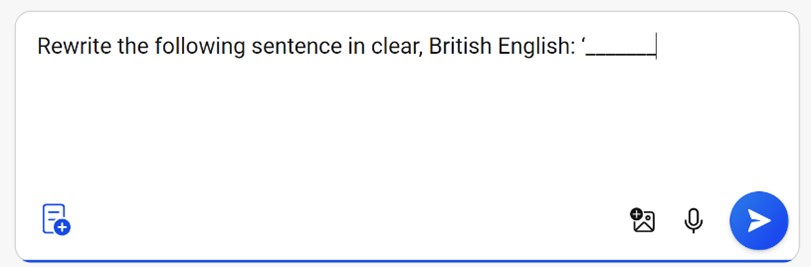
Using rewrite prompts such as, “Rewrite this so it is clear,” with tools like Grammarly and Copilot, are perfect for fine-tuning copy. When using these resources, do not include any references or information that could be used to identify the client, or any excerpts of source material authored by the client in the prompts used.
b. Find Basic Subject Matter on the Content Being Taught.
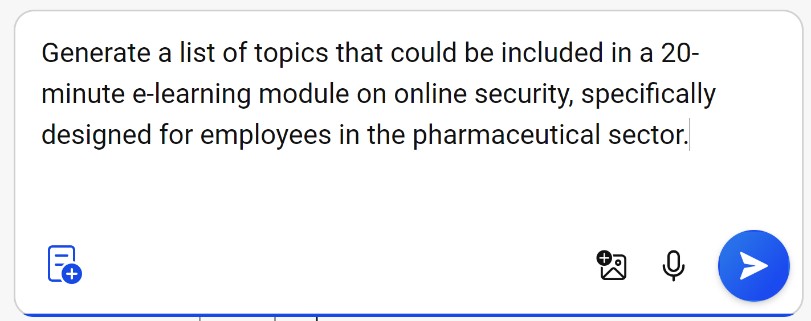
While subject matter experts (SMEs) remain the authority on all learning topics, they may not always be available to provide insight during the initial design stages. In such cases, AI tools such as ChatGPT, Copilot, and Gemini can function as low-level SMEs to provide “serving suggestions” for the kind of learning outcomes and accompanying content that should be covered in the learning module. We use AI in this capacity and any insights gleaned are eventually passed off to the relevant SMEs for their review and refinement.
In cases where one needs to rapidly tabulate research data, you can ask both ChatGPT and Gemini to tabulate data for you, with the latter being able to export the results directly into Google Sheets.
If you need to export the data into a table, ChatGPT can generate CSV tables that can be imported into Excel.
c. Ensure That You’re Delivering Content in a Way That Reaches its Audience.
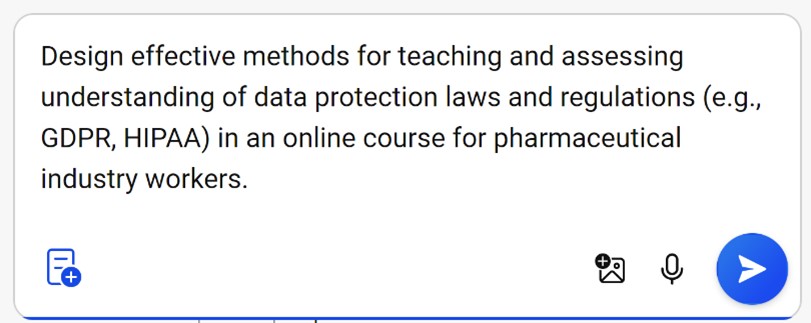
When creating learning materials, remain receptive to fresh ideas. ChatGPT and Copilot can recommend how specific concepts can be delivered and assessed. This can help inspire alternative approaches to learning design and delivery.
d. Generate “Flavor” Images That Illustrate a Proposed Tone or Content Treatment.
Even if you have a professional graphics team, AI can be useful in generating visuals, specifically “flavor” images, that illustrate concepts or ideas related to various delivery methods. Using the prompt “create an image” in Copilot will leverage Microsoft Image Creator (powered by DALL-E) to generate images that depict how things could be presented or conveyed in the final module. When dealing with AI-generated imagery, you need to be fully transparent about where they came from.
3. Crafting a Design Solution
The next step is creating a Design Solution. This is usually a Word document that contains the following information:
The learner journey and design approach
The project’s scoring, tracking, reporting, and bookmarking requirements
The project’s accessibility requirements
a. Improve on Written Work.
Various AI tools can be used to ensure that the Design Solution document is accurate, comprehensive, and easy to understand. For example, ChatGPT and Copilot can be used to simplify complex technical terms.
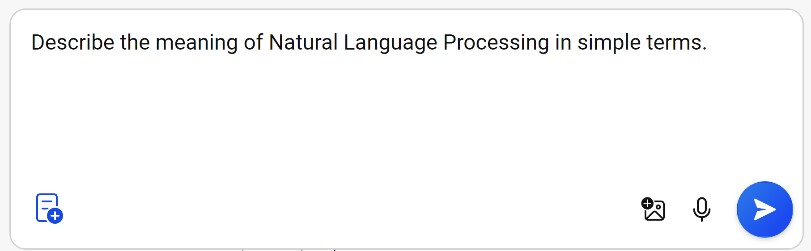
Additionally, once the Design Solution has gone through a review, creators can use AI tools to rework or reword certain sections that reviewers feel are not as clear or succinct as they could be. The best tools to use here are typically Gemini, Copilot, and ChatGPT. The “temperature” of AI tools is a setting that controls how creative and unpredictable the generated text is. It’s like adjusting the thermostat in your house, but instead of controlling the temperature, you’re controlling the creativity of the text.
Most generative AI tools have a “temperature” setting. If you turn up the temperature, you’ll get more wild and crazy responses, but if you turn it down, you’ll get more predictable and straightforward responses. Users can adjust the creative temperature to rapidly generate several different responses and then improve on the ones they like best.
An additional feature of Copilot is that it can provide you with links to the sources of its information, whereas ChatGPT and Gemini will not. These sources allow designers to delve deeper into their research and verify the validity of the AI’s results.
The final step before moving into production is creating a script that outlines all the text and dialogue that will appear on the learner’s screen throughout the entire eLearning module. During the scriptwriting process, generative AI can suggest ways to make human-created content clearer, more concise, and better aligned to its intended audience.
Leveraging Human+AI Collaboration in Digital Learning
AI is a powerful tool for enhancing human creativity in the digital learning space. By integrating AI throughout the design process, we not only make the process faster and more efficient for designers, but pave the way for adaptive, customized, and effective eLearning experiences that empower individuals to learn and grow in new and exciting ways.
About the Authors
Paul Andrews
Paul Andrews is a Senior Learning Experience Designer at GP Strategies. Paul began his career teaching Mathematics and Computer Science and has a Master's degree in Adult Education and E-Learning. He played a pivotal role in introducing Moodle to the UK in the early 2000s, transforming the digital learning landscape. At GP, he is dedicated to continuously exploring methods that will enhance the collaborative dynamic between humans and AI and working with clients to recognize and embrace the advantages of cohesive learning systems.
Get in touch.
Learn more about our talent transformation solutions.
Transformation doesn’t happen overnight if you’re doing it right. We continuously deliver measurable outcomes and help you stay the course – choose the right partner for your journey.
The rise of Artificial Intelligence (AI) has forced organizations to redefine their learning strategies as they strive to equip their workers with the skills necessary to compete in this new arena. Those that prioritize learning will thrive in this new environment, while those that don’t are in danger of falling behind. Ekpedeme “Pamay” Bassey, chief learning and diversity officer at Kraft Heinz, summed up the key role that learning and development (L&D) plays in this new paradigm: “AI will change the skills needed to do the jobs of the future. It’s up to us to create an environment of curiosity and inspire employees to operate with agility and a growth mindset.”
There are four basic foundations that will help you modernize your learning organization. By prioritizing skilling and upskilling, building a relevant, trusted learning ecosystem, working to engage your learners, and embracing the possibilities of AI in learning, you will create more effective learning experiences that drive real value across your organization.
Modern Learning Organization Foundation #1: Prioritize Skilling and Upskilling
Skilling and upskilling initiatives are vital to keeping your employees up to date on AI and other recent innovations. When creating these courses, begin by assessing your workforce and conducting a skills inventory. This will help you identify any skills gaps within your organization. Once you’ve identified crucial missing skills, align your learning goals to established business objectives. For instance, if your organization is struggling to remain productive in a hybrid environment, a course that focuses on building leadership skills for distributed workforces can help offset this disruption.
The Skills Pyramid: Investing in the Different Skills Tiers
Learning budgets are limited, so it’s important for leaders to prioritize skills that will make the most impact within the organization. Job skills can be divided into three basic tiers that take place at different levels of the organization and target different organizational outcomes:
Skills Designed to Help You “Play the Game”
Include basic essential skills that enable your workforce to perform within your industry
Prioritize compliance training, curated learning, learning experience platforms, and professional development activities
Typically require fewer customized solutions
Skills Designed to Help You “Win the Game”
Include unique differentiating skills that enable your organization to outperform competitors in the field or become the best in class
Skills are tied to the organization’s Unique Selling Points (USPs)
Often require highly customized bespoke content, such as those found in organizational universities
Skills Designed to Help You “Change the Game”
Focus on innovative strategic skills that allow your organization to evolve its scope, enhance its capabilities, and break into new markets, services, and products
Prioritize senior strategic leaders
Take place in highly collaborative environments
There is a level of strategy involved in how an organization deploys its learning dollars to remain competitive. If your company is looking to distinguish itself within its industry, you will want to prioritize building skills in the second and third tiers. On the other hand, allocating your entire budget into the second and third tiers won’t benefit your organization if your employees lack essential skills. When investing in learning, strike a balance between basic needs and more specialized skills that will drive organizational innovation.
Modern Learning Organization Foundation #2: Build Healthy Learning Ecosystems
A learning ecosystem is built of all the different systems, platforms, and delivery methods used within an organization. This can include learning management systems (LMS), learning platforms, learning record stores, HR systems, intranet, internet, and so on. To deliver effective learning, your ecosystem must be optimized, transparent, integrated, and UX-focused. If the pieces of your ecosystem don’t fit together, assessing your pain points can provide steps for improvement. Start by asking questions such as:
How do you host and maintain your content?
Does your LMS fit your learning needs?
How do you move from one system to another?
Do your systems integrate with one another?
How do you automate processes?
How do you use data analytics to measure the effectiveness of your learning?
In some cases, optimizing an ecosystem may require new technologies or systems that better align with the organization’s learning goals. In many cases, however, an organization will have a perfectly viable system in place that’s not being leveraged as effectively as possible. In these instances, improving the ecosystem is simply a matter of taking better advantage of the resources already in place.
Modern Learning Organization Foundation #3: Supercharge Learner Engagement
Learning content is only as good as its ability to engage the audience. When designing content, remember that time is precious. To truly move the needle when it comes to learning, you need to ensure that your content is as engaging as possible. Here are a few fundamental steps to building audience engagement.
Step #1: Make Learning Usable and Accessible
Integrate learning time into existing workflows and ensure that your content is available on a variety of devices, such as desktops, laptops, phones, and tablets. Make your content accessible to employees who come from different cultures, speak different languages, or who are hearing or visually impaired.
Step #2: Make Learning Relevant
Personalized learning content and adaptive pathways offer much better outcomes than a one-size-fits-all approach. For annual compliance topics, consider adding test-outs that enable learners who already possess the relevant knowledge to skip unnecessary learning. Also, be sure to eliminate any old or outdated material from your curriculum.
Step #3 Make Learning on Brand
Make sure that your learning is in line with your organization and reflects its priorities, culture, and voice where appropriate. That does not necessarily mean that you need an expensive bespoke solution. Designers can alter off-the-shelf learning in subtle ways that make it feel more connected to your organization.
Step #4: Make Learning Social
People learn better when they can discuss, share, and work through problems together. When building a learning program, whenever possible, include some social aspect to the experience. This doesn’t require a live in-person training session; you can drive social learning strategies using a variety of alternate methods. Virtual sessions are perfect for allowing learners to work together, share and collaborate, while gamified elements such as scoring systems, leaderboards, badges, and other awards are effective at driving engagement through competition.
Step #5: Adopt a Blended Learning Approach
Not only is a blended learning approach more entertaining, but it will also provide activities and experiences that deploy the right media to align with the different needs of learners and their learning. When creating a learning program, aim for a combination of various activities, such as virtual and in-person workshops, eLearning modules, hands-on experiences, role-playing scenarios, learning games, manager check-ins, and coaching sessions.
Modern Learning Organization Foundation #4: Leverage AI Tools
We recently asked 50 C-suite senior L&D leaders to assess their organizations’ use of AI. This is a breakdown of what they said:
43
%
Exploring, experimenting, and piloting phases
35
%
Had not used AI yet
10
%
Actively using AI for scripting learning content
4
%
Using vendor tools and platforms that have AI functionality
4
%
Actively using AI to generate assets
4
%
Using AI for learning portfolio management
0
%
Using AI tools that support personalization and adaptive learning
As you can see, most of the organizations surveyed had either not incorporated AI into their work or reported being in the early stages of use. If you are searching for a place to start, here are a few example areas in which AI can provide tremendous value for your learning organization.
Analyze and Optimize Content
Many organizations have a large amount of learning content. If these assets lack metadata such as titles, descriptions, and clear learning objectives, it can be nearly impossible for administrators to assess the full contents of their learning library, much less deliver it to its intended audience.
The GP Learning Content AIQ tool can help organize and optimize your learning library by scanning your catalog and filling in missing meta data. This makes it easy to assess your catalog of content so you can organize your library, identify content gaps, update existing material, and streamline your assets by eliminating old and outdated content.
Create Tests and Assessments
Assessments can play a significant role in measuring the effectiveness of a learning program. There are a variety of AI tools that can quickly generate quizzes and other assessments based on PDFs, documents, web pages, and even videos. These tools can create tests in a variety of different formats and can even import your tests into your LMS or embed them into a website.
Translate Content
By leveraging AI-enabled tools, L&D departments can translate learning content in a fraction of the time, at no additional cost. These tools are simple to use and provide a fast, cost-effective way to translate texts, images, documents, and websites.
AI also offers exciting tools for translating videos as well. These tools can provide subtitles in hundreds of languages. It is also possible to leverage voice-generation technology to clone the voice of the original speaker and create dubbed multi-language speech using the speaker’s original voice and cadence.
Personalize Content
AI can create personalized learning journeys by analyzing the courses that a learner has taken in the past and suggesting similarly themed courses that align with their role and responsibilities. AI can also create adaptive pathways by assessing an individual’s learning pace and performance and adjusting the difficulty of a course to match the learner’s abilities. These systems make it easy to provide additional learning resources or create custom content aligned to an individual’s specific learning style.
Create a Modern Learning Organization
Effective learning is critical for thriving in the face of change. As technology continues to advance, an organization’s successes will become increasingly defined by the effectiveness of its learning efforts. These four foundations provide a valuable starting point. As you continue to improve and expand your learning, strive to build a culture of continuous improvement in which learning is prioritized across the organization and built into employees’ everyday workflows. This will provide your people with the flexibility to successfully tackle the challenges of tomorrow.
GP Strategies is a global performance improvement solutions provider of sales and technical training, e-Learning solutions, management consulting and engineering services. GP Strategies' solutions improve the effectiveness of organizations by delivering innovative and superior training, consulting and business improvement services, customized to meet the specific needs of its clients. Clients include Fortune 500 companies, manufacturing, process and energy industries, and other commercial and government customers.
Get in touch.
Learn more about our talent transformation solutions.
Transformation doesn’t happen overnight if you’re doing it right. We continuously deliver measurable outcomes and help you stay the course – choose the right partner for your journey.
Leaders have an extremely important role in fostering safe and productive environments to allow their people to thrive. Not only do you need an understanding of what true inclusion is, you need to be able to conduct self-reflection and put strategies in place that allow space for others to grow and develop.
The call for inclusive leadership is louder than ever. As organizations strive to create environments where every individual feels valued and heard, they are turning to managers to adopt inclusive leadership styles.
But what does it mean to be an “inclusive leader”? And how do you become one?
What Is an Inclusive Leader?
An inclusive leader is intrinsically motivated to bring out the best in people, to positively impact business outcomes. They leverage the power of diversity in their teams by creating a safe, unbiased, and equitable space making all team members feel valued, respected, and able to contribute fully.
The aim of an inclusive leader is to foster a feeling of belonging among their people through deliberate daily practices. Here are five immediate impactful practices that you can implement today to become an inclusive leader:
Recognize and mitigate unconscious biases in hiring, promotion, and day-to-day interactions.
Ensure equitable opportunities for growth and development for all team members, regardless of their background, identity, or personal characteristics.
Foster open communication and encourage diverse perspectives in decision-making processes.
Adapt a leadership style that accommodates the different working preferences and needs of team members.
Promote cultural competence and sensitivity within the team.
How to Develop the Mindset of an Inclusive Manager
Effective leaders possess a specific mindset that shapes and directs their actions. They practice self-reflection to develop this ability, understanding how they impact those around them. This is an effective method that can help you shift toward a more inclusive mindset.
These two reflections points will allow you to develop an inclusive mindset:
Question the source of your motivation to practice and promote inclusion. If your motivation is driven by external sources like human resources or senior leadership, then it won’t last long and your efforts will be wasted.
Seek to connect the benefits of inclusive practice to positive business outcomes. When you come across a high performer, be curious about how included they feel and if they feel a sense of belonging to the team or organization. When your people feel like they belong, they tend to be personally driven to achieve what is best for the business.
How Managers Can Bring Inclusion into Daily Operations
Leaders who champion inclusivity are not only building better workplaces but are also setting their organizations up for long-term success. Inclusive practices foster innovation, attract top talent, and enhance overall business performance.
Sarah Thompson, HR Thought Leader
After you have reflected on your behaviors and gained an understanding of the different forces impacting your daily work environment, you can identify opportunities within your daily operations to integrate and practice inclusive behaviors. Open your mind to strategies and influence inclusive practices within your broader organizational circle.
Here are some examples of actions that promote inclusion at all levels.
Address and prevent discrimination, harassment, and exclusionary behaviors promptly and effectively.
Seek feedback from team members on inclusivity and continuously work to improve the work environment.
Implement flexible work arrangements to support work-life balance and accommodate various personal circumstances.
Champion diversity, equity, and inclusion initiatives at the organizational level.
Make Your Organization Inclusion Ready
It is also critical to learn about what you can do from your position of power to influence policy and support teams to adapt inclusive practices at an organizational level.
Think about your touch points with these colleagues and departments and use each opportunity to bring inclusion to the forefront of your conversations. Inclusive leaders are successful because they embed inclusion into their mindset and daily practices.
As Organizational Psychologist Michael Chen would say, “Inclusion is not a one-time initiative; it is a continuous journey that requires ongoing commitment and reflection.” By embedding inclusive practices into the core of our operations, we build resilient and adaptive organizations. Allow for an awareness and assessment of your external forces at play and examine your dominant work culture to identify gaps and opportunities for inclusion.
About the Authors
Joel Louis Sequeira
Joel Louis Sequeira is the Head of Digital Learning (Leadership & DEI) at GP Strategies Corporation, with over 15 years of experience shaping learning and development programs across diverse industries. He is recognized for his work in designing and implementing cutting-edge learning solutions that foster leadership and performance geared towards organizational success.
Previously, Joel has held key roles at Ministry of Justice UK, Dorchester Collection and British Airways, consistently championing inclusive work environments and performance improvement through strategic learning initiatives.
Joel is passionate about developing transformative digital learning experiences that empower leaders to create more inclusive, high-performing teams. He is committed to advancing the field of leadership development with a focus on equity, innovation, and measurable business impact.
Get in touch.
Learn more about our talent transformation solutions.
Transformation doesn’t happen overnight if you’re doing it right. We continuously deliver measurable outcomes and help you stay the course – choose the right partner for your journey.
When it comes to learning, the teaching method is often just as important as the message. Teaching seeks to foster change, which is only possible when your learners truly connect with the subject matter. Forging that connection means providing learners with experiences relevant to their needs. Of course, organizations have their own priorities that must also be addressed. Blended learning can help you strike a balance between the needs of both through learning journeys that are highly flexible and engaging.
What Is Blended Learning?
Blended learning is an approach that combines both online and face-to-face learning in ways that complement and reinforce each other. A blended learning journey is the perfect way to ignite curiosity, drive engagement, and prioritize the needs of different types of learners in your organization. Learning blends can consist of various activities such as eLearning, animations, podcasts, traditional classroom lecturing, roleplays, digital interactive scenarios, video dramas, digital games, and augmented or virtual reality sessions. Here is an example of what a potential learning journey might look like:
What Are the Benefits of Blended Learning?
Blended Learning Prioritizes Your Learners’ Needs
Learners today are incredibly time-poor, making it challenging to create content that can be delivered in their daily workflow. When designing blended learning journeys, you can maximize limited training time by creating activities that can be consumed at any time and anywhere. Here are a few examples:
Make your learning as accessible as possible through a variety of devices such as laptops, tablets, and phones.
Activities such as podcasts, games, and videos can be consumed while traveling or on the way to work.
Microlearning courses can be completed in a matter of minutes, making them easy to do during normal work hours.
Blended learning journeys can help serve the needs of a diverse workplace through personalized learning paths. Incorporating branching pathways or a choice of activities enables learners to pursue a path that reflects their specific role and region, while meeting their personal learning needs and preferences.
Blended Learning Accommodates the Needs of the Organization
Delivering Learning That’s Efficient and Cost-Effective
Blended curriculums offer you more choices regarding how key learning is delivered. Imagine you need to train your employees on a complex new process, and are considering either three half-day classroom sessions, or a series of online explainer videos.
Online videos are more flexible and cost-effective, but they won’t provide employees with the opportunity to ask questions and collaborate with peers the way a live training session does. A blended approach, consisting of an in-person session combined with supporting online resources can be both cost-effective and impactful.
Learning Blends Can Be Adapted During Times of Change
Big unpredictable changes, such as our experience during Covid-19, can rapidly change the way an organization does business. To remain competitive, it is crucial for a business to be adaptable in its methods, technologies, and its training. If your learning is made up of multiple formats, you will be able to continue using some of them during significant disruptions, while reworking others to fit in the new changed environment.
Additionally, a well-designed blend makes it easier to integrate new ideas, approaches, and technologies. For example, incorporating AI into an existing 60-minute eLearning course would be difficult to accomplish; however, enhancing an existing blend with a chatbot to help learners navigate the material is much easier to do.
Blended Learning Maximizes Engagement and Retention
Stimulating Different Senses
Blended learning has tremendous value because the brain processes different kinds of information in different ways. Learning journeys are constructed using a combination of activities that target these different areas. For example:
Raising Learner Retention
It is important to remember that all learning content is competing for your audience’s attention. At any given moment, your employees will be juggling a combination of work responsibilities, personal problems, and distractions.
If your content isn’t interesting or entertaining it will fail to engage your audience. A blended learning strategy offers learners something varied, stimulating, and interesting that does not ask them to absorb all the material in one session or in one way. Not only does this make learning sessions more interesting to learners, but it greatly enhances their ability to retain what they have learned.
Incorporating Spaced Practice
Even if your learners are highly focused and motivated, they’re still subject to the forgetting curve. Research shows that people forget approximately 50 percent of new information after one hour. Within 24 hours, that jumps to 70 percent, and within one week it becomes 90 percent.
The spaced repetition or distributed practice approach has learners revisit information at repeated intervals. For instance, you might use a short initial learning session to introduce the information, then follow that up with a series of interventions that test learners’ recall of what they’ve learned, refresh their understanding, and incorporate additional information.
Spaced learning has been shown to be effective at improving long-term retention. If you want learners to attain deep understanding of material, remember it over time, and be able to apply it in different circumstances, have them revisit key concepts in their learning journeys.
Blended Learning Journeys Can Transform Your Organization
Blended learning offers many benefits for your learners and organization. Consistent, ongoing learning not only reinforces critical job skills but provides a valuable first step in creating a continuous learning culture. Once you have established learning journeys in your organization, continue to introduce new learning in the form of reskilling, upskilling, and employee development initiatives. This will make employees feel more valuable and enable your organization to become more flexible by creating an environment in which change becomes a path to improvement rather than a disruption to be feared.
Emma Jourdan is a learning consultant at GP Strategies. With a background in governance, risk and compliance training, she has a particular interest in learning strategies that truly change behavior. She focuses in particular on how storytelling and game design methodologies can be used to design learning experiences that engage learners deeply, showing them why compliance and ESG topics matter to them and giving them the tools to practice and embed the behaviors they need.
Get in touch.
Learn more about our talent transformation solutions.
Transformation doesn’t happen overnight if you’re doing it right. We continuously deliver measurable outcomes and help you stay the course – choose the right partner for your journey.
Today’s organizations are becoming increasingly age-diverse, with leaders managing teams that span up to four different generations. While this dynamic comes with its share of challenges, organizations have begun to realize that there is great value in embracing age diversity. A recent AARP survey of 6,000 employees found that, “83 percent of business leaders say multigenerational workforces are key to the growth and long-term success of their companies.” Additionally, 68 percent of those surveyed said that they would purposefully design mixed-age teams.
Clearly, there is a benefit to be found in cultivating a multigenerational workforce, but how do you effectively manage a team made up of people with such distinctly different views on technology, communication, and productivity? Here are five tips that will help you reduce friction and get the most out of your multi-generational team.
#1 Confront Stereotyped Beliefs & Biases
Ageism represents one of the most significant challenges to the modern workplace because it is largely universal. At one point or another, we have all questioned someone’s capability because they were “so young” or perhaps “getting on in years.” Like all forms of discrimination, when left unchecked, ageism can influence the way we act, even if subconsciously.
It is crucial for leaders to actively confront and challenge these stereotypes directly. Begin by identifying your own blind spots, particularly in how you respond to people. Then, challenge the assumptions behind those reactions. The Three Questions method is a useful tactic for deconstructing your assumptions. When you notice yourself slipping into stereotypical thinking, pause and ask: Is this true? Is this always true? What examples do I have when it was not true? Here is an example of how this works:
Assumption: Older employees are bad with technology
Is this true? In some cases, this may be true.
Is this always true? Most people can think of someone who breaks this stereotype.
What examples do I have when it wasn’t true? Steve Jobs was a baby boomer, but he was incredibly tech savvy.
After you have reframed your own thinking, you can use the same approach to coach your teammates. One thing to keep in mind when confronting biased thinking: Try to avoid calling someone out in public, as this is likely to make them angry and defensive. Instead, take them aside, ask them about their comment, and use the Three Questions to challenge their assumptions. It is amazing how quickly stereotypes fall apart when you begin to question them. If you encounter deeper resistance from team members, you may need to schedule a separate discussion in which you reference company policies or procedures or, in extreme cases, enlist the aid of an HR representative.
#2 Champion Diverse Thinking
Team members from different generations tend to approach problems in different ways. These unique perspectives can provide valuable insights that help to solve problems, spur creativity, and identify defects or risks in an idea, product, or process. This can only happen, however, when the leader creates an environment of psychological safety in which everyone on the team feels empowered to share their opinion without fear of ridicule or judgment.
Just as it is with overcoming bias, psychological safety begins with you as a leader. You may need to take active steps to help everyone feel comfortable. Notice who contributes and who seems reluctant. For instance, some younger team members may be reluctant to share their ideas in front of older, more experienced colleagues. You should also pay attention to how people react to contributions. Are team members reluctant to ask a question or make a suggestion for fear of being judged or ridiculed?
Get to know the members of your team so you can understand how they approach things. Encourage, recognize, and reward contributions and ideas. Lead by example and demonstrate your own humility and vulnerability by being curious and asking questions to promote conversation. Come up with creative ways to inspire your people to think and reflect, and use a variety of tools such as chat, whiteboards, and sticky notes to encourage participation. Listen actively and consciously to what people say and facilitate constructive discussions of opposing views. Your overall goal should be establishing a dynamic in which people feel empowered to speak and share. As team members begin to open up, reinforce this by thanking them for sharing. Celebrate wins and call out individuals for their contributions.
#3 Adopt a Flexible Management Style
Leading teams today is undoubtedly more complex than ever before. Previously, leaders could define “career success” as climbing the corporate ladder. However, as the generational makeup shifts, success is no longer just about securing a high salary or a senior position. Workers are redefining success as the ability to balance their work and life priorities effectively or by becoming an expert in a role they have been honing for years. This is one instance where “group think” no longer applies, with younger workers questioning long-established paradigms related to work ethic, mental health, and corporate responsibility.
Having an open mind is critical when managing different generations in the workplace. Do not brush off working expectations from your younger team members as, “too pie in the sky,” or dismiss input from your more seasoned colleagues as, “stuck in the past.” Instead, zero in on the value of each idea, and think about how they could evolve your team’s experience and help propel your productivity. While it’s handy to know about generational trends, do not forget that everyone is their own person. As a leader, it is important to take the time to get to know the individuals on your team and determine what they need from you to perform at their very best.
#4 Focus on Shared Values and Common Goals
Research reveals that different generations share many core values, such as integrity, achievement, competence, self-respect, and responsibility. We also know that team members will harness their different approaches when presented with a crisis or other common goal. The key to working with different generations lies in defining these shared values in a way that can be understood by everyone on the team, while clarifying what everyone is trying to achieve collectively. Corporate values and objectives are a great place to start, since they apply to all employees. They are easy to understand and provide a universal set of principles that can be applied to achieving team objectives.
Once you have established a set of shared values, you can use them as a benchmark to measure how effectively the team is functioning both interpersonally and as a business unit. This provides clear standards for handling conflict, evaluating team performance, and delivering employee assessments. Having a set of shared values takes age completely out of the equation and allows a variety of approaches toward the same goal. Leaders can evaluate the achievement of goals by how well the team’s actions align with shared corporate values and principles.
#5 Pair Up Employees from Different Age Groups
When managing a team made up of multiple generations, establish a growth mindset in which team members believe their skills and behaviors develop through learning, dedication, and hard work. This can be accomplished by establishing a culture of continuous learning. When team members are constantly learning, they become open to change. This creates an environment in which team members can influence one another in positive ways.
Two-way mentorships offer a fantastic way for workers from different age groups to share their own unique strengths. In this arrangement, both employees can serve as teacher and student. A veteran employee might help develop leadership skills in a younger employee, who in turn might teach the older employee best practices regarding social media marketing.
Your efforts do not have to be so formal, however. Any activity that pairs people from different age groups together can have the same effect. Once your team members begin to see the value in one another, they will behave less like individuals and more as an integrated team.
Drive Change by Breaking Down Barriers
While there can be broad differences between different age groups, remember that no one is completely defined by their generation. For every individual who corresponds to generational stereotypes, you will find many others who completely shatter these expectations. As a leader, it is your responsibility to look beyond generational boundaries by challenging biased and stereotyped thinking—both in yourself and others. Breaking down these barriers may seem challenging at times, but doing so will provide tremendous value for yourself, your team members, and your organization.
Are you looking to push your leadership to the next level? Our Leadership and DEI Training offers solutions for leaders at every level of your organization.
About the Authors
Nic Girvan
A leader of impactful and unique learning innovations, Nic Girvan is GP Strategies DEI, Director of Learning and Delivery. With over 20 years’ experience working within Learning & Organizational Development, Nic blends her expertise in adult learning theory and general psychology to create hard hitting and inspirational interventions, that promote culture change and transform working environments.
As a previous award winner for innovative instructional design, Nic is driven by the desire to lead her learning services to deliver truly impactful and ground-breaking DEI interventions. Not one to shy away from ‘unusual yet successful’ learning shake ups, Nic inspires her services to break industry boundaries and move beyond ’tick box training’.
A truly inclusive and authentic leader, Nic works closely with both instructor-led and digital design teams to ensure her services offer not only return on investment but go beyond client expectation. A committed thought leader for effective training efforts, she regularly publishes blogs, articles, and thought pieces to promote the importance of effective training investment and transformative DEI upskills.
Get in touch.
Learn more about our talent transformation solutions.
Transformation doesn’t happen overnight if you’re doing it right. We continuously deliver measurable outcomes and help you stay the course – choose the right partner for your journey.
The way we work is changing. In just the past five years we’ve seen an influx of new technologies, new team arrangements, along with a new generation of workers. As leaders adapt to these ongoing disruptions, many are embracing alternative leadership styles to thrive in this new environment. Transformative leadership has become increasingly popular in recent years because of its emphasis on embracing change.
The key component of transformative leadership is a visionary mindset. Transformative leadership prioritizes two things: driving innovation and empowering people, with the larger goal of shaping an organization’s future success. Are you interested in evolving and improving your leadership skills to make a more positive impact on the people you lead? Here are eight strategies to help you develop the traits of a transformative leader.
1. Embrace Change
Transformative leaders are change agents who actively challenge the status quo. Innovation is a part of their everyday thought process, and they are dedicated to continuous growth and development. As you develop your management style, try to reframe the way you think about change. Try treating change as an opportunity rather than a disruption. This will make you more receptive to unique approaches and out-of-the-box thinking.
2. Empower Others
Becoming a transformative leader means learning how to improve those around you. This does not happen organically; it is something that you must prioritize as a leader. Start out small by selecting someone on your team and putting a development plan in place. Then, slowly build this process to include others over time.
3. Develop Self-Awareness
Self-reflection and emotional intelligence are both critical to transformative leadership. Understanding your own strengths, weaknesses, and blind spots will help you build empathy and be more authentic, enabling you to inspire and lead your team members more effectively. Focus on changing yourself first. Then you can inspire change in others, which will in turn create change in the organization.
4. Cultivate a Growth Mindset
A growth mindset is the belief that an individual’s skills and behaviors are not set in stone but can be improved through dedication and hard work. This mindset is essential for empowering team members and inspiring them to perform at their very best. Transformative leaders provide their team members with a great deal of autonomy and will encourage them to complete tasks however they choose, provided that performance expectations are met.
5. Communicate Effectively
Talking is not the same as communicating. Effective communicators know how to listen to what other people are saying and use those insights to coach and lead them more efficiently. Strive for transparency in your communication style and work to create an environment in which team members feel encouraged to share their thoughts, opinions, and insights.
6. Build Relationships
Transformative leaders view their team members as partners, not merely as employees. They work to create a sense of trust and psychological safety within the group. Try to create bonds with your team members that provide insights into what they think and how they feel. Understanding your employees’ unique passions, challenges, and frustrations will enable you to meet their needs and deploy them more effectively within the team structure.
7. Lead by Example
Be aware that other people are watching you. Employees look to you as an inspiration and a model for how to perform. It’s important to take this responsibility seriously by embodying the same traits you want to cultivate in others. A transformative leader will seek to lead by example and function as an active member of the team.
8. Stay Informed and Up to Date
Increase your awareness of what’s taking place in the company around you. Seek out leaders you admire and learn from their behaviors. Strive to stay current on all learning and technology within the company and pay attention to the impact it has on other employees.
Leading Change Through Personal Growth
Transformative leadership is an ongoing process of personal and professional improvement that starts with you as a leader. You serve as the central engine for your team, and it is only by cultivating ingenuity, integrity, and authenticity in yourself that you can begin to inspire similar greatness in others.
GP Strategies is a global performance improvement solutions provider of sales and technical training, e-Learning solutions, management consulting and engineering services. GP Strategies' solutions improve the effectiveness of organizations by delivering innovative and superior training, consulting and business improvement services, customized to meet the specific needs of its clients. Clients include Fortune 500 companies, manufacturing, process and energy industries, and other commercial and government customers.
Get in touch.
Learn more about our talent transformation solutions.
Transformation doesn’t happen overnight if you’re doing it right. We continuously deliver measurable outcomes and help you stay the course – choose the right partner for your journey.
AI technology is so rapidly advancing that you may sometimes feel like you are being swept up by a powerful force and carried away to a strange and unfamiliar land.. Leading a Human plus AI team requires —brains, heart, and courage—all of which can help each of us as we continue down the path of integrating AI into leadership and learning.
Learning to Harness AI Brainpower
AI can provide information that previously required human intervention to research, source, and summarize with just a few keystrokes. It can analyze massive amounts of data in a fraction of the time, and its natural language capabilities can help it understand human language as it is written or spoken. AI can also generate images or videos from text prompts and scan vast quantities of data to summarize with ease. These AI capabilities are already transforming learning content generation and optimization with alarming (and exciting) speed.
Many predict that, in the future, the AI “brain” will be capable of accomplishing many of the tasks currently performed by humans. While this shift will result in some workers being replaced, it will also create new roles yet to be imagined that will be responsible for harnessing and regulating the power of AI.
Pulling Emotional Intelligence into the World of AI
Technology is not enough – people want to feel and experience emotions like a humans. Humans have an advantage over technology—our ability to feel. But possessing a heart is not enough; it is what we do with it that matters. Leaders and employees must express their emotions, tune into the feelings of others, and harness these emotions to connect, make decisions, and persevere when the road becomes difficult.
Leaders must also understand the unique individuals in front of them by examining their values and priorities and how they prefer to work and connect with others. Despite AI’s big brain, it lacks the emotion to lead others. The power of emotion helps us relate to each other and empathize with our colleagues or customers, something AI will never have because it cannot feel.
Leaders need both head and heart to guide the future. They must still channel their emotions and express empathy for those they lead as they implement AI into their workflow.
Finding Courage in an AI-Driven World
Though some may appear confident, underneath lies uncertainty and apprehension. Similarly, when confronted with the challenges of artificial intelligence, many leaders and employees experience palpable fear. They question the role AI will play in their industry, whether it might replace roles on their teams, how to incorporate it into their leadership style, and whether it might even replace them.
While navigating these uncertainties, leaders need the same thing the Lion needed—a bit of courage, the gentle nudge from those around them to stay the course, and the knowledge that they are in this together with colleagues who are just as perplexed about how to work in the ever-changing world of AI in learning.
Approaching the Unknown with Brains, Heart, and Courage
AI is not a story that ends with a return to familiarity; rather, it propels us toward new and unfamiliar territories. As we navigate this journey, we can harness AI’s capabilities while using our human emotions to stay connected. However, it is courage that leaders will need most to step confidently into the future of a Human+AI world.
About the Authors
Leah Clark
Leah Clark is the Leadership Practice Lead at GP Strategies, as well as an author and the founder of LeaderConnect. With over 28 years of experience in her field, Leah brings a unique perspective on the mindsets and skillset that are critical to leadership success to her coaching and consulting. Her clients benefit from her collaborative approach to crafting a well-connected and thoughtful leadership development strategy. Leah holds a Master of Arts; Organizational Psychology, Columbia University and a Bachelor of Arts; English and Sociology, Boston College.
Get in touch.
Learn more about our talent transformation solutions.
Transformation doesn’t happen overnight if you’re doing it right. We continuously deliver measurable outcomes and help you stay the course – choose the right partner for your journey.