
Digital Learning Journey Examples for Modern Learners

Technology has modified the way we digest information; gone are the days of stuffy hour-long informative training videos and hefty, physical manuals or how-to guides. Gone even are the early days of eLearning courses, like Judy Lowder points out, when “clicking the ‘next’ button [is] synonymous with turning the page. You open the course, start in the beginning with a table of contents, work your way through the material, and by the end you understand American history, Shakespeare’s Hamlet, or the importance of corporate compliance.” 

Digital learning is the evolution of learning with new technologies and strategies used to enhance both in-person and learning at a distance. So, what is a learning journey and what should it look like? In a world full of learners with basically all knowledge known to humankind perpetually at their fingertips, what is the best way to learn? And what do learners even want? 

What Is a Modern Learner?

The modern learner, contrary to the beliefs of some, is really not that much of an enigma. Learners are busy. They have constant, prolific access to technology. They want to be available for learning, but it’s difficult to make time for. Any new quest for knowledge a modern learner might embark on must inherently have a sense of relevance baked right into the experience. 

Research has described modern learners as “overwhelmed, distracted, and impatient,” which more or less matches the stereotype of the youngest generations in our workforce, but these issues are not restricted to specific age groups. Everyone is overwhelmed, distracted, and impatient. 

So how does this translate into learning? Well, modern learners need flexibility; they need information that’s ready to go whenever they are, and it needs to be transportable. The learning experience should be brief and provide explanations of big, juicy concepts in snippets or small doses over time, and, above all else, it needs to be relevant. If the value of learning a certain thing is not immediately apparent, it’s a no-go for the modern learner. 

What Is a Modern Learning Journey?

Traditional instructional design takes a systematic approach to creating an instructional output. This approach focuses on providing the information you need in the order you need it, maybe with a little interactivity throughout the experience. That’s not necessarily a bad thing if your end goal is just to relay large chunks of information—but education, as Plato once put it, “isn’t what some people declare it to be, namely, putting knowledge into souls that lack it, like putting sight into blind eyes.” The transfer of information does not necessitate learning. 

Elements of an Effective Learning Journey

What you miss with that more traditional approach is the systemic experience of learning. In a modern learning journey, we consider how you build a system of learning or a learning experience, and we’re concerned with what wraps around or envelops the actual learner throughout the process: all the simple interactions, tools, and reinforcing moments that occur. We need to design an experience that creates space for the learner to pull themselves into it and be fully immersed. This immersion allows them to take ownership of their personal learning journey. 

Accountability and Relevance

However, one of the first rules of a modern learning experience is that the modern learner must take accountability to find true value in their learning, and a learner will not take accountability if they do not see the relevance. You also can’t actually ensure relevance, but you can create the conditions for it. Prioritizing accountability is a major culture shift for a lot of organizations because they simply are not used to helping learners take accountability. 

Here are a few elements of wraparound, digital learning experiences that facilitate relevance and personal accountability: 

  • Chatbots and digital assistants 
  • Curated skill plans 
  • Testimonial videos and podcasts from influencers 
  • Virtual community and support 
  • A manager’s toolkit with activities to use with their team
  • Interactive quizzes and scenarios that offer insight and opportunities to practice a particular skill 
  • Timely communications to reach employees wherever they are in their learning journey 

To make something ruthlessly relevant, learners must be able to step in and autonomously make the connection of why it is important to them or how it is going to help their career or growth, all by themselves. This is why thinking about the modern learning journey as a wraparound, non-linear experience is so important. And our goal is to build an experience around learners that allows them to step in and own that journey. It is their journey, after all. 

An Illustration: Sarah’s Digital Learning Journey

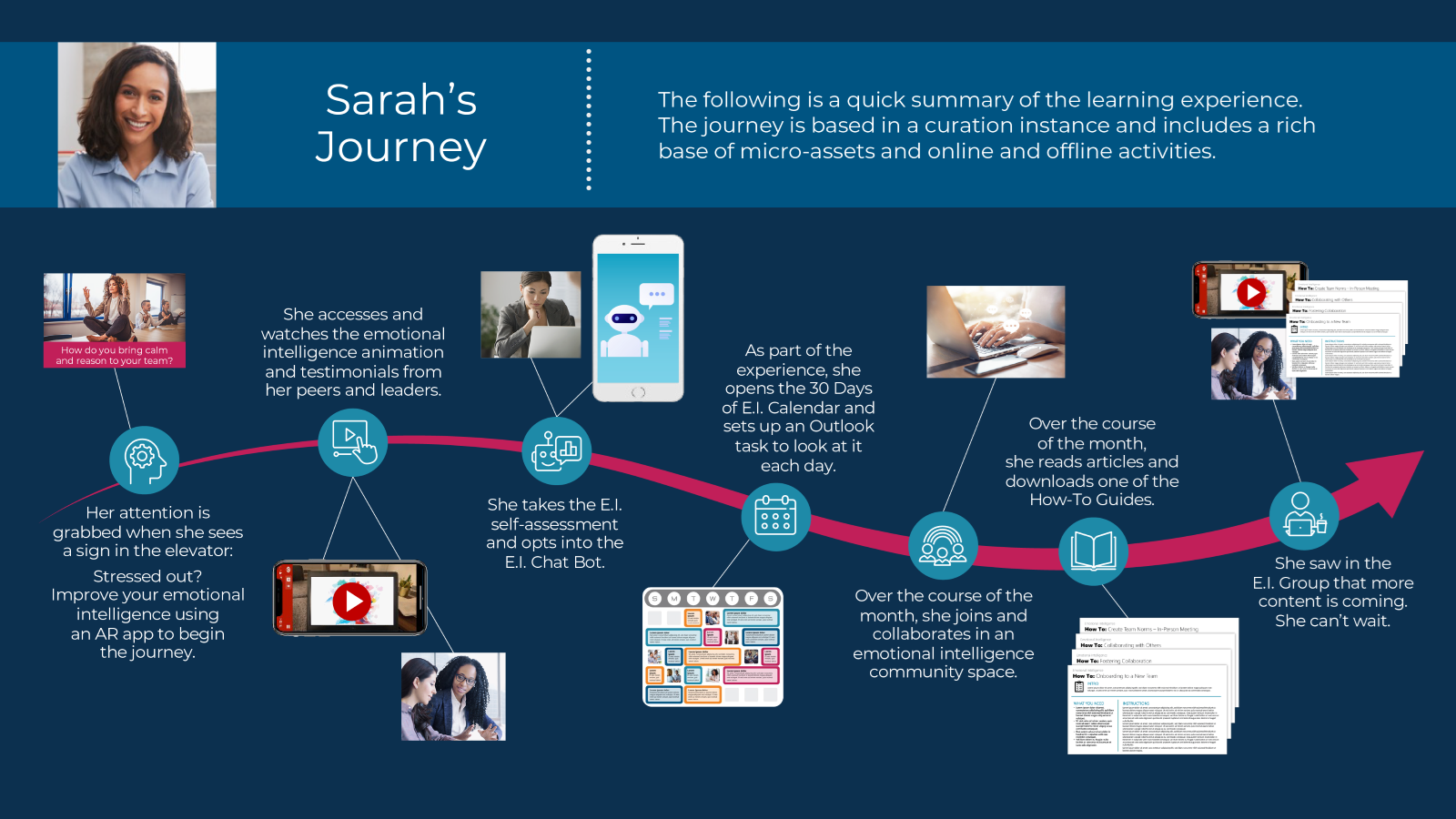
Let’s explore what an effective digital learning journey example might look like in action. We’ll pretend we know a woman named Sarah. She is a single parent and a rising professional in her field with aspirations, and her primary professional goal is to ensure she’s a viable option for future promotions. She heard recently that emotional intelligence (E.I.) is a critical skill for future positions she’s interested in, so the concept of developing her E.I. is already on her mind. 
Starting with Curiosity and Motivation

Here’s how Sarah’s digital learning journey might unfold: 

Her attention is caught by a flyer in the elevator at work that says, “Stressed out? Improve your emotional intelligence using an AR app to begin your journey,” and it includes a QR code. This resonates with her. She is stressed, she is curious about E.I., and getting app notifications on her phone to remind her that she’s trying to build this skill would be really useful. She quickly scans the QR code to download the app on her way to grab lunch. 

She’s prompted to watch a few videos of animations and testimonials from industry leaders and peers discussing how developing their E.I. helped them personally and professionally. She easily watches them on her way to pick up her lunch. Through these short videos, Sarah now understands from a range of voices how others use E.I. and why they value it. 

This tactic provides an opportunity for Sarah that differs from the traditional approach, which would probably consist of an authoritative voice from her organization declaring, “This is E.I., and here’s how to use it and why we want you to.” 

Using Tools Like Chatbots and Skill Challenges 

Sarah is intrigued, so back at her desk, she decides to move forward through the app’s prompts. She takes the E.I. self-assessment and opts into the E.I. chat bot. 

The self-assessment is a brief diagnostic to help make Sarah more aware of her own E.I. and how she envisions E.I. will help her in her personal and professional goals. 

The chatbot shares information with her over time by pulsing message notifications containing snippets of information and prompts for E.I. thought activities. Additionally, the chatbot can answer questions she might have. 

Building Skills Through Small, Consistent Steps

After a week or so of receiving easily digestible chunks of information about E.I., Sarah is ready for more action and downloads the 30-Day E.I. Calendar Challenge that the app mentioned in one of the notifications. This calendar loads itself right into her Outlook calendar and feeds her a small E.I. activity she can do every day. 

Providing the content in small doses works like magic: she’s slowly learning and practicing a new skill at a pace that works for her routine. 

Measuring Success in Learning Journeys 

Reflection and Real-World Application 

After completing the 30-Day E.I. Calendar Challenge, Sarah receives an email asking her to reflect on her experience, which makes her realize she has been experiencing less stress about her upcoming annual review than normal, and she realizes she was more patient with her daughter over the last few weeks. 

Sharing Experience Through Collaboration 

Emboldened by this, she joins the online community advertised in the email and begins collaborating with others there. She shares her own experience, provides advice on some posts, and learns about even more E.I. resources and training. 

A week or so later, Sarah downloads one of the “How-To” guides someone posted in the online community, and, with that, she learns a specific E.I. strategy for discussing concerns with coworkers. 

Setting Milestones and Tracking Growth 

When whispers of new management begin to circulate around her office shortly after, Sarah is able to pull on her E.I. development and handle conversations with coworkers tactfully, confidently, and empathetically. 

Through this self-paced, semi-synchronous online environment, Sarah has begun to develop her E.I. from bits of useful information and through actionable, realistic initiatives. She began expanding an invaluable skill over a matter of weeks and is already seeing the positive effects of her efforts, personally and professionally. 

Take Ownership of Your Learning Journey

We want a modern learner on a modern learning journey to grow through convenient learning and to transfer the new information into their everyday life over time. From a traditional instructional design perspective, this means sequencing and chunking information. 

But with modern learning, we want to cultivate intentionality, support, and autonomy through an ecosystem of supportive learning experiences. This helps to greatly enhance the impact of learning by aligning with the learner’s specific needs.   

To learn more about creating modern learning journeys, reach out to our Learning Content Design and Development experts. pective, we are thinking about sequencing and the chunking of information. But here, we are cultivating intentionality, support, and autonomy through an ecosystem of supportive learning experiences.

About the Authors

Matt Donovan
Chief Learning & Innovation Officer
Early in life, I found that I had a natural curiosity that not only led to a passion for learning and sharing with others, but it also got me into trouble. Although not a bad kid, I often found overly structured classrooms a challenge. I could be a bit disruptive as I would explore the content and activities in a manner that made sense to me. I found that classes and teachers that nurtured a personalized approach really resonated with me, while those that did not were demotivating and affected my relationship with the content. Too often, the conversation would come to a head where the teacher would ask, “Why can’t you learn it this way?” I would push back with, “Why can’t you teach it in a variety of ways?” The only path for success was when I would deconstruct and reconstruct the lessons in a meaningful way for myself. I would say that this early experience has shaped my career. I have been blessed with a range of opportunities to work with innovative organizations that advocate for the learner, endeavor to deliver relevance, and look to bend technology to further these goals. For example, while working at Unext.com, I had the opportunity to experience over 3,000 hours of “learnability” testing on my blended learning designs. I could see for my own eyes how learners would react to my designs and how they made meaning of it. Learners asked two common questions: Is it relevant to me? Is it authentic? Through observations of and conversations with learners, I began to sharpen my skills and designed for inclusion and relevance rather than control. This lesson has served me well. In our industry, we have become overly focused on the volume and arrangement of content, instead of its value. Not surprising—content is static and easier to define. Value (relevance), on the other hand, is fluid and much harder to describe. The real insight is that you can’t really design relevance; you can only design the environment or systems that promote it. Relevance ultimately is in the eye of the learner—not the designer. So, this is why, when asked for an elevator pitch, I share my passion of being an advocate for the learner and a warrior for relevance.

Get in touch.

Learn more about our talent transformation solutions.

Transformation doesn’t happen overnight if you’re doing it right. We continuously deliver measurable outcomes and help you stay the course – choose the right partner for your journey.

Our suite of offerings include:

  • Managed Learning Services
  • Learning Content Design & Development
  • Consulting
  • AI Readiness, Integration, & Support
  • Leadership & Inclusion Training
  • Technical Training
  • Learning Technologies & Implementation
  • Off-the-Shelf Training Courses


New Roles for the Connected Learning Experience

To create a valuable and connected learning experience, it’s important to consider the range of learning types and the roles people in your organization play throughout the learning lifecycle. Identifying the different types of learning moments, learners, and learning facilitators enables us to take full advantage of our ecosystem of assets and take charge of the learning process.

Moments of Learning Need

We should frequently consider the resources we make available to our employees during a learning experience, but it shouldn’t end there. We need to consider the moment of need learners are encountering.

The concept of moments of learning need was discovered by Conrad Gottfredson and Bob Mosher, and it is powerfully learning centric. This perspective focuses on when and under what conditions a performer will need to learn something in order to drive a desired outcome.

The moments of learning need are:

  • Learning for the first time
  • Learning more
  • Applying/refining
  • Adjusting to change
  • Reacting to failure

Each of these moments has different requirements. When someone is learning something for the first time, they are building a new concept, a new foundation they will be able to use and apply to get better at something. In this context, you need the most structure and scaffolding.

If you’re adjusting to change or reacting to failure, however, you will need more performance support in real time. If you’re trying to fix something or address an issue, you don’t need all the same history and context about the subject that you needed when you were learning it for the first time or learning more; you just need insight on how to fix or change your current performance to get to your desired outcome.

Emerging moments of learning need:

  • Innovating
  • Growing for the next role

Two other emerging moments of need that are crucial to consider outside of Gottfredson and Mosher’s work are innovating and growing for the next role. These moments of need are more about driving toward something new, taking original approaches, gaining insight, and expanding.

As we consider these moments of learning, we also need to think about how we set systems up to make the resources needed for different learning moments available to help learners reach their objectives. Expanding our concept of a learner to one of several distinct types of learning roles is useful when supporting someone throughout an entire learning experience.

Expanded Learner Roles

We’re no longer subscribing to the traditional mindset of organizations merely providing content that a learner consumes and then regurgitates at some point. When we move beyond the first two learning moments—learning for the first time and learning more—and move into adjusting, refining, reacting, innovating, and growing, it becomes critical to understand the expanded learner roles at play during different moments of learning.

Expanded Learner Roles:

  1. Consumer
  2. Moderator
  3. Curator
  4. Contributor
  5. Creator
  6. Collaborator

When we pull people into the learning experience and treat them like active participants, we’re expanding beyond the mindset of just a consumer learning experience, and we begin to consider the roles of moderators, curators, contributors, and so on.

We can use an understanding of expanded learner roles and the needs of each learning role to apply, refine, and amplify the learning experience in innovative ways. When learning moments of need and learner roles are identified and nurtured, we can see real response to change and in conflict resolution.

Connected Organizational Learning Roles

Another equally important yet often overlooked component of building a connected learning organization lies in how humans in an organization facilitate learning and provide support throughout the learning life cycle.

The following list or organizational learning roles is largely inspired by Robert Cross’s work on organizational network analysis, which studies how organizations actually become productive. When we think about how people in an organization learn or how an organization transforms itself from the workforce perspective, these folks really become a critical part of it.

We have four main organizational learning roles:

  • Learning connectors – people inside the business who have access to resources. These people are who you know you can call when you need help with something.
  • Learning bridges – individuals who make connections across the organization or team by bringing insights and different perspectives. They know where to find and how to share resources.
  • Coaches and mentors – these people are your topic specialists, the people who have an area of expertise and can help facilitate specific types of projects so you can move quickly onto your next task or learning challenge.
  • Information brokers – these people have access to information in a very fluid state. They not only enable us to learn but ultimately to perform.

All of these roles are critical inside a transforming organization. It’s important that we uncover who is performing these roles, identify how to nurture them, and make sure we retain them, especially if we wish to grow our workforce with valuable individuals.

Once we start to truly see how the entire organizational learning ecosystem operates and contributes resources and information, learning itself will flourish without much formal intervention. We’re now pulling full value from our entire community and making real strides toward success.

About the Authors

Matt Donovan
Chief Learning & Innovation Officer
Early in life, I found that I had a natural curiosity that not only led to a passion for learning and sharing with others, but it also got me into trouble. Although not a bad kid, I often found overly structured classrooms a challenge. I could be a bit disruptive as I would explore the content and activities in a manner that made sense to me. I found that classes and teachers that nurtured a personalized approach really resonated with me, while those that did not were demotivating and affected my relationship with the content. Too often, the conversation would come to a head where the teacher would ask, “Why can’t you learn it this way?” I would push back with, “Why can’t you teach it in a variety of ways?” The only path for success was when I would deconstruct and reconstruct the lessons in a meaningful way for myself. I would say that this early experience has shaped my career. I have been blessed with a range of opportunities to work with innovative organizations that advocate for the learner, endeavor to deliver relevance, and look to bend technology to further these goals. For example, while working at Unext.com, I had the opportunity to experience over 3,000 hours of “learnability” testing on my blended learning designs. I could see for my own eyes how learners would react to my designs and how they made meaning of it. Learners asked two common questions: Is it relevant to me? Is it authentic? Through observations of and conversations with learners, I began to sharpen my skills and designed for inclusion and relevance rather than control. This lesson has served me well. In our industry, we have become overly focused on the volume and arrangement of content, instead of its value. Not surprising—content is static and easier to define. Value (relevance), on the other hand, is fluid and much harder to describe. The real insight is that you can’t really design relevance; you can only design the environment or systems that promote it. Relevance ultimately is in the eye of the learner—not the designer. So, this is why, when asked for an elevator pitch, I share my passion of being an advocate for the learner and a warrior for relevance.

Get in touch.

Learn more about our talent transformation solutions.

Transformation doesn’t happen overnight if you’re doing it right. We continuously deliver measurable outcomes and help you stay the course – choose the right partner for your journey.

Our suite of offerings include:

  • Managed Learning Services
  • Learning Content Design & Development
  • Consulting
  • AI Readiness, Integration, & Support
  • Leadership & Inclusion Training
  • Technical Training
  • Learning Technologies & Implementation
  • Off-the-Shelf Training Courses


5 Powerful Conversations L&D Leaders Should Have with their Business Partners

How do you build trust and engage your business leaders?

Responding to the continuously changing business ecosystem where the work, worker, and work environment are all in motion is paramount when becoming a strategic learning partner. And whilst this may take time and effort, it is undeniably worthwhile. One of the most effective ways you can achieve this is through the power of conversation.

Read our article with Matt Donovan, GP Strategies Chief Learning & Innovation Officer, to find out what 5 conversations L&D leaders should be having with their business partners.

About the Authors

Matt Donovan
Chief Learning & Innovation Officer
Early in life, I found that I had a natural curiosity that not only led to a passion for learning and sharing with others, but it also got me into trouble. Although not a bad kid, I often found overly structured classrooms a challenge. I could be a bit disruptive as I would explore the content and activities in a manner that made sense to me. I found that classes and teachers that nurtured a personalized approach really resonated with me, while those that did not were demotivating and affected my relationship with the content. Too often, the conversation would come to a head where the teacher would ask, “Why can’t you learn it this way?” I would push back with, “Why can’t you teach it in a variety of ways?” The only path for success was when I would deconstruct and reconstruct the lessons in a meaningful way for myself. I would say that this early experience has shaped my career. I have been blessed with a range of opportunities to work with innovative organizations that advocate for the learner, endeavor to deliver relevance, and look to bend technology to further these goals. For example, while working at Unext.com, I had the opportunity to experience over 3,000 hours of “learnability” testing on my blended learning designs. I could see for my own eyes how learners would react to my designs and how they made meaning of it. Learners asked two common questions: Is it relevant to me? Is it authentic? Through observations of and conversations with learners, I began to sharpen my skills and designed for inclusion and relevance rather than control. This lesson has served me well. In our industry, we have become overly focused on the volume and arrangement of content, instead of its value. Not surprising—content is static and easier to define. Value (relevance), on the other hand, is fluid and much harder to describe. The real insight is that you can’t really design relevance; you can only design the environment or systems that promote it. Relevance ultimately is in the eye of the learner—not the designer. So, this is why, when asked for an elevator pitch, I share my passion of being an advocate for the learner and a warrior for relevance.

Get in touch.

Learn more about our talent transformation solutions.

Transformation doesn’t happen overnight if you’re doing it right. We continuously deliver measurable outcomes and help you stay the course – choose the right partner for your journey.

Our suite of offerings include:

  • Managed Learning Services
  • Learning Content Design & Development
  • Consulting
  • AI Readiness, Integration, & Support
  • Leadership & Inclusion Training
  • Technical Training
  • Learning Technologies & Implementation
  • Off-the-Shelf Training Courses


State of Disruption: A Snapshot of the Automotive Industry

I took a 13-year time-out from my 40+-year career in autos to run a tech company. (With impeccable timing: I joined the company in December of 1999 …)

In that position, I spent countless hours pondering how the industry might evolve—especially the result of new entrants with new business models, and how we might stay ahead of the curve. (Or better yet, be the ones driving change.)

Historical Disruption in the Automotive Industry

Compared to tech, the automotive industry traditionally seems to be an island of stability with just a few periods of rapid change. For example, early in the last century, Henry Ford introduced mass production and the Model T. This vehicle was offered at a dramatically lower price than competitors’ vehicles, and a vast new market was created.

A more recent example: In the 1970s, oil shocks, a wave of aggressive safety and emissions regulations, and persistent inflation left the “Big Three” American manufacturers flat-footed. The Japanese manufacturers did not waste this opportunity.

Fortunately for automakers, these types of marketplace disturbances have been few and far between, but this may be changing.

Modern Disruption in the Automotive Industry

Once again, we are going through a period of accelerating change. As in the ’70s, we’re facing oil price shocks, aggressive regulation, and inflation. Unlike the ’70s, we’re also contending with a war in Europe, a global pandemic, and emerging technologies that may well (mostly) replace the internal combustion engine (ICE).

Core to this technology change is the introduction of electric powertrains, which are vastly simpler than ICEs to manufacture—and service. With regulatory support and (sometimes) tax subsidies for these technologies, new manufacturers have been encouraged to enter the market. Many of these hail from the tech world and, along with their very different cultures and mindsets, see the marketplace in novel ways.

Tesla has been the best example. Each of its models is a tech platform that happens to provide transportation. Tesla provides performance updates when ready as over-the-air (OTA) software patches and often introduces entirely new features. Wanting to deliver an integrated customer experience—shopping (mostly online), delivery, and ownership—Tesla has gone to great to lengths to control the experience both online and in person.

Rewriting the Rules of Disruption from the Business Model

From a marketing perspective, Tesla is an Internet native. It has no PR department, and its marketing budget is minimal. Like Apple, Tesla leverages the hype around product introductions (and maybe its co-founder’s public persona) to maintain customer interest.

In fact, if we were to brainstorm how Apple might enter the auto business, the model we would describe would probably look very much like Tesla; except Apple is not a manufacturer. It researches and designs a product and controls the customer experience but doesn’t manufacture anything.

So it’s interesting that Sony (arguably the Apple of the ’80s) has announced its Vision-S: an electric vehicle that will actually be built by Honda. And Foxconn—already a major manufacturing partner for Apple—is taking steps to be ready to build vehicles.

In this emerging world, critical skills that yield brand differentiation are more about software-supported experiences and design. Manufacturing, not so much.

Legacy vehicle manufacturers are not oblivious to these challenges, and they benefit from some inherent advantages: lots of experience in manufacturing complex products in a heavily regulated marketplace, a demonstrated history of profitability and the ability to raise capital when needed, large R&D budgets, long histories building storied nameplates, and large retail footprints.

But it would be a mistake for them to sit back and wait for the new entrants to self-destruct. (Although even Tesla could hit a wall.) Technology is changing rapidly and along with it, consumer preferences. This will be true even if these newer businesses fail.

For legacy automakers—even with their advantages—the threat is real. After all, they have built entire organizations around developing, supporting, and profiting from a particular business model. Ideas that haven’t supported this model get killed.

Yet many of these nonconforming ideas are now precisely the ones that need to be taken seriously.

Support, however, will be hard to garner. As Machiavelli noted in his famous remark, proponents of change have tepid support whilst enemies are fierce and widespread. (I have simplified the quote for brevity. The original is much longer and more eloquent.)

Having pointed this out, there are many cases of “legacy” companies that faced the threat of change head on and went on to achieve new levels of success. I’ll look at key examples, then analyze the steps they took and what it all means for automakers in future blog posts.

About the Authors

Jeremy Anwyl
GP Strategies Automotive Advisory Board member Jeremy Anwyl is the founder of AnwylPartners and former CEO of Edmunds.com. He launched his automotive career in 1979 working with auto dealers who were looking for more consumer-centric and cost-efficient ways of marketing. Over the next 10 years, he worked with hundreds of dealers and surveyed hundreds of thousands more to learn what worked—exploring along the way many of the notions that many dealers held as “truths.” In 1991, Jeremy leveraged his experience to work with manufacturers on retailing and marketing efficiency. Notable projects include retail best practice studies for Toyota and Lexus, custom research assignments, conferences, and more. More recently, he spent 13 years leading Edmunds.com, during which time it transformed from an Internet curiosity to the largest automotive consumer website in the world. Since leaving Edmunds, Jeremy has worked as an author, mentor for start-ups, international consultant, and sought-after speaker.

Get in touch.

Learn more about our talent transformation solutions.

Transformation doesn’t happen overnight if you’re doing it right. We continuously deliver measurable outcomes and help you stay the course – choose the right partner for your journey.

Our suite of offerings include:

  • Managed Learning Services
  • Learning Content Design & Development
  • Consulting
  • AI Readiness, Integration, & Support
  • Leadership & Inclusion Training
  • Technical Training
  • Learning Technologies & Implementation
  • Off-the-Shelf Training Courses


Your Migration Journey to the Reimagined Home Page

What is happening with the SuccessFactors home page? Is this a big deal? Should you be concerned?   What do you need to do?

SAP has launched the Reimagined Home Page and will be pushing the updates to your Production instance(s) in a staggered manner starting September 15, 2022, if the Reimagined Home Page is not fully migrated before then. To ensure that the Reimagined Home Page aligns with your business processes, there are several decisions to make before SAP makes the move in September. For those customers that do not migrate before the mass update, there will likely be a negative impact on your users due to the unplanned change.

Current timeline

SAP will be universally applying the Reimagined Home Page to all instances (that are not already migrated as follows):

  • Preview instances: Aug 2, 2022 – Oct 28, 2022
  • Production instances: Sep 15, 2022 – Dec 9, 2022
    • SAP will send an email to customers in mid/late August regarding their Production instances 3-week upgrade window

Note: NS2 and Integrated Validated Learning (VSaaS) customers are on a different schedule for the universal push. More details for NS2 customers are posted under the Resources section below.

Example: Current Home Page

Example: New Home Page

What happens if you do not act before September 15, 2022*?

Your current Home Page will be replaced with the Reimagined Home Page that has default settings. The Reimagined Home Page might be missing key functionality and some new unwanted functionality may appear.

For example:

  • Some of your custom tiles may not migrate to the Reimagined Home Page and will not appear like you are used to seeing. 
  • Most custom tiles should migrate, but you will not know for sure until you have tested this.
    • Note: There is a limit of 16 custom tiles that the user can see—only the first 16 will migrate. If you have more than 16 tiles that a user can see then, then this is a risk for you.
  • The Reimagined Home Page has a different look and just works differently. You may need change management for your managers/employees, especially when the Home Page is used extensively for manager and employee self-services.

Recommended next steps 

Kick off the migration process soon, for specific details on how to migrate check out the first link in the Resource section.  Below, I have outlined a summary of the steps you will need to take:

  1. Process three mandatory Upgrade Center tasks and several optional module-specific tasks.
  2. Grant two New RBPs. You can gradually roll out the New Home Page to control which users will see the New Home Page. Only those users that you explicitly grant access will see the Reimagined Home Page, while others will see the current Home Page.
  3. Migrate custom cards and adjust/replace them if needed, SAP provides a simple process for this, but it may not work for all cards.
  4. Review branding and theme settings and adjust as needed.
  5. Add custom quick links—short-cuts to navigate internally in SuccessFactors or jump to 3rd party sites.

After the migration, ask a group of users to test and provide feedback on the new functionality.

What’s the effort and time needed to migrate to the New Home Page?

It depends. We cannot provide an exact answer without knowing your requirements.  To give you a guide, answer these questions about your current Home Page situation:

  • Is your current Home Page complex, for example, are there many custom tiles that are actively used?
  • Are there many manager and employee self-services initiated from the Home Page?
  • Does your current Home Page act as the main landing page for the corporation or for HR?

If you answered that your current Home Page is not complex or many services are not initiated from the current Home Page, then your migration should be straightforward. However, if your current Home Page is complex, then your journey will be more challenging.

There’s a bit of a learning curve for all

The New Home Page has loads of pre-defined or hard-coded logic which might take some time to digest. Luckily, this information is now documented. See the Resources section below, especially the Engagement and Quick Action blogs—these will save you hours of time troubleshooting:

  • As an example, with the “Time for a break?” Card, you may wonder why some users see this and others do not, and when will it disappear?
  • Another example is with the “Birthday Card,” why does it appear for only admins that are managers and not for regular managers?

Summary

There are many variations to this migration since not every customer is the same so the effort will vary.  We recommend that you migrate to the Reimagined Home Page in your preview instance right away, and then take care of your production instances before Sep 15, 2022.

Resources (valid S-User ID required):

  1. Migration to Reimagined Home Page June 2022 – Innovation Alert–This is the main SAP blog and should be the first place to go
    https://community.successfactors.com/t5/Platform-Resources-Blog/Reimagined-Home-Page-Self-Migration-Deadline-Quickly-Approaching/ba-p/262091

*This is applicable to your preview instance(s) as of August 3

About the Authors

Randy Stenberg
Randy Stenberg is a senior consultant at GP Strategies and has been active in the HR Technology consulting business for over 20 years. He specializes in supporting clients' HR transformations, from implementing new technologies to redesigning business processes, across all industries to improve business performance. Randy has experience in ERP solution architecture, project planning and estimating, process improvement, application design, requirements gathering, functional integration, and quality assurance testing, post-implementation support, and training. His technology specialty is SAP HCM and SuccessFactors.

Get in touch.

Learn more about our talent transformation solutions.

Transformation doesn’t happen overnight if you’re doing it right. We continuously deliver measurable outcomes and help you stay the course – choose the right partner for your journey.

Our suite of offerings include:

  • Managed Learning Services
  • Learning Content Design & Development
  • Consulting
  • AI Readiness, Integration, & Support
  • Leadership & Inclusion Training
  • Technical Training
  • Learning Technologies & Implementation
  • Off-the-Shelf Training Courses


Well-Being Conversations: Why Should Leaders Bother?

As GP’s vice president of leadership development, I have unsurprisingly been taking part in a lot of conversations about employee well-being growing increasingly vulnerable and how that leads to disengagement and job dissatisfaction. Those discussions can sometimes become a bit academic and abstract, so I decided to ask my own team how I can help them, as individuals, with their well-being. What I heard back surprised me.

Let’s face it: the work environment has been permanently redefined over the past two-plus years. Leaders are navigating uncharted waters, and there is no “going back to normal.” This dynamic of not knowing what the future holds—coupled with the challenges of the moment—has magnified the stress and pressure on leaders.

Connect on a Human Level

Trying to manage everything from meeting the goals of the business to engaging and managing employees who aren’t in the traditional confines of the office makes the idea of a well-being conversation seem big and hard to many leaders. Am I going to hear complaints about things I can’t change? Am I going to hear about personal issues I don’t want to know about? What if I find someone with significant psychological or physical issues?

What I learned from my team this week is that it doesn’t have to be hard at all. Each of their responses could be boiled down to one thing: “I just want to know you care.” They recognize that what we’re dealing with in the work world is bigger than me as their manager. They know I can’t solve their personal and professional problems. They just want me to ask, “How are you doing?” and “How can I help?”

Old-school guidance on these conversations told us, as leaders, to avoid personal issues with employees. Keep it professional. Anything that an employee divulges about personal struggles is an HR issue. While it is true that we must be mindful of employee concerns that should be shared with our colleagues in HR, we can’t use that as an excuse to shy away from connecting with our team members on a human level. We know that both contribution and satisfaction are impacted by an employee’s overall well-being. The consequence of not having a well-being conversation in today’s work environment is sending the message to the employee that we don’t care, that they’re on their own to figure it out, and that we just expect them to get the work done.

While we don’t know what the future work world will look like, in this moment, we’re all struggling with how to draw a line between work and life. One team member told me, “I don’t know if I am working from home or living at work.” As workers and organizations figure out how to redefine the boundaries between work and life, what employees need most from their leaders is care and empathy. Let them know you trust them to manage their workday and that, for example, you don’t expect them to take a quick dinner break and come right back online to work through the evening.

Model Care and Concern

As I personally reflect on this issue, I think of my own manager: how is he having well-being conversations with me? Interestingly, he doesn’t conduct a formal discussion with me at all. He just calls to check in and ask how my week is going and what I need. When I did need to bring a personal issue to him on a recent call, his first concern was for me. I let him know some personal challenges would prevent me from traveling for a few scheduled meetings and rule out any business travel for the foreseeable future. His response? “Lisa, are you okay?” And later in the conversation: “Don’t worry about the travel issue. If you can’t come to us, maybe we can come to you. How would you feel about that?” The way my manager handled this conversation took a significant stressor off of me. My manager made it okay for me to be human, and I genuinely felt cared about.

Thinking about how my manager models care and concern—and hearing from my team what they need from me—has shed helpful light on the topic of well-being conversations. It has helped me feel more connected to my team and enabled me to see that these conversations can be a natural extension of my relationships with my team members.

I see the tremendous power in these conversations. They don’t have to be heavy-handed; the hybrid work world still allows for informal interaction, and the way leaders interact with employees still really matters—maybe more than ever.

About the Authors

Lisa Fagan-Joseph
Vice President at GP Strategies, Lisa Fagan-Joseph has focused on providing clients with GP leadership development, employee engagement, coaching, and mentoring solutions since 2018. Prior to joining the company, Lisa worked in global executive sales leader roles primarily in the L&D industry. She has also served as president of ISA, the association of learning providers. Most recently, Lisa was the General Manager for North America Insights Learning and Development where she was responsible for strategy deployment, growth, and business management. She has built and deployed growth strategies, managed global and national sales teams, designed and executed alliance programs, built and managed client advisory boards, and revamped alternate distribution channels. She has also designed sales processes and implemented sales operational support systems for continued growth and capacity management. Lisa holds a bachelor degree in marketing and communications from Florida Southern College.

Get in touch.

Learn more about our talent transformation solutions.

Transformation doesn’t happen overnight if you’re doing it right. We continuously deliver measurable outcomes and help you stay the course – choose the right partner for your journey.

Our suite of offerings include:

  • Managed Learning Services
  • Learning Content Design & Development
  • Consulting
  • AI Readiness, Integration, & Support
  • Leadership & Inclusion Training
  • Technical Training
  • Learning Technologies & Implementation
  • Off-the-Shelf Training Courses


How to Become a Successful Project Manager in the SAP World

Last week, I completed the delta Stay Current content so I could stay compliant with my SAP certifications. This allows me to maintain the credentials of the technical certifications. But the question I hear often is, as a project manager, why maintain technical certifications?

Soft Skills and Hard Skills

Project managers must have important soft skills (behavioral and social skills), such as planning and organizing, leadership and influence, communication, negotiation and conflict management, to effectively manage a team during any kind of project. We also require the hard skills (technical skills), for which the project manager has the support of their team (PMO, solution architect, technical lead, technical consultant). Even with this technical support, I never stop trying to think outside the box, in a process of continuous improvement.

So, on some occasions, I asked the opinion of the technical team that worked with me on several projects. The opinion is almost unanimous: project managers who understand (even at a high level) what is being discussed effectively contribute to the scenario and proposal of the solution, and are critical to identifying risks and evaluating opportunities. Often these project managers can be proactive, anticipating the identification and mitigation of risks, bringing important points to the discussion and in a timely manner for taking action.

Project managers who understand (even at a high level) what is being discussed effectively contribute to the scenario and proposal of the solution, and are critical to identifying risks and evaluating opportunities.

Also listening to my project manager pairs, I often hear comments about a great discomfort they usually have: insecurity in relation to the technical lack of knowledge about subjects being discussed in meetings with clients or team of consultants. In these situations, the project manager participates in technical meetings only as a listener, feeling insecure to contribute to something he or she doesn’t know about. In relation to the team of consultants, the project manager may feel uncomfortable when not being able to contribute proposed solutions or criticize what he doesn’t know, being insecure even to evaluate the technical efforts estimated by the team. What project manager has not experienced this in their professional career?

The project manager, with minimal technical knowledge, can:

1. Support the technical team during the projects

In many situations, the technical team is impacted in its activities due to impediments and offenders, such as unavailable tools, undefined processes, or lack of resources. With the information obtained from the technical team and a minimum technical knowledge, the project manager can be more effective in actions to eliminate impediments and offenders with the team, customer, and suppliers. This increases the overall perception and satisfaction of the technical team, since the project manager doesn’t act only in delegating roles and tasks to the team without understanding the context (which is one of the biggest annoyances of the technical team) but also in the search for the solution, allowing the plan made at the beginning of the project can be fulfilled.

2. Support the client in their strategy

When executing a project for the client, the project manager can get to know the client’s reality and support them more effectively in defining the landscape and solution strategy, seeking the best solution to meet their particularities and staying tuned for new features that are constantly being released by SAP. This improves the client’s perception of the partnership and level of satisfaction, as the client recognizes the partner’s effort and concern.

3. Support the Commercial team in its actions

With minimal technical knowledge, the project manager will be able to work in pre-sales, especially with clients where he or she already knows the environment and can be precise in his proposals, as well as in the elaboration of proposals (aware of the base and new clients).

Some suggestions for the project manager to obtain technical knowledge are to actively participate in discussions during projects (especially during the Explore phase), participate in technical and solution webinars, and carry out training in the OpenSap and Learning Hub platforms. In addition, the experience of managing projects naturally results in good opportunities and knowledge.

In summary, I don’t think the project manager should have the technical knowledge of a consultant or architect, but in having a minimum of technical knowledge, he or she can become a more complete professional. In the same way, in my opinion, technical consultants would be more complete if they had a minimum knowledge of Project Management and SAP Activate methodology, as they would understand many actions and concerns of the project manager—in the end, the best of both worlds.

Wishing you success in all in your projects!

About the Authors

Marcelo Martins
Marcelo Martins is a Project Manager at GP Strategies with 34 years of experience in the IT field and 20 years of experience in leading IT teams and projects. He has certifications related to project management and technical modules. He believes in planning, training, and focus, and that we can always improve and innovate. He understands that the strength is in the union of the team, where each one acts with the best they have.

Get in touch.

Learn more about our talent transformation solutions.

Transformation doesn’t happen overnight if you’re doing it right. We continuously deliver measurable outcomes and help you stay the course – choose the right partner for your journey.

Our suite of offerings include:

  • Managed Learning Services
  • Learning Content Design & Development
  • Consulting
  • AI Readiness, Integration, & Support
  • Leadership & Inclusion Training
  • Technical Training
  • Learning Technologies & Implementation
  • Off-the-Shelf Training Courses


With so many changes taking place in the learning space, Learning & Development (L&D) can now get future ready. From adjusting to the shifting demands of the learner to challenging the norms that exist in the learning space and creating personalized learning experiences, we can evolve and adapt into the new world of work.

In our three-part video series, GP Strategies thought leaders share their insights on what the future of L&D looks like and explore how organizations can transform their workforces to keep up with the accelerating pace of change.

L&D as the Disrupting Force

Heidi Milberg, Vice President, and Neil Johnson, Senior Director

Hear how L&D functions can adapt to the changes taking place in the workplace, along with how they can challenge the standard practices that currently exist in the learning space.

Shifting Demands of the Learner

Jamie Vigrass, Senior Vice President, and Megan Bridgett, Senior Director

Explore the evolving demands of the learner and how L&D functions can respond to these changes through performance support and content delivery.

Democratization of Learning

Heidi Milberg, Vice President, and Neil Johnson, Senior Director

Discover the role of L&D in response to learner autonomy and hear insights on how L&D functions can add value in this innovative approach to learning.

Learn more about how your organization can create a future-ready environment for your workforce.

About the Authors

Heidi Milberg, Vice President
Neil Johnson
Senior Director, Managed Learning Services, GP Strategies EMEA
Neil Johnson, Managed Learning Services EMEA has worked within the training industry 25 years, working with multiple industry clients to transform their learning organisations. Included in this work has been numerous automotive clients across the globe who he has supported to build highly effective learning operations

Get in touch.

Learn more about our talent transformation solutions.

Transformation doesn’t happen overnight if you’re doing it right. We continuously deliver measurable outcomes and help you stay the course – choose the right partner for your journey.

Our suite of offerings include:

  • Managed Learning Services
  • Learning Content Design & Development
  • Consulting
  • AI Readiness, Integration, & Support
  • Leadership & Inclusion Training
  • Technical Training
  • Learning Technologies & Implementation
  • Off-the-Shelf Training Courses


6 Ways to Leverage Mergers and Acquisitions to Build Better Inclusion

Mergers and acquisitions can be a source of significant stress and upheaval for any organization. Even when managed well, they’re certain to disrupt employee lives. In this context, diversity, equity, and inclusion can quickly fall off the agenda, with the excuse that everyone is waiting for things to calm down.

However, this period of disruption actually presents a huge opportunity for DE&I. By making the implicit aspects of your workplace culture explicit, you’ll help to ensure that the organization emerging from the merger is a stronger and more inclusive one. But if you fail to exploit the opportunity as early as possible, you may find that hidden biases and assumptions will create issues you’ll be fighting for years to come.

The formula for a successful merger or acquisition includes effective onboarding, as well as clear guidance on attitudes, values, and behaviors. Here are six ways you can seize the opportunity to create a better business.

1) Start Building Better Inclusion With Pre-Merger Due Diligence

Even before those early, potentially tumultuous weeks of your merger, you should perform a thorough and honest evaluation of the DE&I realities of every party. Performing due diligence on the culture, processes, and training practices of all organizations involved will give you a clearer picture of the work yet to be done. It will also help you identify potential culture clashes alongside points of similarity that can be emphasized going forward.

2) Integrate Your DE&I Missions Into Onboarding

If DE&I isn’t integrated into your merger’s onboarding process, you’re making it clear that it’s not a priority for the newly-formed organization. You should use the process to make your expectations around behavior and values clear. You can also use this opportunity to consider whether you have any unspoken, non-inclusive habits, and reflect on how they should change. This could include communication styles, biases exhibited towards certain traits, or wider philosophies at the organizational level that ultimately exclude certain groups.

3) Be Open About Organizational Differences

When organizations merge there’s hopefully a lot they have in common. However, there are always differences. As these differences slowly emerge in the post-merger period, the discourse around them can become toxic. To avoid this issue, it’s important to respect and celebrate the past—the goal of a merger is to create something greater than the sum of its parts, but that’s only possible when the best aspects of each business are retained.

Nonetheless, you should avoid letting employees unnecessarily cultivate assumptions and biases. One legacy organization could be seen, for example, as the more technically excellent, while the others are seen as the ‘fly-by-night’ consultants—if these ideas get embedded, the real talent in the here and now can get overlooked. One small thing you can do is to encourage everyone to follow some rules that discourage negative assumptions about your legacy organizations. These might include avoiding phrases like: “but this is how we used to do it”, or de-emphasizing which legacy organization a given employee used to be part of.

4) Make Sure DE&I Is Considered When Re-evaluating Talent

The uncertainty of the merger or acquisition period always presents a talent retention challenge, and replacement and reduction strategies have to consider the potential impact on workforce DE&I.

Those in charge of such processes, as well as senior teams and hiring managers, must have the tools they need to mitigate and reduce bias in their decision-making. A single wrong decision can drastically reduce pay equity, gender balance, and other measures of diversity and equity. Inclusion is best served during talent re-evaluations by ensuring that the process is transparent (as far as possible) and well evidenced—otherwise it will be difficult to build trust in your ability to make equitable decisions.

5) Remember That Clients Are Part of the Equation

Clients will have their own biases about the organizations involved in any merger or acquisition. They may be concerned about whether the new organization will continue to provide the same products and services in the same way, and at the same price points they’ve previously enjoyed. They may also be wary of incoming personnel changes and service disruptions.

Inclusion is a further source of anxiety for some clients during this process. Firstly, organizations are increasingly considering the DE&I credentials of their whole supply chain—so you won’t want to fall out of alignment with client expectations. Secondly, even if working with an inclusive organization isn’t a priority for your clients, your employees may think differently. If your own people are unhappy with how inclusion has been managed, they’re likely to have a cooling effect on client interactions. The loss of advocates and well-motivated employees in the room can cost you business.

6) Expand Your Employees’ Cultural Competencies

DE&I professionals have a role to play in ensuring that everyone has the necessary skills and resources to thrive alongside new cultures. They may need to offer new types of training, or greater support on managing unconscious biases, in order to ease the transition.

Can Inclusion Be Simply Mixed and Matched From Merging Organizations?

Many post-merger conversations have, in the past, boiled down to declarations in mission statements and “culture relaunches” solely based on what worked well in each legacy organization. Nowadays, this is at best ineffective—at worst, it’s a strategy-ruining mistake.

Culture must be the driver for post-merger strategies, rather than the other way round. Waiting for things to “bed down” will mean missing a strategic advantage. A program of simple messaging and workshops around inclusion and unconscious bias should be used to help challenge each legacy organization’s assumptions.

This can be further iterated across more in-depth programs that promote robust decision-making around talent selection, appointments, and DE&I-related communications. Only then will you be able to move forward with a strategy that improves upon what came before.

If you would like to discuss how to create a more diverse, inclusive, and equitable organization, please contact us today.

A version of this article originally appeared in Training Journal.

About the Authors

Angela Peacock
Global Director of Diversity and Inclusion for PDT Global, a GP Strategies company.
She is a DE&I practitioner with nearly twenty-five years experience helping organizations and their people create the environments where anyone who’s capable can excel. At PDT Global, she leads the Strategic Inclusion team—a group who works directly with C-suite executives to build alignment and strategic understanding around DE&I. 

Get in touch.

Learn more about our talent transformation solutions.

Transformation doesn’t happen overnight if you’re doing it right. We continuously deliver measurable outcomes and help you stay the course – choose the right partner for your journey.

Our suite of offerings include:

  • Managed Learning Services
  • Learning Content Design & Development
  • Consulting
  • AI Readiness, Integration, & Support
  • Leadership & Inclusion Training
  • Technical Training
  • Learning Technologies & Implementation
  • Off-the-Shelf Training Courses


5 Steps for Measuring the ‘Unmeasurable’ and Creating a Data-Led Diversity and Inclusion Plan

DE&I gets treated very differently from typical business issues. There is a misconception that it isn’t possible or useful to measure DE&I-related activity or subjects. However, the proper way to approach DE&I is by using a data-driven strategy that creates outcomes both specific and measurable. Here are five steps your organization should take to realize such a strategy.

Step 1: Collect Diversity Data (But Lay the Groundwork First!)

You’ll have to forgive us for stating the obvious when we say that a data-driven plan starts with you collecting data. But what does that actually involve? When it comes to diversity data specifically, you won’t get anywhere if you don’t first build a culture where people are willing to share their data. That comes with trust. You can’t just ask people to categorize themselves out of the blue; they need to understand why you’re asking for it, and to genuinely believe that you will use it to further diversity and inclusion.

Clearly, to create this culture will take continuous effort and communication—it’s an important and necessary journey.

When you’re able to, you’ll also need to collect the right data. Go too narrow—recording just gender and ethnicity, for example—and you’ll give yourself an incomplete picture. Your people may even doubt your commitment. A good guiding principle is to collect data that helps you understand whether your workforce properly reflects the communities that you serve.

Step 2: Don’t Neglect Inclusion Data

Inclusion data is just as important as diversity data, though more likely to be overlooked. When collected correctly, it should tell you whether people really feel they belong, whether they’re understood, and whether they feel listened to. Inclusion-related questions can also be asked about important aspects of your organizational practices, such as your communications and your learning programs.

However, it’s important that you’re able to relate this data back to the groups in your diversity data. Organization-wide inclusion data can sound impressive but ultimately distract you from genuine issues. If 90% of people are telling you that your communications are inclusive, but that other 10% represent 100% of your disabled employees, the concerns of the latter group are what you should be most concerned about.

Step 3: Find Appropriate Benchmarks

A truly effective data-led plan can’t just be led by your data. Your organization doesn’t exist in a vacuum, so you’ll need to benchmark any data you gather against your wider context. While your industry and your direct competitors are relevant to a certain extent, the community you serve is the most relevant source of benchmarking data. Measuring yourself against an industry that simply isn’t making an effort to serve the diversity of the wider community can only really make you complacent. Don’t settle for being the best in a bad industry!

Step 4: Discover What’s Driving the Data

By cross-referencing your diversity data with your people data, you can begin to understand what’s driving that diversity data. How does it interact with recruitment, promotions, attrition, and absences? Answering that question will better lead you toward creating a meaningful and targeted action plan and reveal where you have significant barriers to diversity.

For example, this process can help you understand if you have a problem with assessing or promoting talent in certain groups, or if you’re failing in your attempts to attract and appeal to particular diverse communities.

On the flip side, it can also help you identify where expensive solutions may not be necessary. A good example of this is anonymizing recruitment processes—a labor-intensive activity that many organizations have moved toward regardless of whether any bias was actually found in the process. After all, the issue may actually be that you’re not getting a diversity of applicants—meaning your money could be better spent elsewhere.

Step 5: Continue to Measure Ongoing Activity

By following the process to this point, you’ll have the means to measure the success of your actions going forward. If you discover that LGBTQ+ people are leaving your organization after taking parental leave, you may implement a new, more inclusive parental-leave policy. At that point, you can return to your retention data to see whether those policy changes made a difference—and investigate new causes and actions based on what you find.

Why Data-Led DE&I Is So Powerful

Because they allow for strategic and measurable actions, data-driven DE&I plans are more likely to produce results. They can also help you prove the existence of certain issues when people in the organization are unable or unwilling to recognize that a problem exists. When faced with evidence, numbers, and facts that clearly demonstrate that injustice operates unchecked, it cannot be as easily denied. Only then can we begin to work together towards a solution.

A version of this article previously appeared in Diversity Journal Magazine (First Quarter 2022).

About the Authors

Renato Hoxha

Get in touch.

Learn more about our talent transformation solutions.

Transformation doesn’t happen overnight if you’re doing it right. We continuously deliver measurable outcomes and help you stay the course – choose the right partner for your journey.

Our suite of offerings include:

  • Managed Learning Services
  • Learning Content Design & Development
  • Consulting
  • AI Readiness, Integration, & Support
  • Leadership & Inclusion Training
  • Technical Training
  • Learning Technologies & Implementation
  • Off-the-Shelf Training Courses