Rethinking Design for Sustainable Learning

The past two years have shown that learning and development (L&D) can deliver experiences at scale with a hybrid strategy when needed. Historically, it wasn’t clear what types of programs organizations could deliver from a distance, but when faced with the recent challenges across the industry, every organization implemented some form of virtual learning and work.

As organizations transition from a survive to thrive strategy, learning teams are reaching the inflection point and challenge of creating sustainable learning. Learning teams need to think differently about how organizations deliver, enable, and support the workforce at a distance.

An Example of Transformation from the Supply Chain and Logistics Industry

Other industries have transformed. The supply chain and logistics industry used to focus on location of warehouses, the price of gas, and union relationships. The strategy focused on distance and cost containment.

But some companies like Walmart and Amazon started to think differently about how to tackle the supply chain and logistics. They looked at everything from negotiating with vendors to the infusion and expectation around using data to drive informed decisions around logistics and enablement, and more. They started to solve problems in new ways.

Now that these ideas have been around for a couple of years, instead of continuing with older practices and mindsets for what success looked like, organizations are changing, bringing in new skillsets and new ways of thinking, and integrating those relationships to continuously evolve the industry approaches over time.

Similarly, learning and development as an industry is going to continually evolve and need new skillsets and mindsets. Organizations will always need humans in the workforce who need to learn new skillsets for every disruption. Learning teams need to think differently about how organizations are solving those problems.

Learning and development has proven that they can solve problems differently, but the critical question is how can they do it differently really well?

From Accommodation to Intentionality

The difference between virtual learning and hybrid learning is the intentionality behind it. Virtual learning was considered an accommodation. It was left up to the individual worker to figure out how to be productive and successful.

Now that organizations are working and learning virtually at scale, it’s up to the organizations to create productive environments when people are not working at the same place or at the same time.

For hybrid working, it’s not just the work that’s changing. It’s the when, where, and how along with the environment they’re working in. All three of those elements of the equation, the work, the worker, and the work environment are changing. This is where learning teams need to bring intentionality into their strategy and design for equity in hybrid classrooms. This strategy is about enabling an overarching view of the organization and how the workforce can be productive at a distance. And the strategy should include a way to grow and respond to the next disruption.

Upskilling L&D for Sustainable Learning

Organizations need to take time to upskill L&D teams looking ahead and beyond 2022. For the longest time, the L&D industry hasn’t had the time to upskill themselves and instead has been focused on meeting the needs of the workforce.

Instructional design skills have always been important, but new skills are in demand to enable the business from the learning perspective. This includes commercial acumen–how well teams understand the competitive environment, where the business goes to market, and how the business wins. When disruption happens, understanding the commercial side helps to understand how it affects the business, the business decisions needed, and how that need cascades down to helping the workforce prepare and respond to the business and commercial aspects.

Learning teams need to spend time upskilling on data analytics. Practitioners need to understand and better utilize data to provide more insights. It shouldn’t be limited to learning data but also should include business and HR data. Collecting the right data will help prove that learning interventions and systems are working and how to improve them over time.

Understanding cloud-based systems and platforms will help with the IT partnerships when determining what is needed along with HR partnerships. This will help learning teams provide a clear direction for what is needed out of tools and new technologies they are integrating. In turn, these insights and close partnerships will help learning teams drive adoption and engage the workforce.

For more on this research, read our report with Future Workplace: The Evolving Role of Learning in Workforce Transformation

From Survive to Thrive

We are starting to see classrooms where some people are co-located physically in the same space and some of their counterparts are participating virtually. Going from a survive to a thrive mindset will mean learning teams need to design learning that brings them together in an equitable experience. This experience shouldn’t be disadvantageous to physical or virtual participants.
It’s more than conveyance of content or concepts. It’s important to build connections both physically and virtually as new ideas are introduced and practiced.
Learning’s most precious commodity might be same location opportunities, where people are brought together. But it will need to be more reserved. Historically, concepts were taught over 1-3 weeks, pouring content and ending with an exam.
Learning teams need to change the way learning is designed, resetting expectations of participants, building for engagement and connection, and creating equity in the experience.

About the Authors

Matt Donovan
Chief Learning & Innovation Officer
Early in life, I found that I had a natural curiosity that not only led to a passion for learning and sharing with others, but it also got me into trouble. Although not a bad kid, I often found overly structured classrooms a challenge. I could be a bit disruptive as I would explore the content and activities in a manner that made sense to me. I found that classes and teachers that nurtured a personalized approach really resonated with me, while those that did not were demotivating and affected my relationship with the content. Too often, the conversation would come to a head where the teacher would ask, “Why can’t you learn it this way?” I would push back with, “Why can’t you teach it in a variety of ways?” The only path for success was when I would deconstruct and reconstruct the lessons in a meaningful way for myself. I would say that this early experience has shaped my career. I have been blessed with a range of opportunities to work with innovative organizations that advocate for the learner, endeavor to deliver relevance, and look to bend technology to further these goals. For example, while working at Unext.com, I had the opportunity to experience over 3,000 hours of “learnability” testing on my blended learning designs. I could see for my own eyes how learners would react to my designs and how they made meaning of it. Learners asked two common questions: Is it relevant to me? Is it authentic? Through observations of and conversations with learners, I began to sharpen my skills and designed for inclusion and relevance rather than control. This lesson has served me well. In our industry, we have become overly focused on the volume and arrangement of content, instead of its value. Not surprising—content is static and easier to define. Value (relevance), on the other hand, is fluid and much harder to describe. The real insight is that you can’t really design relevance; you can only design the environment or systems that promote it. Relevance ultimately is in the eye of the learner—not the designer. So, this is why, when asked for an elevator pitch, I share my passion of being an advocate for the learner and a warrior for relevance.

Get in touch.

Learn more about our talent transformation solutions.

Transformation doesn’t happen overnight if you’re doing it right. We continuously deliver measurable outcomes and help you stay the course – choose the right partner for your journey.

Our suite of offerings include:

  • Managed Learning Services
  • Learning Content Design & Development
  • Consulting
  • AI Readiness, Integration, & Support
  • Leadership & Inclusion Training
  • Technical Training
  • Learning Technologies & Implementation
  • Off-the-Shelf Training Courses


Read Our Highlights From the Future of DE&I 2022 Report

What is the state of play for DE&I in 2022? The recent Affirmity-sponsored HR Research Institute study, “The Future of DE&I 2022,” surveyed HR professionals on how diversity, equity, and inclusion are executed in their organizations. In this blog post, we’ve picked out some key highlights that help underline how much remains to be done—and some of the best tactics for getting it accomplished.

1) Organizations Continue to Lack Diversity in Their Leadership Ranks

47% of respondents say that women represent no more than 40% of the people managers in their organizations, and only around 26% believe that their organization has roughly equal male/female representation. In terms of racial and ethnic diversity in leadership, 57% say that only 1 to 20% of their people managers are members of minority groups. This is despite these groups making up around two-thirds of the US population.

These numbers are the realities of current representation, but are organizations actually doing anything to address them? 45% of respondents have one or more leadership development initiatives focused on diversity in leadership. Other measures, such as having a mandate to increase diversity in leadership, are more rare.

2) Most Companies Fall Short in Terms of Metrics Measurement

Only one-fifth of organizations say they actually know how effective their DE&I programs are, and two-fifths cite a lack of metrics with which to identify DE&I shortfalls as a major barrier in the effectiveness of their initiatives. Furthermore, where metrics are available, they tend to meet only the minimum requirements. 56% of companies collect only this basic workforce data—i.e. data about legally protected traits such as gender.

Clearly, such measurement is important. However, a well-rounded approach to measurement data should also consider elements such as diversity in leadership ranks (42%), diversity among teams (41%), and employee engagement and satisfaction levels (48%). There is also a lack of measurement of diversity goals related to succession planning and management (just 23% claim to measure this area). Most worryingly, 16% do not measure DE&I at all.

3) Many Companies Are Also Failing on DE&I Training

Certain types of DE&I training have made significant inroads into the curriculums of businesses. 69% of organizations now provide unconscious bias training to their employees and 55% offer inclusion awareness training. However, the absence of a large variety of topics beyond this points to the lack of a wider framework driving change. Fewer businesses run conversations training (48%), inclusive recruitment policies training (42%), conflict resolutions training (33%), or DE&I-specific communications practices training (23%).

Who receives DE&I training is also an important issue. Only 40% of organizations extend their training to all employees, with 21% training senior executives, 17% “select” managers, and 12% all managers. 24% say they have no DE&I training at all.

Considering the numbers of those that don’t train, those that limit the reach of their training, and those that lack certain types or a wide spread of DE&I training, it’s perhaps unsurprising that inadequate training is cited as one of the most significant barriers to DE&I by 41% of all respondents.

4) There’s Room for Improvement in Equitable Pay

48% of all respondents to the survey state that they believe pay is equitable in their organization. However, this response decreases greatly with organization size: 65% in small, 52% in mid-size, and 33% in large organizations. There are many factors that could explain this—larger organizations are more likely to be compelled to make their pay disparities common knowledge, for example. Furthermore, scale inevitably makes equitable pay more complex to administrate.

However, the lack of other measures around equitable pay does suggest that there is still a lot of work for organizations of all sizes to do. For example, just 16% of companies claim to have a formal budget allocated to closing pay gaps. Similarly, only 9% say equitable pay is a top priority among executives, and 28% say it’s not an organizational priority at all.

In terms of equitable pay measurement, 55% use comparisons of pay among comparable jobs, and 41% use comparisons within pay bands. Only 10% factor in either comparison of bonuses and stock options, or use regression analysis.

5) The 8 Tactics DE&I High Performers Typically Use

As usual, the ‘Future of DE&I’ research report has sorted respondents into high- and low-performance groups based on how they rate their organization’s DE&I maturity. This allows for the observation of some common traits and tactics among high performers. These include:

  1. Supporting the closing of pay gaps with budget and directives from the top of the business
  2. Considering a wide range of characteristics in DE&I work
  3. Integrating DE&I strategic frameworks into business strategies with the goal of making DE&I more visible to employees at every level
  4. Including DE&I in both talent acquisition and succession planning processes
  5. Relying on more advanced metrics while setting a greater number of DE&I-related goals and using more incentives to encourage DE&I best practices
  6. Training employees on pay equity, communication, anti-racism, inclusion awareness, and inclusive recruitment policies
  7. Operating programs to improve diversity in the leadership ranks
  8. Focusing on more inclusive, family-friendly benefits

To take a deeper dive into high-performance tactics and to learn more about current trends in diversity, equity, and inclusion, get in touch—we’d love to help!

Versions of this article originally appeared on Affirmity.com.

About the Authors

GP Strategies Corporation
GP Strategies is a global performance improvement solutions provider of sales and technical training, e-Learning solutions, management consulting and engineering services. GP Strategies' solutions improve the effectiveness of organizations by delivering innovative and superior training, consulting and business improvement services, customized to meet the specific needs of its clients. Clients include Fortune 500 companies, manufacturing, process and energy industries, and other commercial and government customers.

Get in touch.

Learn more about our talent transformation solutions.

Transformation doesn’t happen overnight if you’re doing it right. We continuously deliver measurable outcomes and help you stay the course – choose the right partner for your journey.

Our suite of offerings include:

  • Managed Learning Services
  • Learning Content Design & Development
  • Consulting
  • AI Readiness, Integration, & Support
  • Leadership & Inclusion Training
  • Technical Training
  • Learning Technologies & Implementation
  • Off-the-Shelf Training Courses


Building Organizational Resilience: Top 5 Key Indicators

Understanding Organizational Resilience 

What is Organizational Resilience? 

Why do some organizations succeed at achieving meaningful change while others can’t seem to make the shift?  

One of the most powerful factors at play when implementing large-scale change is organizational resilience. Psychologists refer to resilience as the ability to adapt well in the face of challenges. A key measure of resilience is how quickly an individual or organization bounces back after encountering a setback.  

Why Organizational Resilience Matters Now

Simply surviving through adversity does not mean an organization has what it takes to do it again. Given the right circumstances, some organizations that lack resilience may still manage to succeed for a time, despite great weaknesses. However, the ability for that organization to bounce back will dwindle over time if resilience isn’t established. In our increasingly tumultuous business landscape, establishing and building resilience is more important than ever. 

Core Qualities of Resilient Organizations

Organizational resilience shares many of the same characteristics as personal resilience, such as: 

Flexibility: Adapting to Change

Organizations demonstrate flexibility when their leaders recognize the way they have always done things may not work now, in the face of new challenges. Flexible organizations are able to adapt to the current circumstances, even when those circumstances turn on a dime. 

Vision: Focusing on Future Goals

Organizations with a strong vision for the future tend to focus more on the goal than the path to get there. As bumps occur, they maneuver around them to continue moving forward. They can quickly bounce back because they recognize that the path is not as critical as moving toward the goal. 

Optimism: Turning Setbacks into Opportunities

Resilient organizations treat setbacks as temporary, specific challenges that can be overcome. They do not expend unnecessary energy questioning everything they’re doing. Rather, they break down the problem to tackle it bit by bit, holding on to the confidence in their teams and capabilities. 

Openness: Embracing Diverse Ideas

Inclusive cultures that welcome diverse opinions and a willingness to try new ideas are better positioned for resilience. Isolation is limiting and makes challenges feel bigger. By cultivating diversity and inviting a wider range of perspectives, enterprises can tackle challenges from multiple perspectives, allowing individuals to test new ideas, learn from the results, and bounce back quickly. 

Forward-Thinking: Moving Beyond Tradition

Resilient organizations do not spend too much time rehashing past efforts, clinging to “the way we’ve always done it,” or fixating on what could go wrong. A balanced view of risk is important, and resilient organizations focus forward by asking, “Why not try it?” rather than saying, “We tried something before, and it didn’t work.” 

Key Indicators of Resilience

1. Workforce Resilience: Building Strong Teams 

If you read the checklist above and thought those characteristics look a lot like individual competencies or soft skills, you’re right. As much as we talk about organizations as living, breathing entities, it is the individuals within who define their capabilities, personality, and culture. So, for an organization to be resilient, it must start with a resilient workforce—particularly at the leadership levels. Teams pick up cues from their leaders regarding how to respond to crises and other uncertain situations. Resilient leaders provide the guidance and encouragement necessary to keep their teams focused and moving forward. 

Leaders can make or break an organization in times of uncertainty.

A formal leadership assessment, diving into these characteristics, can uncover a great deal about the resilience and overall health of an organization. But even when leaders are skilled and willing, systems must be in place to support their actions.

A formal leadership assessment, diving into these characteristics, can uncover a great deal about the resilience and overall health of an organization. But even when leaders are skilled and willing, systems must be in place to support their actions. 

2. Decision-Making: Streamlining Processes 

Well-defined processes are the hallmarks of an efficient, mature organization. They create consistency and help ensure the machine runs smoothly. But in times of crisis, these processes can become a hinderance to acting quickly, especially when the prescribed procedures are cumbersome. Process-dependent organizations can strangle themselves with red tape. The more steps, layers, and approvals required to make a change or request, the longer it takes to make progress. When every day counts, overly complex processes can be detrimental. 

At the onset of the pandemic, some organizations were able to quickly make decisions about equipping employees to work from home, and many had full setups within days or weeks. Others had to run requests up an endless chain of command, complete (virtual) piles of paperwork, and secure multiple approvals before taking critical action to sustain their business. Providing leaders with flexibility to make vital decisions for their businesses and teams can significantly impact an organization’s success and ability to recover from challenges. 

3. Structure: Improving Communication

In conjunction with processes and decision-making, an important part of any organizational assessment is a review of the structure. Structure can have a significant impact on how quickly an organization can pivot to address external challenges or changing priorities by influencing how quickly information moves through the organization and how easily ideas are shared. 

Excessive layers of hierarchy can create separation between leaders and the rest of the organization, which slows down communication. Leaders will experience delays delivering updates down through the organization, while employees in other roles will have a tough time sending ideas, concerns, and recommendations back up the chain of command. Divisions or groups operating as independent lines of business can face similar challenges, while siloed structures risk wasting time and resources through duplication of efforts. When change needs to happen quickly, miscommunication or information bottlenecks can significantly hamper an organization’s ability to act. 

Moreover, structure can hinder speedy identification of experts or project teams to address challenges. Not all of these issues require changing the structure itself, but recognizing potential challenges early can allow for organizations to put practices in place to move quickly when necessary. 

4. Role Clarity: Aligning Efforts 

Change of any kind usually creates some stress. When people experience stress, they tend to revert to the fight-or-flight response. At work, a fight response manifests as fixation on the issue, trying to influence uncontrollable circumstances, or turning to self-preservation by brushing up one’s résumé. Flight can take the form of water-cooler sessions gossiping about what’s going on or withdrawing to “wait it out.” It is not surprising, then, that the collective may exhibit the same patterns—throwing out a bunch of random ideas to see what sticks or totally hunkering down, waiting for the storm to pass. 

Like a strong organizational vision, role clarity helps teams and individuals stay focused on their contributions to the larger effort. Engagement surveys often reveal that leaders have a clear understanding of the mission and vision of the organization, but people in other levels of the organization often have different views. When employees don’t have a clear idea of their role in alignment with the greater vision, it’s hard for them to prioritize their work at the individual or team level. This is magnified in crisis situations: Lack of clarity can manifest in misspending time and resources, bogging down the entire system. 

In an organizational assessment, role clarity and alignment to the mission can be evaluated through interviews, surveys, and focus groups. It doesn’t usually take long to uncover misalignment of work, but the good news is that minor tweaks or visioning sessions can often quickly reset the team or organization onto the right path. 

5. Technology: Effective Use and Adoption

We’ve seen how technology can serve as a powerful change enabler in both social movements and corporate environments. Regardless of how many software licenses an organization holds, the inability of employees to use technology effectively will always present a major roadblock. When knowledge workers shifted from in-office to at-home environments in 2020, many organizations belatedly realized they did not have the right digital tools in place to support them—or that their employees didn’t have the skills necessary to make use of the tools available. Similarly, restaurants and retail businesses without online ordering platforms struggled to survive. 

Companies that hadn’t implemented the right technology or the tech adoption programs to upskill their employees before the big pivot immediately struggled with continuity of critical business operations. A thorough technology assessment must be part of any evaluation of organizational resilience. 

Evaluating and Strengthening Resilience

Internal vs. External Assessments

While assessments are widely accepted as the way to gauge organizational resilience, one element still up for debate is whether internal consultants can effectively conduct that assessment. Although they have the most extensive understanding of the organization, internal consultants sometimes run into interpersonal politics and pockets of resistance when conducting an enterprise-wide review. Over time, they can also develop an insider’s perspective that may inadvertently affect their analysis.  

External consultants, on the other hand, bring fresh perspective, often employing novel angles of inquiry to reveal the organization’s hidden strengths and weaknesses. Where possible, it is a good idea for internal and external consultants to partner in performing an organizational assessment. Regardless of the approach an organization takes, executive buy-in and support are crucial to the success of any organizational assessment—and the change that results from it. 

The Importance of Leadership Support

Despite their best efforts, very few organizations are fully prepared on all levels for disruptive change. That means there is always room to grow. Building resilience doesn’t happen overnight, but by fostering flexibility, championing optimism and inclusion, and creating a strong vision that prioritizes looking forward, you can begin to build a more resilient organization.  

If your organization is struggling to adapt? Our change management experts can help you create a strategy that will align your leaders, break down resistance, and provide your people with the motivation to embrace new ways of working.  

About the Authors

Cheryl Jackson, PhD
Organization Design & Change Practice Lead
For over 15 years, Dr. Cheryl Jackson has been supporting transformational efforts in Fortune 500 organizations across a variety of industries including retail, manufacturing, healthcare, and food and beverage. With a doctorate in Industrial-organizational psychology, she combines her experience with scientific methodology and research techniques to create practical solutions that drive meaningful change in the workplace. Cheryl is driven to create effective solutions that help the organization as well as its employees thrive. Her focus is organizational effectiveness strategies supported by organization design, change management, assessment and development, employee engagement, leader development, and performance management. Cheryl is driving the development of the OD and Change Management practice within and across GP Strategies through the development of offerings and solutions, internal and external education, and supporting client initiatives. She remains actively engaged in the practice by contributing to whitepapers, blogs, articles, conferences, and podcasts on organizational design and change management and serving as a lecturer in the Master of I/O program at Texas A&M University.

Get in touch.

Learn more about our talent transformation solutions.

Transformation doesn’t happen overnight if you’re doing it right. We continuously deliver measurable outcomes and help you stay the course – choose the right partner for your journey.

Our suite of offerings include:

  • Managed Learning Services
  • Learning Content Design & Development
  • Consulting
  • AI Readiness, Integration, & Support
  • Leadership & Inclusion Training
  • Technical Training
  • Learning Technologies & Implementation
  • Off-the-Shelf Training Courses


Five Organizational Change Management Trends for 2022

As Organizational Change Management (OCM) continues to evolve, key areas are trending as major focal points that practitioners and executives might want to pay attention to in 2022. In my opinion, focusing on the following five areas will help IT projects and other organizational change management initiatives reach their full potential. Let’s explore!

Agility

This word is mentioned more and more as a differentiator in project success and expedited product delivery. But what does it really mean, and how does it affect the bottom-line results of technology implementations? According to Dictionary.com, agility means:

  1. The power of moving quickly and easily; nimbleness
  2. The ability to think and draw conclusions quickly; intellectual acuity

Change agility is and will continue to be a key differentiator for organizations as they move through digital transformation. Moving at the pace of a project, considering sponsor engagement and organizational rigidity, and being flexible with the types and timing of deliverables will be imperative to effective OCM execution. As organizations use agile frameworks for project delivery, traditional OCM efforts must align with the project cadence to ensure people-readiness success!

Analysis

Discovery will be as important in 2022 as it has ever been. Analyzing a current-state environment as change occurs will provide insight into the barriers and enablers to technology implementations. As the speed of change increases, assessing organizational capabilities, stakeholder group dynamics, and the complexity of the change will allow for greater understanding of what’s needed to accelerate change adoption.

Tactical Execution

This is where the rubber will continue to meet the road in 2022 and beyond. All the agility and planning in the world is of little benefit if you cannot put it into action. The tactics used to move stakeholder groups and individuals from “awareness” to “commitment” should be intentional, tangible, and measurable. This laser-focus effort should be about pulling change levers to enable buy-in and support, addressing resistance where it lies, effectively communicating at the right level, with the right messages, and at the right time, and holding change leaders accountable for executing change plans and getting results.

Adoption

The key to successful change lies in the adoption of the new solution, maximizing the “people-dependent” part of the ROI for the transformation. Going live is a major milestone in the project life cycle and should be celebrated with much fanfare. However, it’s not the barometer for how we should measure project success. If the system is live and nobody is using it, what is its true value? The people responsible for the day-to-day operation of an organization must use and embrace the new technology. With the overabundance of change that has happened since 2020, employees are overwhelmed, and resistance to change is high. Managing that resistance with a comprehensive change-and-adoption plan will be beneficial for any organization going through a digital transformation.

Adoption is a key post-go live activity that requires measuring and should be considered part of the overall change solution. These measurements are designed to determine how fast people adopt the change, whether they are using the system, and whether they are proficient in getting work done within the new system. Understanding adoption issues and closing gaps will lead to benefits realization. Without proper adoption, attainment of expected benefits is in jeopardy.

Benefits Realization

Achieving adoption of new technology is the first step toward benefits realization. Adoption of planned changes, or successfully changing the way in which people think, act, and behave to align with the future state, should result in achieving organizational outcomes. So, my new words for 2022 are “Benefits Realization.” Every change tactic should have this as its primary purpose. From targeted communications to leadership alignment sessions to managing change resistance, all should have the one goal of obtaining bottom-line results for the organization. Without an approach, plan, and metrics for benefits realization, technology projects will struggle to reach their maximum value and desired transition to a sustainable future state.

These trends are what I believe to be the most important for 2022 and beyond. One might say these have always been a focus of organizational change management, and I would agree. But by highlighting these key areas in your OCM initiatives, you could yield significant results and outcomes from change projects moving forward.

About the Authors

Julyan Lee
Julyan is the Organizational Change Management Practice Lead at GP Strategies within Platform Adoption. His focus is on executing the OCM disciplines of Prosci, ADKAR, SAP Activate, Infor IDM Methodologies in both waterfall and Agile project environments. He is responsible for building GP standard OCM processes and methodologies, and ensuring uniformity in their application across OCM resources and their projects. He also supports business development teams in their sales pursuits, in formulating OCM solutions and proposal responses, and presenting to clients.

Get in touch.

Learn more about our talent transformation solutions.

Transformation doesn’t happen overnight if you’re doing it right. We continuously deliver measurable outcomes and help you stay the course – choose the right partner for your journey.

Our suite of offerings include:

  • Managed Learning Services
  • Learning Content Design & Development
  • Consulting
  • AI Readiness, Integration, & Support
  • Leadership & Inclusion Training
  • Technical Training
  • Learning Technologies & Implementation
  • Off-the-Shelf Training Courses


Human-Centered Design Is Critical for Digital Learning

This blog article was written prior to LEO Learning becoming part of GP Strategies. 

In its infancy, digital learning was largely seen as one learner sitting in front of a computer working through text-based learning modules. However, humans are social. We learn most effectively from other humans—when we talk to people, network, and receive coaching. Making connections with other humans is how we learn what to do, and how to be independent. One of the potential downsides of digital learning has been that this human connection often gets stripped out.

Andrew Joly and Ella Richardson share their views on the importance of human-centered learning, and offer ideas on how organizations can best incorporate the human element into their digital learning journeys.

Social Learning and Why Human-Centered Thinking Is Important in Digital Learning

“Learning is a social, human-to-human activity. It’s widely accepted—with plenty of research to back it up—that people learn mostly from other people, on the job, and when they’re dropped in the deep end.”

– Andrew Joly, LX Senior Director of Strategy

In the early days of CBT (Computer Based Training), digital learning solutions were computer-based, solitary experiences. While there are certain things people can learn on their own, embedding real behavior change requires learning—and potentially failing—in real-time, together. Other important elements of learning such as narrative, context, and emotion, are often provided by other people. Leadership skills, for example—cannot easily be learned from a computer alone. In this way, social learning is a fundamental building block of a fully effective approach.

8 Methods of Cultivating Human-Centered Design In Digital Learning

Human-Centered thinking can influence the design of your digital learning in several ways.

1. Build Your Learning Journey By Focusing on the End-User

In many sectors, training has traditionally been generated in a top-down way. The problem with top-down creation is that the learning journey is often not designed from the point of view of the person who needs the learning. For example, a manager putting together an onboarding process may prioritize topics such as the heritage of the company, whereas a new starter would rather know how to log in to the IT systems. Creating the learning journey with the end-user in mind at every point is an example of learner-centered, or human-centered design.

2. Focus on Usability

User Experience (UX) is another important aspect of learner-oriented design. It’s a critical area of expertise that LEO has covered elsewhere, but there are some key questions you can ask yourself to check that your learning is landing well with users:

  • Is it easy to navigate?
  • Does any element make you feel lost or confused?
  • Was it clear where to click to get to where you needed to go?
  • Is there a logical hierarchy to the interface and typography?
  • Is the branding and color scheme consistent with the whole experience?

L&D professionals must check that the layout and overall design is clear and accessible. It’s also vital that the language used is pitched appropriately to the people doing the learning.

3. Personalize Your Learning

In the past, a lot of learning has been ‘one size fits all’. There’s a list of topics or modules and everyone has to complete all of them. However, as most of us would agree, time pressure is critical and everyone is busy. At LEO, we aspire to ‘zero waste learning’—where a learner gets the learning that they need, and no more.

There are complex solutions to this, but here are some first steps:

Diagnostic Tools

A diagnostic is a useful engagement tool. Usually in the form of a quiz or assessment, a diagnostic can be used to gauge the existing knowledge or skill level of the learner before they take the course.

The results can then be used to determine if the learner:

  • Needs to take the course at all
  • Just needs to complete various topics or modules

Role Filters

Role filters are placed at the start of the course and ask learners to select their role before advancing. This ensures that course content is tailored to a learner’s position in the business. This level of personalization ensures the learning always feels relevant and reinforces the idea that the learning has been tailored to their needs.

4. Create Engaging Virtual Classrooms and Workshops

Zoom, Teams, and other video conference platforms facilitate human-to-human interactions that are simple to set-up while—if facilitated well—being comparably effective with traditional face-to-face learning.

In fact, connecting virtually comes with unique benefits. Digital can act as a kind of protective shield for people, when compared to the conventions of a traditional organization. Many people have reported feeling much more comfortable speaking with senior members of staff via video, as they’re more casual and relaxed in their own environments. While digital can feel like it disconnects us, it can also allow us a way to connect in a way that we couldn’t before. There can be more honesty and vulnerability. Without feeling tied down by the weight of organizational expectations, ironically, digital interactions can make us feel more human.

5. Harness the Empathetic Potential of Storytelling

Storytelling is one of humanity’s most powerful learning mediums: before we even had the means to write lessons down, we found ways to share them. And by living vicariously through other people’s experiences—usually through the stories they tell—we’ve been able to learn key lessons without experiencing them for ourselves.

Using stories in learning creates emotion, takes the learner on a journey, and helps them understand what other people feel in certain situations. Take, for example, a customer service training solution for people who work in main street banks. Often, bank workers are faced with customers who are unhappy, perhaps because their bills haven’t been paid. Instead of telling bank workers how to deal with these situations, we encourage them to explore moments in their lives when they’ve been unhappy with a service. Have they ever been in a restaurant and complained about the food or service? What did that feel like?

By using storytelling to encourage people to explore how they feel emotionally, in the customer’s shoes, they’ll be better able to empathize when they’re back in their job role and are faced with a complaining customer.

6. Don’t Be Afraid to Use Pre-Recorded Video

Human connection in learning doesn’t require people to speak to each other in real-time. Even watching a pre-recorded video can enable a learner to feel a deep human connection with the person speaking.

As humans, emotion resonates with us, and that’s what we find memorable. Understanding someone’s lived perspective and how they feel allows a learner to empathize, and they’re more likely to remember the message. One of the reasons storytelling is so powerful is that when a person listens to a story, their brain and body feel as if they’re experiencing the story for themselves, as a reality.

Using video in this way is a relatively simple but effective way to enhance your digital learning solution.

7. Take Learning Onto Social Media

“Social media is the purest form of learning” – Ella Richardson, Learning Design Director.

Most of us use social media platforms in our personal lives, but they’re also places for learning. YouTube, for example, is designed specifically for sharing information. People go to YouTube, connect digitally, and learn things. Human connection doesn’t have to be live and in real-time—reading comments on a post, or in a Facebook group, can facilitate learning without us really being aware that we are, in fact, learning.

L&D can use social media to build learning communities around programs and courses. Learners can share their experiences as they go through the learning, as well as their success stories as they apply their learning and put it into practice.

8. Understand the Importance of Feedback (and Implementing It!)

Learning delivered in a vacuum can never improve. Feedback from your learners and business on how successful their learning experience has been, as well as measuring the impact of the learning on your business, is needed when maintaining any human-centric learning solution. In order to improve your learning, it’s important to know how it’s landing—what’s working and what’s not. You need a return channel to learn all of this, and while this exists in many organizations, few use it well. Measurement data will reveal how the learning is working and how learners have completed the modules. In addition to gathering data, speaking to people who have completed the learning is the best way to improve your learning solution.

Learning is a social experience. Allowing your learners to connect with other humans will allow them to learn more naturally, effectively, and will help to inspire long-term professional improvement and change.

Need an expert hand in designing and delivering human-centric learning programs? Get in touch today to see how GP Strategies can help!

About the Authors

GP Strategies Corporation
GP Strategies is a global performance improvement solutions provider of sales and technical training, e-Learning solutions, management consulting and engineering services. GP Strategies' solutions improve the effectiveness of organizations by delivering innovative and superior training, consulting and business improvement services, customized to meet the specific needs of its clients. Clients include Fortune 500 companies, manufacturing, process and energy industries, and other commercial and government customers.

Get in touch.

Learn more about our talent transformation solutions.

Transformation doesn’t happen overnight if you’re doing it right. We continuously deliver measurable outcomes and help you stay the course – choose the right partner for your journey.

Our suite of offerings include:

  • Managed Learning Services
  • Learning Content Design & Development
  • Consulting
  • AI Readiness, Integration, & Support
  • Leadership & Inclusion Training
  • Technical Training
  • Learning Technologies & Implementation
  • Off-the-Shelf Training Courses


Strengthening Your Technical Workforce

The technical workforce is often saddled with the responsibility of the most difficult – and often most dangerous – jobs in the world today. For decades, technical organizations have faced a widening skills gap.

This is a problem that cannot be ignored. Ensuring that your workforce has the skills to perform at their highest level is vital to the success of your organization at large, as well as to the safety of each individual worker.

Why are you training?

There’s an old aphorism: to a hammer, every problem looks like a nail. To carry the metaphor, someone trying to sell your organization an off-the-shelf, one-size fits all, training program will likely identify many ways their solution will help you improve. But the reality is that a simplified training program isn’t always the solution, and training budget dollars are typically precious. The best place to start is identifying the business drivers, and what gaps you are trying to find solutions for.  Is the training intended to upskill specific job duties and tasks or is it knowledge based?

It is important to align solutions to fit your specific business needs. Often, further training will not solve the root cause of an organizational misfire. What if there is a cultural issue? What if the modality being used to support a specific job is insufficient? Throwing limited training dollars at these problems typically won’t help without identifying your current state and what gaps exist to target exactly what is needed to make an impact.

Begin with a needs analysis

Most organizations are currently experiencing a multi-generational, blended workforce with an ever-widening skills-gap. The first step on developing your program should be to determine where your workforce currently is, versus where you need them to be. Taking an analysis approach will ensure you select the right tools, modalities, and solutions to properly fit the specific needs of your workforce. All solutions should support the learner in the moment of need and be scalable to various personas.

Beginning your transformation with an understanding of the specific job duties, as well as the skills needed for individual roles, will allow you to put in place tools that truly support those roles. This will also allow you to align your training to your overall organizational vision.

A typical learning assessment can also include a Design session, allowing your organization to workshop solutions for the full project or workforce lifecycle.

Hybrid learning models

It is important to understand how much time in the field is required for hands-on learning, but also to recognize which training can be self-paced, or virtual. Many organizations are seeking ways to further innovate and provide blended solutions to meet their specific workforce needs. Because learning needs differ from person to person, and position to position – some professional development can be absolutely done via a virtual or hybrid model. However, virtual learning is not appropriate for every position. Maintenance training, for example, should typically be done through hands-on training, or on training simulations or equipment where other topics could lend towards a virtual solution. Hybrid work is here to stay, and that means hybrid learning is here to stay.

How GP Strategies partners with you

Over 50 years of workforce transformation has taught GP Strategies that every organization is like a fingerprint – no two are the same. We help you perform a fit/gap analysis on the workforce, your learning programs, your culture and align a solution to fit your goals.

Beyond the learning assessment, GP Strategies also has teams in place to support the development and delivery of your technical workforce transformation, as well. 

If you’re ready to fast-track the reinforcement and strengthening of your technical workforce, contact us today to get started with your needs analysis.

For More on This Topic

Research Report | Bridging the Skills Gap: Workforce Development in Changing Times

Blog | Connected Technologies: Reduce Skill Gaps and Create Opportunity

Article | Developing a Holistic Approach to Enable the Hybrid Workforce

About the Authors

Ashley Johnson
Ashley specializes in global performance improvement strategies using technology-based solutions and technical resources to reduce cost, eliminate waste, and improve safety, efficiency, and overall performance of the organization. Ashley works to provide customers with strategies for achieving operational excellence and measurable changes to help promote growth, and in some cases, overall transformation.

Get in touch.

Learn more about our talent transformation solutions.

Transformation doesn’t happen overnight if you’re doing it right. We continuously deliver measurable outcomes and help you stay the course – choose the right partner for your journey.

Our suite of offerings include:

  • Managed Learning Services
  • Learning Content Design & Development
  • Consulting
  • AI Readiness, Integration, & Support
  • Leadership & Inclusion Training
  • Technical Training
  • Learning Technologies & Implementation
  • Off-the-Shelf Training Courses


Automotive Retail: Tips for a Stronger Field Force

Automakers spend massive amounts of money and resources on supporting their franchised dealers. On the front line of that effort is the field force: zone managers, area managers, and dealer operations managers—automakers have a variety of terms to describe this critical link to their retail network. (I will use the terms interchangeably here).

Consumers experience automotive brands at dealerships, where they buy and service their vehicles. They form lasting impressions based on the interactions they have in the dealer’s facility with dealership employees. So, optimizing dealer performance is of critical importance to automotive brands.

One could describe the field force as the OEM’s account managers for dealers, but that description hardly does the role justice. The job scope is incredibly wide-ranging: from selling stock into the retail channel, to supporting dealer efforts to improve the customer experience and auditing dealer standards.

Knowing the care with which automakers craft their brands and the resources they spend to maintain them, most people might imagine a modern field force comprising deeply experienced, highly skilled pros—the Delta Force of the organization. However, spend a short amount of time with any field organization, and you’ll find that unfortunately, nothing could be further from reality. Zone managers are usually among the most junior people on the OEM’s payroll, and they often appear to operate with inadequate support and be overwhelmed with competing priorities.

In essence, the least senior people are responsible for the OEM’s most important relationships.

With the profound changes underway in retail, now is a good time to fundamentally rethink the role of a field force. At GP Strategies, we often talk about the need for retooling retail, and that certainly encompasses the field team. Here are a few tips for making your existing field force rock:

  1. Create an approval gateway for assigning monthly tasks. I have observed in some OEMs that virtually any manager can assign a new task to the field team, and these tasks are almost always flagged as “urgent.” This practice is not only disruptive, but it also gradually erodes the zone manager’s motivation to plan and act proactively. The zone manager should be assigned a limited number of tasks at the beginning of each month. It’s healthy to have a vigorous debate about what’s important, but in the end, some managers’ priorities won’t make the cut. So be it. Because the field force has a much greater chance at real success when they’re held accountable for achieving a manageable number of agreed-upon objectives.
  2. Revisit authority levels. Many field teams only have a fuzzy idea of what actions they are authorized to take on the company’s behalf. Delegation-of-authority documents should be clear, written in plain language, and mapped to operational reality. The leaders designing the delegation of authority should err on the side of speed. Most authority documents focus only on avoiding risk, but they should consider the energy and momentum created when a zone manager can say, “Yes!” When it comes to the field force, what frustrates dealers the most? When the only response their zone manager can muster is, “I need to check back with head office.”
  3. Deliver meaningful training. I see some OEMs with a strong commitment to proactively training their field force, and others who choose the hands-off, let-the-dealers-train-them approach. Given the importance of the dealer relationship, regularly upskilling the field force is critical. They must be developed in soft skills such as negotiation and building trust—and positioned at the front of the queue for new product launch and business process training.
  4. Manage the reaction to errors. Even with great training and clear delegation of authority, field force employees will make mistakes. I vividly remember an expensive mistake I made early in my own field career, involving my dealer on the West Coast of New Zealand’s South Island and whether a certain model had leather seats. How managers react to these mistakes determines whether the field force pushes to explore their capabilities or shrinks into a safe comfort zone. A leader should support the decisions made by an area manager wherever possible; then they can impart the lesson of how to improve for next time. Luckily in my case, my manager approved the dealer claim and (through a clenched jaw) told me I needed to better understand that particular model lineup.
  5. Use the available tools. There are still zone managers manually writing up visit reports and plugging numbers into spreadsheets. This is wasted time. There is a plethora of tools available that automate audit checks and visit reports. The data is entered as part of the dealer visit and parsed to central portals for senior management to view. As I mentioned above, the field team can only juggle so many tasks. Old-fashioned paperwork shouldn’t be one of them.

As I talk with automotive leaders, I don’t perceive a huge appetite for tearing up the current field force model. Most leaders agree it can be improved, and that at some point, it might need to be overhauled, but it’s low on the current list of priorities. That may be, but there’s still plenty of scope for improving the effectiveness of your current field force, even without disruptive changes to the overarching structure.

About the Authors

Scott McCormack
Scott is Vice President of Thailand, Philippines & India with GP Strategies Corporation. His 28-year career in the automotive industry spans the Asia Pacific and Middle East regions. Prior to joining TTi Global (a division of GP Strategies) in 2012, Scott spent 20 years at automotive manufacturers and distributors, in a variety of finance and marketing, sales, and service leadership roles. He’s lived and worked in New Zealand, Indonesia, Thailand (twice), India, Saudi Arabia, and China. Scott brings deep experience from both the OEM and retail perspectives to bear on improving automotive performance. Scott’s home is in Bangkok, and he is a senior leader in GP’s APAC automotive practice.

Get in touch.

Learn more about our talent transformation solutions.

Transformation doesn’t happen overnight if you’re doing it right. We continuously deliver measurable outcomes and help you stay the course – choose the right partner for your journey.

Our suite of offerings include:

  • Managed Learning Services
  • Learning Content Design & Development
  • Consulting
  • AI Readiness, Integration, & Support
  • Leadership & Inclusion Training
  • Technical Training
  • Learning Technologies & Implementation
  • Off-the-Shelf Training Courses


The Lean Learning Experience: A User-Focused Approach to Technology Adoption

Configuring and rolling out new enterprise software applications, such as Enterprise Resource Planning (ERP) applications, is an extraordinarily difficult and consequential effort for most organizations. The numbers confirm the challenge in successfully implementing these applications: 91% of such efforts go over budget, 57% are not completed on time, and 67% never realize their intended benefits (1).

The challenge increases after a new system goes live. At an individual level, the challenge can be like injuring your dominant hand, forcing you to use your other hand when performing everyday tasks. The daily tasks are the same (get dressed, drive a car, eat a salad), but the level of difficulty increases substantially. Muscle memory is useless, and the little details and processes one develops and practices over years (or decades) no longer work. At an enterprise level, hundreds or thousands of people are all similarly challenged, and most struggle as they learn to operate in the new reality.

This people challenge is commonly referred to as the “adoption” challenge. We find organizations engaged in such efforts must perform at a high level and develop quality solutions in three critical—and equally important—areas: the Technology being implemented, the Abilities of the users, and the Commitment of the organization and its users. This is GP’s TAC model of adoption.

The TAC model proposes that the success of the implementation and adoption of any enterprise technology solution is a function of the quality of the solution itself (the fully configured and tested enterprise solution), the ability (knowledge and skills) of the users of that technology, and the commitment of those users and the organization in enthusiastically embracing the new technology. This model shows that, like a tripod, weakness or failure in one leg of the model can cause failure in the entire effort.

After years of working with customers, offering methods to create highly effective technology and OCM solutions, we noticed that most companies struggled with the ‘A’ part of the TAC model. The ability to create and deliver highly effective front-line user learning solutions was the number one challenge in a successful technology go-live. In response to this trend, we have created and tested the Lean Learning Experience (LLX) methodology of development, which provides such a solution for any large technology implementation and adoption effort.

LLX has two essential components designed to drive the success of an ERP implementation. The first is a fierce focus on getting ERP users back to pre-implementation productivity levels and beyond as quickly as possible, thus minimizing the dip in productivity often experienced immediately after an ERP solution’s go-live. The other essential component is the learning team. LLX teams have the flexibility and adaptability required to operate at high levels despite resource constraints, ambiguous or missing information, and lack of attention from the project team. Lean, or agile, teams are focused on the high-value content, can quickly adapt to changing circumstances, and function effectively despite real-world constraints.

Often, training consists of inundating users with tons of facts right before a go-live, doing more harm than good in driving business results. We know that identifying the essential business processes and tasks that drive business results and helping users create new, highly focused mental models lead to success in their new environment. This is achieved by taking a disciplined approach to adult learning that helps reduce the confusion that most users of a new enterprise software system experience.

Want to learn more about LLX? Read about our latest LLX project at a global aerospace and defense company.

  1. Critical success factors of ERP implementation in SMEs, 2019

About the Authors

Scott Barber
Scott Barber has over 15 years of experience in training and performance and has been an instructor, lecturer, instructional designer, and project manager for a wide range of training and performance solutions in multiple industry segments. Most recently, one of Scott’s projects that used Agile methods was awarded a 2015 Brandon Hall silver medal for Best Improvement for Custom Content. Scott is a Certified Scrum Master and earned a Master of Business Administration degree from Liberty University.

Get in touch.

Learn more about our talent transformation solutions.

Transformation doesn’t happen overnight if you’re doing it right. We continuously deliver measurable outcomes and help you stay the course – choose the right partner for your journey.

Our suite of offerings include:

  • Managed Learning Services
  • Learning Content Design & Development
  • Consulting
  • AI Readiness, Integration, & Support
  • Leadership & Inclusion Training
  • Technical Training
  • Learning Technologies & Implementation
  • Off-the-Shelf Training Courses


Unleash Your Organization’s Innovation Potential

In an ever-changing work environment, there is increasing demand for innovation and new ways of working—whether it’s pressure from your customers who expect the best and the latest products, or simply a desire to increase collaboration within your immediate team. Having a system in place to share and experiment with new ideas can help your organization progress.

The concept of a “test-and-learn factory” may fit the bill: an environment where you can share ideas, experiment, and evaluate findings to reflect and adjust or move on to try something new. The test-and-learn factory is a framework you can use to incubate creative ideas, document experimentation, and uncover new best practices that are ready to be shared across the enterprise. Frequently, those practices, when applied to new use cases, lead to improvement insights and even more ideas for experimentation.

It’s important to note and appreciate that innovation comes in all shapes and sizes. Not all innovations will revolutionize an industry. It’s just as important to explore smaller ideas that solve a specific problem. These little victories often serve as fertile ground for the curious mind, leading to a host of additional ideas.

The primary role of the test-and-learn factory is to generate a pipeline of creative ideas to test and accelerate your organization’s rate of innovation. So, let’s get into the details of this framework. It’s comprised of five basic stages (see our infographic below):

  1. Analyze
  2. Ideate
  3. Prioritize
  4. Test
  5. Reflect and adjust

Stage 1: Analyze

Opportunities for improvement will present themselves in different ways to different groups. The key is to be aware that these openings exist and to look for ways to document them so you have data to evaluate. Sometimes opportunities for improvement are glaring, like a significant drop in sales; other times, they’re harder to spot. Either way, look for data sources related to the problem so you can perform an analysis.

Generally, it’s a good idea to follow these steps in analyzing an opportunity:

  1. Ask questions.
  2. Collect data.
  3. Clean the data.
  4. Apply analytics.
  5. Interpret the results.

Your goal is to have a clear understanding of the situation in a measurable way. If the team agrees the opportunity is worth pursuing, you can start kicking around ideas.

Stage 2: Ideate

There are many good ways to gather ideas, but here are a few methods to consider:

  • Use a virtual idea box: create a space, accessible to all stakeholders, where people can submit ideas and catalog them to apply against the opportunities.
  • Conduct a brainstorming session: Give participants an overview of the opportunity and time to think of ways to take on the challenge. Then, meet as a team to present, challenge, and expand on those ideas. Catalog the ideas.
  • Conduct benchmarking research: Explore industry research, trends, and thought leadership in the marketplace. Identify promising ideas and don’t be afraid to dig deeper.
  • Explore lessons learned: Review previous efforts to solve for a similar challenge. These can be initiatives that took place inside your organization or external case studies. Note what others tried and how it went. Create a list of ideas to try.

No matter how you generate and capture ideas, it’s important to keep your audience or end user in mind to provide direction for approaching the opportunity. At the end of this stage, you should have a catalog of ideas for possible experimentation.

Stage 3: Prioritize

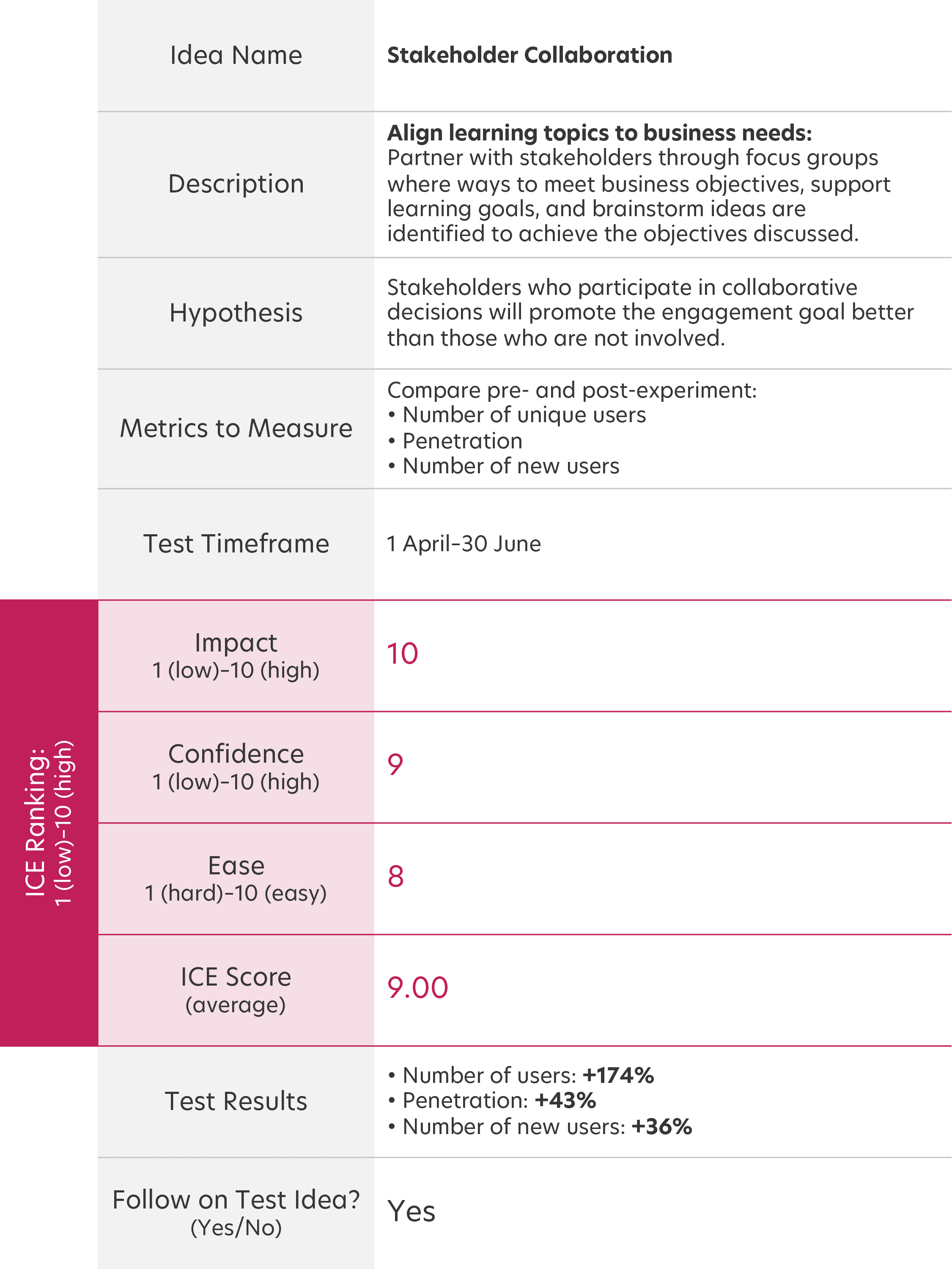
Prioritize your ideas in any way that works for the team, but one recommendation is to use the ICE model and rate the ideas based on three factors—each scored as high, medium, or low.

  • Impact: How much of an impact will this idea have on your team or business?
  • Confidence: How confident are you that this idea will be successful?
  • Ease: How easy will it be to implement this idea?

Note: Scoring of the above should be a team activity and will depend on several factors within your organization, such as the size of your team, the resources available, sponsorship support, competing priorities, the corporate culture, dependencies, etc.

Consider the ideas with the best ICE scores for testing. Those that rate highest will likely bring you the largest return on your investment. Review all scores and identify the top experiment to try first.

ICE Ranking

Stage 4: Test

Begin by setting up the experiment. This includes determining who needs to be part of the test. Larger initiatives may necessitate a cross-functional team, while you may be able to run smaller experiments by yourself.

Documenting the specifics of the testing is crucial for the benefit of others within your organization who may need to repeat or adapt the experiment to a new use case. It’s also helpful to establish parameters at the outset so you know when the goal is met or when the test is complete. Be sure you’re capturing all relevant data and comments, but at the very least, you should include:

  • Name and description (what you’re testing)
  • Hypothesis (what you expect to happen)
  • Duration (how long you expect the experiment to run)
  • Metrics (a rubric for success—specific, measurable, relevant)
  • Notes (how you can replicate and understand the experiment results, areas of focus for the next iteration)

Give thought to the optimal amount of documentation rigor. Developing a standardized experiment template is a common best practice. Consider the following benefits when evaluating the level of rigor your organization needs. Good documentation allows you to:

  • Debrief the experiment to determine whether your hypothesis was accurate.
  • Rapidly scale (“lift and shift”) your learnings to other parts of the enterprise.
  • Create a record in support of continuous improvement.

Based on our experience, here are a few tips and tricks to keep in mind during the testing stage:

  1. Assign someone as an experiment lead.
  2. If you have the resources, it’s okay to conduct multiple experiments at a time.
  3. Document best practices quickly and build on proven results.
  4. Compare experiments against one another to help prioritize the sequence of experiments that others may try.

Stage 5: Reflect and Adjust

Conduct a retrospective (a team discussion—often used in Agile practices—that creates common understanding of what went well, what didn’t, and what could be improved) to decide what actions you want to take going forward. Was the experiment successful? Did it meet your success metrics? Are there parts of the experiment that you want to continue implementing? What challenges did the team face? Is there anything that didn’t go well that you could change to improve the process or develop a new way of working?

Maybe you want to keep running the experiment with a few adjustments. Or maybe it’s time to move to the next prioritized idea on your list. It’s okay to say the experiment was a failure if it was. The important thing is to understand your lessons learned.

Reflect as a team on how the test-and-learn factory process is working for you. Take some time to pause at appropriate intervals (for example, after your first experiment or after a predefined amount of time) to evaluate the process and make any necessary changes to optimize the process for your team.

Test-and-Learn Factory in Action

“The best way to have a great idea is to have more ideas.”

—Linus Pauling

The test-and-learn factory approach offers a structured way to surface and capture great ideas sooner and more consistently. It can empower everyone in your organization to seek opportunities for improvement and innovation. The test-and-learn factory harnesses a teams’ innovative thinking by providing a designated safe space to try new things, no matter how big or small the innovation may be. It also:

  • Helps retain and motivate talent with an openness to try new things and to drive toward positive changes
  • Promotes risk-taking in a structured, safe way where experimentation is “just the way we work”
  • Provides cover for creative thinking rather than doing things “the way we’ve always done them”
  • Integrates easily with Agile methodology, where approved experiments can become part of a sprint backlog prioritization exercise and related meeting ceremonies
  • Facilitates propagation of best practices across the enterprise through the documentation process

The test-and-learn factory can be used as a way to address challenges and new ways of working, or as an intake model when you’re tasked with providing solutions to a customer or internal clients. It’s also a great framework for companies who want to stay ahead of the competition by generating and sustaining an innovation pipeline. It can be applied in a variety of settings to address any number of challenges you may face.

Do you spot an opportunity for improvement in your team or organization? Start brainstorming ideas with your team and put the test-and-learn factory into action! What new idea do you want to test out first?

The test-and-learn factory is a framework for innovation

About the Author

James Carpenter
A solver of complex problems, James is a Principal Business Consultant for GP Strategies, specializing in organizational change management, sales optimization, Agile program management, and large-scale project management. His industry expertise encompasses retail, global manufacturing, telecommunications, health insurance, global food services, defense contracting, and technology. In his time with the company, James has implemented a new-associate onboarding redesign for a global retailer (with 80,000 new hires annually) that improved employee retention, customer satisfaction, and time to sales proficiency. He’s also established a strategic workforce planning framework for a United States federal agency to ensure critical cyber security training and defined the portfolio of projects for a large manufacturer to realize $98 million in savings.
Michelle Crowe
Michelle is a Business Consultant at GP Strategies who brings meaningful strategies and solutions to companies undergoing a transformational change. She works with enterprise leaders and managers to help drive, support, and sustain a change to lead to successful adoption within the organization.
Rocky Ellens
Rocky Ellens is a GP Strategies Sales Enablement Practice leader, helping drive client business-to-business sales team performance. Rocky has over 15 years of experience providing innovative thought leadership and performance consulting across Fortune 100 clients in Manufacturing, Retail, Finance, Food and Beverage, and IT market segments. He holds an MS in Human Resources and Organizational Development. He is a retired Army Colonel experienced at providing a foundation of leadership training and teaming designed to pull work groups together in pursuit of a common objective or goal. Follow Rocky on LinkedIn

Get in touch.

Learn more about our talent transformation solutions.

Transformation doesn’t happen overnight if you’re doing it right. We continuously deliver measurable outcomes and help you stay the course – choose the right partner for your journey.

Our suite of offerings include:

  • Managed Learning Services
  • Learning Content Design & Development
  • Consulting
  • AI Readiness, Integration, & Support
  • Leadership & Inclusion Training
  • Technical Training
  • Learning Technologies & Implementation
  • Off-the-Shelf Training Courses


6 Disability-Inclusive Best Practices for Your Recruitment Process

One billion people globally live with a disability, accounting for around 15% of the global population. Nonetheless, people with disabilities are significantly less likely to be represented in the workforce. The US Bureau of Labor Statistics suggests that in 2020, 17.9% of persons with a disability were in employment—compared with 61.8% of those without a disability. Closing this gap is a social responsibility, but as with any form of change towards a more diverse and inclusive organization, attracting more candidates with disabilities could offer a competitive advantage.

1) Accessibility Begins With Where You Post Your Positions

It was once claimed that the average candidate takes only 49.7 seconds to decide that a job isn’t right for them—a very short window to convince a great candidate that they would be a good fit. For every second of that time, they’ll be looking for red flags that disqualify you immediately. For applicants with a disability, accessibility is a real sticking point.

This starts with where you list the position. If you’re not advertising on a job platform that meets accessibility standards, why would a candidate trust that anything else about your business is accessible? Seek out job platforms that have a proven track record for attracting candidates with disabilities. Avoid providers that lack considerations such as properly color-contrasted or small text, or those that lack compatibility with screen readers and other assistive technologies.

2) Focus on Writing Inclusive Job Descriptions

The way your job descriptions are phrased and structured can also send up red flags for your candidate. You may be writing non-inclusive job descriptions if you use:

  • Ableist terms such as ‘crazy’, ‘visionary’, or ‘mobile’.
  • Clichéd, ultimately ableist requirements such as ‘thrives in a busy environment’.
  • Complex language. Shorter sentences are easier to read. Shorter job descriptions show that you already have a clear idea of what is important about both the role and the person who will fill it. We recommend somewhere between 300 to 650 words.

Additionally, don’t rely solely on a standardized ‘equal opportunities statement’. These statements tend to focus on vague principles and obligations rather than practical steps. Instead aim to write a clear inclusion statement that includes references to accommodations that you will make during the recruitment process.

3) Collect Diversity Data and Use It

Driving recruitment of disabled people is easier with a data-driven approach. You need to understand your hiring patterns up to this point to get a good understanding of what you have to do to improve them. You also need to understand what happens at each stage of your process—from the initial point of contact through to viewing your job description, application, and further progress.

This data-driven view will help you understand whether there is a particular part of your process that is a barrier to candidates with a disability. Perhaps they never engage with your adverts, or perhaps they’re being ignored at the application stage? Each touchpoint offers an opportunity to reassess. Maybe you should rewrite your adverts. Maybe more work needs to be done to accommodate the needs of interviewees. Continued measurement of these touchpoints will lead to continual improvement.

4) Train Your Hiring Managers and Recruiters

Candidates with disabilities often find that regardless of being fully able to do a job, they’ll still get rejected because of the views and biases of hiring professionals. Sometimes this is from a misguided belief that a candidate would be at physical or emotional risk if they took the job. It’s critical that everyone responsible for hiring in your organization receives DE&I training to highlight and challenge these viewpoints. You should also use tools that eliminate the scope for bias in the process.

Recruitment teams don’t need to be all-knowing experts on disability, but they should know local equality and labor laws, and should be able to advise hiring managers accordingly. They must also be experts in the organization’s approach to adhering to these laws. Therefore, this knowledge should be embedded within the onboarding and skills development for recruitment roles.

It’s important to understand there is no ‘one size fits all’ approach. Disability-inclusive recruitment isn’t about checklists. It’s about letting disabled candidates and employees feel comfortable about sharing their individual needs, and it’s about those same individuals feeling assured that their needs will be met.

5) Proactively Make Accommodations for Applicants

Candidates may hesitate to ask for reasonable adjustments to your recruitment process. By proactively discussing the possibility of adjustments with everyone, you’ll show that applicants won’t be discriminated against because they require them. Bear in mind that you cannot ask candidates about disabilities or impairments, but you can ask about the accommodations you can make. Your approach to implementing these accommodations will need to be flexible—people’s requirements will be different. This helps to build trust that you are committed to disability inclusion and demonstrates the organization’s capacity to listen to and believe its employees.

You will also need to train hiring managers on the organization’s accessibility responsibilities and how to implement accommodations when requested. For example, if a candidate requests software to assist with the completion of an assessment, your hiring manager should know what this means, how to implement it, and where they can go for further support.

6) Show How You’re Already Acting Inclusively

76% of all job seekers take into account whether an organization has a diverse workforce when applying for a role. It therefore stands to reason that being able to demonstrate disability inclusion alongside other types of diverse and inclusive aspects of your working environment will help you secure more interest. You should promote your disability-relevant policies (including disability leave, workplace health strategies), and also allow space to showcase the disability-inclusive experiences of employees at a variety of levels in the business. You can also be open and honest about what you intend to address—it’s better to be upfront and authentic, as candidates can usually tell when you’re overpromising.

About the Authors

Renato Hoxha

Get in touch.

Learn more about our talent transformation solutions.

Transformation doesn’t happen overnight if you’re doing it right. We continuously deliver measurable outcomes and help you stay the course – choose the right partner for your journey.

Our suite of offerings include:

  • Managed Learning Services
  • Learning Content Design & Development
  • Consulting
  • AI Readiness, Integration, & Support
  • Leadership & Inclusion Training
  • Technical Training
  • Learning Technologies & Implementation
  • Off-the-Shelf Training Courses