June marks the end of the first quarter for many businesses and the mid-year review for others. Both are critical moments in the execution calendar and valuable opportunities to assess performance and take steps to drive commitment.
This Spring, I returned to the tennis court after a long hiatus, revisiting the game’s precision, technique, and rhythm. Performance in business—much like in tennis—relies heavily on our ability to unlock critical insights, improve our mental agility, and course-correct how we play.
For business leaders, these quarterly moments are akin to the end of a set. The clarity and decisiveness that must accompany each action are not just prerequisites on the court but also resonate deeply with the business review process.
Pivotal Questions for Your Next Performance Review
One of the most impactful habits we encourage leaders to adopt in preparation for a mission review is the discipline of writing an executive summary that answers five pivotal questions.
Each of the following questions requires leaders to be brutally honest, bring an intimate understanding of their performance to the table, and address feedback in the moment to maintain high levels of trust in the team.
1. Are You On Mission or Off Mission?
In tennis, a ball is either in or out; there is no room for subjectivity. The same should apply to your mission. The answer is binary. The answer to this question brings transparency and sets the scene for purposeful debate and action.
2. Why or Why Not?
As a follow-up to the first question, understanding the “why” helps people identify and address their weaknesses and recognize what helps them drive mission outcomes. Understanding what is influencing performance is critical for outstanding performance. Great leaders, like great coaches, study the stats, making interventions based on data, not assumptions or emotions.
Referencing these pivotal questions to evaluate mission performance is a needed habit for leaders and teams who are committed to winning.
3. What Changes to the Plan Are Required, If Any?
Assessing the effect of your plan involves prioritizing critical metrics, responding to external forces, and overcoming interference. When answering this question, it is important to anticipate future opportunities and risks, your customers’ and competitors’ behaviors, and internal commitment to your organization’s strategy. Are you willing to shift your approach and make bold moves?
4. What Are Your Commitments for the Next 30 Days?
Every set and every game brings a fresh start. Similarly, each new quarter brings an opportunity to regain lost ground or grow momentum. Commit to one or two clear actions for the next month that will keep you on mission or help you recover. Remember, matches are won one point at a time.
5. What Support Do You Need?
Once the changes you plan to make are clear, ensuring your core team is aligned is important. Communicate effectively by highlighting interdependencies and resource reallocations. Developing a shared understanding of incoming changes keeps everyone aligned with the mission.
Performance Reviews Unlock Critical Insights
Successful execution demands a mission delivery mindset with clear intent, continuous alignment, and the ability to pivot and adjust tactically to propel your game and business forward. Reference these five pivotal questions to evaluate performance and provide valuable feedback to leaders and teams committed to winning.
About the Authors
Will Casselton
Will is CEO of McKinney Rogers, a division of GP Strategies, based in London. He leads our Strategy to Execution work with leadership teams in the pursuit of bold visions, organization alignment and mobilisation of high performance teams.
Get in touch.
Learn more about our talent transformation solutions.
Transformation doesn’t happen overnight if you’re doing it right. We continuously deliver measurable outcomes and help you stay the course – choose the right partner for your journey.
Learning and development professionals know the hassle of finding the right content for eLearning, such as images, infographics, job aids, and other visuals. Content designers, graphic artists, and media developers spend endless time scrolling through stock photo libraries to find adequate images for their content. In many cases, the selection is limited, especially when searching for photos of people that match specific criteria like age, ethnicity, and emotion.
By using AI, learning professionals no longer have to rely on preexisting photos. Now, they can use tools such as Midjourney, Stable Diffusion, DALL-E, and others to create new images based on their own specific and individual requirements. In this blog, we’ll discuss how to use AI to create images through effective prompt design and offer valuable tips on how to refine those AI images using prompt engineering techniques.
Note: The use of AI-generated images is a gray area. There are many concerns related to copyright and the safe and transparent use of such images. Using AI to generate images remains nascent and the legal ramifications are currently under investigation. Determining whether AI-generated images violate intellectual property rights is a multifaceted issue without a simple, definitive response.
Implementing AI for Image Creation
Challenges and Considerations
When using AI to create images, learning professionals should take into consideration that AI tools are trained using existing image databases. There are many examples showing how biased AI applications can be and how dependent they are on their training material and trainers. It is important to ensure that, as learning professionals, we embrace diversity, equity, and inclusion through AI-generated images for improved quality, safety, and accuracy.
Ethical and Accuracy Issues
Respecting intellectual property, rights, patents, and copyright obligations around the use of AI-generated images is of tremendous importance. As learning professionals, we should ensure safe and reliable use of any image appearing in our work. We should be transparent regarding the use of these images, which prompts were used, and which AI tool and version was used to generate the image.
Note: The U.S. copyright office reiterated that copyright protection depends on the amount of human creativity involved, and that the most popular AI systems likely do not create copyrightable work. The EU has put together an early EU agreement that could pave the way for the world’s first comprehensive laws governing the technology. According to this agreement, companies deploying generative AI tools will have to disclose any copyrighted material used to develop their systems.
Understanding AI Prompt Design
Watch the following video to learn more about prompting and the importance of being as specific as possible:
Learning professionals should learn the key principles of prompt design and prompt engineering to get the images they need for their learning content.
Prompt Design
AI prompt design refers to formulating the question or instruction that is used by a language model. This means carefully writing the input text to get the desired response from the tool. The goal of prompt design is to provide clear instructions, specify the format or structure of the desired response, and guide the model to produce the desired output. Then, you can use the response as inspiration to create content or images with available development tools.
Prompt Engineering
Prompt engineering is the ongoing process of refining and optimizing the original prompt design to improve the performance and output quality of the language model. This includes experimenting with different prompts, adding context or constraints, customizing the instructions, or including additional hints to control the model’s behavior.
For example, here is the prompt used in the video to produce the final image. The image was created in Midjourney, using ChatGPT.
The more details and specifics that learning professionals provide in the prompt, the faster and more direct the output is.
Integration and Optimization
Use these prompt details to craft images for your learning content:
Descriptive keywords
Subject
Style and environment
Desired emotions and mood
Details such as time of day or lighting conditions, contrast, color effects, backgrounds, style of photograph
Type of film, including camera type and lens type
Aspect ratio such as 16:9 or 3:2
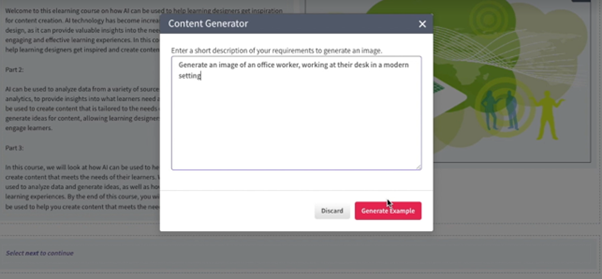
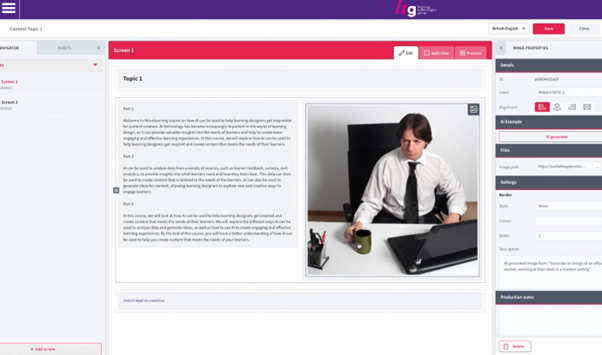
Prompting for images can be done within an AI chatbot like ChatGPT, an AI image generation tool like Midjourney, Stable Diffusion, or DALL-E, or even within a learning authoring tool. Different learning content authoring tool providers, such as Gomo Learning, are currently prototyping and working on ways to integrate AI into their tools without the need to log on to an additional tool.
The user writes their own image prompt using the built-in AI art generator.The user checks the AI image generated and considers other built-in AI tools for additional help.
Transform Your Organization Through AI
The future of using AI-generated images in learning content is promising. With careful planning and consideration of the ethical use of AI-generated imagery, the future of the learning and development professional’s work can become easier and more efficient.
Interested in what AI can do for you? Learn how to transform your organization through AI integration.
About the Authors
Tim Burmeister
Tim Burmeister has +20 years of experience in the Learning & Performance field.
In his current role as Learning Transformation Manager in the Innovation Team at GP Strategies, he is supporting companies and L&D departments towards next-generation learning transformation and helps to provide Modern Workplace Learning, starting with the strategy, the restructuring of learning teams, the implementation of Modern Learning Technology and most importantly, anchoring L&D in the business.
Tim also sheds light on the impact of the digital Transformation on the future working environment and what that means to Learning & Development.
He was born in Germany, lived six years in Mexico-City, five years in London and is currently located in Munich at the GP Germany headquarter.
Get in touch.
Learn more about our talent transformation solutions.
Transformation doesn’t happen overnight if you’re doing it right. We continuously deliver measurable outcomes and help you stay the course – choose the right partner for your journey.
Mandatory training is geared toward keeping your people and your company compliant. It is a key part of being able to demonstrate compliance to regulators and auditors and understanding if your people have learned what they need and, crucially, whether they are likely to change their behaviors as a result.
However, testing can be difficult to do effectively. Historically, end testing has been the default for mandatory training. Nowadays, there are a variety of testing methods that are being used increasingly to engage the learner and create lasting behavior change. Here, three methods are considered and compared—end testing, pre-testing, and inline testing. All three methods are valuable and useful for achieving different outcomes. Read on to learn about all three methods, when you might use them, and how you can make the testing process as engaging as possible for your learners.
1. End Testing
What is End Testing?
End testing is traditionally the assessment type used in most mandatory training. Most people have seen the ten-question test—they must score 80% to pass the test, and they are required to keep taking the same test (perhaps with a randomized set of questions) until they achieve that 80%. The advantage to this type of testing is that your organization can have solid evidence that each of your learners has passed the learning assessment.
End Testing Is Valuable
End testing has a valuable place in mandatory training. For example, when handling sensitive topics such as money laundering, it is vital that your organization can demonstrate that its people are properly trained and that its senior management has complied with external training requirements.
End testing can also be a great form of bite-size training—the assessment can be written to be closely aligned with the learning outcomes, so that the test itself not only assesses knowledge, but reinforces it. Each question, with its feedback, becomes an opportunity to cement in the learner’s mind the things they really need to know.
End Testing That Engages Your Learners
The main consideration when going down this traditional route is that we want to make mandatory training as engaging as possible. End tests can be a turn-off for learners and have a bad reputation.
There are different ways to design end testing that are potentially more engaging and more effective than simply allowing learners to take a test as many times as they need to pass. Just as the whole learning solution should be designed to be learner-centric, the end test should be part of a positive learning experience too.
One key way to do this is to include scenario-based questions as well as fact-based questions in the test. Making the end test more scenario-based helps ensure that the questions are practical, rather than purely theoretical, making it both more useful and more engaging. To make the testing experience even more immersive, the end test could take the form of a continuing scenario, perhaps incorporating branching, in which the learner must make a series of decisions and see how each impacts the next. However, constructing a story like this generally means the questions will not be randomized, so it is important to consider if it is right for a particular piece of training.
Overall, end testing can be an effective way of measuring behavior change in your learners. However, it is important to avoid questions that simply test if a person has memorized a certain policy. Learning should be about internalizing the principles and changing behaviors, not learning by rote and regurgitating information.
2. Pre-Testing
What is Pre-Testing
Pre-testing is asking your learners to complete a test prior to starting their learning. This is to assess their level of understanding on the topics before they begin.
Personalized, Targeted Training
Pre-testing can play a key role in mandatory training. For example, if your people must complete a course on the same topic every year, they may have a great deal of knowledge already. Having to go through the same content could lead to learners becoming bored and feeling that their level of knowledge is disregarded and they’re wasting their time.
If you use a pre-test, a learner takes a test at the start of the learning and will then only have to cover content about topics in which their knowledge is not as strong. By making pre-tests granular and adaptive, learners can receive highly personalized, targeted training focused on exactly what they need to know. This approach respects learners’ time—and the cost of that time—and increases their focus and attention on the training they do receive.
In some mandatory training topics where there is an external requirement for training, there may be a concern that allowing learners to “test out” of some material could be too high risk. In these cases, a similar effect can be achieved by presenting learners who pass a topic with brief key points on that topic, while learners who do not pass receive more detail.
Pre-Testing to Engage and Play
Another advantage of pre-testing is that learners will be made aware at the start of the training that they don’t know everything they need to know. This will encourage them to engage and pay attention during the course.
3. Inline Testing
What is Inline Testing?
Inline testing is a great solution if you want to drive learner engagement throughout training. Rather than clicking through a training course and not paying attention, inline testing requires a learner to follow a scenario and answer questions through the learning journey, rather than just at the start or the end.
Inline Testing to Reveal Knowledge Gaps
Although inline testing lacks the clarity of an 80% end test pass rate, your organization can still foster useful data and statistics. This data will show in which knowledge areas your people are strong and weak and enable you to target additional learning resources at areas where there are weaknesses. Ultimately, this can lead to a stronger assurance of genuine understanding and behavior change than someone achieving 80% on an end test on their fourth attempt.
Inline testing can allow you to create an experience that feels gripping and immersive, while also cutting down on the time needed for training. By integrating content and testing seamlessly, there’s no need for the learner to take additional time at the end of the training to demonstrate their knowledge.
Inline Testing for Storytelling
Inline testing is great for storytelling-based learning solutions and fits the apply-learn approach to learning. A learner is presented with a question, they answer it, and they get feedback on their answer—and these questions are presented regularly throughout the training. This is especially useful if your topic has a large amount of dense content that could become dry and feel irrelevant to what the learner does in their day-to-day role. When using the apply-learn approach, you are better able to streamline the content, and the learner will immediately see how it relates to their job and why it therefore should matter to them.
Inline testing is also a useful tool for behavior change. Using a story can allow your people to engage and see why a topic is important by showing the consequences of making the wrong decisions.
We know that mandatory training is at its most effective when it goes beyond “ticking the box,” while of course still meeting the requirements it needs to. Scenarios, storytelling, video, and gamification are all great ways to drive engagement, and all work really well with inline testing, as the need to assess learning by scoring can be incorporated into a gamified approach.
Create Engaging Mandatory Training Experiences
Mandatory training is geared toward keeping your people and your company compliant. Whatever your learning topic and goals, testing is a crucial element to engage and motivate your learners. If you want help building engaging learning experiences for your people, GP Strategies can help you with all your compliance training needs.
About the Authors
Renato Hoxha
Get in touch.
Learn more about our talent transformation solutions.
Transformation doesn’t happen overnight if you’re doing it right. We continuously deliver measurable outcomes and help you stay the course – choose the right partner for your journey.
Learning videos are a core learning delivery medium in today’s world, and every organization can benefit from video as an essential element of its learning strategy. Storytelling that’s relatable and emotive makes video a powerful tool to drive behavior change for your learners. To make video effective in driving behavior change, it is vital that it is relevant and relatable for your learners so they can empathize with the characters and engage with the learning.
Learning Videos Have Changed
In recent years, the way companies are approaching their learning challenges has changed fundamentally. Leaders are taking a far more holistic 360°, human-centered view of business issues than they used to.
For example, 20 years ago, health and safety videos were largely predictable films showing two-dimensional characters breaking—or adhering to—company rules. These videos centered on the message, “follow the rules.” They were aimed at remedial processing—encouraging each learner to take individual responsibility for themselves but, usually, no one else.
Today, organizations acknowledge that even when people know the rules, they still break them. So, leaders are asking themselves, ““how do I help my people understand the importance of the rules and the impact they have on the business?”
Why Behavior Change is Crucial
Through video, you can ask learners to consider problems that don’t necessarily have a clear “right” or “wrong” position for success. By focusing on more complex scenarios and decisions, the learning becomes about encouraging people to think more deeply about issues and make sound judgements rather than simply equipping them with knowledge.
Today’s learning videos often focus on collective responsibility, or the idea that everyone in an organization should be aware of guidelines and work together to ensure they are adhered to. This is a clear and important progression from the mindset that each person is responsible for themselves and not for others.
Employees are three-dimensional beings, and when mistakes happen, often there has been a long chain of events leading to the poor decision. The chain could include events at work, at home, or even other co-workers’ behaviors or actions. This means that encouraging your people to take collective responsibility makes it easier to achieve behavior change.
Create Effective Learning Videos
When planning your video for learning, it is important to consider the learning objectives in relation to your company’s critical issues. This thinking should go far beyond ensuring that your learners score a certain percentage in a post-learning test. The important factors in this kind of learning often fall outside of anything that is easily measurable in the short term but that can have a major positive impact in the long term.
Consider implementing the following four strategies to create effective videos for learning:
1. Reflect Your Company Culture
It is vital that your video encapsulates and reflects your company culture, so it is important to be very clear about what that is and what you want it to be in the future. For your people to feel happy and thrive in their roles, they need to know how they fit into your company culture and how that culture is defined across the organization.
The biggest engagement tool we have in video is empathy, as we want people to reach a place of “rational compassion.” Learners need to be engaged and involved enough in the video to care about what happens. However, they cannot be so involved that they are unable to think rationally about the situations that are being introduced. Rational compassion is the middle point between emotion and intellect; it is the ability to feel something for another human being while also being able to analyze why and what they’re doing is making you feel a certain way.
Any topic that is behavioral in nature works well with a video narrative. If people are to make changes in their own behavior, first they need to empathize. When learners can understand and appreciate other people’s perspectives and experiences, and relate them to their own, they are more likely to adopt behaviors that consider these needs and feelings.
When using video, learners can put themselves in the shoes of the characters and can understand their challenges and struggles. This understanding can help learners modify their own behaviors.
3. Evoke Emotion
If your video makes your people feel, they will remember the message. Memories are linked inextricably to feelings. If people don’t feel something about a piece of information, they don’t tend to remember it.
Memories and feelings are closely linked because emotions are often tied to specific events or experiences. When people recall memories, especially those associated with strong emotions like joy, sadness, fear, or love, the feelings associated with those memories are reactivated. This is why people tend to relive the emotions they felt during a significant event when they think back on it.
A video that triggers emotions in your people is likely to stay with them.
4. Avoid Alienating Your People
Every day in their homes, people watch high quality television—they are used to this quality and expect it. Therefore, it is crucial that your learning video meets these high standards. Video of poor quality is likely to alienate your learners straight away and prevent them from engaging. It is also important that your video is designed to hook your workforce and encourage them to empathize from the start. Opening the video with a situation that is familiar and relatable to the learner is a great way to do this.
Creating a setting and characters that are unrelatable to your people could also alienate them and prevent them from engaging with the learning. Therefore, it is important to create a product that reflects your people and your company. For example, an office setting can be designed to look like your workplace, so it will be familiar to learners as soon as they start watching. It is also important to include characters that reflect the workforce that your learning is targeting.
Connect with and Engage Learners to Drive Behavioral Change Through Video
To create effective learning videos, it is important to employ traditional storytelling and film-making conventions. These established practices around structure, narrative, and character have endured for centuries because they work, and they work because they connect deeply with learners. In learning videos, we can marry these techniques with robust and detailed custom learning design to create highly engaging stories that drive the desired change and create a positive impact.
Get in touch if you’d like help designing learning videos that drive lasting behavior change in your organization.
About the Authors
Frank McCabe
Get in touch.
Learn more about our talent transformation solutions.
Transformation doesn’t happen overnight if you’re doing it right. We continuously deliver measurable outcomes and help you stay the course – choose the right partner for your journey.
Many of my GP Strategies colleagues approach the subject of sustained behavior change from different perspectives. Some of my peers are “tech gurus,” conversant on all the latest tools and techniques that could be used to drive behavior changes. Others are experts in neuroscience and would ideate solutions based on how the adult brain works.
Me? I’ve spent my career in the space of enterprise technology adoption as an informally-trained instructional designer. I’ve learned on the job from some of the best over the years. Most of my experience centers around designing, developing, and deploying learning programs that support complex workplace digital transformations, and there are a few keys for enabling your people to create sustained behavior changes during a technology implementation.
Design and Deploy Technology Adoption Solutions that Modify Behavior and Habits
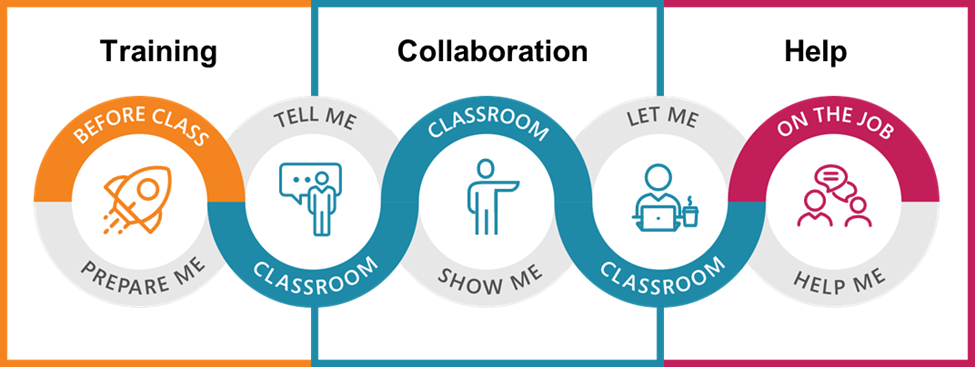
When it comes to learning design, I use the Adult Learning Model for successful user adoption. I was first taught this model when I began my career with GP Strategies, and while we’ve updated the tools we use to create and deploy learning content, the theory behind this model has withstood the test of time.
The Adult Learning Model
The Adult Learning Model posits that adults learn best when they:
Understand the organization’s goals and are prepared for the change.
Are presented information on new business processes and systems.
Are shown how to perform their specific job tasks in the system.
Have an opportunity to practice in a safe but realistic environment.
Know how to look up support information back on the job.
Technology Change Management
This learning model becomes critical when pursuing digital transformations. To sustain new workplace behaviors, alignment with a comprehensive set of technology change management (TCM) activities is critical, and TCM becomes more important as the diversity of an end-user population increases.
With so many different generations and type of learners in the workforce, TCM isn’t a one-size-fits-all activity. As the number of unique end-user groups rises, leaders must be equipped to confidently use a broad suite of tools that promote engagement.
Knowledge Transfer Techniques
A solution that drives sustainable change must also include multiple knowledge transfer techniques to prepare users to be productive and readily support themselves on the job. The five techniques within the Adult Learning Model are:
Prepare Me: Allow for adequate time to think through and talk about what is changing; allow the learner to mentally prepare before plunging into learning new things.
Tell Me: Give context for why learners need to behave differently.
Show Me: Demonstrate the correct approach before asking learners to do it.
Let Me: Make time for learners to have hands-on but realistic practice for the changes you are asking for.
Help Me: Provide learners with access to useful reference content and other resources for when they experience moments of learning need on the job.
Other Drivers of Success for Sustained Behavior Change
Besides the learning design elements discussed above, there are other external ways we can sustain desired behavior changes, from both an organizational level and an individual one.
Organizational Drivers
Support from a cohort of other learner communities: Create spaces that allow learners to engage with each other, ask questions, and learn together.
Access to super users: Open lines of communication with users who are already using the system as intended and make them available for questions and feedback.
Recognition and acknowledgment from managers and senior leaders: Encourage managers and senior leaders to recognize and uplift those that are engaging in the change and adopting the new processes and behaviors as intended.
Tangible reward programs for achievements: An rewards program of some kind can go a long way towards encouraging employees to engage in the change.
Individual Drivers
Feeling accountable to others: When employees feel like they play a crucial role in the success of the group, they are more likely to participate.
Taking pride in the ability to do things differently: Seeing positive results will drive many people to sustain a new behavior. This also goes hand in hand with getting recognition and acknowledgment from managers and senior leadership.
Transparency: Make sure that users have clear communication from leaders on how the change is progressing at large so people feel in the loop.
Fear: Healthy fear can drive users to make behavior changes if they feel like they might be left behind or that they will be unable to complete their day-to-day tasks.
Sustainable Behaviors Drive Sustainable Change
Whatever behavior or process you are trying to change, the strategies in place must be tailored to how your people will best learn, not created to support the training or behavior itself.
To learn more about sustainable change management for your next technology implementation, check out our user adoption solutions.
About the Authors
Ellen Kumar
Ms. Kumar is a Solution Architect with GP Strategies, and has served in roles ranging from Account Executive, to Operations Director, to Project Manager/Training Consultant. Prior to GP Strategies, she worked for University of Dayton Research Institute and GE Aircraft Engines (now GE Aerospace). She holds an M.S. in Materials Science & Engineering from University of Dayton.
Get in touch.
Learn more about our talent transformation solutions.
Transformation doesn’t happen overnight if you’re doing it right. We continuously deliver measurable outcomes and help you stay the course – choose the right partner for your journey.
Talent transformation is a hot topic in the world of business. As learning and development (L&D) professionals, we must identify where we fit into the conversation and how we can drive business forward by fostering our talent. When we talk about talent, we are not just focusing on future leaders; we’re looking at all of our people. So how do we, as learning experts, enable all of our people to engage and work at their optimal performance for our wider success?
Read on to learn why talent is the hot topic, why talent transformation is a crucial focus for your organization, and how learning is central to its success.
Why Focus Transformation Efforts on Talent?
More than 75% of companies are experiencing hiring difficulties, British Chambers of Commerce survey finds.
Financial Times*
It’s no secret that we are facing a capability crisis, and this crisis exists across all industries and sectors. Organizations are facing unprecedented challenges and disruption and need to respond quickly. Markets are also becoming increasingly complex and globalized, which has led to many emerging technologies. This rapid pace and rate of change are creating organizational complexity and confusion.
In addition to changes in the business world, people trends are also shifting. We have a multi-generational workforce, and over the last few years, we’ve seen moments of stress that include large numbers of people moving between companies. Because of these changes, critical workforce skill gaps are appearing.
As learning professionals, we’re at a critical moment of reflection—how do we engage with talent in our organizations? Added to this, many companies are looking back at where they invested time and money in learning, only to see past learning efforts had not been effective. This means that, for some, there is a low level of trust in learning transformation. So, at a time when many organizations’ budgets are being tightened, there may be an added reluctance to fund learning solutions.
We are all facing an increasingly complex and dynamic business environment. This environment requires a diverse set of capabilities that many organizations lack. This challenge is also paired with a shortage of skilled workers, and this situation is creating a risk of organizations falling behind competitors, losing top talent, and struggling to achieve strategic goals. The first step in finding solutions to these challenges is to acknowledge and bring them to the fore, to highlight the business imperative.
Why Is Talent Transformation So Difficult
We are all aware that it’s necessary to focus on transforming our talent, but why does it feel so hard to do?
Addressing this challenge requires significant investments in resources—such as technology, L&D programs, and talent management systems—and many organizations struggle to secure funding to support these initiatives.
Many companies also don’t have the internal expertise or capacity to manage talent initiatives effectively, and ultimately this results in a lack of alignment between an organization’s initiatives and goals. Talent initiatives need consistent investment, to be agile and adaptable to keep up with the pace of technological and market changes, and to have the ability to identify and close skill gaps.
Another difficulty can be the required shift in mindset away from traditional ways of thinking about talent management and people development. This can result in resistance to change, particularly if your people are used to traditional career paths and development opportunities. It also requires a cultural shift within the organization to more of a continuous growth mindset in terms of L&D.
Where Learning Meets Talent
We need to engage more deeply with our talent. However, talent is a broad term. It means different things to different people. But, in an L&D context, we believe we’re asking ourselves these questions: Where does learning fit into the talent conversation? How about what we do as learning professionals?
To answer this question, we’ve tested a way of looking at learning and talent, inspired by Deloitte’s structure for thinking about the future of work. We’ve started using the model to question where L&D fits into the talent transformation story. The model reflects on three key areas of our engagement: the work, the work environment, and the workers (or our learners).
The Work: The Job to Be Done
Businesses and capabilities are shifting. The world of business and what we need people to do are also changing. Learning has the frontline sight as work practices and needs shift. Learning is also an enabling force—constantly seeing and reacting to change. Our job as L&D professionals is to support people and skills transformation in the context of changing work needs.
Our role is also about enabling cultural transformation and engaging with the wider business. L&D acts as the glue between departments and coordinates the ways of thinking within an organization. It’s vital to retain talent as your organizational needs change. This means enabling pathways for learners into your business and throughout their careers. The other key point for talent transformation is to hire for the future. If you retain the best people in your organization, and keep them happy and engaged, they will perform for you and drive your business forward.
The Work Environment: Context
The role of learning in recent years has shifted to include enabling learners to be high performers. We do this by providing optimized ecosystems and environments that include tools, knowledge, and the information they need to engage deeply in their day-to-day tasks. This means providing focused, just-in-time, personalized, and contextual learning.
We want to connect learning and work states: work is learning, and learning is work. Learning needs to become part of everything your people do every day. The work environment is also about developing the broader cultures that support people working at their best—we also want to drive people-focused initiatives, from wellness to diversity and beyond, to keep people happy, healthy, and working optimally.
The Workers: Your People
We build performance behaviors for success that help people and organizations deliver their best. We are the professionals responsible for people’s skills, growth, and change, and we drive core strategic learning skills and capability initiatives, such as resilience, agility, change, and leadership. It is our job to put in pathways that lead to success, from when people apply for their job through all of their other career experiences with the company.
It’s also vital that we engage learners with the business and keep the two-way narrative going continually, for the benefit of both parties. People who feel their opinions are valued and considered are more likely to engage with learning and the organization as a whole.
Finally, we must also focus on measuring and reporting the value of learning and performance behaviors in the talent context. Leading organizations in every industry are successfully answering vital workforce L&D questions using the vast datasets now available. Well-defined and managed impact measurement programs will provide the evidence you need to show your L&D strategies and initiatives are having the positive business impact you planned.
Talent Transformation Is All About Your People
Your talent needs learning, and as L&D professionals, we play a vital role in influencing the work, the work environment, and the learners to thrive and deliver the very best results for your organization. To learn more about how to transform your talent, get in touch today.
Andrew leads the strategy and consulting faculty in the Learning Experience team, which is at the frontline of delivering creative, innovative and effective learning solutions. He focuses on his personal passion: how technology-enabled learning experiences and communication blends can transform behaviors and performance in the workplace. Andrew has a passion for exploring how new modes and strategies for learning and connection can make a real difference to people, teams, and global organizations.
Get in touch.
Learn more about our talent transformation solutions.
Transformation doesn’t happen overnight if you’re doing it right. We continuously deliver measurable outcomes and help you stay the course – choose the right partner for your journey.
How not to ruin your company’s innovation with a lack of psychological safety.
Ah, “psychologically safe workplaces”. Just the phrase alone probably conjures up images of corporate retreats where everyone sits around a campfire singing Kumbaya and sharing their feelings. But the reality is, creating a psychologically safe workplace is more than just a fluffy feel-good exercise. In fact, it’s been found to be key to fostering innovation within an organization, the work that generates unique ideas, produces original solutions to complex problems and encourages teams to be bold and dive into (constructively) risky business.
Let’s start with a basic definition. A psychologically safe workplace is one in which employees feel comfortable taking interpersonal risks without fear of negative consequences to their status, career, or well-being. This means that people can speak up, share their ideas, and challenge the status quo without worrying about being punished or ostracized.
At first glance, it might seem like a psychologically safe workplace would be a breeding ground for groupthink and complacency. After all, if everyone is just nodding along and agreeing with each other, how can anything truly innovative happen? In reality, the opposite is true, and it has a lot to do with how the human brain works.
Our brains are wired to avoid risk and uncertainty, which can be perceived as threats to our survival. In a workplace where employees do not feel safe to share their ideas, they will be less likely to take risks and try new things. They may be more likely to stick to the status quo and avoid challenging the way things are done, even if they believe there is a better way.
When people feel safe to express their thoughts and ideas, it creates an environment of trust and openness. This, in turn, allows for a free flow of information and a diversity of perspectives. When people feel like they can be themselves and speak their minds, they are more likely to share their unique insights and experiences. This can lead to breakthrough ideas that might never have been considered in a less transparent environment.
I’m sure you’re now thinking to yourself that this reads like a perfectly good pop science article, but what about reality? How does this play out in the day-to-day of a busy corporate organization? Well, I’m glad you asked; contemporary research in businesses has shown that psychological safety is closely linked to innovation across several organizations.
In a study published in Harvard Business Review, Amy C. Edmondson, a professor of leadership and management at Harvard Business School, found that psychological safety was the most important factor in creating high-performing teams. She notes that teams that felt safe to speak up were more likely to generate new ideas, experiment, and take risks.
Another study conducted by Google, known as Project Aristotle, found that psychological safety was the key factor in creating high-performing teams. The study found that teams that felt safe to express their opinions, take risks, and make mistakes were more likely to generate innovative ideas and produce better outcomes.
The link between psychological safety and innovation can also be seen in the startup world. Startups are often praised for their innovative culture, but they can also be high-pressure environments where failure can lead to the end of the company. However, some of the most successful startups have been able to create a psychologically safe environment where employees feel free to take risks, learn from their mistakes, and share their ideas.
For example, Airbnb has a culture that encourages experimentation and risk-taking. Employees are encouraged to try new things, even if they fail, and the company’s leadership has publicly recognized and celebrated failures as learning opportunities. This culture has led to the development of new products and services, such as Airbnb Experiences, which have helped the company stay ahead of the curve in the competitive travel industry.
So how can organizations create a psychologically safe workplace that fosters innovation? Here are a few tips to get you started:
Lead by example: Creating a psychologically safe workplace starts at the top. Leaders need to model the behaviors they want to see in their employees. This means being open to feedback, admitting mistakes, and treating others with respect and kindness.
Encourage feedback: Make it clear that feedback is not only welcome but encouraged. Provide multiple channels for employees to share their thoughts and ideas, whether it’s through regular check-ins, suggestion boxes, or anonymous surveys.
Listen actively: When someone does share their thoughts or concerns, make sure you’re really listening. Practice active listening techniques like summarizing what they’ve said and asking clarifying questions. These approaches will make it clear to those around you that you’re listening and engaging with what is being said. Small behaviors like these communicate a big message: “I hear you, I’m actively considering your contributions, and I’m present in this conversation.”
Take action: If someone raises a valid concern or suggests an innovative idea, take action on it. This shows that you’re listening and that their contributions are valued, while also building a sense of trust. When employees feel that their feedback or input is being heard and acted upon, they become more engaged driving a greater sense of contribution and innovation.
Hold people accountable: Finally, it is important to hold people accountable for their actions. If someone is behaving in a way that’s not conducive to a psychologically safe workplace, address it directly and provide consequences if necessary.
Creating a psychologically safe workplace is essential for fostering innovation within an organization. When employees feel safe to share their thoughts and ideas, they are more likely to take risks, experiment with new approaches, and engage in constructive conflict. This can lead to better decision-making, problem-solving, and outcomes. By embracing strategies that promote open communication, constructive conflict, and continuous learning, organizations can create a culture of innovation where safe spaces allow for (constructive) risky business.
About the Authors
Alasdair James Scott
Get in touch.
Learn more about our talent transformation solutions.
Transformation doesn’t happen overnight if you’re doing it right. We continuously deliver measurable outcomes and help you stay the course – choose the right partner for your journey.
Artificial intelligence (AI) is rapidly transforming the field of learning and development (L&D). Over the last year, several new tools have emerged that revolutionize the way we think about and create learner experiences. Our team at GP Strategies spends a significant amount of time exploring, testing, and talking about AI tools in learning and development. Although we are just beginning to learn what is possible, generative AI (GenAI) is already providing new and innovative ways to write content, create video, generate voice-over, formulate test questions, and assist in language translation. Here is a snapshot of five great tools and use cases perfect for the learning and development space.
AI Tool for Text Generation
It is amazing to see how extensively GenAI tools are now being leveraged to find faster, more creative, and more effective ways to generate content.
In September of 2023, Microsoft launched Copilot, a GenAI companion that can be accessed in Bing, Edge, and Windows. Microsoft Copilot is built upon the latest large language models (LLMs) GPT-4 and DALL-E 3 and provides huge content-generation power right at your fingertips. You can use Copilot to ask complex questions, brainstorm ideas, write first drafts, generate images, obtain summarized information, and receive feedback on your writing. You can even control the tone and length of the copy it generates using several pre-set options.
Copilot is different from ChatGPT in that it is considered a hybrid. Whereas ChatGPT is an LLM, Copilot has an LLM, a search engine, and image-generation capabilities. A few differences between Copilot and ChatGPT include the fact that Copilot does not save prior conversations. Also, you can choose between a creative, balanced, or more precise conversation style (with a simple click of a button), and you can see the notification that your personal and company data are protected.
In this example, I simply asked Copilot to help design an icebreaker activity for investment bankers, and I used the “More balanced” option for conversation style. Copilot generated the results in about 10 seconds and provided a complete, relevant, and reasonable activity to use with the target audience.
AI Tool for Video Generation
Think of how much more realistic, accurate, and powerful AI video generation has become in just the last year. Comparing the clunky, anatomically questionable, and more basic AI-generated videos from just a year ago to the realistic, smooth, and hard-to-discern-from-real-life videos you find on something like Sora—there is just no comparison.
Our team has been leveraging Colossyan for generating videos used in sales simulations. Colossyan allows you to choose an avatar and enter a script, then it creates a lifelike video using the characters and script you identified. It provides a catalog of predesigned templates and allows you to incorporate real-time quizzes, adaptive assessments, and other interactive features that makes the video more engaging.
AI is also proving to be an enormous asset in the field of voice-over narration. ElevenLabs is one of the more popular GenAI tools for voice generation, providing a full range of options perfect for the L&D space. The program easily converts text to speech using a library of premade digital voices from all over the world. This makes it perfect for creating learning scenarios, bringing audio scripts to life, and producing other L&D materials. You can also clone your own voice for future use or transform it to fit your needs.
Here is a clip from a podcast episode on AI that uses a combination of AI voices reading an AI-generated script to explain what AI is. We know it’s a little meta, but it is an intriguing and thought-provoking quick listen.
One of ElevenLabs’ best features from a learning perspective is its translation capabilities. The AI tool can translate and dub speech into one of 29 different languages and offers a perfect end-to-end automated process for translating and dubbing. It can translate existing audio, while maintaining the speaker’s voice and delivery. This feature is invaluable when you create learning content for an international audience, as it allows you to make lessons accessible to a wider audience in a matter of minutes without having to rely on multiple speakers or a long translation process.
AI Tool for Testing
AI can even simplify the process of testing learners by generating quizzes, tests, and other learning assessments in minutes. Quizgecko is a perfect AI tool for this. It relies on the same AI engine used in ChatGPT and allows you to create tests based on any text, web page, or video. Simply upload text from any PDF, Word, or Google document of up to 30,000 characters, or upload the URL for a web page or video, and Quizgecko generates tests based on the material. The program can create tests in a variety of question formats, including multiple choice, true/false, fill in the blank, and short answer. The program’s algorithms are trained to avoid overly complex grammar and produce tests that are challenging but still fair. Afterward, you can edit the tests by changing the order of the questions and removing, editing, or adding questions manually.
Once your test has been generated, Quizgecko makes it easy to import your quiz into an LMS or embed it on a website. There are also reporting and analytics tools that allow you track progress of your learners, identify areas of improvement, and view reports covering individual session results and score distributions. Quizgecko even allows you to add copyright-free, AI-generated imagery to your quizzes to make them more visually engaging.
AI Tool for Translation
Using GenAI for translation can masterfully streamline the amount of time and effort required to translate your learning materials into multiple languages. There are a large host of translation tools available using GenAI technology, but one of the most user-friendly options is Google Translate.
With an extremely simple user interface, Google Translate gives you the ability to input text, images, documents, or websites in one language (choose from over 100 languages), then with a simple click of a button, translate that content into another language.
Of course, you still have to apply a human perspective to the equation by checking and refining the results, but it is mind-boggling to think of the time you can save if you have learning materials that you must translate into multiple languages.
Here at GP, we have an AI Resource Center that we use to share news, trends, guidelines, use cases, and resources (you should really subscribe!) with our employees and customers. Just for fun, I plugged that website into Google Translate, selected English as the input language and Spanish as the output language and, in seconds, I was presented with the web page in Spanish. Again, I will have to check the content for context and accuracy, but something like this was unfathomable not that long ago.
Continue Exploring AI Tools for Learning and Development
In short, what a difference a year can make, especially in the world of GenAI! To say that AI tools are revolutionizing learning and development is an understatement. These tools allow us to create content more efficiently and improve learner outcomes by making content accessible to a much wider audience. While GenAI offers many exciting possibilities, it is important to remember that AI technologies are just tools and work best when paired with a human.
This is just a snapshot of several AI tools we at GP Strategies have found useful. What tools are you exploring and using to find better, cheaper, and faster ways to generate content and enhance the learning experience?
About the Authors
Dawn Stapert
Dawn Stapert is a Principal Learning Consultant on the Innovation Research and Development team at GP Strategies where she consults with clients to maximize business impact through learning. Her 25+ years of professional experience spans all phases of learning design, and she has worked as an independent consultant as well as in-house for several Fortune 500 companies in the pharmaceutical, automotive and higher education industries. Dawn is a designer at heart, and she has a passion for creating learner experiences that are engaging, relevant and effective for the learner.
Get in touch.
Learn more about our talent transformation solutions.
Transformation doesn’t happen overnight if you’re doing it right. We continuously deliver measurable outcomes and help you stay the course – choose the right partner for your journey.
Over the years, the term “corporate academy” has cycled in and out, and it is definitely on the rise right now. I’m often approached by clients about them, so what exactly is a corporate academy, why are they on the rise, and what does the future have in store for them?
What Is a Corporate Academy?
A corporate academy is a body of instruction or a learning experience that helps prepare someone for a job or a role in an organization.
We have worked with a lot of customers to create, for example, a marketing academy. A marketing academy builds up the capability of marketing expertise in an organization, for everybody from a marketing associate to a brand manager. A marketing academy enables all those folks to better do their jobs and has the goal of improving employee engagement and performance.
The Current State of Corporate Academies
Many corporate academies are beginning to pull in more modern learning trends, but generally, their current state is in line with the legacy view of corporate academies, a traditional content-driven academy with 100- and 200-level content.
Much like traditional college syllabi, these academies often have a very clear progression, are content-centric, and are created to bring large masses of folks through a consistent learning experience. The problem with this legacy view of corporate academies is that this approach doesn’t always take you to where you need to be and improve your ability to do a job.
The Future of Corporate Academies: 3 Key Elements
Three important dimensions define the evolution of the corporate academy.
1. Tying Skills Taxonomies to Work Output
Across all aspects of learning and development, we’re seeing many discussions about skilling, upskilling, cross-skilling, and reskilling. People want to create skilling infrastructures that enable us to build roles and job functions predictably. The question is not just, “What are the skills that I need to be an effective brand manager?” for example. Instead, we are beginning to ask, “What do I need to know to produce this specific work product, like a brand plan?” Everything in the academy should reflect the skills that enable a brand manager to perform the actual functions of being a brand manager.
Taking that last step to consider and integrate work truly related to a job role removes us from just exploring passive knowledge and enables us to move toward active application. The learning experience goes from being a fringe element of an organization to being woven into the culture.
This shift to an active application changes behaviors and drives results in a given field. It creates deeper learner engagement, too—we’re not just asking people if they learned specific information but are having them apply their new knowledge to something relevant in their field.
2. Learner-Centric Approaches
The traditional approach to corporate academies has been very content centric. That approach usually focuses on sequencing content in a way that progressively provides new information. But we are now seeing much more personalization regarding job roles and learner needs. Learners are also now taking a more active role in their learning experience by identifying what they need to learn.
Additionally, learners often go through these academies with others. Being part of a social collaborative learning group is an important part of engagement and accountability. Because of these shifts to being more learner-centric and to bringing in authentic job-related learning experiences, academies are now enabling learners to take accountability for their journey, resulting in more engaged learners.
3. Curating a Range of Content Sources
The rise in learner-centric designs is pushing us to think more creatively about how we’re building content for these learning experiences. Historically, when we started an academy, we used to think that we had to create everything from scratch, but now we’re able to bring in a range of content sources.
So, you might have some user-generated content from inside the organization, you may buy some content that’s unique in your industry, and you may also be able to open source some of the content. A corporate academy no longer needs to be an absolute build. We are now sourcing content to curate a learner experience that’s held together by performance-oriented outcomes, activities, and achievements.
Early in life, I found that I had a natural curiosity that not only led to a passion for learning and sharing with others, but it also got me into trouble. Although not a bad kid, I often found overly structured classrooms a challenge. I could be a bit disruptive as I would explore the content and activities in a manner that made sense to me. I found that classes and teachers that nurtured a personalized approach really resonated with me, while those that did not were demotivating and affected my relationship with the content. Too often, the conversation would come to a head where the teacher would ask, “Why can’t you learn it this way?” I would push back with, “Why can’t you teach it in a variety of ways?” The only path for success was when I would deconstruct and reconstruct the lessons in a meaningful way for myself.
I would say that this early experience has shaped my career. I have been blessed with a range of opportunities to work with innovative organizations that advocate for the learner, endeavor to deliver relevance, and look to bend technology to further these goals. For example, while working at Unext.com, I had the opportunity to experience over 3,000 hours of “learnability” testing on my blended learning designs. I could see for my own eyes how learners would react to my designs and how they made meaning of it. Learners asked two common questions: Is it relevant to me? Is it authentic? Through observations of and conversations with learners, I began to sharpen my skills and designed for inclusion and relevance rather than control. This lesson has served me well.
In our industry, we have become overly focused on the volume and arrangement of content, instead of its value. Not surprising—content is static and easier to define. Value (relevance), on the other hand, is fluid and much harder to describe. The real insight is that you can’t really design relevance; you can only design the environment or systems that promote it. Relevance ultimately is in the eye of the learner—not the designer.
So, this is why, when asked for an elevator pitch, I share my passion of being an advocate for the learner and a warrior for relevance.
Get in touch.
Learn more about our talent transformation solutions.
Transformation doesn’t happen overnight if you’re doing it right. We continuously deliver measurable outcomes and help you stay the course – choose the right partner for your journey.
In his book Fragments, Greek philosopher Heraclitus coined the phrase, “Change is the only constant,” based on his observation that the natural world was in a constant state of movement. Today’s business climate certainly reflects this maxim. As the world around businesses adjusts to new discoveries, technology, and ideals, they are forced to adapt to the changing needs of their employees and customers. When going through these transformations, organizations can help ensure their success by adopting strong leadership, prioritizing impactful learning, leveraging technology, and creating a healthy corporate culture.
Navigating New Disruptions
Businesses are restructuring to navigate new disruptions such as artificial intelligence to become more adaptable to future disruptions. In addition, employees are demanding their own changes related to how work is accomplished. Employee-driven changes have shifted working structures, policies, workflows, and even culture. Workers have seen what businesses are capable of and are refusing to accept anything less than their best.
The Key Elements of Business Transformation
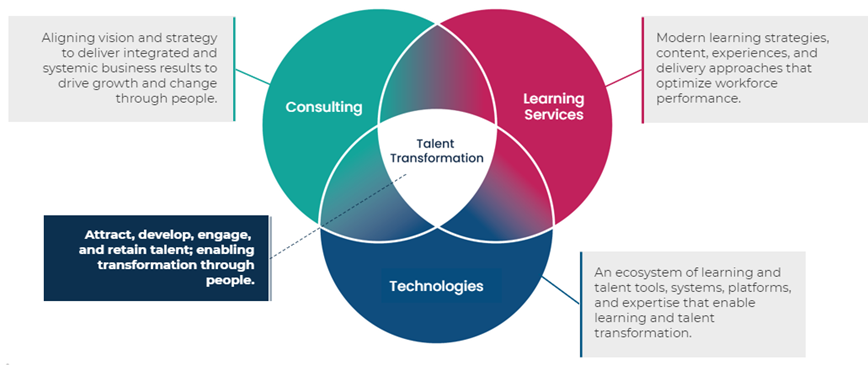
At GP Strategies, we believe that effective business transformation happens at the apex of three key areas: an aligned vision that delivers results, modern learning strategies and experiences that optimize performance, and a well-functioning ecosystem of tools, systems, and technology that enable effective learning and transformation.
The type of transformation experienced during the pandemic (and now artificial intelligence) is what Harvard Business Review refers to as “hijacked transformation”—a fast-paced transformation brought on by someone or something outside of the organization itself.
As we move into the post-pandemic world of work, businesses now have the opportunity to evaluate the landscape and determine how they want to meet the demands of their employees, customers, and communities. Leadership, learning, and technology are the three key areas to consider when establishing a business transformation strategy.
1. Leadership’s Role in Business Transformation
Engaged leaders are the driving force behind any successful company transformation strategy. When on board, they communicate, mirror, and reinforce the new behaviors, driving employees to align to the new effort more easily. When leaders are disengaged or contradict the effort, the initiative is doomed to fail. Aligning leadership early on in the process through alignment workshops, future envisioning sessions, change training, and leadership development efforts can be the key factor in a change initiative’s success or failure.
2. The Importance of Learning and Development
Employee development is an important factor in retention, employee engagement, and productivity. How employees experience learning and maintain critical skills throughout the lifecycle of their employment must be evaluated during any business transformation experience. At times this may even serve as the center of a transformation.
3. Leveraging Technology for Business Transformation
Retaining quality employees within your organization is critical for ongoing success in our current “war for talent.” As the world of work continues to change, employees expect their learning experiences to keep up. Whether this involves an innovative learning technology or on-demand training, employees want the learning experience to be meaningful. As companies begin to drive transformation across their learning organizations, they are forced to consider how their learning is structured, how they deliver content, and what type of content they provide.
Digital Transformation in Business
In our era of the Fourth Industrial Revolution, maintaining a technological advantage is an endless battle. Maintaining this advantage requires a constant focus on what is available and how it can provide a competitive edge. It is easy for technology to become the driving force for change, but it is important to remember that technology works best when it is used to support the existing strategy.
Digital transformation in business is the adoption of digital technology by an organization to digitize non-digital products, services, or operations. This is becoming an increasingly prevalent part of today’s business transformations. The move toward a hybrid and remote workforce plays a significant role in the drive for digital transformation, but this is also a natural progression in an organization’s evolution.
Embracing Digital Learning
The goal of digital transformation and implementation is to increase value through innovation, invention, customer experience, and efficiency. Learning organizations are taking the lead in moving toward an increasingly digital learner and instructor experience. New learning technologies and workforce expectations are transforming the corporate learning environment, promising powerful benefits to learning and development (L&D) professionals. Meanwhile, continuous market disruptions are pushing organizations to move quickly to integrate the latest tools and training technologies into their learning ecosystems.
The Benefits of a Learning Technology Partner
A partner can help supercharge your learning environment by determining which technologies are right for your organization. Learning technology consultant teams help you ask and answer these questions by applying tried and tested methodologies that align with your specific needs. These experts also play a crucial role in helping organizations:
Develop a strategy that guides their use of learning technology.
Deliver content to learners across multiple platforms.
The value of your learning technology is optimized when the right tools are identified for your problems and learning ecosystems are crafted to meet your learners’ needs.
How Organizational Culture Impacts Business Transformation
Only a small percentage of business transformations succeed; a key driver of that success (or lack of it) is how businesses engage their employees and the culture of the organization. All organizations have an underlying collection of beliefs, values, and methods of interaction that create the organizational environment within which all decisions are made, initiatives are implemented, and actions are taken. Organizational culture defines how individuals work and function within the company, making it a crucial element that can make or break a transformation of any size.
Assessing Culture to Create More Effective Transformation Strategies
In the delivery of successful business transformations, understanding the individual corporate culture is critical to defining not only the logistics and details around the learning program itself but also how that initiative will be implemented to ensure successful delivery and adoption. The corporate culture impacts the employee’s journey with the change effort (including individual resistance to the effort, how that resistance is addressed by leadership, and policies and procedures that support the effort).
An open culture with engaged leadership and an effective flow of communication will more effectively address these challenges, allowing the initiative to be more successfully adopted. Cultures in which learning is not promoted or supported will require a different set of strategies to achieve ultimate success. With learning programs, for example, a comprehensive view of the corporate culture will impact the development of the program itself, how it is delivered, and the implementation plan. Many well-developed, best-in-class programs are rejected by an organization because of a lack of this in-depth understanding of the realities of the individual corporate culture.
Business Transformation Services at GP Strategies
Business transformations are bold, strategic shifts that help organizations operate more effectively or make a complete strategic shift that they can use to accelerate change and growth beyond typical incremental advancements. These transformations help organizations compete more effectively, become more efficient, or make a complete shift in direction.
At GP Strategies, business transformation is our core capability. Our business transformation consultants and change management experts draw from decades of L&D experience. We use these insights to help organizations define their ideal culture, ensure that culture is aligned with the future of the company, develop agile learning opportunities that empower employees to confidently adapt to change, and implement technology solutions that reinforce strategic objectives. Partner with us to drive successful business transformations that will create a culture of high performance within your organization.
About the Authors
Cheryl Jackson, PhD
Organization Design & Change Practice Lead
For over 15 years, Dr. Cheryl Jackson has been supporting transformational efforts in Fortune 500 organizations across a variety of industries including retail, manufacturing, healthcare, and food and beverage. With a doctorate in Industrial-organizational psychology, she combines her experience with scientific methodology and research techniques to create practical solutions that drive meaningful change in the workplace.
Cheryl is driven to create effective solutions that help the organization as well as its employees thrive. Her focus is organizational effectiveness strategies supported by organization design, change management, assessment and development, employee engagement, leader development, and performance management.
Cheryl is driving the development of the OD and Change Management practice within and across GP Strategies through the development of offerings and solutions, internal and external education, and supporting client initiatives. She remains actively engaged in the practice by contributing to whitepapers, blogs, articles, conferences, and podcasts on organizational design and change management and serving as a lecturer in the Master of I/O program at Texas A&M University.
Get in touch.
Learn more about our talent transformation solutions.
Transformation doesn’t happen overnight if you’re doing it right. We continuously deliver measurable outcomes and help you stay the course – choose the right partner for your journey.